
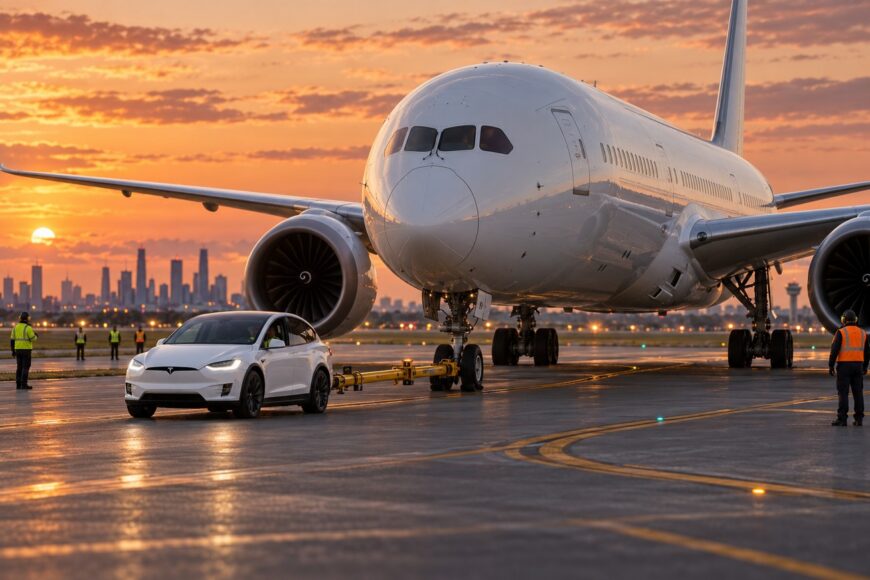
A Tesla Model X P100D once moved a Boeing 787-9 along a Melbourne taxiway, despite the aircraft’s mass being approximately 130 metric tonnes. The image is striking because the SUV’s published trailer rating is only a small fraction of that figure.
The explanation lies in the difference between moving an aircraft briefly on level pavement and towing a braked trailer safely over public roads. The stunt demonstrated low-speed traction under controlled conditions; it did not turn the Model X into a road tractor or airport tug.
- What happened when the Model X towed the Boeing 787?
- How could an SUV move an aircraft that heavy?
- What is the Model X actually rated to tow?
- What the record does not prove about everyday towing
- Frequently asked questions
- Which Model X model year should I choose if I plan to tow?
- Why is Elon discontinuing Model X?
- How much weight can a Tesla Model X tow?
- What year Model X should I stay away from?
What happened when the Model X towed the Boeing 787?
Qantas and Tesla reported that a Model X P100D moved a Boeing 787-9 approximately 300 metres on a Melbourne taxiway. Publications described the aircraft’s mass as approximately 130 metric tonnes, making the demonstration visually dramatic and technically unusual.
Guinness described the achievement as “heaviest tow by an electric production passenger vehicle.” That wording matters. It records a specific electric passenger vehicle moving a heavy aircraft; it does not certify the Model X for airport towing or imply that it carried the aircraft’s mass.
The run was a short, controlled movement on prepared ground. It was therefore a demonstration of available traction and starting force, rather than a normal road tow involving hills, traffic, repeated braking, changing surfaces, or long-distance energy management.
How could an SUV move an aircraft that heavy?
An aircraft’s mass is not the same as the force required to make it roll slowly. On a level, smooth taxiway, rolling resistance can be relatively low, so a vehicle may move a much heavier object once its tires have enough grip and acceleration is carefully controlled.
The distance also changes the engineering problem. A controlled start followed by approximately 300 metres of slow movement places different demands on the vehicle from sustained travel over varied roads. Tire traction, surface condition, wheel motion, and smooth throttle control all matter alongside motor output.
Boeing 787 ground towing uses specialized equipment and coordinated procedures. A suitable aviation towbar and compatible connection are part of that system. An ordinary road-trailer hitch cannot be treated as an equivalent arrangement, even if the vehicle can generate substantial low-speed pulling force.
What is the Model X actually rated to tow?
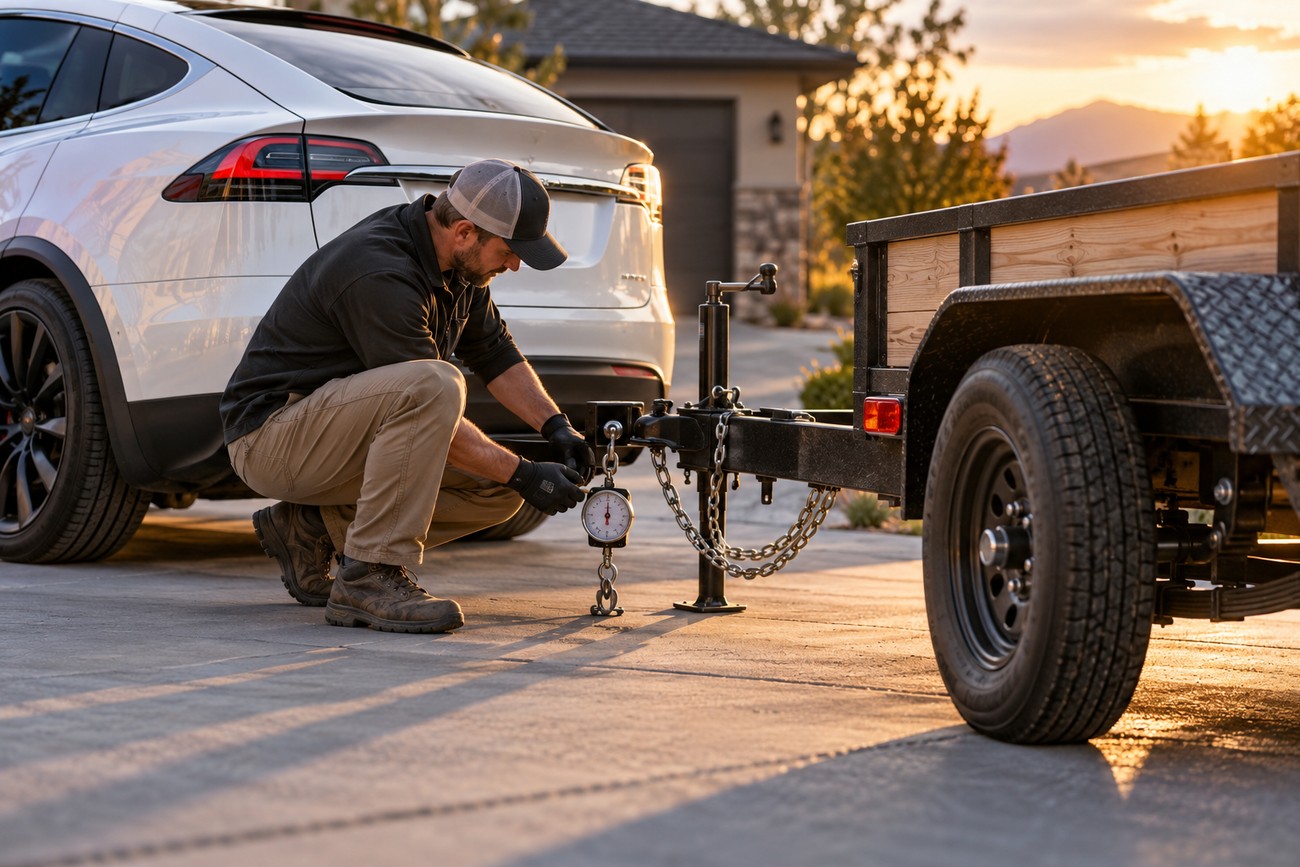
One Tesla manual lists the Long Range Model X at up to 2,300 kg on 20- or 22-inch wheels. The same documentation lists the Plaid at up to 2,250 kg and limits an unbaked trailer to 450 kg. These are conditional road-trailer ratings.
A separate US Tesla listing gives 5,000 lb, approximately 2,300 kg, for 20-inch wheels, and 3,500 lb, approximately 1,588 kg, for 22-inch wheels. It also gives tongue-weight limits of 500 lb and 350 lb, respectively.
The figures should not be combined across documents. Check the documentation for the specific vehicle, market, wheel and tire configuration, hitch equipment, and trailer-brake requirements. The aircraft demonstration is not an additional towing rating.
What the record does not prove about everyday towing
Guinness’s category concerns an electric production passenger vehicle, not certification as an airport tug. A brief taxiway movement cannot establish that a Model X can replace specialist ground equipment or haul oversize loads legally and repeatedly.
Everyday towing depends on trailer brakes, tongue weight, hitch limits, tires, terrain, and the vehicle’s ability to manage heat during acceleration and braking. Owners also report increased energy use while towing, so charging and route planning can become more demanding. No verified range-loss figure is available here.
The practical conclusion is narrow and useful: the Model X demonstrated impressive low-speed traction in a controlled aircraft tow. Tesla’s configuration-specific road-trailer limits remain the figures that govern ordinary use.
Frequently asked questions
The aircraft tow does not change the Model X’s road-trailer limits. Those limits vary by configuration and market documentation. For a used vehicle, its equipment and condition matter too.
Which Model X model year should I choose if I plan to tow?
No model year is universally best for towing. For a used vehicle, verify the applicable Tesla rating, wheel and tire specification, factory or approved hitch, trailer-brake requirements, and the documentation for that market. Condition matters as well, particularly for tires, brakes, cooling systems, and high-voltage components.
Why is Elon discontinuing Model X?
There is no established confirmation here that Elon Musk is discontinuing the Model X or a definitive reason for doing so. Product availability and production decisions can change by market, so check Tesla’s current official listings rather than treating claims about a discontinuation as proof of a towing limitation.
How much weight can a Tesla Model X tow?
The answer depends on the version and documentation. One Tesla manual lists up to 2,300 kg for Long Range, up to 2,250 kg for Plaid, and 450 kg for an unbaked trailer. A separate US listing gives 5,000 lb with 20-inch wheels and 3,500 lb with 22-inch wheels, plus separate tongue-weight limits.
What year Model X should I stay away from?
The available facts do not support naming a universally bad model year. Assess each candidate by its applicable towing documents, wheel and tire setup, hitch, service history, battery condition, brakes, and intended trailer load. A vehicle that meets its published rating on paper may still be unsuitable if its equipment or condition is wrong.







