
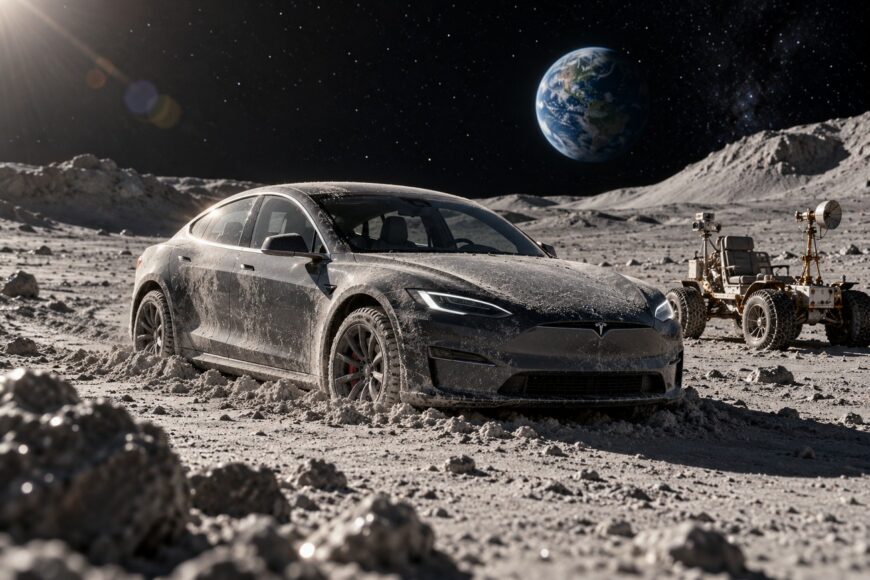
Plaid-level acceleration on the airless Moon has obvious cinematic appeal: three electric motors, instant torque, and no atmosphere to create aerodynamic drag. The speedometer would have a dramatic job, even if the tires had a much less cooperative relationship with the surface.
The engineering conflict is more serious. The motors can produce abundant power, while lunar gravity supplies only about one-sixth of Earth’s tire loading. Heat also has nowhere to escape through ordinary airflow. A road car built for asphalt would therefore face scarce grip, abrasive regolith, vacuum, and difficult thermal control at the same time.
A heavily redesigned electric racer could make good use of electric propulsion. A production Tesla Model S Plaid, however, would be a terrestrial car delivered to a lunar environment, not a ready-made lunar vehicle.
- The short answer: a stock Plaid cannot race on the Moon
- Why less gravity does not mean a faster launch
- Lunar dust is a grip problem and a maintenance problem
- The vacuum turns sustained power into a thermal challenge
- Tesla Model S Plaid vs Apollo lunar rover: different design priorities
- What a real lunar electric racer would need instead
- Could an EV rule lunar dust?
- Frequently asked questions
- What can beat a Tesla Plaid?
- Tesla vs Lamborghini: which is better?
The short answer: a stock Plaid cannot race on the Moon
A stock Tesla Model S Plaid cannot operate as a lunar racing vehicle. Its electric drivetrain is useful in principle because electric motors can deliver controlled torque without an intake air supply or exhaust system. The complete car still depends on tires, seals, bearings, cooling hardware, electronics, and structural systems designed for terrestrial roads and atmosphere.
The Moon has approximately one-sixth of Earth’s gravity and essentially no atmosphere. That removes meaningful aerodynamic drag, downforce, and ambient-air convective cooling. It also changes how the suspension loads the ground and how the vehicle sheds heat.
Being electric does not make the cabin, battery, cooling system, or suspension vacuum-ready. The Plaid’s mass, commonly specified at approximately 2,100–2,300 kg, would remain a major engineering burden even though its weight on the lunar surface would be lower.
A hypothetical lunar racer could retain electric motors, battery control concepts, and software techniques from the Plaid. It would need a new mobility system around them, including lunar wheels, dust protection, vacuum-compatible thermal hardware, and recovery provisions. That would make it a new spacecraft-grade vehicle with selected EV principles rather than an unmodified Model S.
Why less gravity does not mean a faster launch
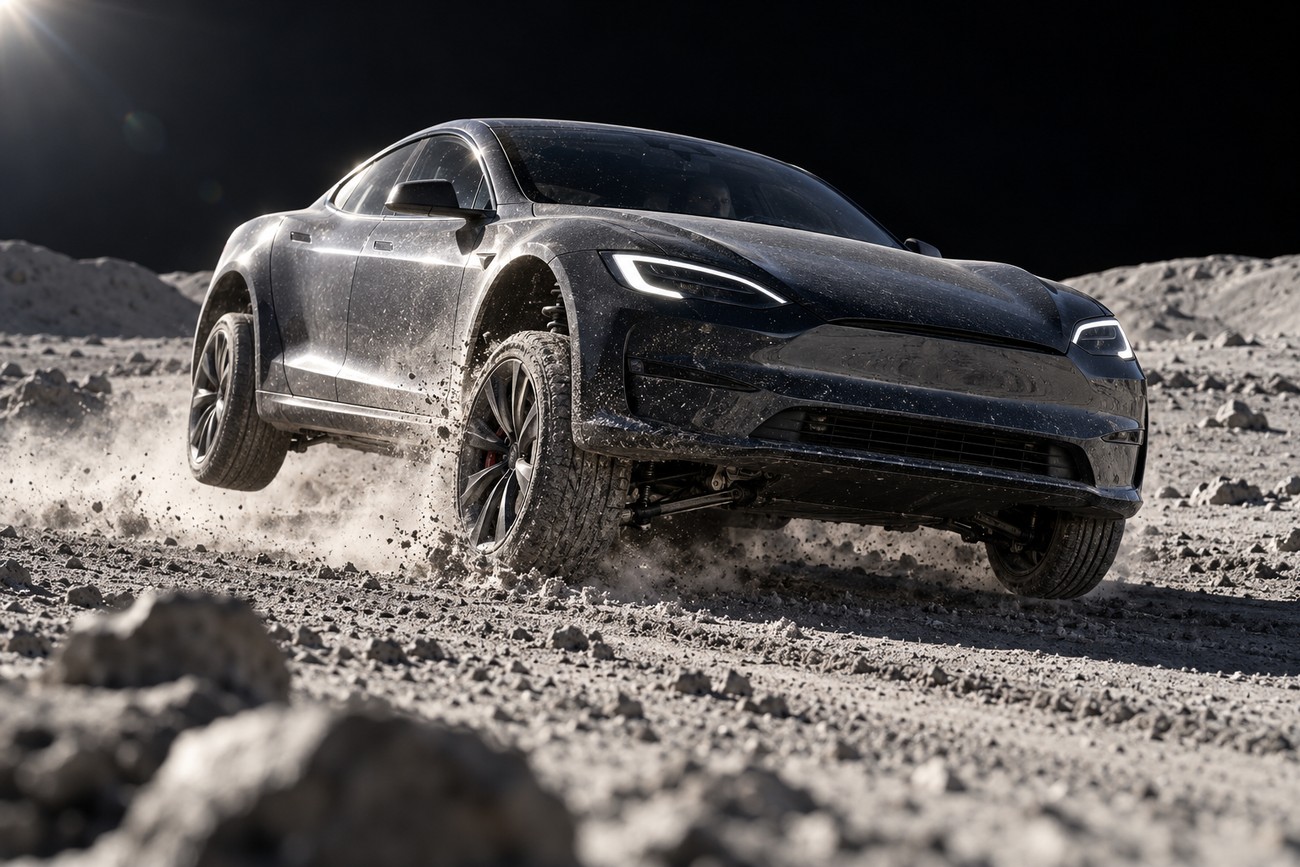
Lunar gravity is approximately 1.62 m/s², about one-sixth of Earth’s gravity; vehicle weight falls, but inertial mass does not. The Plaid would require less force to support its weight, yet its approximately 2,100–2,300 kg of mass would still resist changes in speed and direction.
On Earth, the Plaid’s three motors and approximately 761 kW of peak power support a claimed terrestrial 0–100 km/h time of roughly 2.0–2.1 seconds. That figure describes a prepared road surface, normal tire loading, and Earth-based control systems. It provides no established lunar acceleration time.
Available motor torque would quickly exceed the grip available from lightly loaded tires on loose regolith. Wheelspin could waste energy, dig the tires into the surface, and throw abrasive dust into exposed mechanisms. A control system would need to meter torque carefully, potentially sacrificing the headline acceleration that defines the car on Earth.
Cornering and braking would suffer from the same limitation. With no atmosphere, there is no meaningful aerodynamic downforce to increase tire loading at speed. Braking force would be limited by the tire–soil interface, while a rut or small ridge could unload a wheel and make a stable maneuver harder to achieve.
The absence of drag also allows motion to continue with little aerodynamic resistance once the car is moving. That does not create extra traction. It can make an error more persistent, especially on uneven ground where correcting a slide depends on forces the tires may be unable to transmit.
Lunar dust is a grip problem and a maintenance problem
Fine lunar regolith contains sharp, abrasive particles, and electrostatic adhesion adds a contamination risk. It is unlike ordinary beach sand. Disturbed grains follow ballistic paths in the airless environment, while fine dust can cling to surfaces or move under electrostatic effects rather than simply settling in a predictable way.
The Plaid’s terrestrial mass is commonly specified at approximately 2,100–2,300 kg. Lunar gravity reduces the normal force at the tires, yet it does not reduce that mass or its inertia. A heavy car can therefore press into a soft rut while remaining difficult to steer, stop, or extract once a wheel loses useful contact.
Regolith would also attack the car away from the contact patch. Abrasive particles can damage seals, bearings, fabrics, optical surfaces, and exposed suspension components. Electrostatic dust adhesion could contaminate sensors and interfaces that were never designed to operate in such a material.
Ordinary road tires would be a poor match for sharp particles, rocks, and loose soil. A lunar wheel would need a tread or flexible structure chosen for flotation, puncture tolerance, predictable grip, and low dust retention. Its bearings and joints would require protection that a production road car does not provide.
The vacuum turns sustained power into a thermal challenge
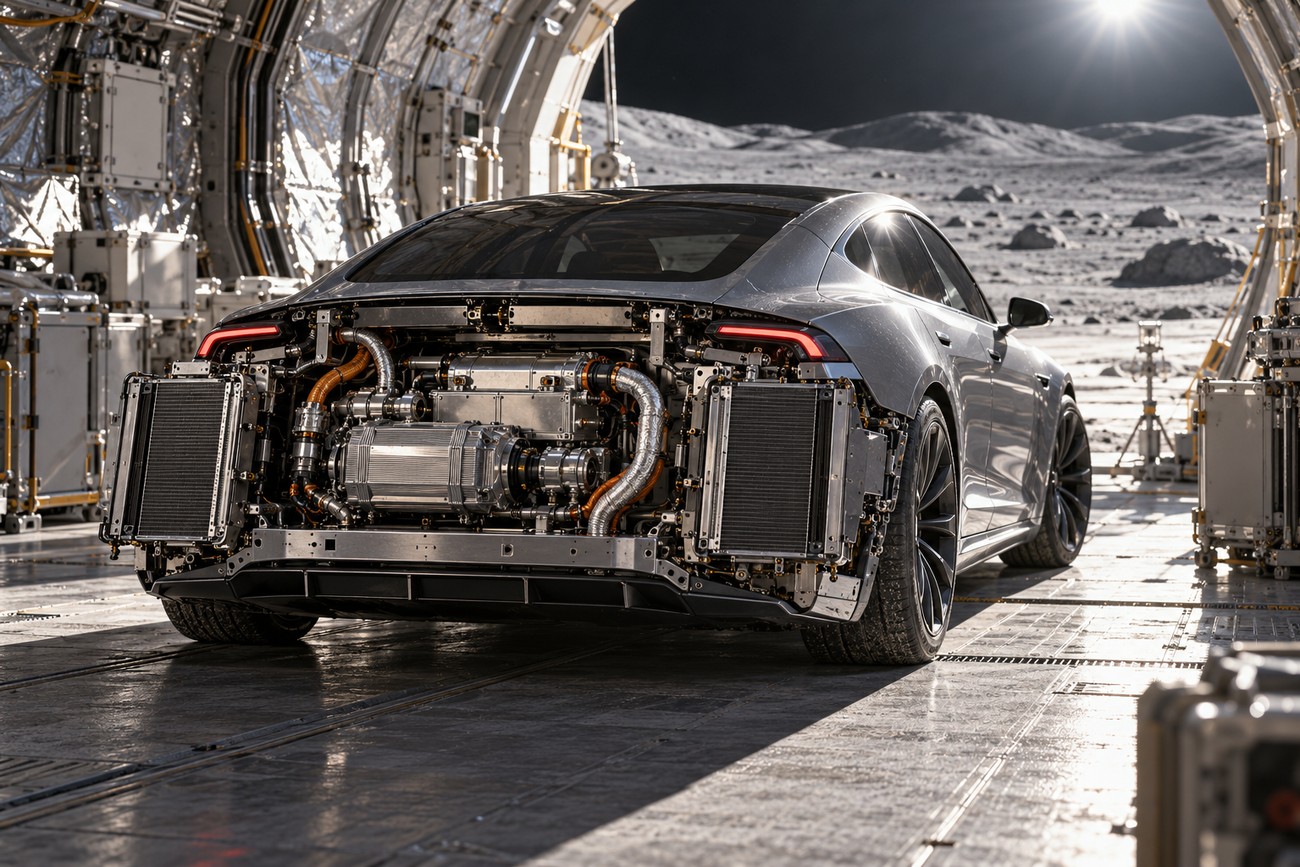
An electric motor can run in principle without atmospheric oxygen, but the complete propulsion system still produces heat. The Moon has essentially no atmosphere, so ambient-air convection cannot serve as the car’s final heat-rejection path.
A sealed coolant loop may circulate fluid through the motors, inverter, and battery. It does not dispose of the heat by itself. The collected heat must ultimately travel by conduction to a suitable sink or leave through radiators that reject energy by radiation.
The Plaid’s approximately 761 kW is a peak-power figure, not a sustained lunar-racing rating. Reports of power reduction during repeated high-load terrestrial track use are a useful warning: repeated acceleration can bring thermal limits into play even with atmospheric cooling available. They do not establish a specific lunar failure time.
Solar exposure and long cold periods would impose additional demands on the battery, electronics, lubricants, and body structure. A lunar thermal system would need to manage both heat input from sunlight and heat generated during driving, while preserving acceptable component temperatures when the vehicle is inactive.
Tesla Model S Plaid vs Apollo lunar rover: different design priorities
These figures describe different missions and environments. The Plaid’s acceleration is an Earth-road figure, while the Lunar Roving Vehicle’s speed is a lunar-operation figure; neither is a head-to-head racing result.
| Category | Tesla Model S Plaid | Apollo Lunar Roving Vehicle |
|---|---|---|
| Vehicle mass | Approximately 2,100–2,300 kg, depending on specification | Approximately 210 kg |
| Propulsion | Three electric motors; approximately 761 kW of peak power | Purpose-built lunar electric drive system |
| Stated performance | Approximately 2.0–2.1 seconds from 0–100 km/h in terrestrial conditions | Approximately 13–18 km/h in reported lunar-rover specifications |
| Payload | Road-car equipment and occupants; no lunar payload rating | Stated payload of up to approximately 490 kg |
| Battery information | Approximately 95–100 kWh appears in third-party estimates; a 130 kWh figure appears in some catalogues but is unverified | Two 36 V, 121 Ah silver-zinc batteries |
| Environmental design | Designed for terrestrial roads, atmosphere, and ordinary service conditions | Designed for lunar operation, low gravity, vacuum, and regolith |
What a real lunar electric racer would need instead
A credible lunar electric racer would begin with its wheels and suspension. Those systems would need predictable contact on loose soil, resistance to sharp particles, and enough compliance to cross rocks and ruts without repeatedly unloading the tires. Low mass would be valuable because it reduces structural loads, recovery difficulty, and the energy required to change speed.
Dust control would be built into every moving interface. Bearings, seals, actuators, sensors, and connectors would need protection against abrasive particles and electrostatic contamination. The design would also have to assume that suited crew members have limited dexterity and visibility during inspection or repair.
Vacuum-compatible components would need a thermal architecture based on conduction and radiation. Radiators, heat paths, battery controls, and operating limits would be designed for sustained duty rather than a brief peak-power event. The system would also need power management that preserves enough energy for navigation, communications, cooling, and recovery.
Recoverability would matter as much as speed. A vehicle that becomes immobilized in a rut, loses a wheel, or suffers a dust-contaminated joint must be towable, repairable, or safely abandoned without endangering the crew. A large, heavy road car would be difficult to service on the Moon because every repair occurs through a spacesuit and within a tightly constrained logistics chain.
The result would use electric propulsion in a much narrower and more purposeful package. The Plaid’s motors or control ideas might inspire parts of the concept, but adapting a production Model S would require changes so extensive that the outcome would no longer be a stock Plaid.
Could an EV rule lunar dust?
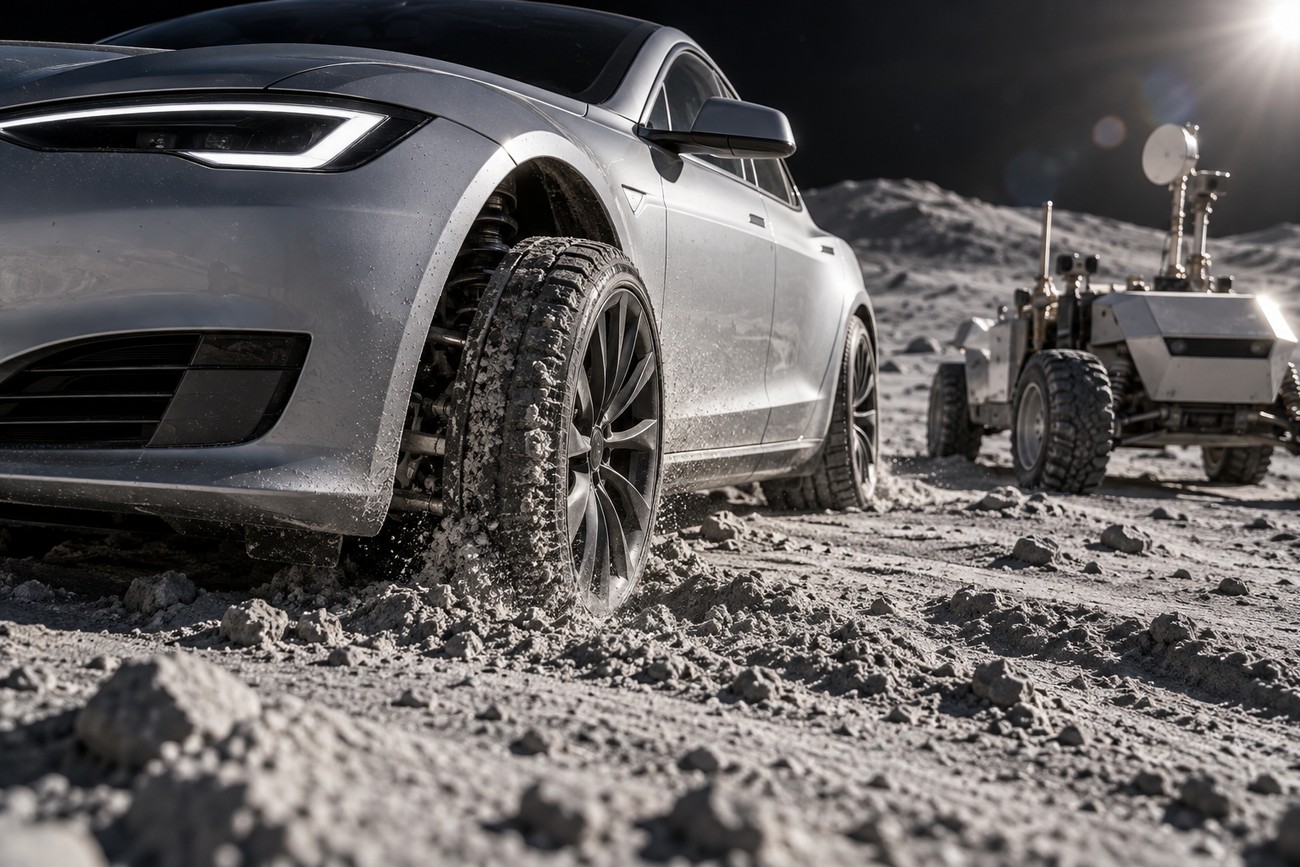
Electric propulsion is well suited to lunar travel because it offers precise torque control, regenerative braking potential, and no dependence on atmospheric oxygen. Those advantages matter only when the wheels can transmit the torque and the thermal system can support repeated operation.
The Plaid’s three motors and approximately 761 kW of peak power would be impressive on a specification sheet. Peak output is not a sustained lunar-racing rating, especially where lunar gravity is approximately 1.62 m/s² and vehicle inertia remains unchanged.
A purpose-built lightweight electric rover could outperform a far more powerful road car in a meaningful lunar event. Its advantage would come from controllable traction, low mass, dust tolerance, recovery options, and repeatable thermal performance rather than headline horsepower.
The Apollo Lunar Roving Vehicle illustrates the principle. Its approximately 210 kg mass and lunar-specific design were aligned with the environment, while the Plaid’s strengths were developed for terrestrial roads. No actual Plaid-versus-rover lunar race has occurred, and assigning either vehicle a speculative lap time would add false precision.
Frequently asked questions
The same distinction applies to common vehicle comparisons: performance depends on the task and environment. On Earth, results change with the course, tires, and conditions. On the Moon, traction, thermal control, and dust tolerance would dominate the comparison.
What can beat a Tesla Plaid?
On Earth, another high-performance road car, a purpose-built race car, or a vehicle with better conditions and tires could beat a Plaid in a particular event. The answer depends on the surface, course, weather, tires, battery state, and whether the test measures acceleration, braking, cornering, or sustained laps.
On the Moon, a purpose-built lightweight electric rover would have the more credible advantage. It could be designed around lunar traction, dust protection, thermal rejection, and recovery, while the Plaid would carry systems optimized for roads and atmosphere.
Tesla vs Lamborghini: which is better?
Neither is universally better. A Plaid emphasizes electric acceleration and all-weather road usability, while a Lamborghini typically emphasizes a different balance of engine character, handling, packaging, and driver experience. A fair comparison requires the same course, tires, weather, and performance criterion.
For lunar use, the badge would matter less than the engineering brief. Both would require extensive redesign for vacuum, regolith, low gravity, thermal control, and servicing; neither production road car is a ready-made lunar rover.







