
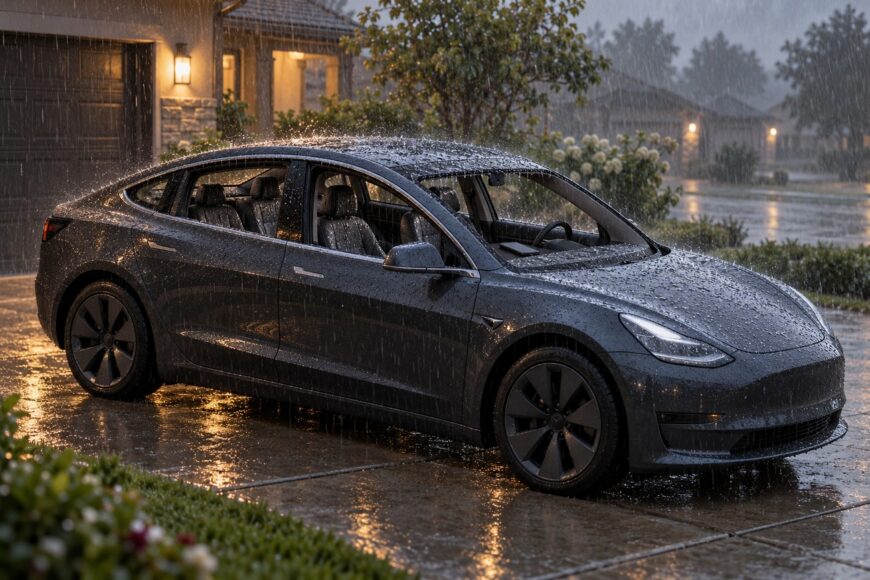
Rain can enter a Tesla Model 3 even while the Tesla app appears to show the windows closed. That mismatch can be difficult to diagnose because the glass may have reopened after the last status update or after the vehicle was locked.
The opening pattern is a useful clue. All four windows moving down by roughly the same amount points first toward a Vent command or another account-related action. A single window that drops, reopens, or behaves differently points more toward calibration, a door switch, a connector, or wiring. Tesla documentation does not describe rain as an automatic window-opening trigger.
- What Can Make Tesla Model 3 Windows Open by Themselves?
- The First Checks to Make After a Rainstorm
- Calibration: Useful First Step, Not a Guaranteed Fix
- When a Door Connector or Wiring Fault Becomes More Likely
- How to Document the Fault Before Service
- What Tesla Confirms—and What the Rain Does Not Prove
- Frequently asked questions
- Can Tesla service tell exactly when a window opened by itself?
- What should I do if rain has already soaked the Model 3 interior?
- Why do Tesla windows randomly open?
- Why are my electric car windows opening on their own?
- What are some common window issues with Tesla Model 3s?
What Can Make Tesla Model 3 Windows Open by Themselves?
All four windows opening together is more consistent with a shared command than with four individual switch failures occurring at the same time. The Tesla app’s Vent function can lower the windows as a group, so an accidental tap, a command from another authorized user, or an account-access issue should be checked before replacing window hardware.
Review who can access the vehicle and whether the app was used around the time of the incident. An unintended screen press or another driver with vehicle access can produce a result that looks like a spontaneous fault. The exact command history may not always be obvious to the owner, so the opening pattern remains useful evidence.
A single window that reopens after closing, or drops slightly while the others remain shut, follows a different diagnostic path. Calibration, a door switch, a door connector, or wiring can affect one door without affecting the other three.
Some owners associate rain-related opening with moisture in a door connector or wiring. That is an owner-reported possibility, not a confirmed cause in every case. Moisture may affect an electrical connection, making the window appear to respond to the weather even though the glass itself is not detecting rain.
The First Checks to Make After a Rainstorm
Start by inspecting the physical position of every window before relying on the app status. Check the upper edge of the glass, the door seals, and the interior for signs of water entry. Tesla states that the owner is responsible for verifying that the windows are closed after locking.
Next, check for an accidental Vent activation and review access to the Tesla account and vehicle. If all four windows are open by a similar amount, this check takes priority over testing four separate switches. Record whether the event occurred shortly after using the app, unlocking the car, or giving another driver access.
Enable the open-window notification at Controls → Locks → Car Left Open Notification → Doors & Windows. This notification can warn you that a window is open, which may reduce the time rain can enter the cabin. It does not prevent a window from opening and should be treated as a warning system rather than a protective control.
Before repeatedly operating the windows, note the weather, the approximate opening amount, and the time of discovery. Take photographs of the glass position and any wet surfaces. Repeated commands can change the evidence and make it harder to tell whether the original event involved Vent, a switch signal, or a recurring electrical fault.
Calibration: Useful First Step, Not a Guaranteed Fix

Tesla’s calibration procedure is a reasonable first step when a window stops in the wrong position, reverses unexpectedly, or shows unusual anti-pinch behavior. Close the door, raise the window fully, lower it fully, then raise it fully again. Follow the vehicle’s instructions for the affected window.
Calibration can restore the window’s learned travel limits and improve its response to the anti-pinch system. It may help when the glass drops slightly or does not settle correctly against the seal. It does not repair a damaged switch, connector, or section of wiring.
If the issue remains after repeating calibration, Tesla recommends contacting service. This is particularly important when a window closes through remote control and then opens again, because the repeat pattern suggests that an underlying signal or electrical fault may still be present.
Repeated calibration can become a distraction when the fault returns after each successful closure. Keep a record of when calibration was performed and whether the window reopened afterward. That comparison gives service more useful information than an unrecorded series of resets.
When a Door Connector or Wiring Fault Becomes More Likely
A single window that drops or reopens is more compatible with calibration, a door switch, a door connector, or wiring than with a shared Vent command. The location of the affected window matters because each door has its own switches and electrical connections, while Vent can affect the windows as a group.
Moisture may affect a connector or wiring in the door rather than the glass itself. Some owners have reported improvement after reconnecting a connector in the lower part of the door, but this is an isolated user case and does not establish a universal repair. Electrical work around a wet vehicle requires care, especially if the fault is intermittent.
A window that closes remotely but opens again deserves particular attention. That behavior means the motor can move the glass, while the command or position signal may still be incorrect. Calibration may help, yet recurrence after calibration supports a service inspection of the switch, connector, and wiring.
How to Document the Fault Before Service
Make a short record as soon as you find the problem. Include the time, rain or humidity conditions, the approximate window opening, the app’s displayed status, and any recent software updates. Add photographs of the wet interior, the glass position, and the surrounding seal where possible.
Preserve the sequence of events rather than repeatedly testing the windows. Note whether the car had been locked, whether the app had been opened, whether another person had vehicle access, and whether all windows or only one were affected. These details help separate a group command from a door-specific electrical symptom.
Some owners report that service may review dates and times of spontaneous activation in vehicle logs. This capability is not guaranteed, and a recorded activation may still fail to identify its cause. A precise timestamp gives technicians the best chance of comparing the complaint with available vehicle data.
Bring evidence that the fault returned after calibration or remote closure. A photo showing the correct closed position followed by a later image of the reopened window is useful, as is a note showing when the app reported the vehicle as closed. Service may not be able to recover every event, so preserving your own record remains important.
What Tesla Confirms—and What the Rain Does Not Prove
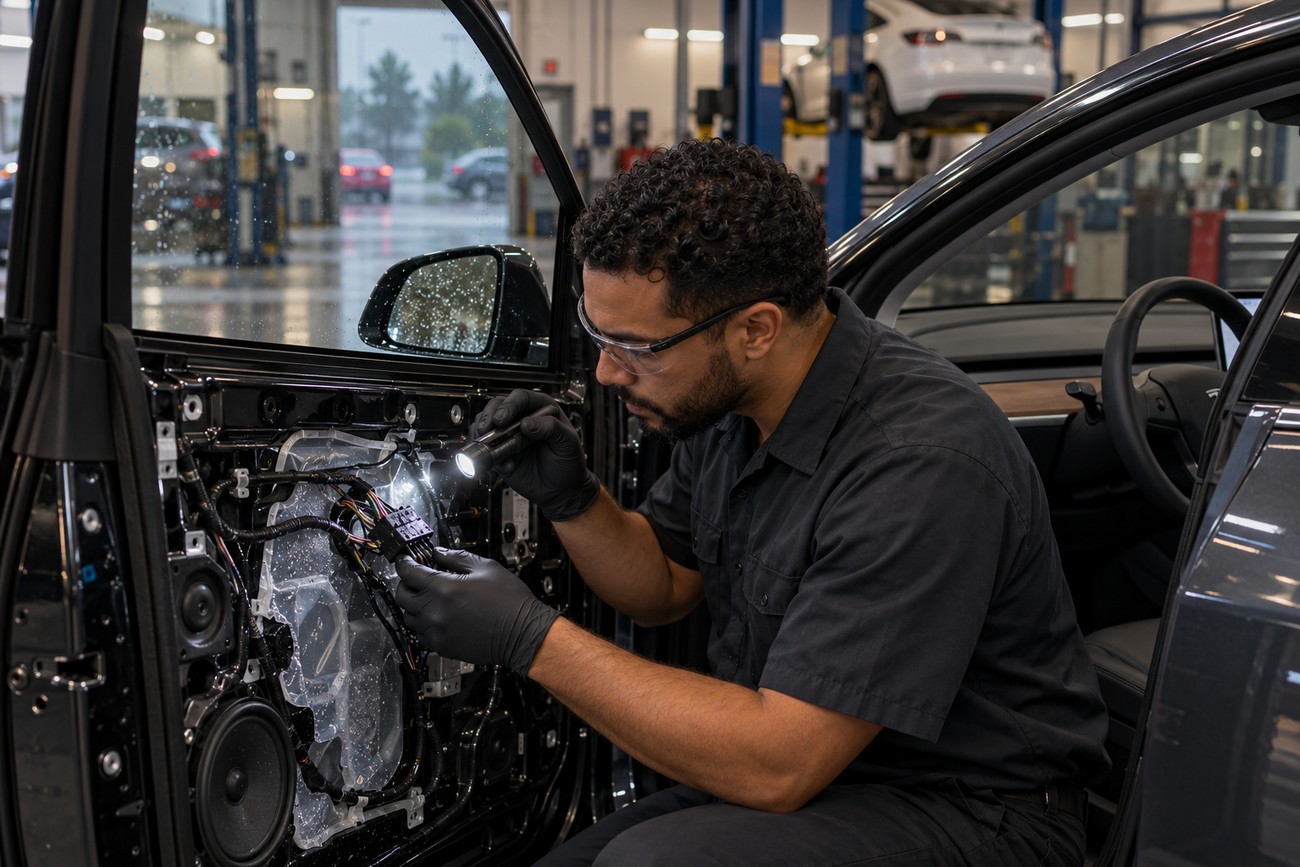
Tesla does not document rain as an automatic ventilation trigger. Rain occurring at the same time as an open window establishes a timing link, not a confirmed cause. The next checks are Vent or account activity, calibration, and the electrical components associated with the affected door.
Owner reports of moisture in a connector or wiring are relevant clues, especially when one window repeatedly misbehaves during wet conditions. They remain reports rather than a universal Tesla diagnosis. A service inspection is needed to determine whether moisture, corrosion, a switch, wiring, or another fault is involved.
A closed status in the app does not conclusively rule out a later physical reopening. The app may have shown the state before the glass moved again. For that reason, visually check every window after locking the vehicle, even when the app indicates that the car is closed.
In freezing weather, glass stopping slightly below the seal can be normal anti-freezing behavior. That position should be distinguished from a window that continues to drop, opens after closure, or leaves a meaningful gap during rain. The repeat pattern and the amount of exposure matter more than a small cold-weather gap alone.
Frequently asked questions
These answers address limits and immediate decisions that are easy to overlook during diagnosis. They do not replace a physical inspection when the fault returns.
Can Tesla service tell exactly when a window opened by itself?
Service may be able to review dates and times of spontaneous activation in vehicle logs, according to some owner reports. This is not guaranteed for every event, and a timestamp may show when an activation was recorded without proving whether it came from Vent, a switch, moisture, or another electrical condition.
What should I do if rain has already soaked the Model 3 interior?
Move the vehicle to a dry, covered location if it is safe to do so, limit further window operation, and remove standing water without disturbing the affected controls. Photograph the wet surfaces, glass position, and any visible water path before cleaning the cabin.
Record the discovery time, app status, and weather conditions. If electrical controls behave unusually after water entry, arrange an inspection rather than repeatedly testing them. Drying the cabin does not identify or repair the root cause.
Why do Tesla windows randomly open?
Possible causes include a Vent command, a calibration problem, or a fault involving a door switch, connector, or wiring. Four windows opening by a similar amount points more toward a shared command, while one window reopening or dropping slightly points toward a door-specific issue.
Why are my electric car windows opening on their own?
Electric windows can move without a deliberate button press when the vehicle receives a remote command or when it misreads an electrical input. Moisture-related connector or wiring problems are possible in some owner reports, although they are not a universal or officially confirmed explanation.
What are some common window issues with Tesla Model 3s?
Reported issues include incorrect window position, anti-pinch behavior, a window reopening after remote closure, and intermittent operation of one door’s glass. In freezing weather, a window stopping slightly below the seal can also be normal anti-freezing behavior.
Note whether the symptom affects one window or all four, whether calibration changes it, and whether it returns after closure. That pattern helps determine whether the next step is an app and access check or a service inspection.







