
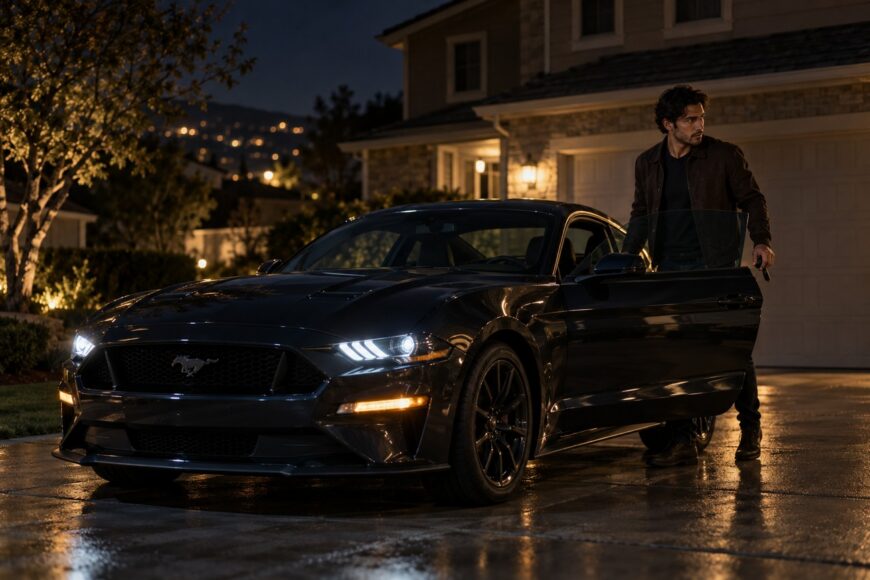
A teenager quietly taking a parent’s Ford Mustang can begin with a spare key, a short route, and the belief that nothing serious will happen. The vehicle may return without visible damage, yet the decision can still create legal, insurance, financial, and family consequences.
The central risk is the combination of inexperience, rear-wheel drive, substantial power, and limited judgment under pressure. A Mustang is also a large, heavy performance car. Its safety systems may help in some situations, but they cannot replace training, permission, or responsible adult supervision.
- Why a Mustang Is Not a “Quick Ride” for an Inexperienced Teen
- The Legal and Financial Fallout Goes Beyond a Traffic Stop
- The Failure Points Parents and Teens Usually Underestimate
- What Parents Should Do Before and After an Unauthorized Drive
- Mustang Myths That Make the Situation Worse
- Frequently asked questions
- What car is known as the “Mustang Killer”?
- What year was the ugliest Ford Mustang?
Why a Mustang Is Not a “Quick Ride” for an Inexperienced Teen
The seventh-generation Ford Mustang arrived for the 2024 model year. It is rear-wheel drive only and is available with a manual transmission or a 10-speed automatic. Depending on the engine, trim, market, and specification, power ranges from approximately 315 hp to more than 500 hp.
The base 2.3-liter EcoBoost produces approximately 315 hp and is rated at about 22/33 mpg city/highway. GT versions use a 5.0-liter V8 with approximately 466 to roughly 486–500 hp in different specifications and markets. Some commercial sites claim up to 850 hp for “stock” versions, but mainstream catalogs and reviews generally place the seventh-generation Mustang near 480–500 hp, making the higher figure doubtful marketing.
Size adds another layer of difficulty. The seventh-generation Mustang is approximately 190 inches long, 75.5 inches wide, and 55 inches high, with a 107-inch wheelbase. An inexperienced driver may misjudge a turn, a narrow parking area, braking distance, or the space needed beside another vehicle.
Rear-wheel drive can make a throttle mistake develop quickly, especially on a wet or uneven road. Stability and traction systems can reduce some risks, yet they cannot overcome excessive speed, abrupt steering, poor braking technique, or a driver who reacts too late. A car with this level of power demands judgment before an emergency begins.
The Legal and Financial Fallout Goes Beyond a Traffic Stop
In the United States, the consequences depend on state law. Driving without a valid license is an offense in every state, and a teen who holds only a learner’s permit or a provisional license may also be violating graduated driver licensing (GDL) rules, such as limits on unsupervised driving, nighttime hours, and passengers. Possible outcomes include a citation, fines, a juvenile or traffic court appearance, and a delayed, suspended, or restricted license. In many states, an adult who knowingly allows an unlicensed or restricted driver to take the wheel can face penalties as well.
Taking a car without the owner’s permission can also fall under joyriding or unauthorized-use laws, although families rarely pursue such charges against their own children. A stop without a crash can still leave a record on the teen’s driving history, and under some GDL systems a violation can extend the time before the teen qualifies for a less restricted license. That record can follow the teenager into future dealings with the state licensing agency and insurers.
Insurance treatment is fact-sensitive. Some reports describe insurers disputing or refusing coverage when an unlicensed minor was driving, but coverage is not automatically denied under every policy or in every jurisdiction. Policy wording, whether the teen is listed or excluded on the policy, permission, the circumstances of the trip, and the claim investigation can all matter. Even when a claim is paid, a crash or violation involving a young driver can raise the household’s premiums.
A collision involving injuries can create substantial civil liability for medical costs, property damage, and other losses. Many states also make parents financially responsible for certain damage caused by their minor children, and doctrines such as negligent entrustment or, in some states, the family purpose doctrine can extend liability to the vehicle owner. Depending on the facts and jurisdiction, serious injuries may also bring criminal consequences. Parents should obtain local legal advice rather than assuming that an informal family arrangement will protect them.
The Failure Points Parents and Teens Usually Underestimate
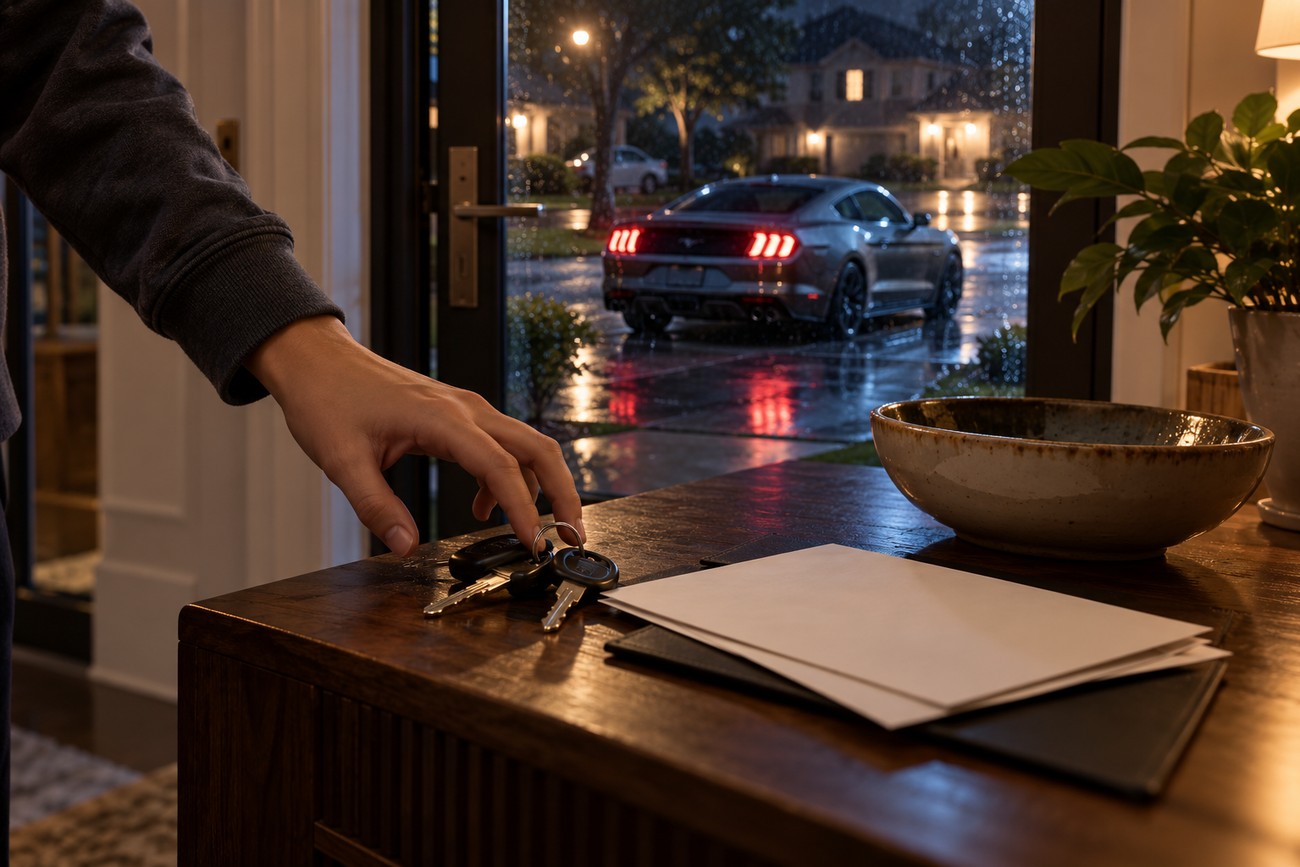
Quietly taking the keys is often treated as a harmless act of curiosity. In practice, it removes the adult’s opportunity to assess weather, traffic, fatigue, passengers, and the teenager’s emotional state before the car moves. Leaving keys and vehicle documents in an accessible place makes an unauthorized nighttime trip easier.
The idea of making “a few laps around the neighborhood” also hides several risks. A teenager may accelerate for friends, imitate a video, or attempt a drift without understanding how quickly rear-wheel drive can turn excess throttle into a loss of control. Public roads provide little space for correcting a mistake.
Peer approval can make the situation worse. A powerful coupe may become a prop for social-media footage or a way to impress passengers, encouraging acceleration and abrupt maneuvers. The driver may focus on the reactions of others instead of road position, pedestrians, intersections, or escape space.
A Mustang should not serve as an informal first training car. Supervised instruction in a suitable lower-powered vehicle gives a learner more time to understand steering, braking, observation, and traffic decisions. Those skills should be established before a teenager is considered for access to a powerful rear-wheel-drive car.
What Parents Should Do Before and After an Unauthorized Drive
Start with safety. Confirm whether the teenager, passengers, or anyone else may be injured, and contact emergency services when necessary. Secure the vehicle and prevent another departure while keeping the initial conversation focused on immediate facts rather than punishment.
Preserve relevant information: the vehicle’s condition, who had access to the keys, when the car left and returned, where it may have traveled, and whether there was contact with police, medical services, or another road user. Do not repair or alter damage before documenting it, unless emergency safety requires action.
Vehicle condition, key access, the exact timeline, and any police or medical contact should be recorded before assumptions are made about insurance or liability.
Contact the insurer when the policy or local rules require notification, and ask for jurisdiction-specific legal advice if there was a stop, collision, injury, or property damage. Parents should avoid guessing what to report or making broad statements before understanding the policy and the relevant law.
Prevention works best as a clear system rather than a trust test. Control key and document access, set written rules about permission and passengers, prohibit unsupervised and nighttime driving, and arrange supervised instruction in an appropriate vehicle. Research cited by the National Highway Traffic Safety Administration associates stricter young-driver restrictions with an 11%–21% reduction in fatal crashes.
Mustang Myths That Make the Situation Worse
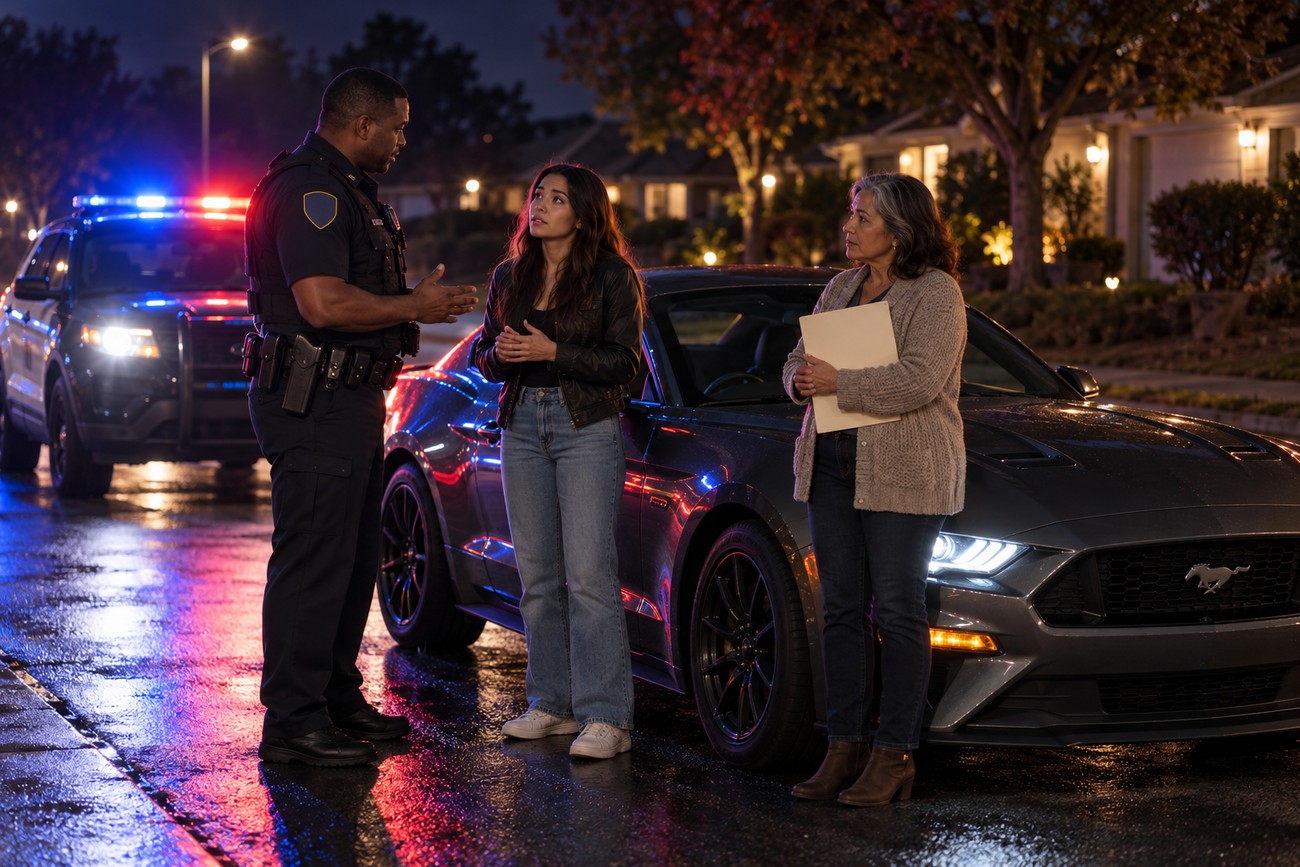
Myth: a quiet trip has no consequences if the car comes back safely. Reality: a traffic stop alone can lead to a citation, fines, and licensing consequences, while unauthorized use may create insurance complications even without a collision.
Myth: modern electronics can save an unskilled driver. Reality: electronic stability and traction systems can reduce risk in some conditions, but they cannot eliminate the effects of speed, excessive throttle, poor observation, or delayed reactions. Physics remains faster than a driver’s confidence.
Myth: teenagers rarely drive without licenses. Reality: police regularly stop underage and unlicensed drivers, and every state’s graduated licensing system exists because inexperienced young drivers face elevated crash risk. Families should treat unauthorized access to a car as a foreseeable safety issue, not an unthinkable one.
Myth: a Mustang is simply a family coupe. Reality: the seventh-generation Mustang is a powerful rear-wheel-drive vehicle with performance-car characteristics. Its technology and comfort may make it easier to operate, yet they do not make unsupervised practice or impulsive driving appropriate for an inexperienced teenager.
Frequently asked questions
The questions below concern automotive terminology and ownership responsibility. Nicknames and design judgments are separate from safety classifications, while insurance and liability depend on the specific facts.
What car is known as the “Mustang Killer”?
The Chevrolet Camaro is commonly called the “Mustang Killer.” The nickname comes from the long-running rivalry between the Camaro and Ford Mustang in the performance-car market.
It is an informal automotive label, not an official safety rating, legal category, or guarantee that one model is superior in every specification. Performance comparisons depend on the model year, engine, trim, transmission, market, and test conditions.
What year was the ugliest Ford Mustang?
The 1974 Mustang II is frequently cited by critics as the ugliest Mustang. That judgment is subjective and reflects design preferences, historical expectations, and comparisons with other generations.
The Mustang II also belongs to a different period in automotive history, shaped by fuel-economy concerns and changing emissions requirements. Its styling has no direct bearing on the safety of a modern Mustang or on whether a teenager should drive one.







