
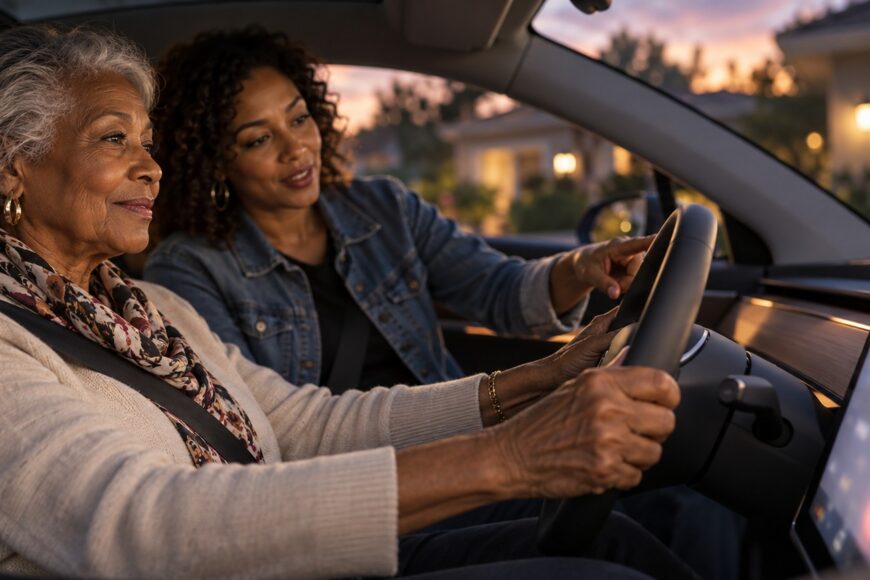
A Tesla can remove some of the work that makes a traditional car feel complicated: there are no gear changes, the electric motor delivers smooth power, and the brake pedal may be used less during ordinary driving. The same car can still feel demanding to a first-time older driver because acceleration is immediate, regenerative braking is noticeable, and many controls sit on a central touchscreen.
The goal is comfort and sound judgment, not making Grandma use every feature. Age alone says little about driving ability. A patient learner who can see the controls clearly, practice regularly, and make calm decisions may adapt well; another driver may need a different vehicle or more support.
Teaching should therefore proceed in small stages. Manual control comes first, followed by familiar local trips and only later, if appropriate, carefully supervised use of driver-assistance features.
- Why a Tesla Can Feel Easier—and More Intimidating
- Set Up the Tesla Before the First Lesson
- Teach the Controls in a Quiet, Predictable Place
- Build Confidence Without Hiding the Hard Parts
- Autopilot Is Not the Graduation Test
- The Family Mistakes That Create Panic
- Frequently asked questions
- What personality is best suited to driving a Tesla?
- How can a family tell whether an older driver is ready to drive alone?
- Is it difficult to learn how to drive a Tesla?
- Why can’t Teslas be sold in Texas?
Why a Tesla Can Feel Easier—and More Intimidating
The absence of a traditional gearbox can simplify basic vehicle control. The driver does not need to select gears while moving, and the electric motor provides smooth power without the shifting sensations found in many gasoline cars. For someone who prefers fewer mechanical steps, that can make starting and driving feel more straightforward.
Regenerative braking changes the familiar rhythm of driving. Releasing the accelerator can produce noticeable deceleration, allowing a one-pedal driving style in which accelerator release handles much of the slowing. The brake pedal remains available for deliberate or emergency braking, but the sensation may be unfamiliar to someone used to a gasoline car coasting forward.
Acceleration deserves equal attention. Tesla delivers strong torque from a standstill, so a small increase in pedal pressure can produce faster acceleration than a typical older driver’s gasoline hatchback. A nervous first reaction may then lead to another mistake, such as lifting off abruptly or pressing the brake in panic.
The central touchscreen adds a separate learning task. Speed, settings, climate controls, navigation, and other functions may be concentrated away from the traditional instrument cluster, which can challenge drivers with weaker vision or limited touchscreen experience. Tesla may feel intuitive to a confident technology user, but that is not a universal rule for older drivers or anyone else.
Set Up the Tesla Before the First Lesson
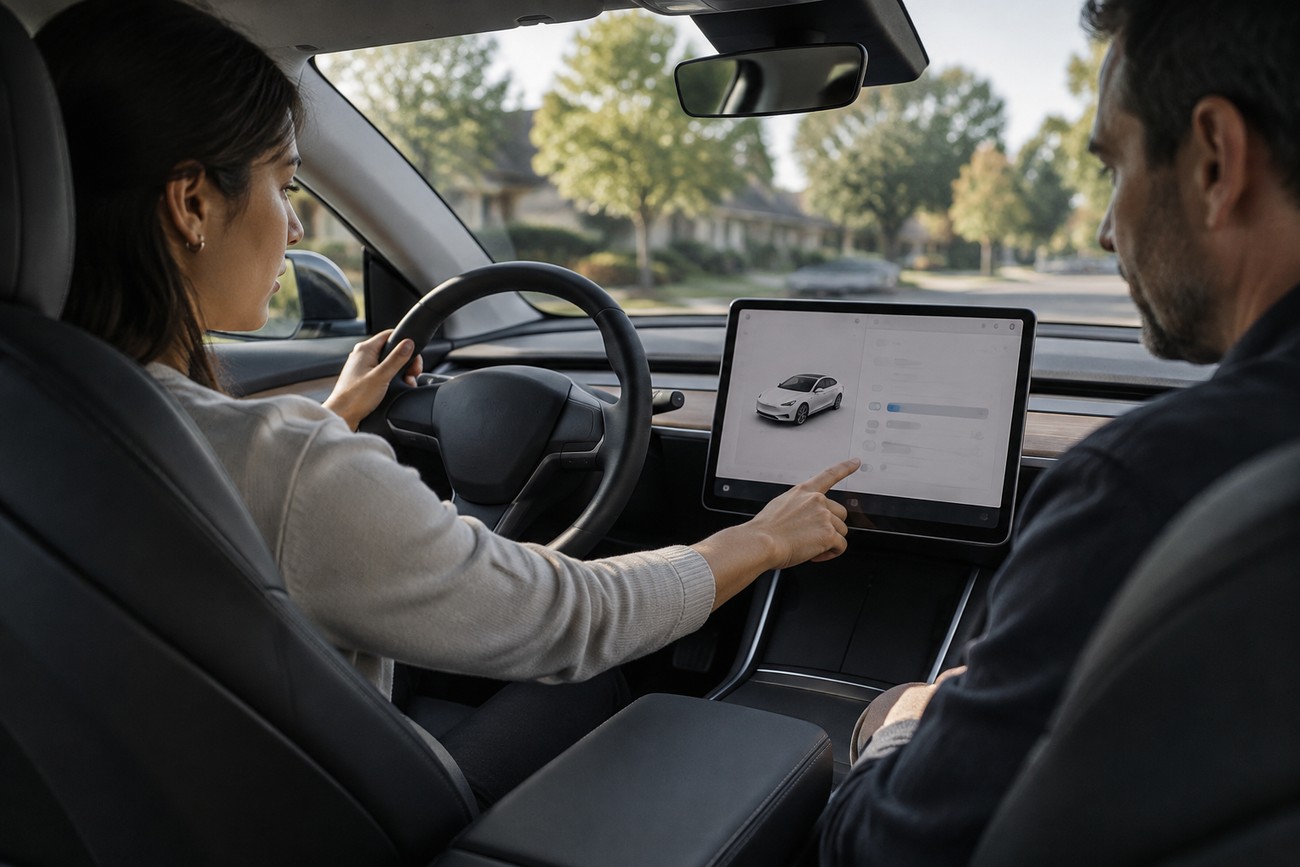
Reduce the number of decisions before the car moves. Adjust the seat and steering wheel so the driver has a clear view of the road, mirrors, and screen, with a comfortable reach to the pedals. A more upright seating position often improves visibility and makes the touchscreen easier to read.
Start in Chill mode rather than the more responsive acceleration setting. Begin with the least aggressive available regenerative-braking setting when possible, so releasing the accelerator does not feel like an unexpected brake application. These choices can be reviewed later as confidence develops.
Prepare a short printed or handwritten control sheet. It should cover only how the car starts, how to select Drive and Reverse, where the brake pedal is, how to signal, and how to enter a simple destination. A small reminder card is easier to use between lessons than a long online manual.
Demonstrate unfamiliar physical details before the first drive, including the door handles, gear selection, and the lack of a traditional instrument cluster. If the driver cannot comfortably read the display or identify the mirrors and indicators, pause the lesson and solve that problem first.
Teach the Controls in a Quiet, Predictable Place
Use a passenger-to-co-driver-to-driver progression. At first, Grandma can watch the driver operate the car and explain each action aloud. Next, she can sit beside the instructor and identify controls, and only then take the driver’s seat for short, supervised movements.
Choose an empty, low-risk surface for the first active practice. Demonstrate how the car starts and selects Drive or Reverse, then practice gentle acceleration, releasing the accelerator, and stopping with the brake pedal. Repeat simple turns and stops at low speed until the sequence feels predictable.
One control at a time keeps a new driver’s attention on the road rather than on memorizing the entire touchscreen. The passenger-to-co-driver-to-driver sequence also lets the learner build a usable mental picture before making independent inputs.
Explain that regenerative braking is predictable but different from a gasoline car. The brake pedal remains available for deliberate or emergency braking, while ABS and electronic stability control operate as safety systems during hard braking. Do not begin on a highway, in heavy traffic, or with Autopilot enabled.
Repeat the same route and instructions at first. Consistency helps reveal whether difficulty comes from the car’s response, the screen layout, or the driver’s position and visibility.
Build Confidence Without Hiding the Hard Parts
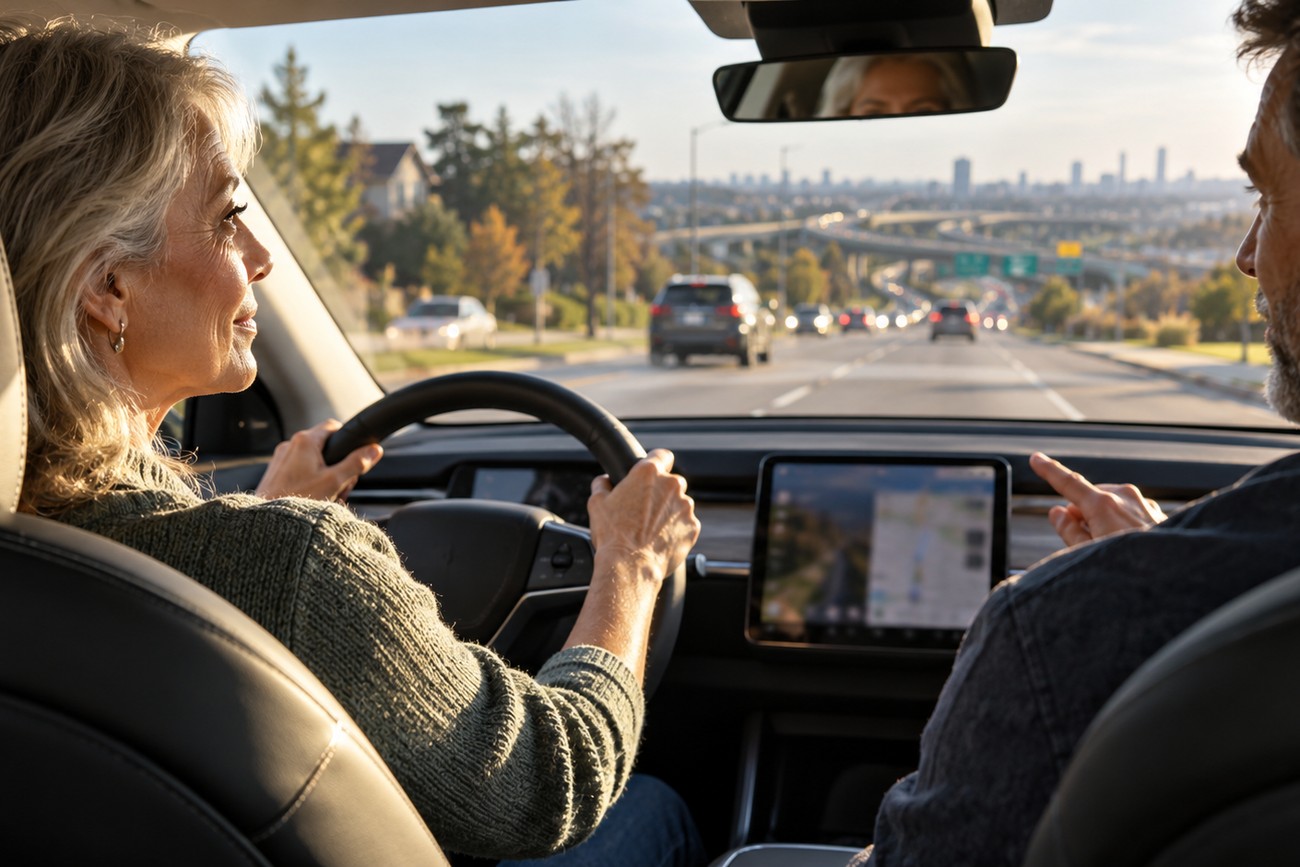
Move from short daytime trips on familiar roads to slightly more demanding routes. Simple navigation can be introduced once basic control is reliable, while complex interchanges and unfamiliar destinations can wait. Several short practice sessions are more realistic than expecting one lesson to create lasting confidence.
General older-driver guidance applies to Tesla as it does to any vehicle. Limit night driving during the learning period, avoid difficult interchanges while adapting, and consider whether vision, reaction time, or cognitive concerns affect safe decision-making. These checks should be practical and respectful rather than based on assumptions about age.
Voice commands can reduce menu hunting for navigation and calls, and a small physical label on a frequently used control may help. The driver still needs to keep attention on the road and should make adjustments only when stopped or when it is safe to do so.
Comfort is useful evidence, but repeatable behavior is stronger evidence. A driver who can start, stop, turn, follow a simple route, and recover calmly from a small mistake is progressing; someone who feels confident only when a family member handles the screen may need more practice.
Autopilot Is Not the Graduation Test
Autopilot, FSD, TACC, and automated parking are driver-assistance features. They assist the driver, but they do not replace continuous human supervision or responsibility. The driver must monitor the vehicle and remain ready to take control.
Promotional messaging may emphasize safety or convenience, while official documentation, regulators, and official reports stress continuous supervision and document crashes associated with misuse or inadequate monitoring. That disagreement in framing matters because a feature’s name or marketing description cannot tell a driver how much attention to give the road.
Overtrust creates a particular problem for anyone who is slow to react or uncertain about the vehicle’s behavior. A driver who expects the system to handle changing conditions may be less prepared to intervene promptly when it does something unexpected.
Manual driving should be mastered first. Use assistance only after the driver can control the car calmly without it, understands its limits, and can take over without hesitation; never use it to compensate for uncertainty or slow reactions.
The Family Mistakes That Create Panic
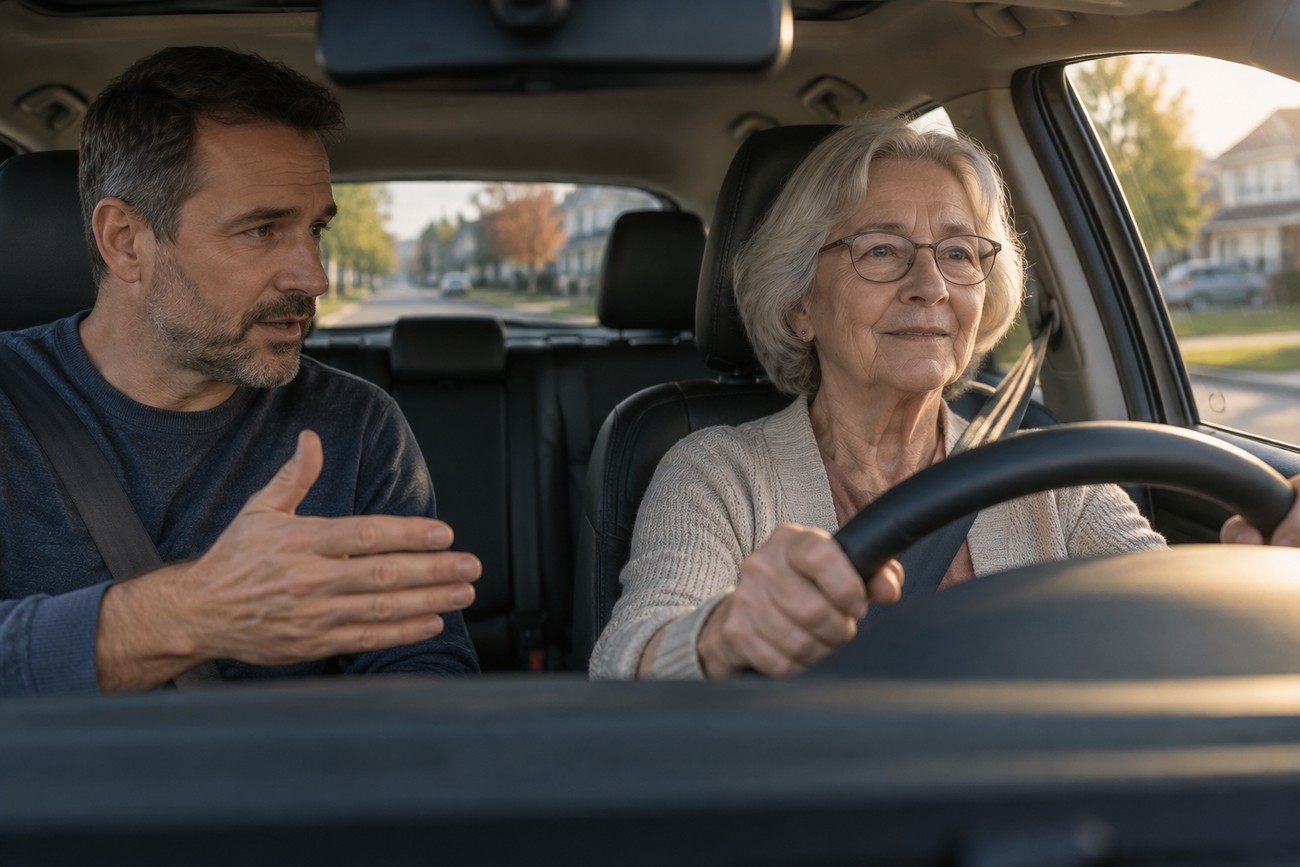
The first mistake is starting on a highway or busy road because the family wants to “get it over with.” Early practice should happen at low speed on a quiet surface, where the driver can learn acceleration, regenerative braking, stopping, turns, door handles, and gear selection without traffic pressure.
Leaving assistance enabled without a careful explanation creates a second problem. The driver may either avoid a useful feature because it feels mysterious or assume the car is driving itself. Chill mode and weaker regenerative braking can make early adaptation less intimidating, provided the driver understands that the brake pedal remains available.
Families also sometimes explain acceleration while skipping deceleration. The driver needs to know whether the car will slow when the accelerator is released, how much slowing to expect, and when to use the brake pedal. Uncertainty about who or what is controlling deceleration can quickly become anxiety.
Finally, do not ignore physical discomfort, screen readability, or mirror visibility. Readiness means consistent manual control, road awareness, and the ability to stop safely. It does not mean willingness to activate Autopilot or operate every feature.
Frequently asked questions
Learning a Tesla starts with basic manual control, clear visibility, and repeated practice. Advanced features are optional and should come only after the driver feels comfortable with the car’s responses. The questions below address personality, readiness, learning difficulty, and purchasing restrictions.
What personality is best suited to driving a Tesla?
Patience, willingness to practice, and comfort asking questions matter more than being naturally tech-savvy. A driver does not need a stereotypical “Tesla personality”; they need to learn how the car responds and admit when a control or setting is unclear.
Someone who prefers gradual repetition may adapt better than someone who rushes to use advanced features. The same principle applies to drivers of any age.
How can a family tell whether an older driver is ready to drive alone?
Look for repeated calm starts, stops, turns, and simple route following across separate practice sessions. The driver should identify the pedals and controls without prompting, maintain road awareness, and recover from small mistakes without freezing or making a sudden unsafe input.
Readiness should be based on observed performance and comfort, not confidence alone or age. If the driver cannot read the screen, react reliably, or stop safely, independent driving should wait while the family addresses that specific limitation.
Is it difficult to learn how to drive a Tesla?
Basic control can be easier because there are no traditional gear changes, but the transition still requires practice. Regenerative braking, strong electric-motor response, touchscreen controls, and unfamiliar door or gear-selection procedures can each create a separate learning hurdle.
The difficulty depends on the driver’s learning preferences, vision, reaction time, and opportunity to practice. The simplest initial setup may not be the best permanent setup, so settings should be reviewed as the driver becomes more comfortable.
Why can’t Teslas be sold in Texas?
Tesla has faced restrictions in Texas on direct manufacturer vehicle sales because state rules have traditionally limited how automakers may sell vehicles. The issue concerns the sales model and dealership regulation, rather than whether a Tesla can be driven in Texas.
Rules and available purchasing arrangements can change, so buyers should check current Texas requirements and Tesla’s official local options. The restriction does not alter the need for driver training or the safety limits of Tesla’s assistance features.







