
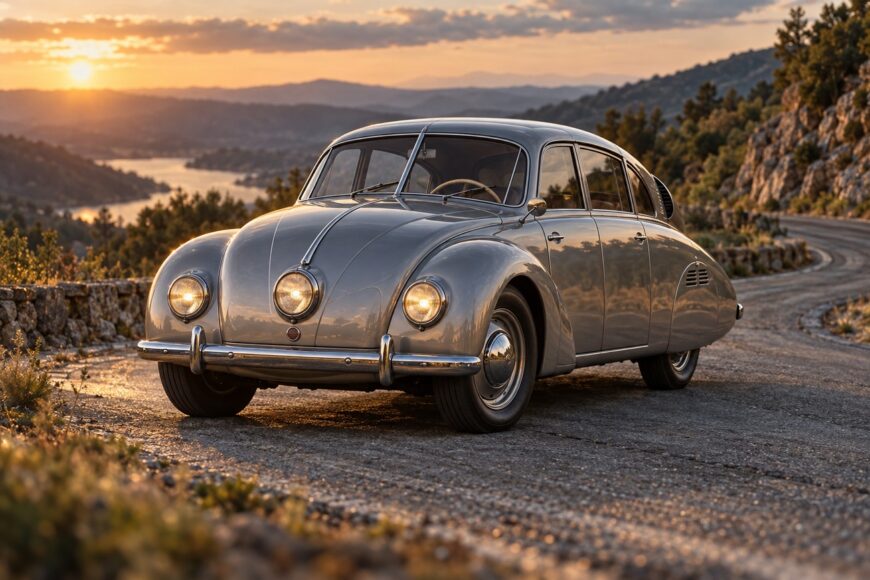
The Tatra T87 looked like a machine from the future: a low, fully streamlined body, a rear-mounted V8, and a claimed top speed of about 160 km/h. Its aerodynamic shape promised effortless high-speed travel, while its rear-engine layout gave it traction and a distinctive mechanical character.
That promise carried a dangerous qualification. With approximately 63 percent of its weight over the rear axle, a high center of gravity, and rear swing axles, the T87 could react sharply when a driver lifted off the throttle in a fast corner. The car was demanding rather than inherently uncontrollable, but its behavior punished habits learned in more conventional front-engine cars.
During and after the war, stories spread that German officers feared the T87, that large numbers had died in crashes, and that Adolf Hitler personally banned the model. The technical dangers and reports of accidents have a credible basis; verified casualty totals and a personal order from Hitler have not been established.
- Why the Tatra T87 became a feared streamliner
- The engineering behind the T87’s futuristic shape
- Tatra T87 specifications: what the period figures really mean
- Why the T87 could turn a fast corner into a trap
- The hidden costs of owning and restoring a T87
- Myth versus evidence: did Hitler really ban the T87?
- What the T87’s legacy gets right—and wrong
- Frequently asked questions
- What is a Tatra?
- What was Hitler’s main vehicle?
- Was Volkswagen Hitler’s idea?
Why the Tatra T87 became a feared streamliner
The T87 entered production in 1936 and remained in production until 1950. Its claimed maximum speed of about 160 km/h placed it among the fastest practical touring cars of its period, especially considering its relatively compact engine and long-distance design brief. That combination made the car conspicuous on roads where most vehicles were slower, heavier, and mechanically more predictable.
Its reputation grew from the interaction between speed and chassis behavior. The rear-mounted V8 placed most of the mass behind the occupants, while the swing-axle rear suspension could produce abrupt changes in wheel camber during cornering. A sudden lift of the throttle at speed could therefore make the rear of the car step outward with little warning to an inexperienced driver.
Wartime use added political drama to an already memorable machine. Stories of German officers crashing T87s circulated widely, and reports of restrictions on the car’s use may reflect genuine concern. The evidence does not support a reliable total of German officers killed, however, and no confirmed personal order from Hitler banning the T87 has been established.
The legend survived because it fit the car’s appearance. A futuristic vehicle with a dangerous reputation was easily turned into a story about political intervention. The more defensible historical conclusion is narrower: the T87 could be fast and unforgiving, and some drivers experienced serious accidents, while the dramatic prohibition story remains unverified.
The engineering behind the T87’s futuristic shape
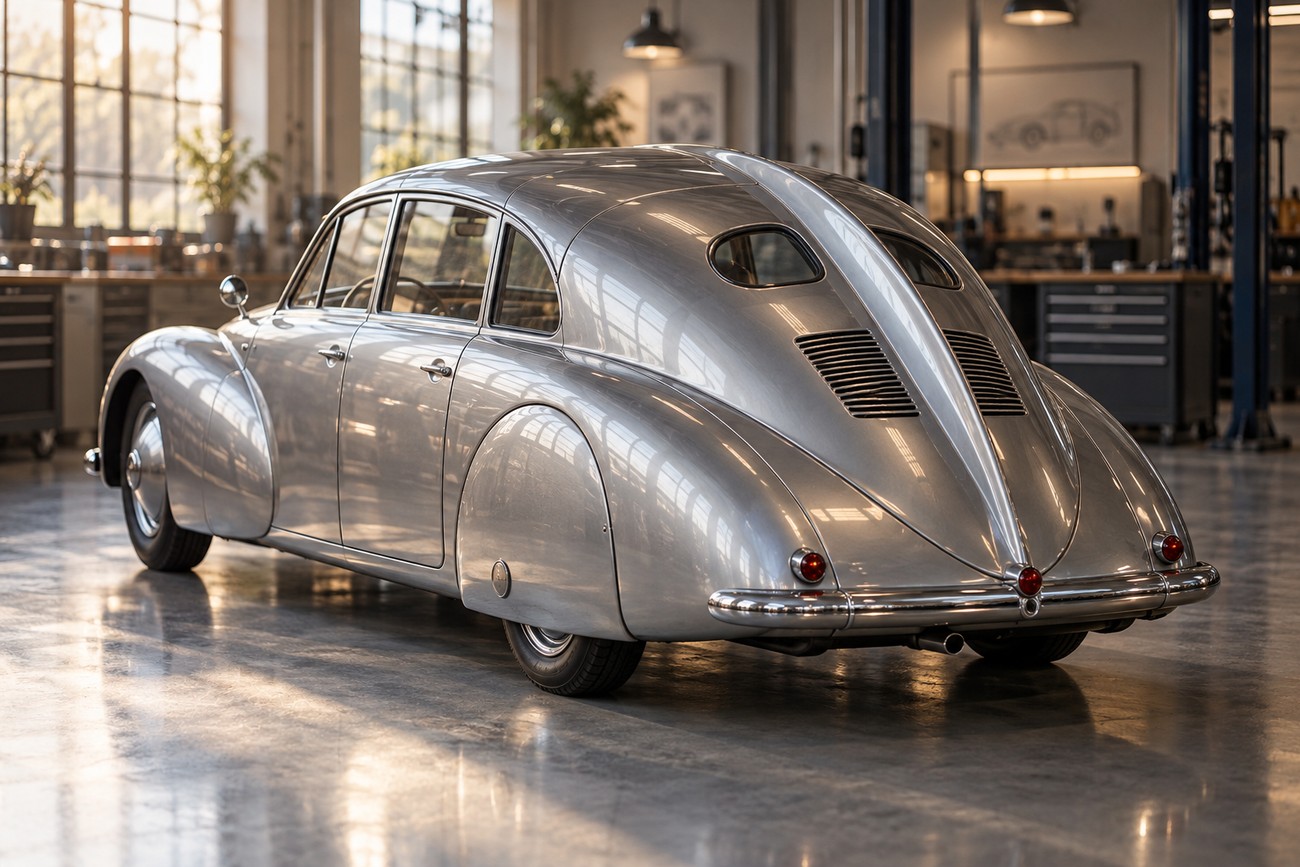
The T87 was an engineering project shaped by aerodynamic principles associated with Paul Jaray and by the engineering school of Hans Ledwinka. Its smooth body was intended to reduce drag and manage airflow, rather than simply imitate an aircraft. The result was a car whose appearance followed a coherent mechanical and aerodynamic idea.
The all-metal body reduced visual clutter and gave the car its continuous, rounded surfaces. The enclosed wheels, tapered rear body, and low frontal area worked together to reduce resistance at speed. This mattered in practical terms: the T87 could maintain high cruising speeds with a relatively modest engine output for its class.
Power came from a rear-mounted, air-cooled V8 of approximately 2.96–3.06 liters. Air cooling removed the radiator, coolant, and much of the plumbing associated with a conventional water-cooled engine. It also placed greater importance on airflow management, engine setup, and the condition of every cooling passage.
The central fin was a functional feature. It helped organize airflow over the tapered rear body and also assisted in directing air toward the engine compartment. Its aviation-like appearance was therefore linked to the car’s aerodynamic and cooling requirements, rather than being a decorative flourish added after the engineering was complete.
Rear-engine packaging influenced the entire car. It improved traction on loose or slippery surfaces and allowed a clean front body, yet it concentrated mass behind the cabin and made access to the mechanical assemblies more difficult. The T87’s visual sophistication and its service compromises came from the same design decision.
Tatra T87 specifications: what the period figures really mean
The following figures describe the T87 across its production life. Published specifications vary because engines, versions, production years, sources, and measurement methods were not always recorded in the same way.
| Specification | Period or commonly cited figure |
|---|---|
| Production years | 1936–1950 |
| Total production | About 3,000–3,056 cars |
| Production count in sources | Museum sources cite 3,056; some registers cite 3,023 |
| Engine | Rear-mounted, air-cooled V8 |
| Displacement | Approximately 2.96–3.06 liters |
| Power | Approximately 75–85 hp |
| Claimed maximum speed | About 160 km/h |
| Suspension | Independent suspension on all wheels; rear swing axles |
| Steering | Rack-and-pinion |
| Brakes | Hydraulic |
The engine figures should be read as a range rather than as a single universal specification. Sources cite approximately 2.96–3.06 liters and approximately 75–85 hp, with the difference reflecting year, version, and measurement method. A museum description and a period catalog may therefore give different figures without describing entirely different cars.
Production totals have a similar problem. The overall figure is commonly reported as about 3,000–3,056 cars; museum sources cite 3,056, while some registers cite 3,023. Such discrepancies are significant for historians, but they do not change the T87’s basic status as a rare, low-volume model.
The 160 km/h figure was a claimed maximum speed, not a guarantee that every surviving car can safely reproduce it. Age, restoration quality, gearing, engine condition, tires, and chassis setup all affect what a particular T87 can do today. The specification table is useful for identifying the design; it is insufficient as a driving recommendation.
Why the T87 could turn a fast corner into a trap
The T87’s approximate 37:63 front-to-rear weight distribution explains much of its character. Rearward mass improves traction for the driven rear wheels, especially on loose surfaces, but it gives the rear tires greater influence over the car’s rotational behavior. The high center of gravity increased the effect of load transfer during rapid changes of direction.
Rear swing axles added another complication. As the suspension moved, the geometry could alter the rear wheels’ camber and contact behavior. In a fast corner, that change could reduce the rear axle’s stability at precisely the moment when the driver needed predictable grip.
The classic danger was lift-off oversteer. If the driver suddenly released the throttle while cornering, weight transferred forward and the rear tires could lose stability. The rear of the T87 might then move outward sharply, demanding immediate and measured correction rather than a large steering input or abrupt braking.
This behavior depended on a combination of conditions. Speed, corner radius, road surface, throttle position, load transfer, tire condition, and steering input all mattered. A T87 driven smoothly within its limits could be manageable; the same car entering an unfamiliar bend too quickly could become difficult to recover.
The car’s reputation therefore contains a technical truth without proving every dramatic story attached to it. The T87 was not permanently impossible to control, and its handling was not explained solely by driver incompetence. Its layout created objective risks that rewarded discipline and exposed abrupt reactions.
The hidden costs of owning and restoring a T87
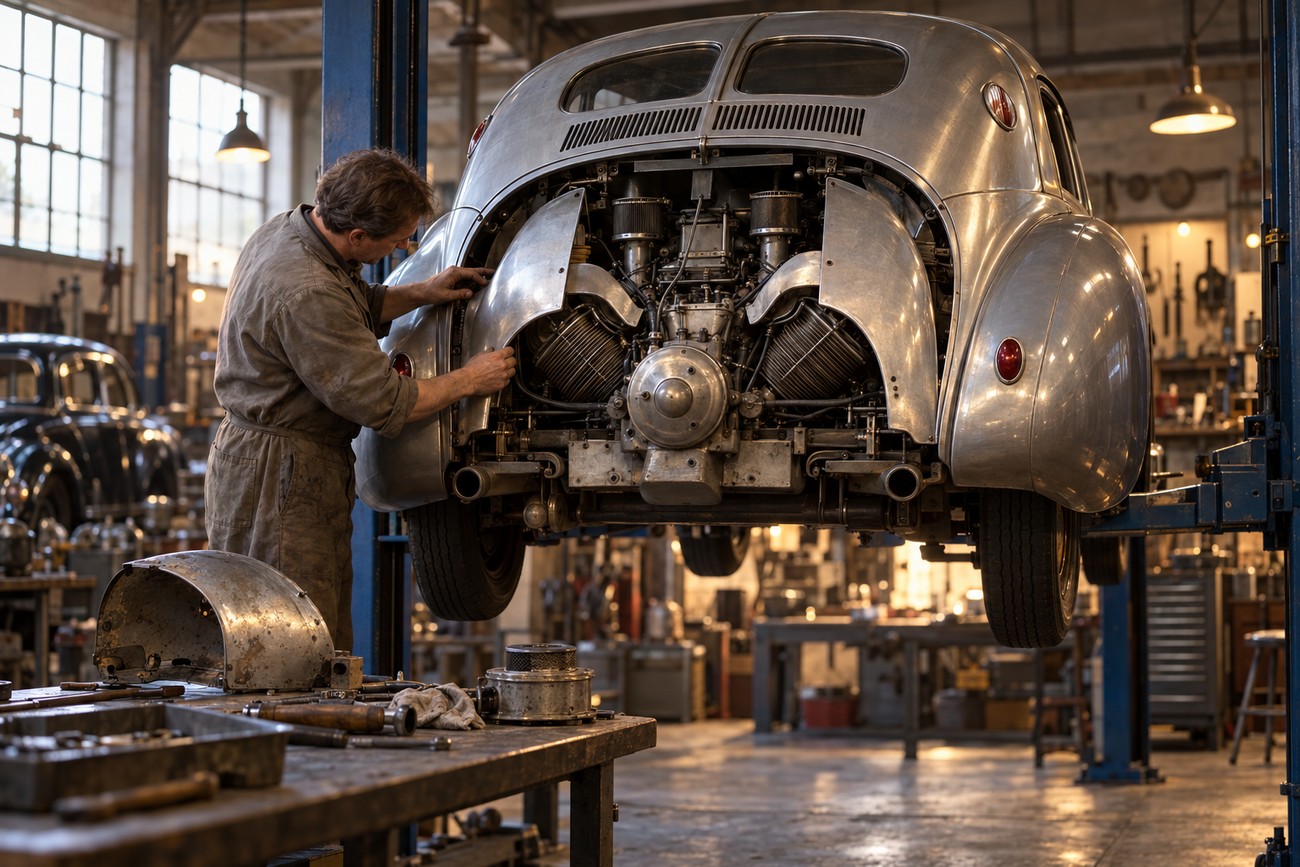
A visual inspection can give a misleading impression of a T87’s condition. The body and interior may appear complete while the more important risks lie underneath: deteriorated magnesium engine components, incorrect suspension geometry, worn steering parts, weak brakes, or damaged cooling ducts and shrouds.
Air cooling simplifies the system, but it leaves little room for neglected details. Missing or poorly fitted shrouds can disturb airflow, while incorrect engine setup can increase heat and reduce reliability. Rear-engine packaging also limits access, so routine work may require more disassembly than an owner expects from a relatively compact V8.
Suspension geometry and rear ride height deserve verification before a restoration chases fine points of originality, because small changes can alter the behavior of a swing-axle car.
Original parts, specialist knowledge, and reliable documentation are scarce. Restorers may need to rebuild or reproduce components individually, and modern replacements can change the car’s geometry, weight distribution, or historical specification. A technically sound restoration requires judgment about both safety and authenticity.
Tires deserve particular attention. Owner accounts describe difficulty finding suitable tires while preserving the car’s original characteristics without creating avoidable safety compromises. Suspension, steering, brakes, engine materials, cooling, and tire choice should be assessed as one system rather than as isolated restoration tasks.
Myth versus evidence: did Hitler really ban the T87?
A personal order from Hitler banning the T87 is not confirmed. Reliable casualty totals for German officers are also not established, so claims that the model killed a documented large number of officers should be treated as legend rather than settled history.
Reports of restrictions on use and T87 crashes are more defensible, although the surviving evidence varies in quality. The car’s rear weight bias, high center of gravity, and swing-axle behavior provide a credible technical explanation for serious accidents without requiring a political ban.
Witness accounts also include non-fatal departures from the road. That detail matters because it weakens the simple version of the story in which every incident became a fatality and every accident led directly to official prohibition.
The T87 was very fast for its class and era, but its absolute status as Europe’s fastest car is unproven. Its historical importance rests on the combination of advanced aerodynamics, unusual packaging, and demanding handling, rather than on an unsupported death toll or a dramatic personal decree.
What the T87’s legacy gets right—and wrong
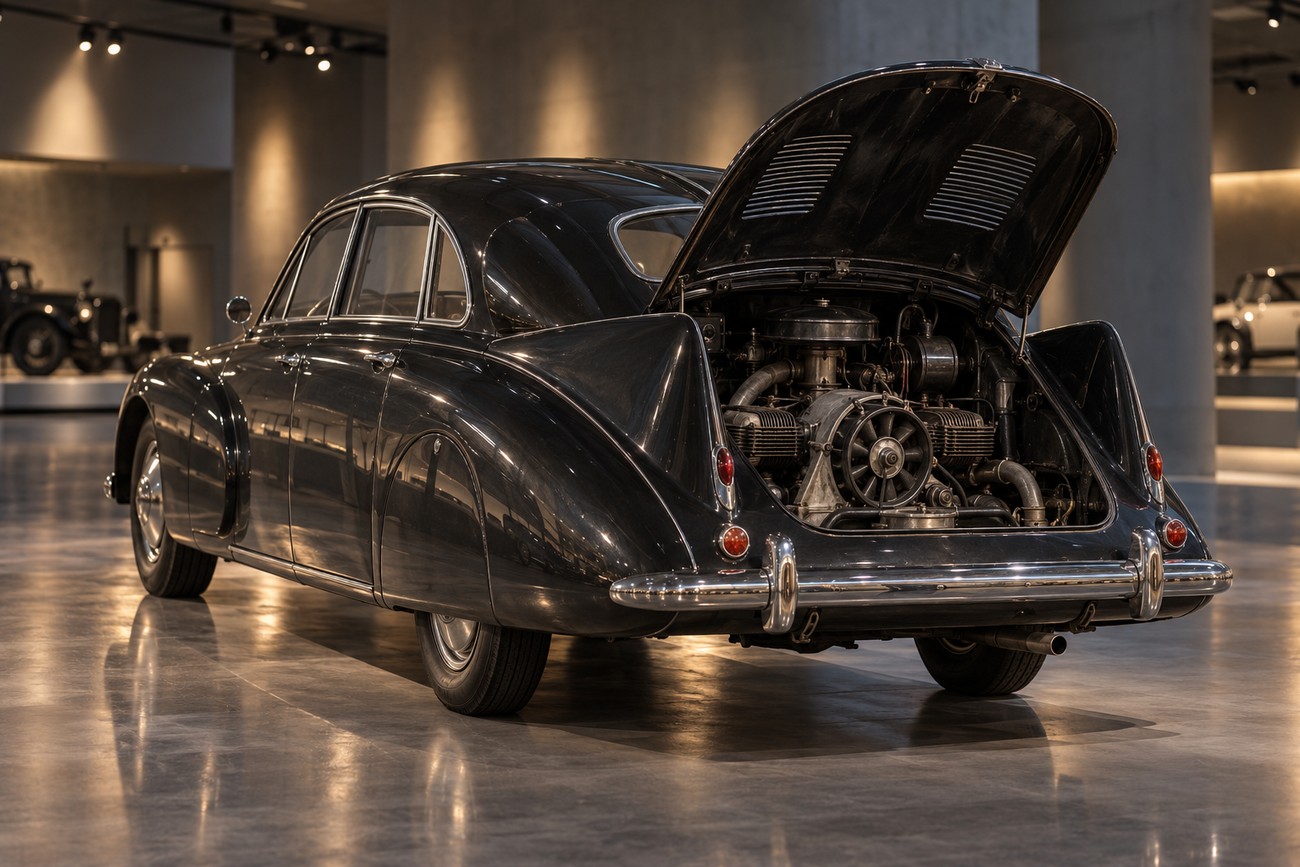
The T87 deserves its reputation as one of the most technically distinctive cars of the prewar period. Its aerodynamic body, rear-mounted air-cooled V8, and compact construction represented a coherent alternative to conventional front-engine touring-car design. Compared with the T77, it was notably simpler and lighter.
That sophistication did not guarantee safe handling. The same rear-engine layout that improved traction and helped the body achieve low drag also produced rearward weight bias and difficult load-transfer behavior. The T87 had no electronic stability systems to compensate for a driver’s mistake or to soften an abrupt maneuver.
Its lesson is especially relevant to collectors. A claimed top speed describes the capability of a period machine under suitable conditions; it says little about how a particular restored car will behave on a modern road. Chassis geometry, tires, brakes, and driver technique matter at least as much as the number in a catalog.
One museum-based estimate places the number of surviving cars below 250, although a unified global register is still needed to confirm the worldwide figure. That scarcity makes the T87 valuable as a historical object, while also making careless restoration and uncritical driving more consequential.
Frequently asked questions
The T87’s story raises separate questions about its maker, its wartime associations, and its relationship to Volkswagen. Tatra’s engineering history is distinct from the later political stories attached to the car. Keeping those threads separate helps put the claims about Hitler and the T87 in context.
What is a Tatra?
Tatra is a Czech automobile and engineering marque known for unusual technical solutions, including rear-engine cars, backbone-style chassis concepts, air-cooled engines, and aerodynamic bodies. The T87 was one model within that broader engineering tradition, produced from 1936 to 1950.
The name therefore describes a manufacturer and design lineage, not a generic type of streamlined car. Tatra’s approach connected advanced aerodynamics with practical mechanical experiments, even when the resulting handling demanded more care than conventional cars.
What was Hitler’s main vehicle?
Hitler’s better-documented official transport was associated with large Mercedes-Benz state cars, especially the Mercedes-Benz 770 used for ceremonial and political purposes. That history should be kept separate from the unconfirmed claim that he personally banned the T87.
The T87’s connection with Nazi officials comes largely from wartime use, crash reports, and later retelling. Political association and documented official transport do not establish that Hitler issued a personal prohibition against the Czech streamliner.
Was Volkswagen Hitler’s idea?
The Volkswagen project received strong political sponsorship from the Nazi regime and was presented as a car for mass motorization. Hitler promoted that project, but the engineering lineage behind the Tatra T87 was independent and rooted in Tatra’s Czech design tradition.
The two histories later became connected through disputes over rear-engine and aerodynamic ideas, but they should not be collapsed into one story. Volkswagen’s political sponsorship does not make the T87 a Volkswagen design, and the T87’s engineering development did not originate as part of the Volkswagen project.







