
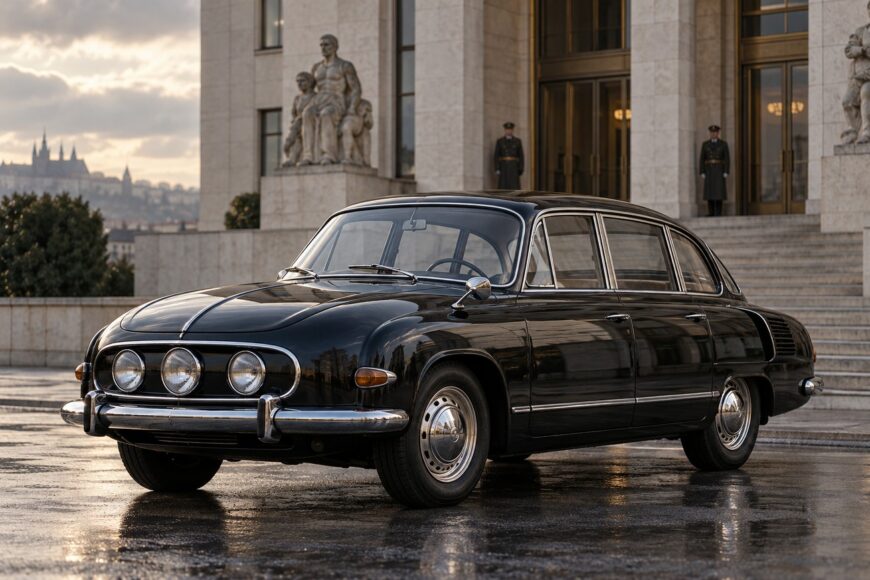
The Tatra 603 was an elegant official limousine with a rear-mounted, air-cooled V8, yet its engineering makes it a demanding classic to own. Built for state service rather than ordinary showroom sales, it paired an unconventional chassis with a body whose details changed substantially during production. That combination still attracts enthusiasts who value the car for more than its Cold War associations.
Its appeal needs a measured reading. Air cooling removes the radiator and the risk of frozen coolant, but it places unusual demands on airflow, seals, and engine tuning. Original parts can be scarce, similar-looking cars may belong to different series, and performance claims in popular accounts sometimes exceed the figures found in factory, museum, and club references.
- A Limo Built for the State, Not the Street
- The Rear Air-Cooled V8: Clever, Fast, and Heat-Sensitive
- The Backbone Chassis Behind the Unusual Road Manners
- Early and Late T603s Are Not Interchangeable by Default
- Why Ownership Gets Expensive After the Shine Fades
- Buying and Operating One Without Falling for the Myths
- Frequently asked questions
- Why did Tatra stop making passenger cars?
- Who owns Tatra now?
- Which country is Tatra Trucks from?
A Limo Built for the State, Not the Street
Serial production of the Tatra 603 ran from 1956 to 1975. It primarily served party nomenklatura and government institutions in socialist countries, where an official car had to carry passengers in comfort over long distances. Its role was closer to that of a restricted service limousine than a family sedan available to anyone with the money to buy one.
That distinction matters when judging the car’s history. Describing the T603 as a socialist “people’s car” confuses its national origin with its availability. It was a conspicuous piece of state transport, and its limited distribution shaped both how it was used and how many examples survived outside official fleets.
Production amounted to several thousand cars. Commonly cited totals are around just over 2,000, although sources differ in how they count series and prototypes; a single exact figure deserves caution unless its basis is clear. Either way, this was a limited-production vehicle, which helps explain why a missing trim piece or incorrect fitting can be a serious restoration problem.
The long production run also masks considerable change. A car from the beginning of the program and one from its final years share the same broad concept, but they should not be assessed as identical specifications. For a prospective owner, the first useful historical question is which version is actually in front of you.
The Rear Air-Cooled V8: Clever, Fast, and Heat-Sensitive
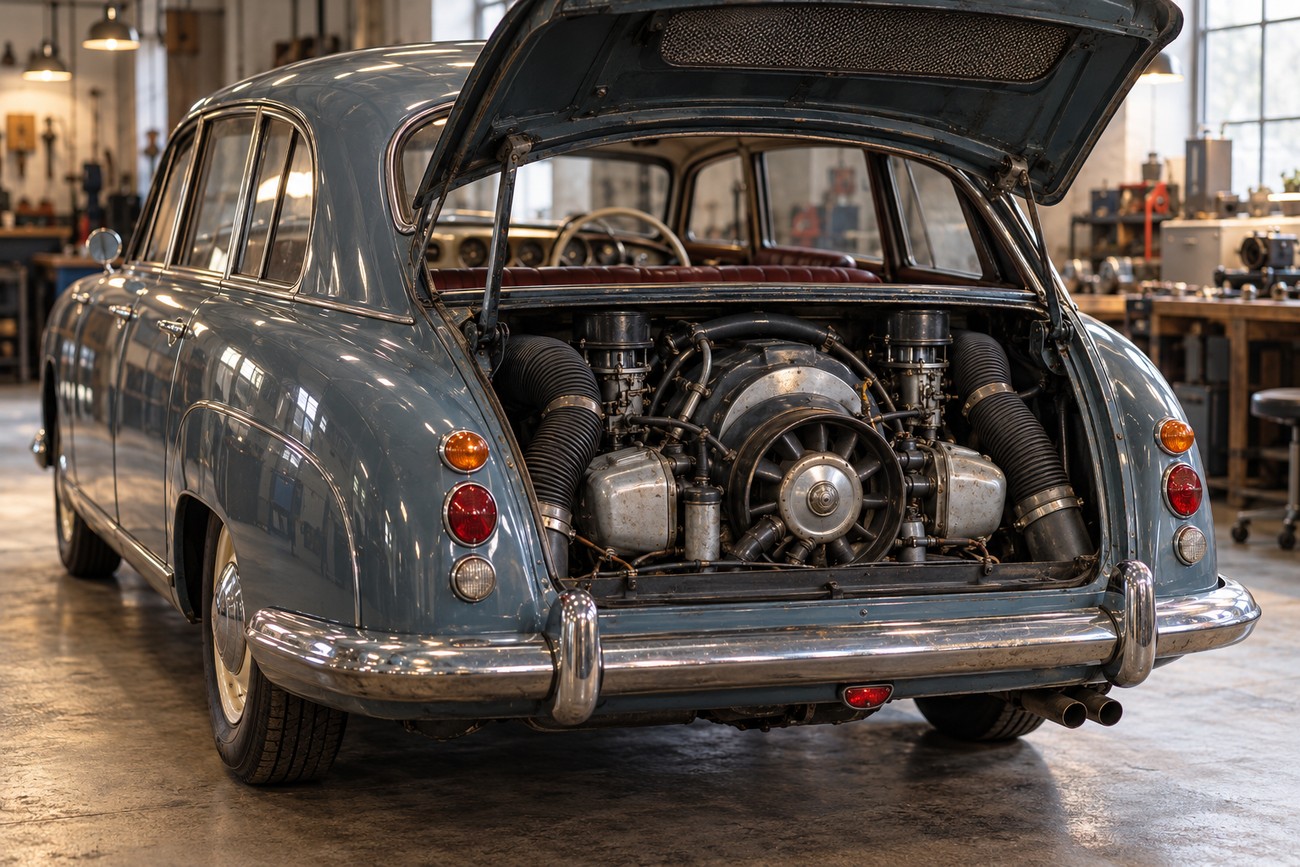
The T603’s 2.5-liter, rear-mounted, air-cooled V8 was integral to its layout. Placing the engine behind the passenger compartment freed the nose from a conventional engine installation, while air cooling avoided dependence on antifreeze. In cold-weather service, that was a practical advantage, though it did not make the engine indifferent to its surroundings.
Later versions are commonly rated at approximately 95–105 hp, depending on series. Factory, museum, and club references usually put top speed at about 160 km/h. Claims of 170+ km/h appear in popular sources, but they are disputed and not reliably verified; figures from another series or an unrelated later Tatra should not be used to inflate a T603’s specification.
Cooling depends on clean passages, intact ducting, sound seals, and airflow reaching the places its designers intended. Dirt in the cooling channels or air escaping through a damaged shroud can undermine heat removal even if the engine starts readily and runs smoothly at idle. Carburetion and tuning matter as well, particularly when the car is asked to idle in traffic or operate in hot weather.
An air-cooled engine has no radiator to leak, but it still has a thermal system to maintain. Treating the V8 as maintenance-free is a costly misunderstanding: a small defect in an unseen air path can be more consequential than a cosmetic flaw visible across a parking lot. A road test and a careful inspection of the cooling hardware tell a buyer far more than the sound of a brief first start.
The Backbone Chassis Behind the Unusual Road Manners
Beneath the body, the T603 uses Tatra’s tubular backbone frame and independent suspension on all four wheels. This is distinct from an ordinary sedan built on longitudinal chassis rails. The architecture is central to the car’s packaging and to the way its mechanical components are arranged, so familiar assumptions about access and repair do not always apply.
That layout rewards a mechanic who understands how Tatra assembled the car. Reaching a component may require a different sequence of work from the one used on a conventional front-engine classic. Before approving a repair, an owner benefits from knowing whether the workshop has suitable tools, technical information, and experience with this particular arrangement.
On the road, the independent suspension and rear engine give the T603 a character that cannot be inferred from its formal bodywork. It may feel capable at cruising speeds, but that impression should be kept separate from its stopping and cornering limits. Brakes, tires, and chassis behavior require allowances that a driver accustomed to a contemporary sedan may no longer make automatically.
Condition also changes the driving experience substantially. A car with tired suspension components or unsuitable tires can obscure the behavior its designers intended, while a well-sorted example still calls for measured inputs and space to slow down. Its quoted top speed is a specification, not a sensible target for ordinary modern traffic.
Early and Late T603s Are Not Interchangeable by Default
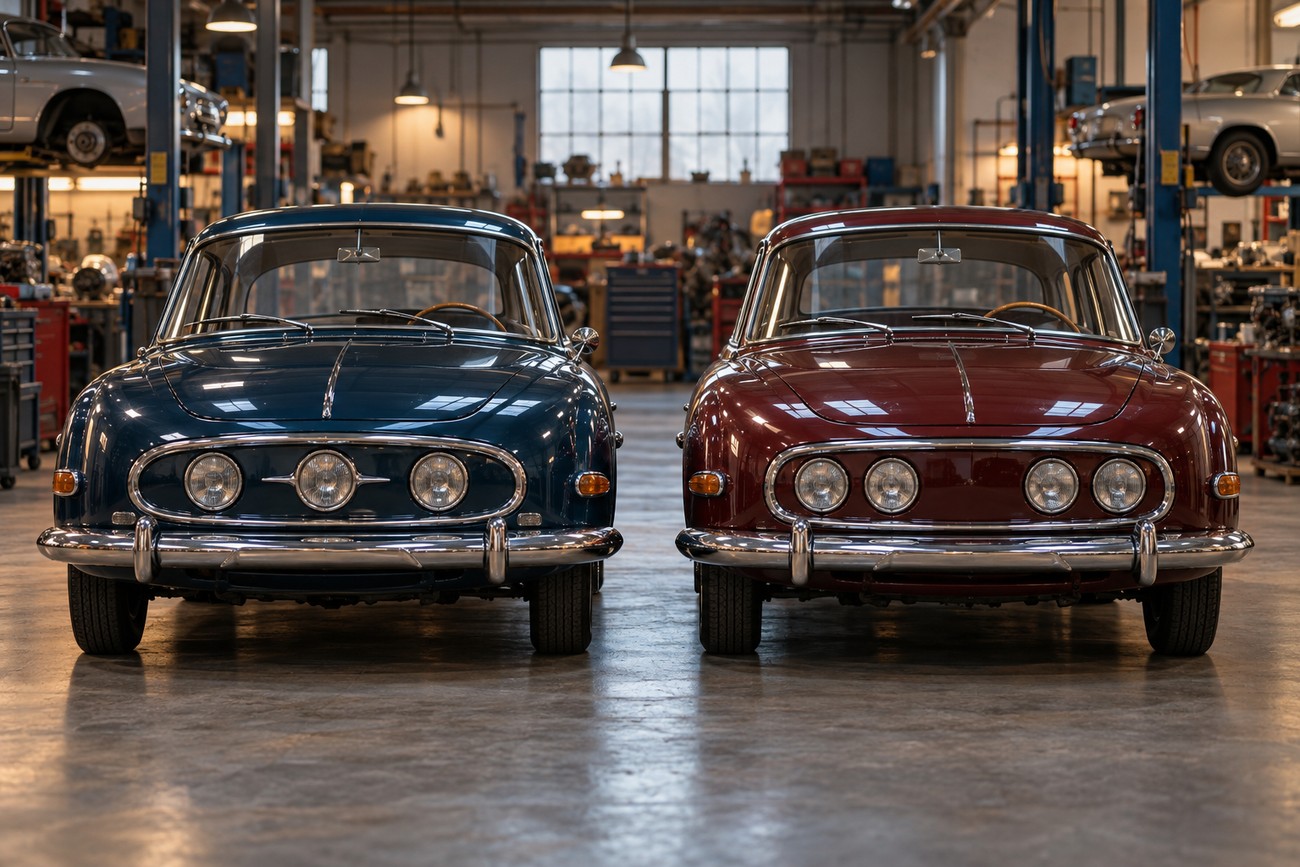
The T603 evolved visibly during its production life, especially in its front-end appearance and lighting. Early and late cars can therefore look quite different even while retaining the recognizable Tatra silhouette. These changes help identify a car, but photographs alone rarely establish that every fitted part belongs to its claimed series.
Similarity is a poor interchange guide. Body fittings, lamps, and smaller pieces may vary across versions, and parts that appear close in an advertisement may fail to fit or look wrong once installed. A restorer should identify the car’s series before buying expensive components, then check the proposed part against the actual mounting and surrounding details.
Specification lists need the same discipline. Later T603/2 data should not be applied indiscriminately to an earlier T603, and figures for the subsequent T613 belong to a different model. Mixing them can produce a persuasive-looking description that is wrong about the engine, performance, or appearance of the vehicle being sold.
Correctness extends inside the cabin. Instruments, controls, and trim are easy to overlook beside prominent exterior changes, yet they help establish whether an example has been preserved, carefully restored, or assembled from whatever parts were available. Provenance and series-correct details give an owner a stronger basis for valuing the car than fresh paint alone.
Why Ownership Gets Expensive After the Shine Fades
Overheating in traffic and hot weather is a recurring concern with an aging air-cooled T603. The first response should be to examine the whole airflow path, rather than assume that the engine needs a single adjustment. Cooling passages, shrouds, ducting, seals, and tuning work together; a fault in one area can make another appear to be the cause.
Long storage adds a separate layer of risk. Seals and hoses deteriorate, carburetion may need attention, and electrical faults can emerge when a dormant car returns to use. An engine that fires after years off the road demonstrates only that it can start, not that it will tolerate a hot journey or repeated stops in traffic.
Bodywork is often the larger financial trap. Original panels and chrome can be difficult to source or restore, and a glossy finish may conceal corrosion or earlier repairs. A buyer who concentrates on making the V8 run while overlooking incomplete exterior trim can discover that the visible finishing work absorbs more resources than the initial mechanical recommissioning.
The cabin deserves equal scrutiny. Correct instruments, controls, upholstery details, and fittings support the car’s authenticity, whereas absent original pieces may be hard to replace convincingly. Collectors generally have more reason to value documented history and correct components than cosmetic shine that hides a mixture of series-specific parts.
Buying and Operating One Without Falling for the Myths
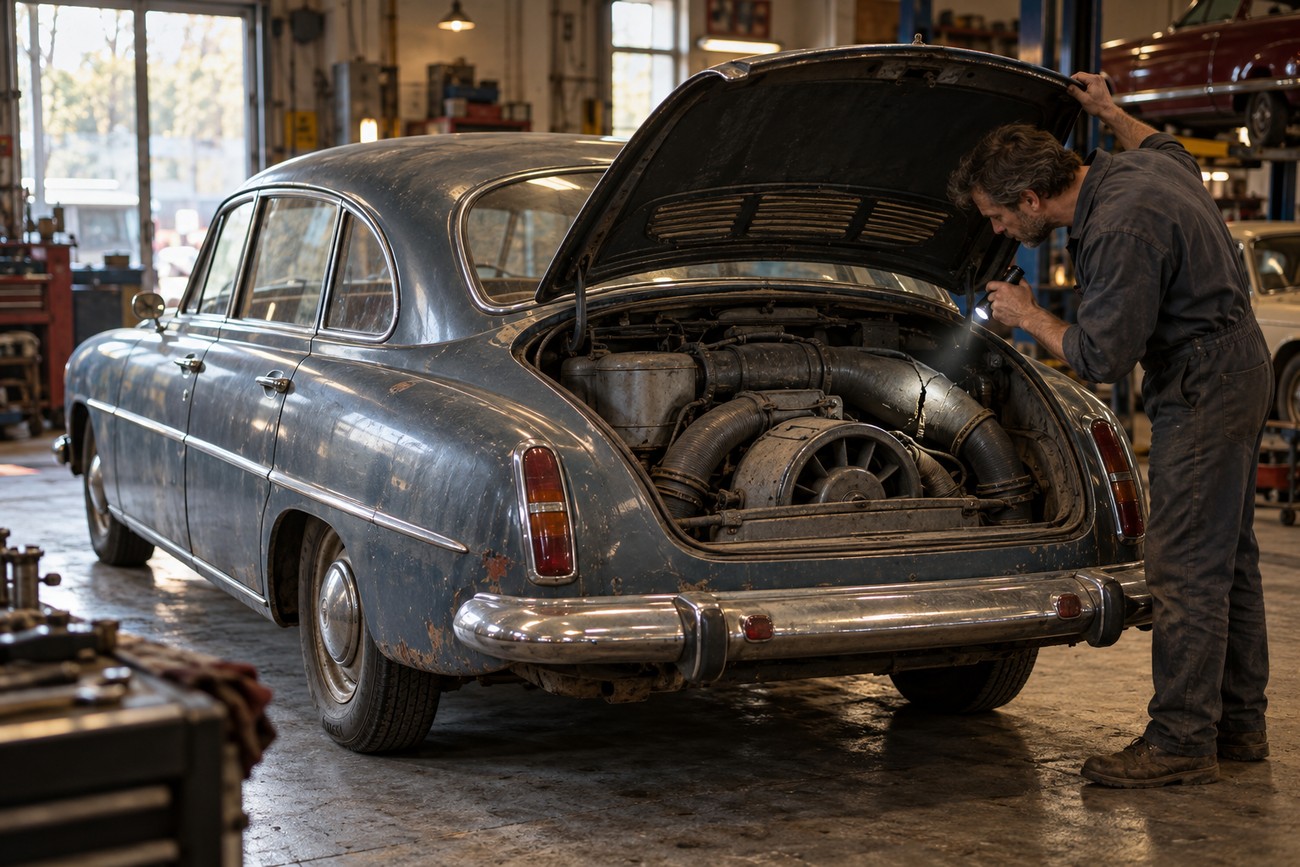
A running T603 is not automatically a sensible purchase. Begin by checking completeness, identifying the series, and comparing its lighting, trim, instruments, and mechanical components with that identification. A cheaper project missing distinctive pieces may cost more to finish than a less dramatic-looking car whose parts are present and correct.
Next, inspect the body for corrosion and evidence of difficult repairs, then assess the cooling system as an assembly. Sound seals, unobstructed air passages, intact ducting, and careful tuning matter more than a short demonstration at idle. Records of maintenance and previous restoration work can help distinguish a sorted car from one that has merely been made presentable.
Specialist support should be part of the purchase decision, rather than an afterthought. The backbone chassis and unusual engine installation can demand knowledge and tools outside the routine work of a general repair shop. Before planning regular use, establish who can inspect the car, obtain suitable parts, and address faults without improvising away its originality.
The persistent myths fail the ownership test: the T603 was a limited official limousine, its air cooling still requires close thermal management, and its series do not all share one specification. It can be enjoyed on modern roads with preventive checks and respect for its brakes, tires, and handling. Treating it as an ordinary modern sedan risks both the machinery and the experience that makes it worth preserving.
Frequently asked questions
Why did Tatra stop making passenger cars?
Tatra’s passenger-car business ended because a small, specialized car program became increasingly difficult to sustain as its market changed. After the end of the socialist state-service system, the company faced a different commercial environment, and its later passenger cars could no longer rely on the institutional role that had supported vehicles such as the T603. Tatra’s last passenger-car model, the T700, ended production in 1999.
The decision concerned the broader passenger-car line, not a sudden end to Tatra as a manufacturer. Truck production remained the stronger continuing business, built around engineering and customers distinct from those of an official limousine.
Who owns Tatra now?
The present Tatra Trucks company is privately owned through Czech industrial groups Czechoslovak Group and Promet Group. It is separate in ownership and business context from the state-era organization that built the T603. Corporate holdings can change, so anyone needing a current ownership breakdown should consult the company’s latest disclosures.
That distinction also matters to collectors. A modern truck manufacturer bearing the Tatra name preserves an industrial lineage, but it does not make historical T603 components readily available as ordinary current-production service parts.
Which country is Tatra Trucks from?
Tatra Trucks is from the Czech Republic and is based in Kopřivnice. The T603 was built when the town was part of Czechoslovakia, which explains why historical accounts describe the car as Czechoslovak rather than Czech.
Today the surviving automotive business concentrates on trucks, particularly vehicles using Tatra’s distinctive chassis engineering. The passenger limousines remain an important part of its history, but they do not describe the company’s current product range.







