
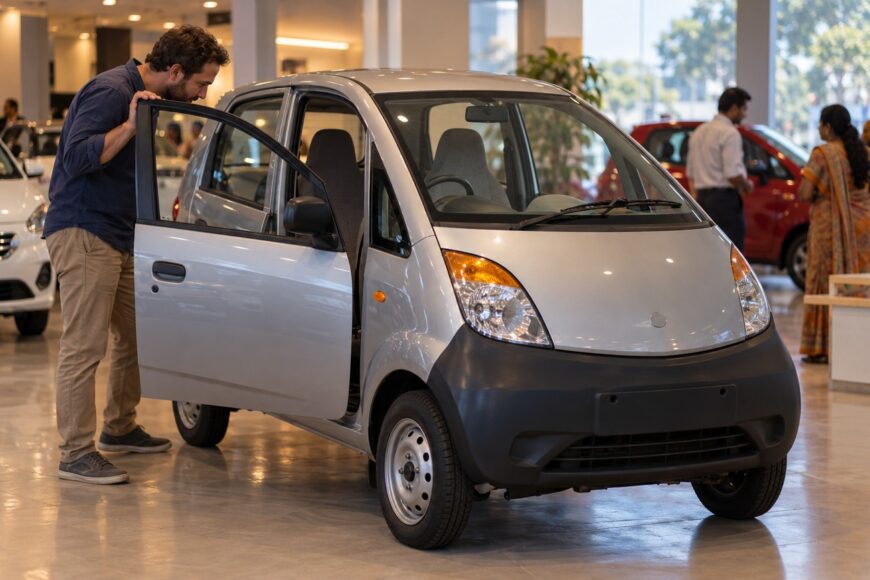
The Tata Nano was designed to make four-wheel ownership accessible to households that had previously relied on motorcycles. Its central promise was simple: a small, efficient car priced at approximately ₹100,000. Yet the model became associated with delay, danger, reliability concerns, and low status. That contrast explains why the Nano remains one of the most instructive failures in modern automotive marketing.
The outcome was not caused by one defective component or by a public refusal to buy inexpensive cars. The headline price created expectations that the finished product could not consistently meet, while the Singur factory conflict delayed supply and weakened launch momentum. Safety-test results, reports of fires and electrical faults, limited performance, and the social meaning of “the world’s cheapest car” then reinforced one another.
- The ₹100,000 Promise Created the Wrong Product Story
- A Disrupted Launch Lost Momentum Before Demand Could Be Tested
- The Safety Problem Was Bigger Than a Missing Airbag
- Fires, Reliability Complaints, and the Cost of Extreme Simplification
- Why Buyers Rejected the Idea, Not Just the Car
- What Used-Car Buyers Commonly Get Wrong About the Nano
- Frequently asked questions
- Why was the Tata Nano discontinued rather than banned?
- What did the GenX Nano improve?
- Was the Tata Nano ever a sensible alternative to a motorcycle?
The ₹100,000 Promise Created the Wrong Product Story
Tata’s original target was approximately ₹100,000, a figure that made the Nano easy to understand and difficult to forget. It was a target or headline price rather than a universal final on-road price. The amount paid by a customer varied with the version, taxes, delivery, and equipment, so the public promise quickly became a benchmark against which every compromise was judged.
The production car used a 624 cm³ two-cylinder petrol engine producing about 38 hp. That specification helped keep the vehicle small, light, and relatively economical, but it also set clear limits on acceleration, refinement, and load-carrying ability. First-time car buyers generally wanted weather protection and manageable running costs, while also expecting acceptable comfort, safety, reliability, and a visible improvement over motorcycle ownership.
That last expectation mattered. The Nano was meant to help Indian households move from motorcycles to cars, yet the cheapest-car label could suggest that its buyers were moving only partway up the social ladder. A low entry price was attractive, but it did not by itself establish that the car would deliver the dignity, security, and everyday practicality associated with owning a conventional automobile.
A Disrupted Launch Lost Momentum Before Demand Could Be Tested
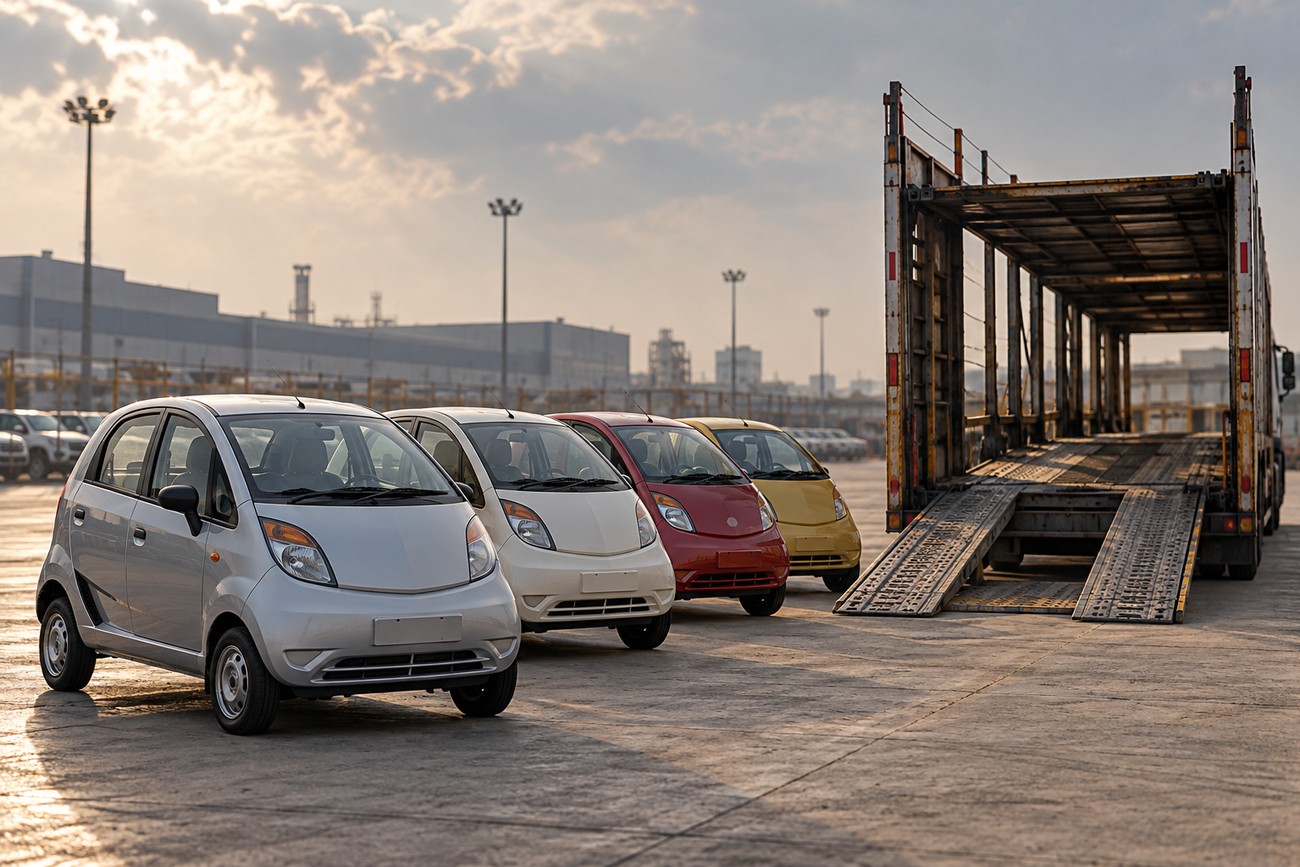
Production was disrupted by the conflict surrounding Tata’s Singur plant. Tata moved manufacturing to Sanand, but the relocation consumed time and made availability uncertain during the period when the Nano needed sustained attention from dealers and buyers. A new product can lose momentum quickly when customers cannot see, order, or receive it with confidence.
By December 2010, approximately 77,000 cars had been sold, far below Tata’s public target of one million cars. The gap exposed a commercial problem, although it does not prove that Indian consumers had rejected small cars as a category. Sales reflected delayed production, changing expectations, limited trust, and the practical difference between an announced price and a finished vehicle available through a dealer.
The launch also lost some of its novelty. Instead of arriving as a smooth demonstration of affordable engineering, the Nano reached the market amid production disruption and public debate. That gave prospective buyers more time to compare it with used cars, motorcycles, and better-equipped small cars, while also making the product appear less certain than its confident original presentation suggested.
Sales figures after the launch should be read carefully. Sources cite different peak-sales measures, including about 74,500 units in financial year 2012 and claims of roughly 9,000 per month. Those figures cannot be directly compared without a common method, but both the disagreement and the broader sales record show that the model never approached the scale required to make its business case work.
The Safety Problem Was Bigger Than a Missing Airbag
Global NCAP tested an Indian Nano in a 64 km/h frontal impact in 2014. The tested car received zero stars for adult and child protection. The result changed the public conversation because it challenged the assumption that a slow, city-focused vehicle could be considered safe simply because it was small and light.
The tested base version lacked airbags and ABS, and rear passengers had static two-point belts. Those omissions were serious, but the assessment went beyond equipment. Global NCAP described the structure as unstable and noted dangerous steering-column movement and intrusion into the passenger compartment.
In practical terms, the test indicated a high risk of severe injuries to the head, neck, and chest in the tested crash. A low vehicle mass and narrow body may assist parking and efficiency, but they leave less room for energy management and passive protection when the structure itself does not remain stable.
The result applied to the Indian specification tested by Global NCAP, not automatically to every export specification. Tata linked some export versions to compliance with European R94 requirements, while Global NCAP documented a failure of the tested Indian version in a comparable frontal-impact context. That distinction is important, but it did not repair the damage to the Nano’s reputation in its home market.
Fires, Reliability Complaints, and the Cost of Extreme Simplification
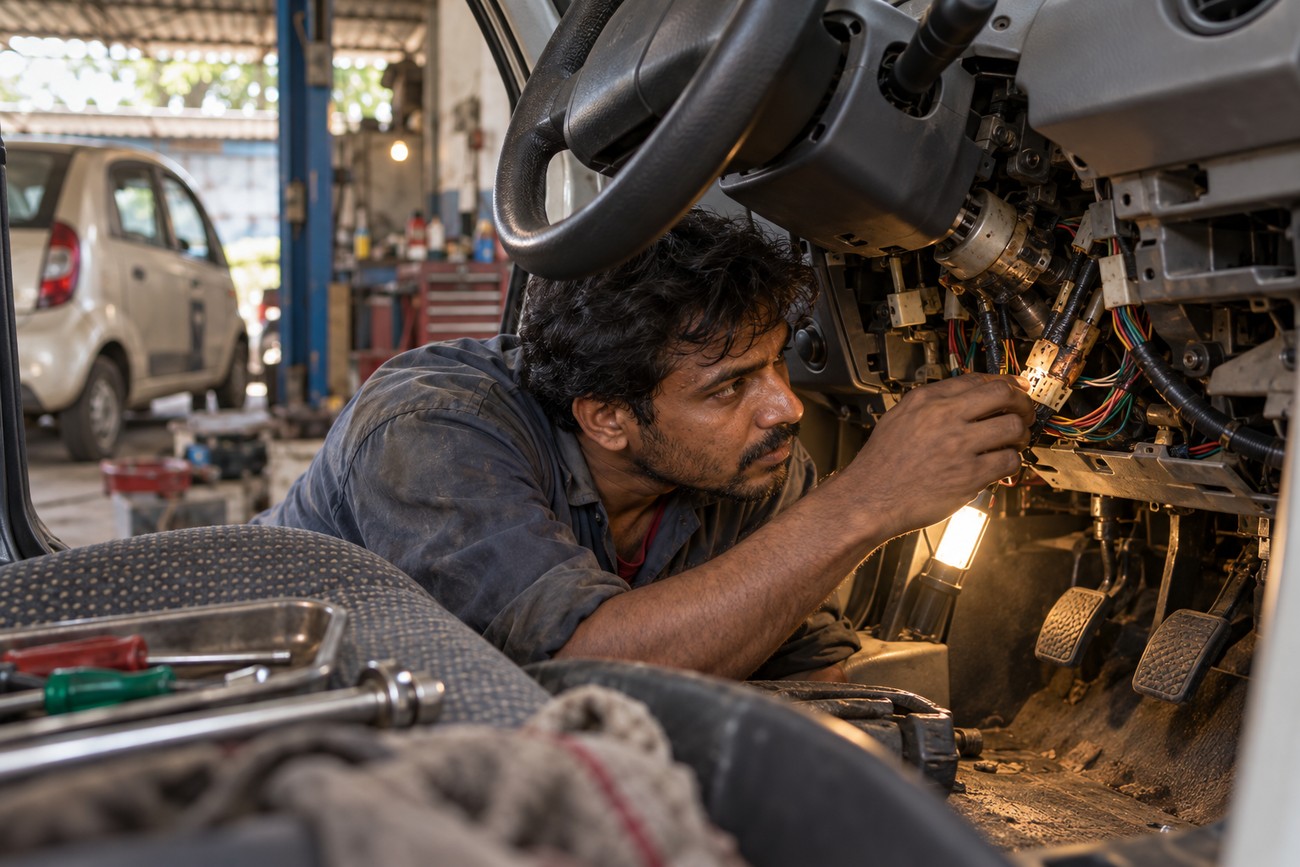
Reports of fires created an additional trust problem. Tata attributed incidents to external electrical equipment or material near the exhaust and offered improvements rather than a full recall. Owners’ reports of smoke, burning smells, and wiring problems produced a much worse market perception, even though such reports should not be treated as a statistical study of the entire fleet.
Other reported complaints included overheating, coolant loss, and water-pump failure. Some owners described smoke or a burning smell near the steering column and reported replacing the wiring harness. A rear-mounted engine also made the service layout different from that of a conventional front-engine car, so cooling-system condition and access to components required particular attention.
The 624 cm³ engine was commonly criticized for weak performance with passengers, on hills, or with the air conditioning running. Noise and vibration added to the impression of a highly stripped-down product. The small front luggage compartment and awkward cargo access reduced usefulness for families, while difficult parts availability later made ownership less predictable.
These complaints did not make every Nano unreliable, but they made the cost of a neglected example harder to estimate. Extreme simplification can reduce the purchase price while increasing the importance of correct maintenance. Once buyers began associating the car with cooling faults, wiring concerns, and limited practicality, even a well-maintained example had to overcome a trust deficit.
Why Buyers Rejected the Idea, Not Just the Car
“The world’s cheapest car” was a powerful media description and an awkward ownership identity. Many buyers moving up from a motorcycle wanted a visible step toward greater security and status. The Nano’s label could instead signal that the buyer had accepted the market’s lowest rung, particularly when the car’s narrow body, basic cabin, and light construction made the cost-cutting easy to see.
The purchase price also represented only the first part of ownership. Fuel, insurance, maintenance, and repairs continued to apply, and replacement parts could become difficult to source. A cheaper car therefore did not automatically produce a lower total cost than a motorcycle, especially for a household that used the vehicle infrequently or faced an unexpected repair.
The Nano was produced in India from 2008 to 2018. Its low mass and narrow dimensions remained useful for crowded streets and tight parking spaces, but they also limited perceived solidity, refinement, and the margin of passive protection. The product could make sense for a specific urban use case, yet its public positioning encouraged people to judge it as a complete family car.
What Used-Car Buyers Commonly Get Wrong About the Nano
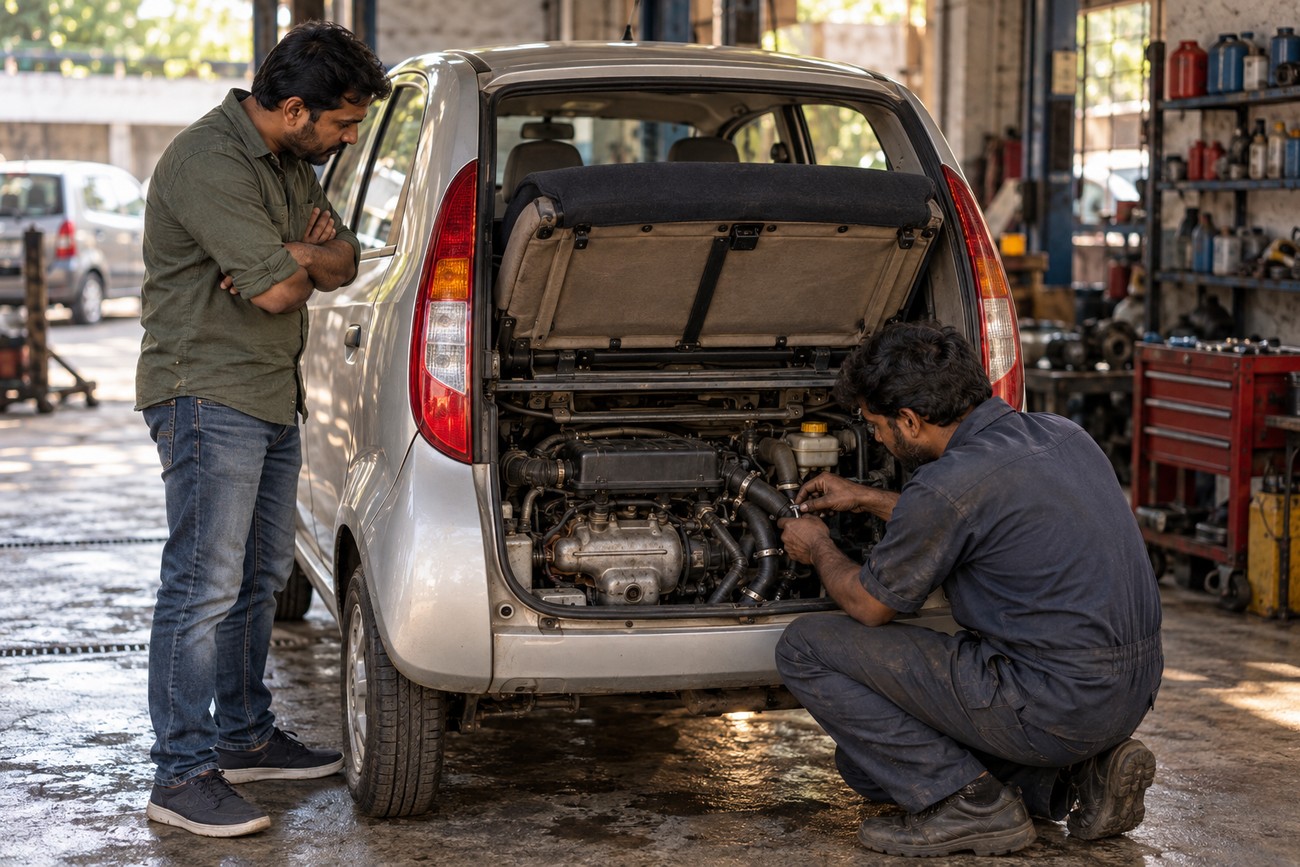
A used Nano should not be assessed as a normal family or highway vehicle. Its suitability depends on urban trips, passenger needs, traffic conditions, and the availability of local service support. A low asking price is a reason to inspect the car more carefully, not evidence that the ownership cost will remain low.
Begin with the cooling system. Check for a history of overheating, coolant leaks, water-pump work, and repeated temperature-related repairs. Then examine the wiring for smoke damage, burning smells, non-factory additions, and evidence that the wiring harness has been replaced. These checks deserve priority because a clean exterior can conceal expensive or safety-relevant electrical and cooling problems.
Verify cooling-system pressure and wiring repairs first, then test the brakes, steering, and underbody condition before judging the price.
Hands-on inspection should cover the brakes, steering, suspension, floor, and underbody for corrosion or damage. A test drive should include hills or a loaded condition where possible, because weak performance with passengers or air conditioning may be more noticeable than during a short, empty-city run. Buyers should also confirm that suitable parts and repair expertise remain available locally.
Resale prospects matter as well. The Nano has weak resale value, and certain parts can be difficult to find. One recent report described a ₹60,000 purchase with a mostly negative experience, but that is one owner account, not statistical evidence about the entire fleet. The correct conclusion is to verify the individual car’s history and support network rather than assume that every Nano is either a bargain or a failure.
Frequently asked questions
The Nano’s history combines a discontinued product, disputed fire explanations, different market specifications, and a later update. These answers separate those issues so that the model is judged on documented evidence rather than on its slogan.
Why was the Tata Nano discontinued rather than banned?
The Tata Nano was discontinued after weak commercial performance and declining demand; it was not generally removed from the market by a government ban. Tata produced the model in India from 2008 to 2018, after which the business case for continued production had weakened substantially.
The zero-star Global NCAP result was serious safety evidence for the tested Indian version, but a poor crash-test rating is not the same as a legal prohibition. A ban would require official regulatory action. The Nano’s end was primarily a market and production decision shaped by sales, reputation, and the cost of sustaining the model.
What did the GenX Nano improve?
The later GenX Nano introduced practical changes, including a revised rear-door design. These updates addressed usability and helped the car remain more relevant in a market that expected greater convenience from small hatchbacks.
They did not quickly erase the earlier reputation damage associated with fires, wiring concerns, and the Indian crash-test result. Incremental equipment and body changes could improve daily use, but they could not make buyers forget the original positioning or treat the updated car as a full correction of every earlier concern.
Was the Tata Nano ever a sensible alternative to a motorcycle?
For some urban users, the Nano offered four seats, weather protection, and easier transport for passengers than a motorcycle. Its compact dimensions also helped in crowded streets and parking spaces. Those advantages could be meaningful for short city trips.
Purchase price alone could not establish lower total ownership cost. Fuel, insurance, maintenance, repairs, and parts availability still mattered, while the car’s limited performance and safety record restricted its suitability for highways or regular family travel. The Nano made sense only when its specific city-use benefits outweighed those continuing costs and limitations.







