
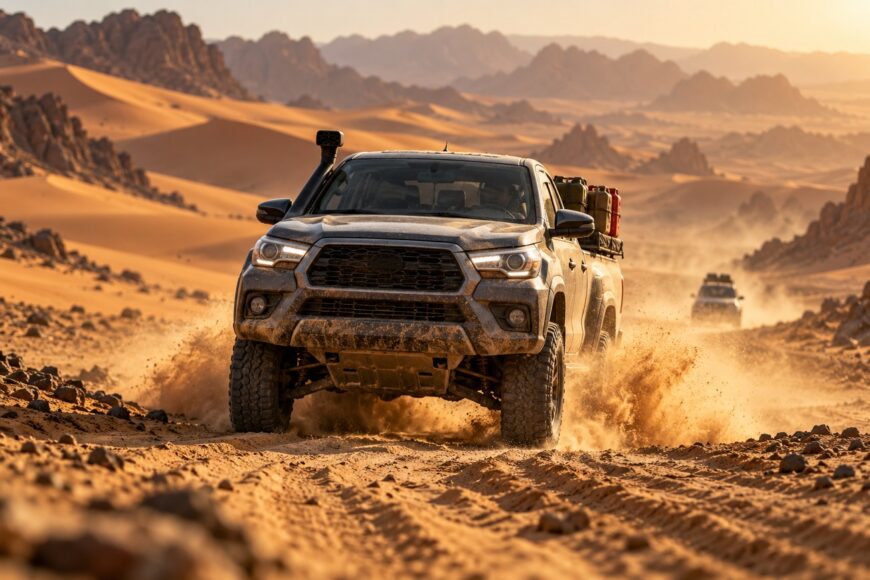
A Toyota Hilux can look surprisingly close to a Dakar vehicle in photographs: four-wheel drive, a tough ladder frame, a diesel engine, and the right silhouette. That visual similarity is misleading. A road-going Hilux and a purpose-built Dakar Hilux share a badge and a broad concept, while their suspension, wheels, geometry, cooling, structure, and operating limits belong to different engineering categories.
Taking a Hilux onto a Dakar-style route therefore depends on more than peak horsepower. You must balance speed against reliability, fuel range, navigation accuracy, heat control, consumable life, and compliance with the relevant class and event rules. The useful question is not whether the truck can cross sand once, but whether it can repeat high-load stages without exhausting its crew or breaking the parts that keep it moving.
- The Dakar Route Is Not a Normal Desert Road Trip
- Stock Hilux vs Dakar Hilux: Same Badge, Different Machine
- What to Change Before Driving at Dakar Pace
- Fuel, Payload, Tyres and the Consumables Trap
- Navigation, Roadbook and Marathon-Stage Discipline
- Choosing the Right Hilux Concept for the Route
- Frequently asked questions
- What is the best car for a Dakar rally?
- Why is the Toyota Hilux not allowed in America?
- What is the price of a Toyota Hilux Dakar Rally?
- Which is faster, a Hilux or a Tacoma?
The Dakar Route Is Not a Normal Desert Road Trip
The Dakar route combines public roads, rough tracks, and high-speed special stages. It is not always run on fully closed roads, so route legality, road awareness, and disciplined transitions matter alongside off-road ability. A recreational desert trip can tolerate a slow recovery, a detour, or a damaged shock absorber; a rally stage turns each problem into lost time, workload, and often further mechanical damage.
Dakar automobiles are admitted up to 3,500 kg, with the automobile classes including T1, T2, and Open. T2 is associated with production-based SUVs, while T1 covers modified SUVs. That classification is more than paperwork: it determines what kind of vehicle you are building, which modifications may be relevant, and how far a production Hilux has moved from its original specification.
Clearance helps a vehicle pass over a ridge or a buried rut, but sustained speed produces different loads. Heat accumulates in the engine bay, transmission, brakes, wheel hubs, and dampers. Repeated impacts also expose weaknesses that may never appear during low-speed rock crawling, especially when the vehicle carries fuel, water, tools, spare wheels, and recovery equipment.
A stock pickup crossing a dune is therefore a poor test of Dakar suitability. The meaningful test is repeated operation over changing surfaces while maintaining control, cooling, fuel discipline, and legal road behavior. A truck that survives one spectacular section may still be badly matched to the full route.
Stock Hilux vs Dakar Hilux: Same Badge, Different Machine
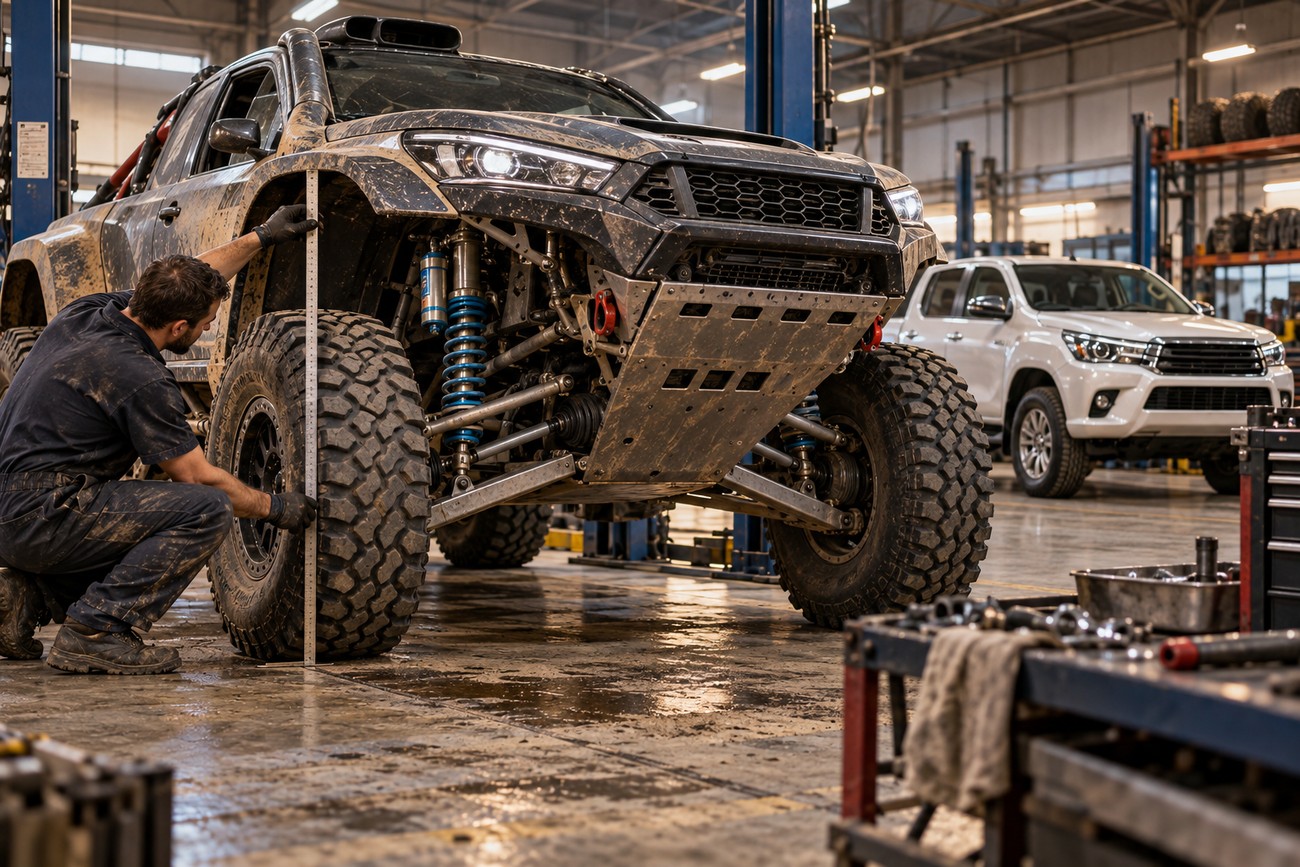
A commonly specified production Hilux uses a 2.4-litre diesel producing 150 hp and 400 Nm, with 4WD, 215 mm of ground clearance, an 80-litre fuel tank, and payload of about 500 kg. Those figures describe a practical road and work pickup. They do not describe a race truck with the suspension capacity, wheel size, and thermal margin needed for sustained rally speed.
The modern Dakar Hilux uses a 3.5-litre twin-turbo V6. It is about 2.3 m wide, runs 37-inch wheels, and has up to 350 mm of suspension travel. The larger-diameter tires improve obstacle rollover and can help with compliance, while long travel helps keep the tires in contact with uneven ground. Width also contributes to stability, although it creates different clearance and transport considerations on narrow tracks and public roads.
The key distinction is control rather than a single headline number. A production Hilux with 215 mm of clearance can pass through sand and rough tracks, yet it does not have the same ability to absorb repeated high-speed impacts. Suspension travel, damper control, bump-stop behavior, hub strength, braking capacity, and cooling determine whether speed can be used repeatedly.
Recent publications about a 2026 Hilux claim 204 hp with 48V Hybrid, 310 mm of clearance, a 29-degree approach angle, and a 24-degree departure angle. These are claimed recent-production figures and should not be merged with the Dakar truck’s race specifications. A newer road model may improve off-road geometry while remaining a road vehicle with different service, safety, and competition constraints.
The badge also does not decide the class. A production-oriented Hilux may be closer in spirit to a T2 approach, while a heavily rebuilt truck belongs to a different engineering and regulatory discussion. Before buying parts, establish the intended event, class, technical regulations, and support plan; otherwise, a capable build can become expensive without becoming eligible or reliable.
What to Change Before Driving at Dakar Pace
A stock Hilux is not ready for Dakar-level use without substantial preparation. The first priorities are suspension control, underbody protection, cooling, hubs, brakes, and the durability of the shock absorbers and mounting points. More engine power is useful only after the chassis can transmit it over rough ground without overheating or losing control.
Suspension work should address travel, damping, spring rates, bump control, and the way the loaded truck behaves through corrugations and whoops. Raising the body alone does not create the control of long-travel suspension. The production reference has 215 mm of ground clearance, while the Dakar Hilux has up to 350 mm of suspension travel; those measurements describe different aspects of a vehicle and should not be treated as interchangeable.
Catalogue parts rarely reveal how a loaded pickup behaves after repeated impacts. Sand and grader testing expose heat buildup, bottoming, steering instability, and mounting fatigue before those faults appear on a long stage.
Protection should cover the parts most likely to stop the vehicle: the underside, cooling system, fuel system, suspension hardware, and vulnerable electrical components. Cooling capacity needs validation under sustained load, because a truck can have a healthy engine and still fail through heat in the transmission, brakes, hubs, or dampers.
Build validation must happen in sand and on a grader, with the intended load and realistic tire pressures. A catalog build can look impressive while producing excessive rear movement, harsh bottoming, or poor service access. Testing should determine what to remove, reinforce, or redesign before power upgrades consume the remaining budget and payload.
Fuel, Payload, Tyres and the Consumables Trap
The commonly specified production Hilux has an 80-litre fuel tank. That may be workable for road travel, yet long desert stages require route-specific calculations for distance, surface, speed, temperature, tire pressure, and reserve. Water, tools, recovery equipment, spare wheels, and protective hardware add weight, so fuel planning cannot be separated from payload planning.
Payload of about 500 kg can disappear quickly once the truck is equipped for remote work. Extra mass in the bed loads the rear axle and changes how the leaf-sprung rear end reacts on corrugations, ruts, and sand. Drivers often describe a lightly prepared pickup as nervous at speed over a wave or in a tracked section; an overloaded bed can make that behavior harder to control.
Rear-axle load and tire life should be calculated together. Spare wheels, water, and tools alter the contact loads and suspension response, while aggressive tires may consume their useful margin faster under that same weight.
Tire selection is a compromise between puncture resistance, grip, heat, wear, pressure management, and stage distance. An aggressive tread may improve traction on one surface while increasing rolling stress or shortening service life elsewhere. Pressure changes must be deliberate, because the wrong pressure can damage a tire, overheat it, or make the vehicle unstable.
Consumables disappear faster than beginners expect. Tires, brakes, shock absorbers, and suspension components receive repeated impacts and heat cycles, while a damaged wheel or damper can affect the next section even if the engine remains healthy. Carrying spares is useful only when the crew has the time, tools, and rule-compliant opportunity to use them.
Navigation, Roadbook and Marathon-Stage Discipline
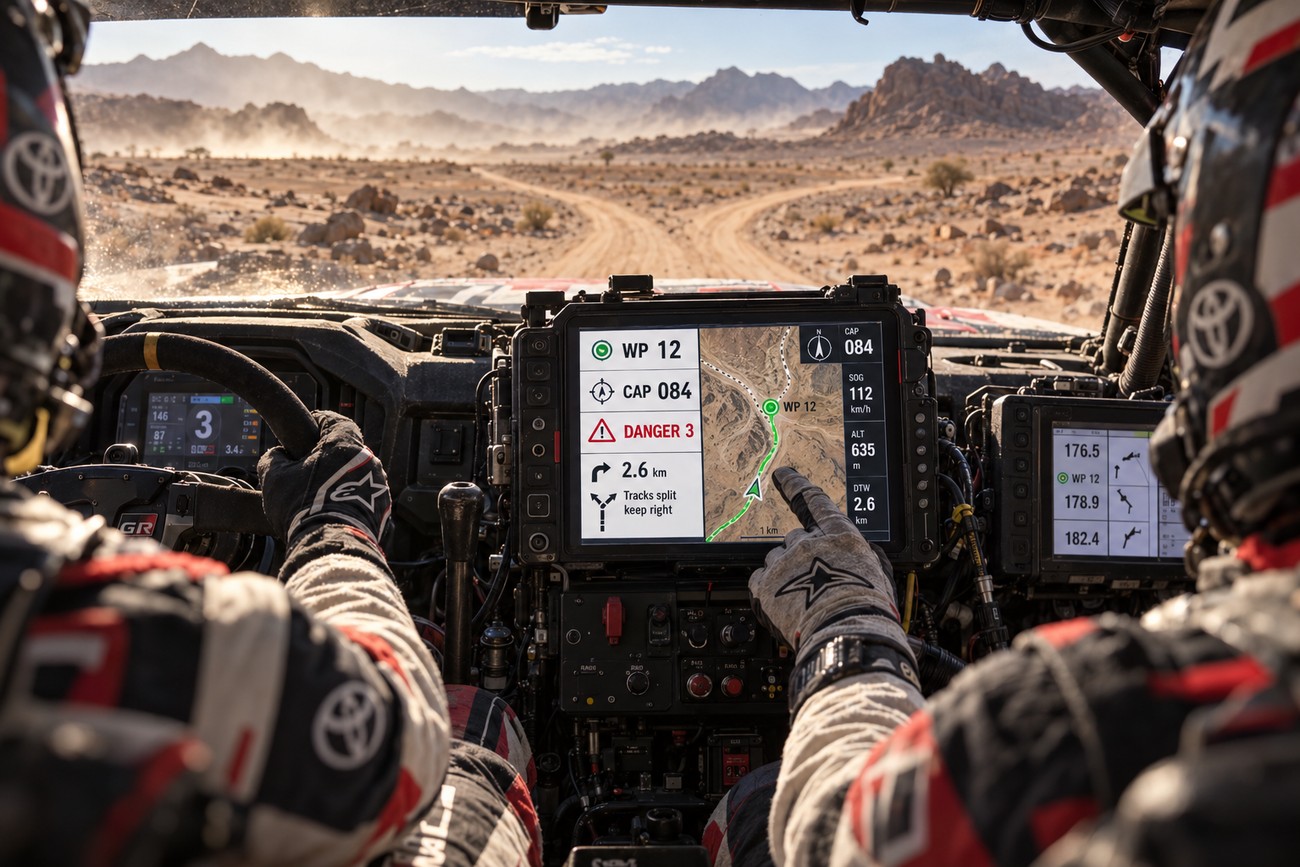
Dakar navigation uses electronic roadbooks, GPS, and organizer tracking. Crews receive daily navigation information and remain under organizer control, so the navigator’s work is a continuous operating task rather than a backup for a driver who already knows the terrain.
A small speed deficit on a straight section can be recovered through steady driving. A roadbook error can send the crew onto the wrong track, create a missed waypoint, or force a difficult correction. That loss can exceed what would have been surrendered by driving more conservatively over a rough section.
Marathon-stage restrictions make wheel planning especially important. Under the stated restriction, tires cannot be changed, including by exchanging wheels between crews. A service plan based on ordinary recreational off-roading—where a damaged tire is simply replaced at the next stop—may therefore be unavailable when the vehicle needs it most.
Navigation discipline is a performance system. The crew must protect the roadbook equipment, confirm instructions, manage speed against visibility, and keep the truck within its mechanical limits. Power and clearance cannot compensate for a missed instruction, poor communication, or a tire strategy that ignores the rules.
Choosing the Right Hilux Concept for the Route
These categories describe working concepts, not automatic homologation. The event regulations, the actual vehicle specification, and the technical inspection determine eligibility.
| Hilux concept | Intended use | Suspension and wheels | Fuel and service planning | Navigation exposure | Main compromise |
|---|---|---|---|---|---|
| Production-oriented Hilux | Road travel, work, and recreational desert use | Production suspension and wheels; 215 mm clearance reference | 80-litre tank; payload of about 500 kg must cover people and equipment | Suitable for guided or independently planned routes, with lower competition integration | Lower speed and durability margin on repeated rough stages |
| T2-style production-based build | Competition using a production-based SUV concept | Strengthened and carefully tuned suspension, with tire and protection choices constrained by regulations | Route calculations, spares, cooling checks, and disciplined service planning | Electronic roadbook, GPS, and tracking become central crew systems | Retains more production character while accepting less freedom than a full race build |
| T1-style modified race build | High-speed rally competition with a heavily modified vehicle | Dakar Hilux reference: 37-inch wheels and up to 350 mm suspension travel | Race-specific fuel, cooling, spares, and service support; greater technical workload | Full competition navigation and organizer control | High complexity, cost, maintenance demand, and limited road-car practicality |
The race reference also uses a 3.5-litre twin-turbo V6 and a body about 2.3 m wide, which shows how materially a T1-style Hilux differs from the 2.4-litre production truck. Choose the concept around route, regulations, support, and crew capacity rather than trying to make one pickup perform every role.
Frequently asked questions
The answer to each question depends on whether the comparison concerns a road vehicle, a class-compliant competition build, or a purpose-built race truck.
What is the best car for a Dakar rally?
There is no universal best car. The sound choice is the vehicle that fits the intended class, has reliable suspension and cooling, can be supported with parts and crew, and matches the navigator’s and driver’s skill.
A production-based build may offer simpler servicing and stronger familiarity, while a modified race build can carry more speed at a much higher engineering and support cost. Route surface, event rules, fuel strategy, spare parts, and crew discipline matter as much as the badge on the body.
Why is the Toyota Hilux not allowed in America?
Limited Hilux availability in the United States is primarily a market and vehicle-compliance issue. It does not show that the Hilux is banned from Dakar or inherently unsuitable for competition.
A vehicle can be unavailable as a new road model in one market while remaining available elsewhere or appearing in motorsport in a substantially modified form. Road certification and rally eligibility are separate questions.
What is the price of a Toyota Hilux Dakar Rally?
A race-built Hilux has no single normal retail price. The cost depends on the build specification, class requirements, chassis and suspension work, spare parts, testing, transport, and ongoing support.
The race truck should therefore be treated as a competition program rather than a trim level. Two vehicles carrying the same badge may have completely different levels of preparation and support, so a road-car price cannot establish the cost of a Dakar-ready package.
Which is faster, a Hilux or a Tacoma?
The comparison cannot be answered fairly without separating stock road vehicles from Dakar-specification builds, drivetrain versions, and terrain. A road Hilux compared with a road Tacoma is one question; a Dakar Hilux compared with a modified off-road truck is another.
Acceleration is also only one part of rally performance. Suspension control, cooling, tire management, navigation, fuel range, and the ability to complete the stage can matter more than a short straight-line comparison.







