
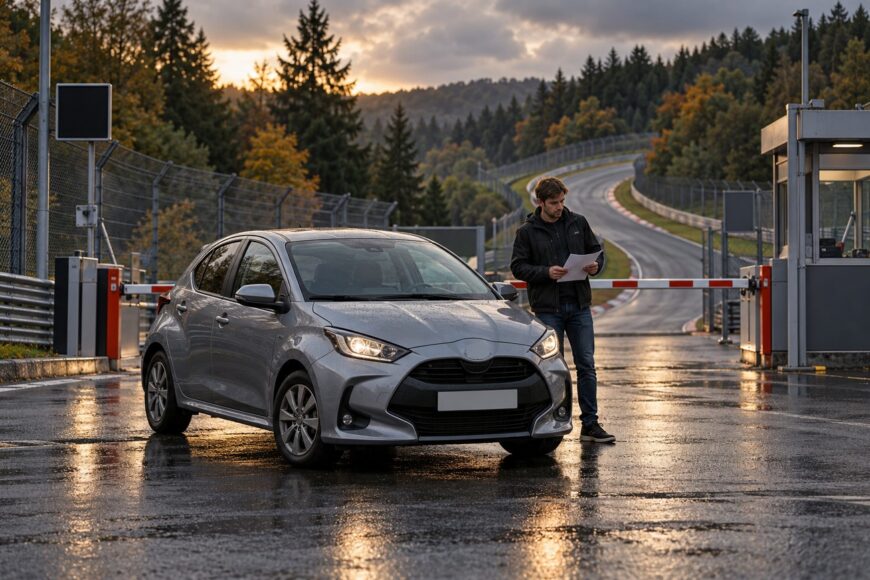
Taking an ordinary Toyota Yaris onto the Nürburgring Nordschleife can be an appealing way to see the circuit without hiring a specialized sports car. A small hatchback is easier to place on the road, and its modest performance can keep your attention on visibility, braking points, and the unfamiliar layout.
The central complication is that two separate permissions apply. Tourist Drives may admit a road-legal Yaris that meets the circuit’s requirements, while the rental agreement may prohibit Nürburgring or circuit use and exclude related insurance cover. Before approaching the entrance, decide whether the particular car, contract, and insurance terms all allow the drive.
- Can a rental Toyota Yaris enter the Nordschleife?
- The rental contract decides whether you can drive
- What a mistake could cost beyond the Yaris
- Check the particular Yaris, not just the badge
- Drive by road rules, even with faster cars behind
- Make the first lap a learning lap
- Frequently asked questions
- How much does a Nürburgring tourist lap cost?
- How much does it cost to rent a Yaris for the Nürburgring?
- What should I do immediately after an incident?
Can a rental Toyota Yaris enter the Nordschleife?
A rental Toyota Yaris can enter only if the particular vehicle meets the Nordschleife’s entry conditions. It must be road-registered, comply with German StVZO requirements, and have its registration documents. A foreign-registered car also requires proof of valid insurance. The circuit may check the vehicle before entry, so a car with an obvious defect or unsuitable condition can be refused.
There is also a performance threshold. Vehicles technically incapable of exceeding 130 km/h are not admitted to Tourist Drives, but the Yaris badge alone does not establish whether a particular car qualifies. Generations, engines, equipment, and technical condition vary. Check the exact vehicle rather than assuming that every version has identical capability.
Tourist Drives follow the German StVO and applicable posted restrictions, flags, and instructions. This is a public-road traffic environment, not a private race session: overtaking is on the left, and overtaking on the right is prohibited. The Nordschleife’s full flying lap measures 20.832 km, but that figure should not be treated as a guaranteed distance for every Tourist Drive entry or lap procedure.
The rental contract decides whether you can drive
The circuit’s acceptance of a compliant car does not override the rental agreement. Read the exact contract and booking conditions for references to Nürburgring, Nordschleife, circuit use, racing, competition, or use on restricted roads. Check the insurance exclusions separately, because permission to take the car there and insurance cover for doing so are different questions.
An ordinary airport rental may be road-legal and accepted at the gate while still prohibiting circuit use. If the agreement excludes the Nordschleife, entering may place the renter outside the policy’s normal protections and expose them to contractual charges. Do not rely on a company’s general reputation or on the fact that another customer has driven a similar car there.
Written permission to enter the Nordschleife in a specific rental vehicle does not by itself confirm insurance cover; obtain both permissions in clear, applicable terms.
Specialist suppliers may offer cars prepared or approved for track use, but the booking still needs careful checking. Confirm the permitted circuit, included cover, excess, exclusions, mileage, and any required deposit. A fixed fine or blacklisting should not be assumed as a universal consequence; any sanction must be verified in the particular contract.
What a mistake could cost beyond the Yaris
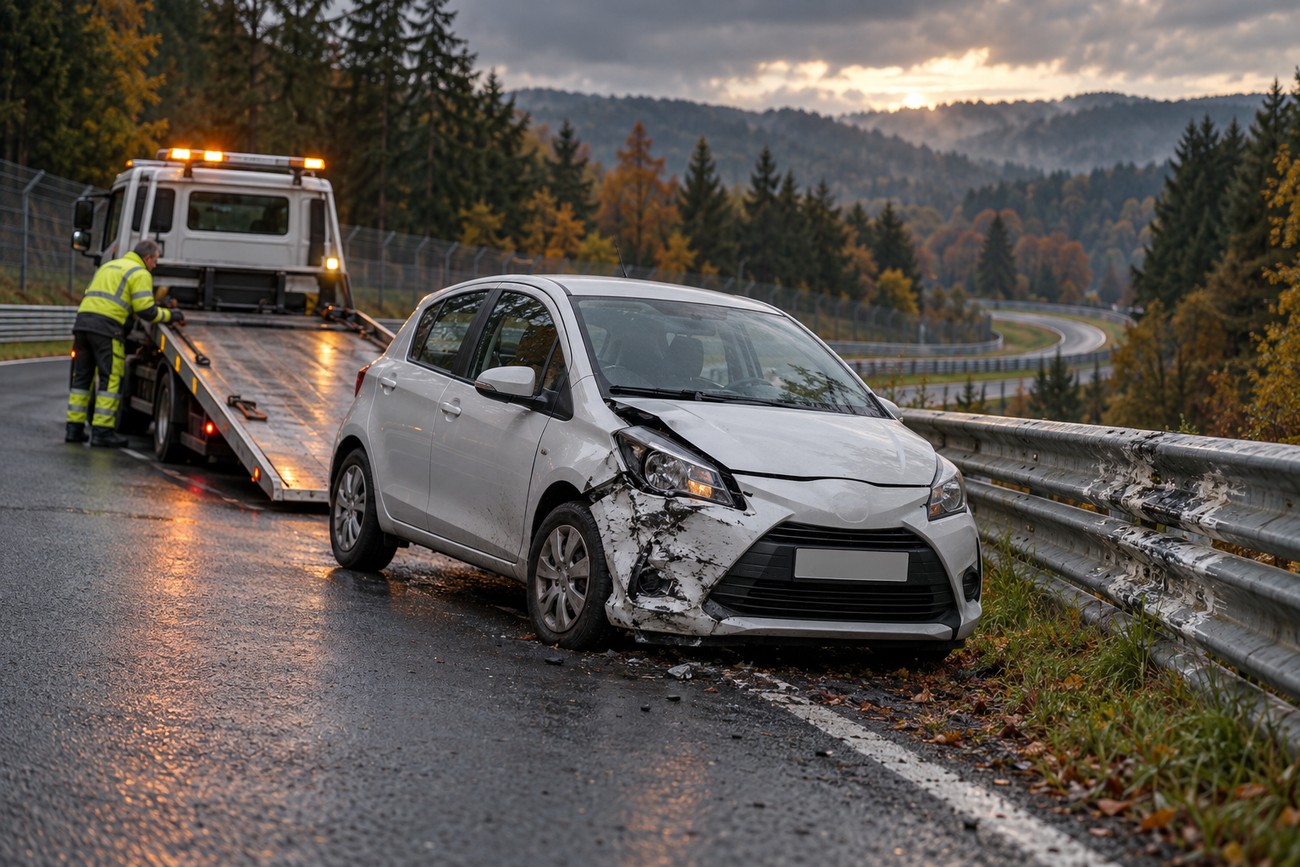
The financial exposure after an incident can extend beyond visible damage to the rental car. Depending on the circumstances and applicable terms, costs may include vehicle repair, recovery, damaged barriers, other infrastructure repairs, track repairs, and interruption-related charges. A car that looks drivable after contact may still need recovery or inspection.
Specialist rentals sometimes quote an excess of around €2,500, but that is an example reported for some specialist hires, not a standard Nürburgring charge. The amount, scope, and exclusions depend on the agreement. A quoted excess may also sit alongside costs that the policy excludes altogether, so read the liability section rather than focusing only on the headline figure.
Another driver’s apparent fault does not automatically make the renter’s policy respond. Responsibility may be disputed, and the rental contract may exclude circuit use regardless of who caused the contact. Follow the incident procedure required by the circuit, rental company, and insurer, and keep the relevant documents and policy details available.
Check the particular Yaris, not just the badge
Inspect the car before entering. Check the tires for damage and adequate condition, confirm that there are no warning lights, and look over the brakes, fluids, and bodywork. Do not invent a special tire pressure setting; use the vehicle or rental company’s stated guidance. Remove loose items from the cabin and trunk, since they can move under heavy braking or cornering.
A Yaris designed for city driving does not have the same margin as a track-prepared rental. Road tires, standard brakes, electronic assistance, and a taller ride height may all be appropriate for ordinary travel while offering limited tolerance for repeated hard use. The model name does not establish braking endurance or handling behavior.
Carry your driving license, the vehicle registration documents, and, for a foreign-registered car, proof of valid insurance. The vehicle must continue to meet StVZO requirements, and staff may reject an unsuitable or defective car. A clean dashboard and a recent rental handover do not replace this check.
Drive by road rules, even with faster cars behind
Tourist Drives follow the StVO: overtake on the left, never on the right, and obey applicable posted restrictions. Use the mirrors regularly, hold a predictable line, and let faster traffic pass only when this can happen within the rules and without a sudden or unsafe move. A faster car behind you does not authorize crossing the road or creating a new hazard.
There is no single general speed limit across Tourist Drives. Posted limits, StVO requirements, flags, closures, and instructions remain binding. A yellow-flag section or other control can require a substantial reduction in speed, and the appropriate response is to slow down and remain alert rather than continue at the pace used on a clear section.
The racing-session mindset causes avoidable errors. Treat blind rises, compression, and changing grip as road hazards, not invitations to attack curbs or brake later. Do not try to match a faster car, defend a position, or turn a Yaris into a competition vehicle. Predictability and a clear view matter more than carrying speed.
Keep both hands available, leave room for mistakes, and expect the track environment to change quickly. A closure, repair area, or flag condition can turn a familiar-looking section into a controlled low-speed zone. The correct pace is the one that leaves enough margin for what you can actually see.
Make the first lap a learning lap
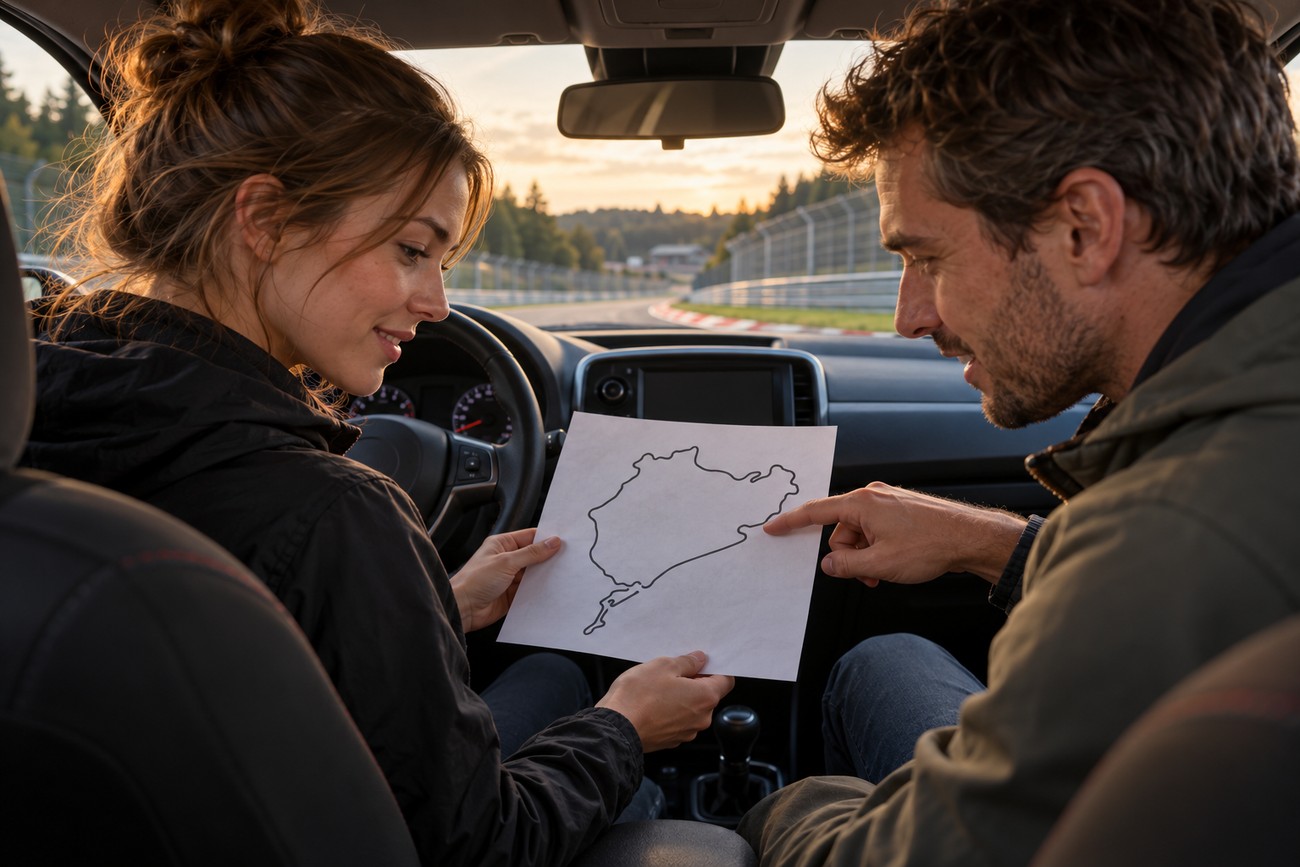
Check the published opening hours and current conditions before leaving for the circuit. Tourist Drives generally need no advance lap booking: drivers buy laps and enter during published opening hours. A specialist rental, however, may require its own reservation, collection time, and document checks.
Learn the flag meanings, entry arrangements, and exit procedure before joining the circuit. If possible, choose dry conditions, since rain changes braking distances and grip on a long, unfamiliar road. Focus on sightlines, surface changes, and conservative braking points instead of trying to remember a racing line.
One dry-weather familiarization lap without passengers is a cautious recommendation, not an entry requirement. Leaving passengers behind reduces distraction and avoids adding another person to an already demanding first run. If the car feels unsettled, the weather changes, or traffic becomes stressful, reduce the pace and use the appropriate exit rather than pressing on.
The practical decision should be made before the entrance. If the rental agreement does not expressly allow Nürburgring use and the applicable insurance terms are unclear, leave that Yaris off the circuit. A suitable specialist rental with written conditions is safer than relying on the assumption that circuit admission also protects the renter.
Frequently asked questions
These answers cover the main costs, contract issues, and safety steps involved in a Tourist Drive. Check current circuit information and the exact rental and insurance terms before driving.
The circuit tariff covers the lap itself, while the rental agreement determines whether the car may be used there. After an incident, follow the instructions of the circuit, rental company, and insurer.
How much does a Nürburgring tourist lap cost?
Check the circuit’s current Tourist Drives tariff for the date you plan to drive and the payment method accepted. Prices and operating arrangements can change, so an undated figure from an old guide or forum is not a reliable budget.
Also allow for costs beyond the lap itself, such as travel to the circuit, fuel, and any required rental arrangements. The tariff confirms the circuit charge; it does not confirm insurance cover or permission under a rental contract.
How much does it cost to rent a Yaris for the Nürburgring?
Request a like-for-like quotation from a supplier that expressly offers the Yaris for circuit use. Compare the hire period, included laps, deposit, excess, mileage allowance, and fuel terms, and confirm which damage and recovery costs are excluded.
Do not compare only the daily rental price. A road-car booking may be cheaper while prohibiting the Nordschleife, whereas a specialist booking may include different conditions and a substantial excess.
What should I do immediately after an incident?
Follow marshals’ directions and avoid creating another hazard. Move or stop only as instructed, remain alert to approaching traffic, and record relevant details when it is safe, including the location, vehicles involved, and available contact information.
Notify the rental company and insurer promptly using the required procedure. Keep any incident reference, photographs, and recovery information, and do not assume that another driver’s apparent fault settles the rental claim or establishes cover.







