
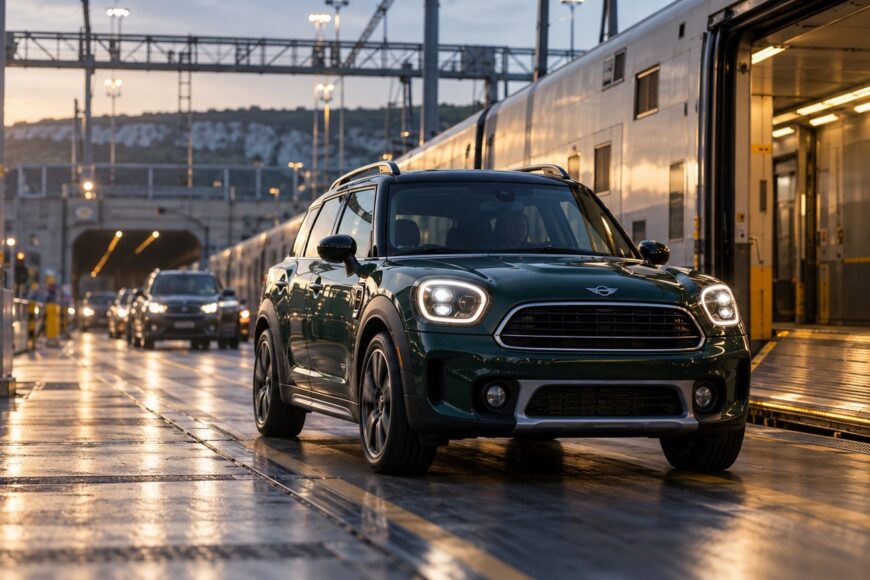
Eurotunnel Le Shuttle carries cars and their occupants through the Channel Tunnel between Folkestone, UK, and Calais, France, in either direction. It is a vehicle shuttle, not a conventional passenger train, so you do not book a passenger seat and leave the Mini Countryman in a separate car park. The practical challenge is arriving with the correct vehicle category, valid travel documents, and enough time for the booked check-in.
An unmodified Mini Countryman usually fits the standard passenger-car use case. That expectation changes if you add a roof box, roof rails, a bicycle carrier, unusually tall luggage, or other equipment. The vehicle presented at the terminal is what matters, and its actual dimensions may affect the applicable category or conditions.
Most avoidable problems happen before the train itself: an incorrect vehicle selection, a late arrival, or documents that were left until the terminal. A short preparation check makes the journey more predictable, especially during busy travel periods.
- What taking a Mini Countryman on Le Shuttle actually involves
- Check the Countryman’s real height before you book
- Book the right vehicle category and arrive for the right slot
- Documents, fuel, and special equipment: what can stop the trip
- From terminal arrival to unloading: what the journey feels like
- Common Countryman mistakes and a low-stress preparation plan
- Frequently asked questions
- How much does it cost to take a Mini Countryman on Le Shuttle?
- How many cars fit on a Le Shuttle train?
- How much does it cost to take a car on the Eurotunnel?
- How many cars fit on the LeShuttle Eurotunnel?
What taking a Mini Countryman on Le Shuttle actually involves
Le Shuttle is designed to move vehicles through the Channel Tunnel. You drive to the terminal, complete the required checks, follow the assigned lanes, and board with the Countryman. The route links Folkestone and Calais, with the same basic process in the reverse direction.
This service is different from Eurostar. Eurostar is a separate passenger service and is not a substitute for transporting your Mini Countryman. If you need the car at your destination, you need a vehicle booking with Le Shuttle rather than a passenger ticket on a conventional train.
A normal, unmodified Countryman is generally treated as a standard passenger car for this type of journey. That is a useful starting point, though it is not an unconditional guarantee of acceptance in every setup. The vehicle category depends on the car and equipment actually presented at check-in.
At the terminal, expect a sequence of approach roads, document and booking checks, queues, and lane assignment. The process can feel more involved than the tunnel crossing itself, particularly on a first trip. Once loaded, passengers generally remain with the vehicle as instructed during loading and unloading, rather than moving to a separate passenger carriage.
Check the Countryman’s real height before you book
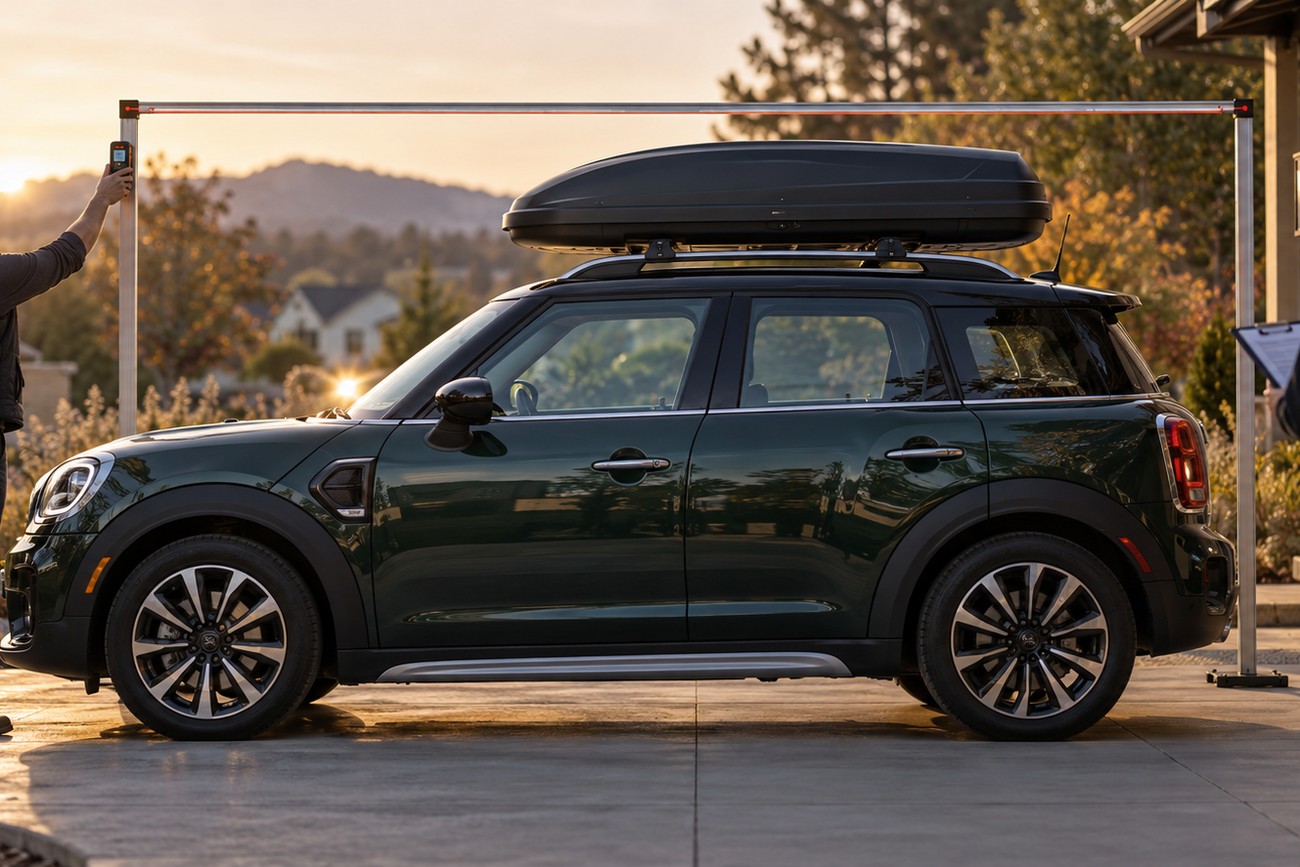
The most important measurement is the height of the Countryman as it will travel on that day. Check the fully equipped vehicle, including roof rails, a roof box, antennas, loaded luggage, and any equipment that affects its height. Check rear-mounted equipment separately for its effect on the vehicle’s dimensions and classification. The model name alone does not establish the correct vehicle category.
This distinction matters because a standard Countryman can change its relevant dimensions after accessories are fitted. A roof box may add substantial height even when the vehicle underneath remains completely standard. A bicycle carrier or tall load can also affect the conditions attached to the booking, so it should be included in the assessment rather than treated as separate from the car.
Marketing language may describe the Countryman as a standard car, while the official rules can depend on actual height, dimensions, and modifications. These descriptions are not necessarily contradictory: one is a simplified vehicle label, while the other is an assessment of the vehicle you bring to the terminal.
Before paying, compare your complete setup with the current Le Shuttle booking rules. If the roof box, rails, bicycle equipment, or another modification makes the category uncertain, confirm the correct option through the operator’s current guidance. Keep a record of the equipment included in the booking, since removing or adding it later may change the vehicle presented.
Book the right vehicle category and arrive for the right slot
Le Shuttle bookings are made by vehicle category. Price and availability depend on the travel date, departure time, and vehicle classification, so select the category that matches the actual Countryman setup rather than relying only on the basic model description. Enter or declare relevant equipment accurately during the booking process.
Keep the booking confirmation accessible, including the reference and booked check-in information. The service is slot-based, rather than an arrive-whenever ferry experience. Last-minute flexibility is limited, and a low advertised fare may apply only to particular dates, times, and vehicle conditions.
Plan the journey to allow for approach-road traffic as well as terminal processing. You may need time for document checks, booking verification, queues, and lane assignment before boarding. A schedule that allows only the nominal driving time to the terminal can become fragile during peak periods.
The booked check-in time matters. Late arrival may lead to loss of the slot or additional charges, depending on the applicable conditions. Reaching the terminal early enough to absorb road delays is usually safer than assuming staff can place an incorrectly timed or incorrectly classified vehicle on the next departure.
Documents, fuel, and special equipment: what can stop the trip

A Le Shuttle reservation does not replace border and immigration requirements. Every traveler needs a valid passport and the documents required for entry into the destination country. Check these requirements for the direction of travel and for each person in the vehicle before leaving home.
Make sure the names and travel details connected with the booking are correct, and keep essential documents available rather than buried in luggage. Depending on your circumstances and destination, additional permissions or supporting documents may be required. A booking confirmation alone is not proof that you can enter the UK or the Schengen area.
Vehicle restrictions also deserve a separate check. Review the current rules for fuel, LPG equipment, EV-related arrangements, traction batteries, and heavily modified vehicles. The relevant requirements can differ from those for an ordinary petrol or diesel Countryman, and an unusual installation should be clarified before the booking is finalized.
Children and pets may have separate conditions and documentation requirements. This is especially important for pet travel, where entry rules and transport procedures may involve more than simply adding an animal to a car reservation. Confirm the requirements for the destination and the selected service before the travel day.
Do not assume that a familiar vehicle is automatically acceptable in every configuration. A Countryman with a non-standard fuel system, special battery arrangement, or substantial modification may need a different assessment. Checking the current operator rules before departure is more reliable than trying to resolve an uncertainty at the terminal.
From terminal arrival to unloading: what the journey feels like
Approach the correct terminal and follow the signs for Le Shuttle. Keep the booking reference and travel documents ready, then follow the marked lanes rather than selecting a lane based on appearance. At busy times, traffic management may involve several stages before you reach the main check-in point.
At check-in, staff may verify the booking, the vehicle details, and the documents needed for the journey. Follow the instructions shown on the terminal signs and given by staff. After the relevant checks, you are directed toward the appropriate waiting area or loading lane.
Boarding takes place with the Countryman. Passengers generally remain with the vehicle during loading and unloading as instructed, and there is no separate passenger carriage to find. The crossing is designed as a short vehicle transit through the Channel Tunnel, so the main task is to remain in the correct place and follow the onboard instructions.
Prepare before entering the loading area. Keep passports, booking details, medication, drinks, and other essential items accessible in the cabin. Once the vehicle is positioned, searching through luggage can be awkward, and there is little practical benefit in opening the boot for items you could have placed within reach beforehand.
After arrival, wait for the unloading instructions and leave the shuttle through the assigned route. The same attention to signs and lanes applies on the destination side, where border or customs procedures may still form part of the onward journey. The tunnel transit is only one stage of crossing an international border.
Common Countryman mistakes and a low-stress preparation plan
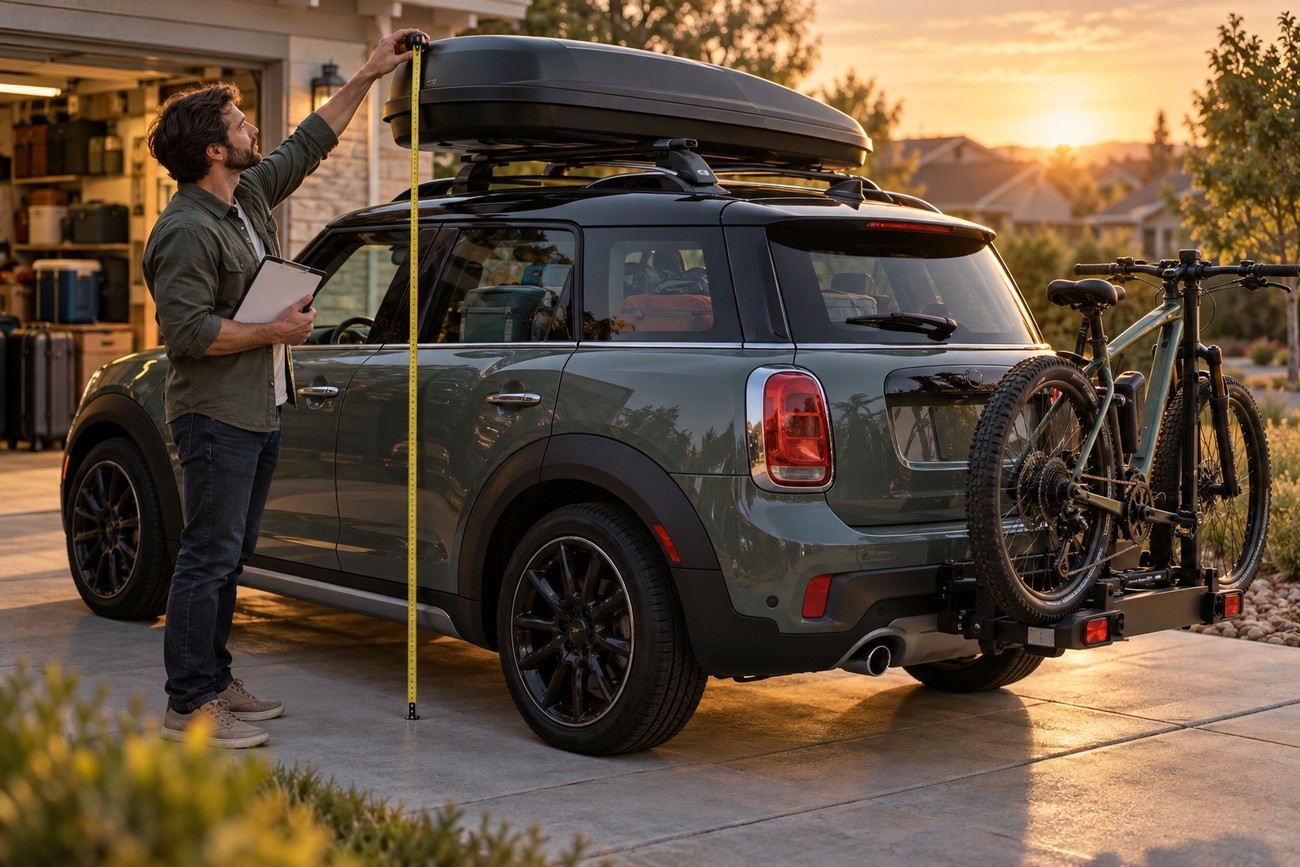
The commonest error is checking the brochure dimensions of the base Countryman while ignoring the vehicle’s travel-day setup. Measure or verify the height with roof rails, the roof box, antennas, loaded luggage, and any mounted equipment in place. If a bicycle carrier or other accessory is fitted, include it in the category check.
A second mistake is choosing the standard-car option automatically because the vehicle badge looks familiar. An unmodified Countryman usually fits the standard passenger-car use case, but modifications and accessories can affect classification. An incorrect category can create questions, delays, or additional cost at check-in, and staff should not be treated as a guaranteed solution to an inaccurate booking.
Late arrival creates a separate risk. Build a buffer for approach traffic, document checks, queues, and lane assignment, particularly during peak periods. The booking is tied to a check-in slot, so turning up whenever convenient is less realistic than it may be with a flexible ferry journey.
Use this short preparation sequence:
- On the day before travel, confirm the date, direction, check-in time, booking reference, and vehicle category.
- Check the Countryman in its complete travel configuration, including roof equipment, luggage, and modifications.
- Review current rules for fuel, LPG equipment, EV-related arrangements, traction batteries, and unusual vehicle features.
- Confirm passports, entry documents, and any separate requirements for children or pets.
- Before loading, place essential items in the cabin and keep the documents ready for terminal checks.
- Leave enough time for the approach road and terminal process, rather than planning only around the driving distance.
This preparation also reduces a less obvious source of stress: uncertainty about where to go next. Following the signs, keeping the confirmation available, and accepting the assigned lane removes much of the guesswork from the first journey.
Frequently asked questions
How much does it cost to take a Mini Countryman on Le Shuttle?
There is no single standard fare for taking a Mini Countryman on Le Shuttle. The live quote changes with the travel date, departure time, and vehicle category, so an advertised low price should not be treated as the price for a specific journey.
An unmodified Countryman will usually be considered within the standard passenger-car use case, while a roof box or other equipment may affect the relevant classification. Select the category for the vehicle as it will travel, then use the live quote for the exact date and time.
How many cars fit on a Le Shuttle train?
The number of cars varies with the shuttle configuration and loading plan. There is no single capacity figure that applies universally to every departure, so a busy service should not be used to judge whether an incorrectly booked vehicle will be accepted.
Availability is handled through the booking system for the selected departure and vehicle category. The practical concern for a Countryman owner is therefore an accurate booking and timely check-in, rather than calculating a fixed number of cars.
How much does it cost to take a car on the Eurotunnel?
The live Le Shuttle fare depends on the date, departure time, and vehicle classification. A Mini Countryman is normally booked as a standard passenger car when unmodified, but the price shown for a particular journey must come from the current quote.
“Eurotunnel” is commonly used for the crossing, while the vehicle service is Eurotunnel Le Shuttle, also styled LeShuttle. Eurostar is a separate passenger service and does not provide the same car-transport booking.
How many cars fit on the LeShuttle Eurotunnel?
LeShuttle capacity varies according to the shuttle’s configuration and loading plan. Because of that variation, a universal car count cannot be used to predict availability for a particular departure.
Vehicle acceptance still depends on the booking, the vehicle category, and the car presented at check-in. A Countryman with roof equipment or other modifications should be classified correctly in advance, regardless of how much space appears to remain on a departure.







