
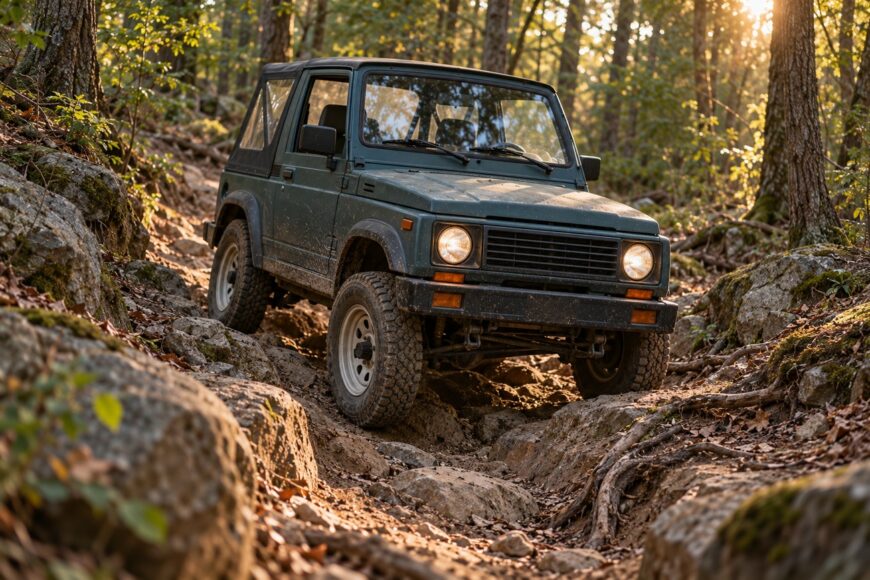
The Suzuki Samurai can squeeze through a narrow trail that stops a larger 4×4. Its rollover reputation, however, follows it onto every paved road. For a buyer or driver, the useful question is whether that reputation predicts how a particular Samurai will behave, especially after decades of wear or modification.
The argument began with a 1988 emergency-maneuver test and never settled into a simple verdict. The test raised a serious concern; the dispute that followed did not make the concern disappear. Understanding the vehicle means separating that documented episode from everyday handling, crash risk, and the condition of the example in front of you.
- A tiny 4×4 built for trails, not highway pace
- How the 1988 rollover claim took hold
- What the evidence does—and does not—prove
- Why it can feel unsettled on the road
- Off-road strengths and the limits of a side slope
- Buying or modifying one without making it worse
- Frequently asked questions
- What was the legal issue in the Suzuki Samurai lawsuit?
- Was there a Chevrolet version of the Suzuki Samurai?
- What paperwork matters when buying a modified Samurai?
A tiny 4×4 built for trails, not highway pace
The Samurai is a compact, body-on-frame 4×4 with part-time four-wheel drive, low range, and solid front and rear axles. Equipment and dimensions vary by market and year, but its light weight and narrow body are central to its character. They let it fit between obstacles and ask relatively little of the ground beneath its tires.
Low range gives the small engine useful control at trail speeds. Short overhangs and compact proportions help when approaching a rut or crest, while the axles keep the layout mechanically straightforward. Those are practical advantages on a tight route, where a wider, heavier vehicle may struggle simply to find a line.
The same proportions carry compromises onto pavement. A narrow, relatively tall vehicle has less of the planted feel drivers expect from a modern passenger car, and a short wheelbase can make its responses seem busy. Light weight helps off-road; it does not make sudden highway steering inputs harmless.
It is best judged against the job it was built to do. On a slow trail, placement and traction matter more than relaxed cruising. On a long, fast journey, noise, limited power, and the need for steady corrections become much harder to ignore.
How the 1988 rollover claim took hold
In 1988, Consumer Reports rated the Samurai “Not Acceptable” after an emergency-maneuver test raised rollover concerns. The finding gained wide attention because it attached a stark safety judgment to an affordable, small 4×4. For many people, that rating became the vehicle’s defining fact.
Suzuki disputed the publication, and the conflict led to prolonged litigation. The publicity damaged the Samurai’s standing in the US market, while the dispute kept the test in public view long after the original review. That history explains why a discussion of its handling can quickly become an argument about the publisher.
An emergency maneuver is intended to expose behavior that ordinary, gentle driving may never reveal. It also depends on test conditions and driver inputs, so disagreement over how results were produced and described matters. Such disagreement does not, by itself, erase what the testers observed.
Nor does one dramatic test describe every later drive in an aging Samurai. Tires, steering condition, load, and modifications can change how an individual vehicle responds. The 1988 rating is important evidence of a concern, rather than a substitute for assessing the vehicle and the situation.
What the evidence does—and does not—prove
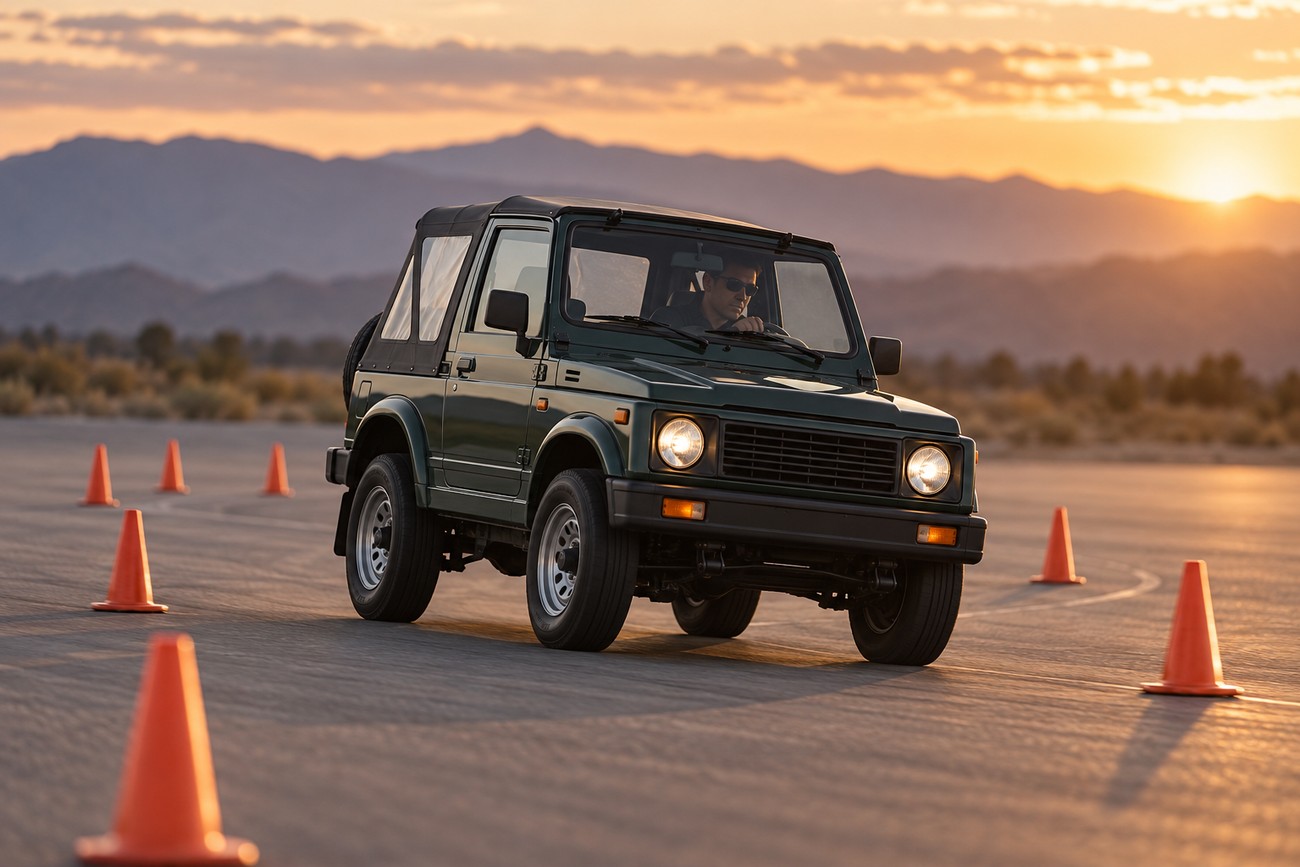
A vehicle leaning or lifting in an emergency test, a regulator identifying a safety defect, and a measured real-world crash rate are different kinds of evidence. Each answers a different question. Treating any one of them as a complete verdict makes the Samurai sound either more dangerous or more secure than the evidence supports.
Later NHTSA scrutiny did not result in a finding that the Samurai was inherently defective for rollover risk. Equally, the absence of such a finding would not certify it as rollover-proof. Regulatory decisions have a particular scope; they do not remove the effects of a narrow stance, abrupt inputs, or poor maintenance.
Claims that the Samurai had uniquely high crash rates compared with similar period 4x4s need reliable, like-for-like figures. Those claims are not established here. Driver use, terrain, vehicle condition, and the vehicles chosen for comparison would all matter before a meaningful ranking could be made.
Figures sometimes quoted for later Jimny models do not fill that gap. A later vehicle with different engineering is not a statistical stand-in for the Samurai. For a prospective owner, the defensible conclusion is narrower: take rollover risk seriously, without turning an old headline into a probability for a specific vehicle.
Why it can feel unsettled on the road
The Samurai’s narrow, relatively tall, short-wheelbase layout rewards smooth steering and measured speed. Body roll can make a quick direction change feel more dramatic than it would in a lower passenger car. If a driver responds with another sharp correction, the ride can feel less settled still.
Owners report wandering in ruts, sensitivity to wind, and noise or nervousness at higher speeds. Those accounts are useful descriptions of the driving experience, not measured rollover probabilities. A well-sorted Samurai can still feel old-fashioned on a highway without being on the verge of tipping over.
Condition can sharpen the difference. Play in steering components, tired dampers, or unsuitable tires may delay or muddy the response to an input. Before accepting vague steering as a fixed trait of the model, check the hardware that locates the wheels and controls their movement.
Loading matters as much as the driver’s hands. Roof cargo puts weight high above the axles, while a heavy rear accessory changes how the vehicle carries its mass. Keep loads modest and secure, reduce speed for bends and rough surfaces, and leave room to steer or brake progressively.
Off-road strengths and the limits of a side slope
The Samurai’s trail reputation has a mechanical basis. Low range, low weight, compact dimensions, and useful approach and departure geometry let it work through places that challenge larger vehicles. Its body-on-frame construction and solid axles also make sense in a vehicle intended for rough ground.
Small size is especially valuable where the safest route is a narrow one. A driver can often avoid an obstacle rather than climb over it, reducing the need for speed or violent steering. That ability makes the Samurai a capable off-roader, though capability should not be confused with an unlimited margin for error.
A side slope introduces a different problem from a steep climb: the vehicle’s weight is already acting across its narrow stance. A rut, a sliding tire, or a load shifting inside the cabin can change the situation abruptly. There is no universal safe side-slope angle that accounts for ground conditions and vehicle setup.
Slow travel helps the driver read the surface, but it does not make a rollover harmless. Avoid sharp steering or braking while the vehicle is leaning, and choose a less exposed line when one is available. Trail skill includes deciding that an obstacle is a poor place to test the limit.
Buying or modifying one without making it worse
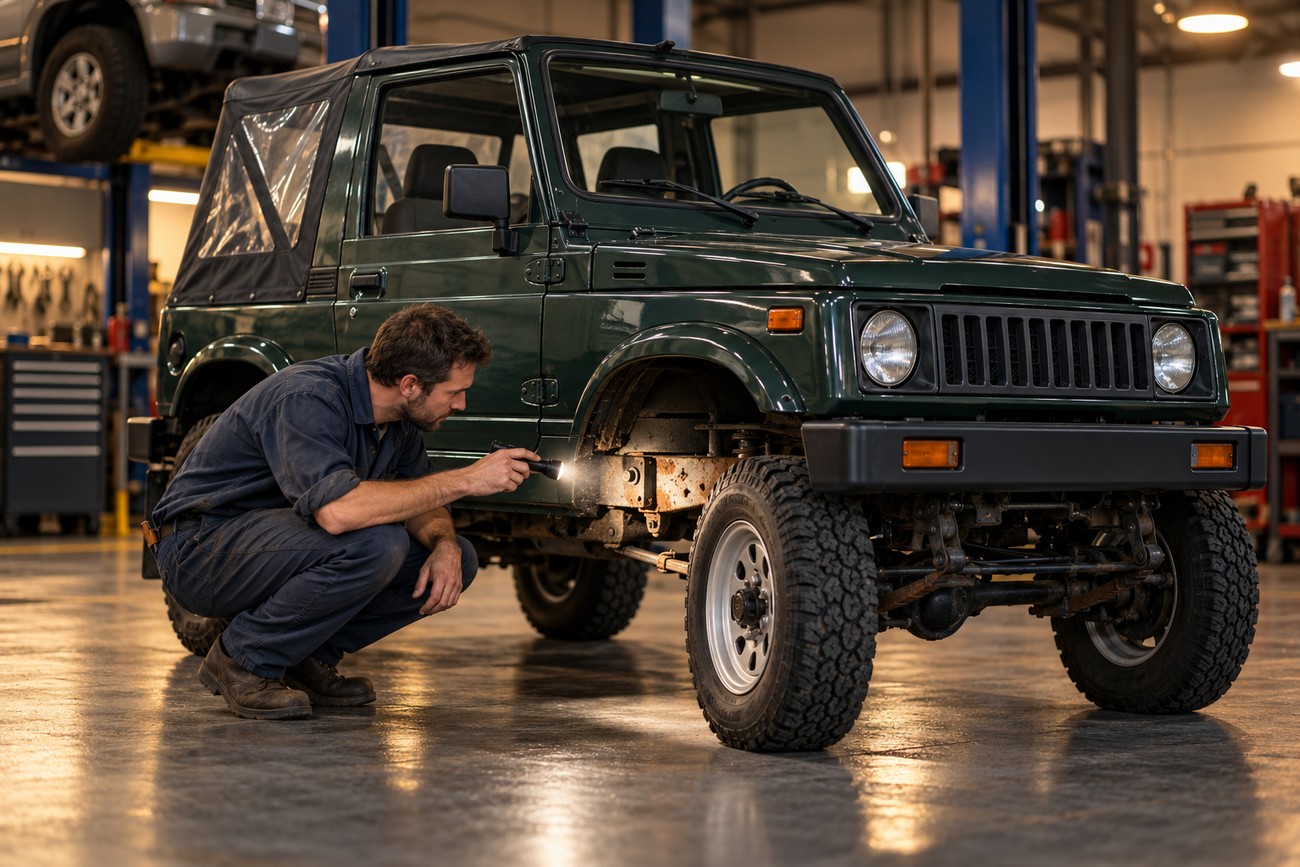
Start with the structure. Inspect the frame and body for hidden corrosion, particularly around mounting points and repaired areas, rather than trusting paint and an attractive exterior. Also look for signs of a previous rollover or major impact; a vehicle that no longer sits square may be difficult to put right.
Next, assess steering play, suspension wear, tire condition, and how the vehicle tracks on a careful test drive. A stock-height, well-maintained example provides a more useful baseline than a heavily altered one. If it feels nervous, identify the cause before assuming that all Samurais behave the same way.
Lifts, oversize tires, and added high-mounted weight can make handling less predictable, particularly when parts have been combined without regard to steering and suspension geometry. Ask what was changed and how it was installed. A dramatic stance offers little benefit if the vehicle no longer drives consistently between trails.
Finally, distinguish rollover prevention from occupant protection. A soft-top hoop should not be assumed to be a protective cage, and an aftermarket cage is no guarantee of safety if its design, mounting, or surrounding structure is inadequate. Seat and belt mounts deserve the same scrutiny as visible metalwork.
Frequently asked questions
The Samurai’s name and history vary across markets, which can complicate a search for parts or a used vehicle. Legal coverage can also be mistaken for an official engineering verdict. These distinctions are worth checking before relying on a listing, an old headline, or a seller’s description.
What was the legal issue in the Suzuki Samurai lawsuit?
Suzuki challenged Consumer Reports over its test methods and the way its 1988 findings characterized the Samurai. The dispute concerned the publication and its claims; it was separate from an official safety-defect determination. The litigation lasted for years, but its existence alone proves neither that every Samurai was unsafe nor that the test concern was baseless.
Was there a Chevrolet version of the Suzuki Samurai?
Yes. Chevrolet-badge Samurai models were sold in some markets, so a Chevrolet badge does not automatically indicate a different underlying vehicle. Check the market and model details before ordering parts. The Chevrolet Tracker is a different Suzuki-derived vehicle and should not be treated as another name for the Samurai.
What paperwork matters when buying a modified Samurai?
Seek records for structural repairs, suspension lifts, wheel and tire changes, and any cage installation. They can help establish what was done and give an inspector a starting point for checking the workmanship. Also confirm whether your location requires certification, inspection, or registration updates for those changes; paperwork complements a physical inspection rather than replacing one.







