
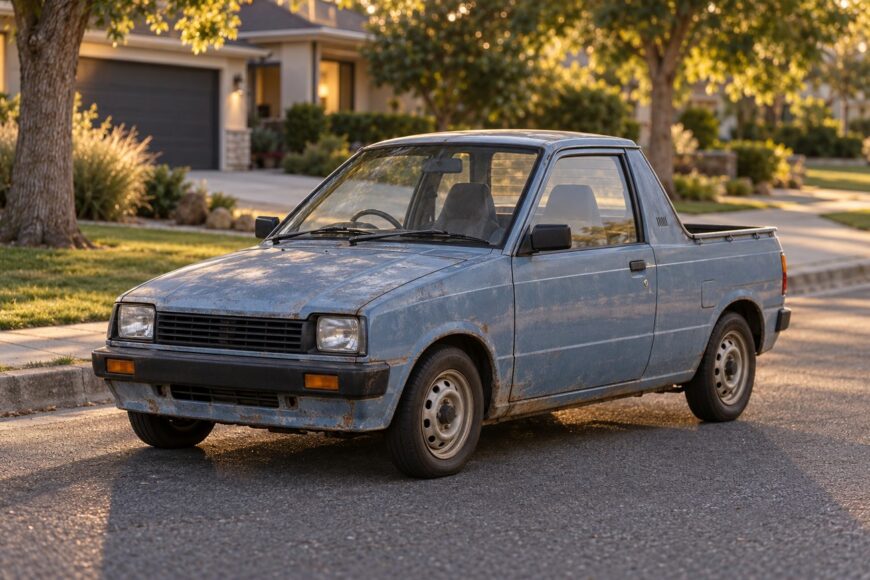
The Suzuki Mighty Boy looks like a small coupe whose rear bodywork has been opened into a pickup bed. That unusual shape gives it an appeal few kei vehicles share: it is compact enough for tight streets, yet offers space for modest, weather-tolerant loads. Its proportions also make clear that the bed is small, and the car was never a substitute for a conventional truck.
Charm alone is a poor basis for buying one. The stock engine has limited power, the open bed leaves vulnerable bodywork exposed to water, and model-specific parts can be difficult to find. A sound Mighty Boy can be an engaging small classic, but its condition matters far more than a tidy paint job or an easy start.
- What makes the Mighty Boy a kei coupe pickup?
- Suzuki Mighty Boy specifications at a glance
- What is it like to drive and use?
- Rust and repairs: where ownership gets expensive
- A buyer’s inspection that goes beyond a test start
- Specifications and claims worth questioning
- Frequently asked questions
- What is the price of a Suzuki Mighty Boy?
- Can I import and register a Suzuki Mighty Boy where I live?
- What fuel should I put in a Suzuki Mighty Boy?
What makes the Mighty Boy a kei coupe pickup?
The Suzuki Mighty Boy SS40T was produced from 1983 to 1988 as a front-wheel-drive kei coupe pickup. Its passenger-car-like cabin and short, open cargo bed explain the name more accurately than “kei truck.” That distinction matters when you assess how it drives, what it can carry, and which parts it needs.
Early cars measure approximately 3,195–3,200 mm long and 1,395–1,400 mm wide, depending on specification. Those dimensions fit the kei limits of the period: 3.2 m in length, 1.4 m in width, and 550 cc in engine capacity. The tiny footprint helps in narrow parking spaces, while leaving little room for cargo or occupants.
The Mighty Boy drives its front wheels, unlike a conventional rear-wheel-drive kei truck. Its layout affects how it behaves with weight in the bed and where a mechanic should look when inspecting the drivetrain. Treating it as a miniature version of a larger pickup can lead to unrealistic expectations about hauling.
Later kei rules permit 3.4 m of length, 1.48 m of width, and 660 cc; the 660 cc limit arrived in 1990, after Mighty Boy production ended. Those later figures should not be used to describe an original SS40T. They are especially misleading in listings that confuse a stock car with one that has received an engine swap.
Suzuki Mighty Boy specifications at a glance
These figures identify the original SS40T, with variations noted where the available specifications differ. Check an individual car’s documents and components before relying on a listing.
| Specification | Reported value | Essential qualification |
|---|---|---|
| Layout | Front-wheel-drive kei coupe pickup | Produced from 1983 to 1988 |
| Stock engine | Naturally aspirated, carbureted SOHC F5A three-cylinder gasoline engine, 543 cc | Neither a stock 660 cc nor a turbocharged engine |
| Reported output | 28 PS at 6,000 rpm and 40 Nm at 4,000 rpm | Early specification; do not apply to every version |
| Other reported power figure | 19.2 kW, approximately 26 PS | Separate 1987 card; check year, market, and measurement method |
| Transmissions | Four-speed or five-speed manual; two-speed automatic | Confirm the gearbox fitted to the car |
| Approximate early-car dimensions | 3,195–3,200 × 1,395–1,400 × 1,290–1,370 mm | Length × width × height; varies by specification |
| Approximate early-car weight | 530–550 kg | Verify the basis of any weight quoted for a particular vehicle |
| Wheelbase | 2,150 mm | Relevant to its response to uneven roads and loading |
What is it like to drive and use?
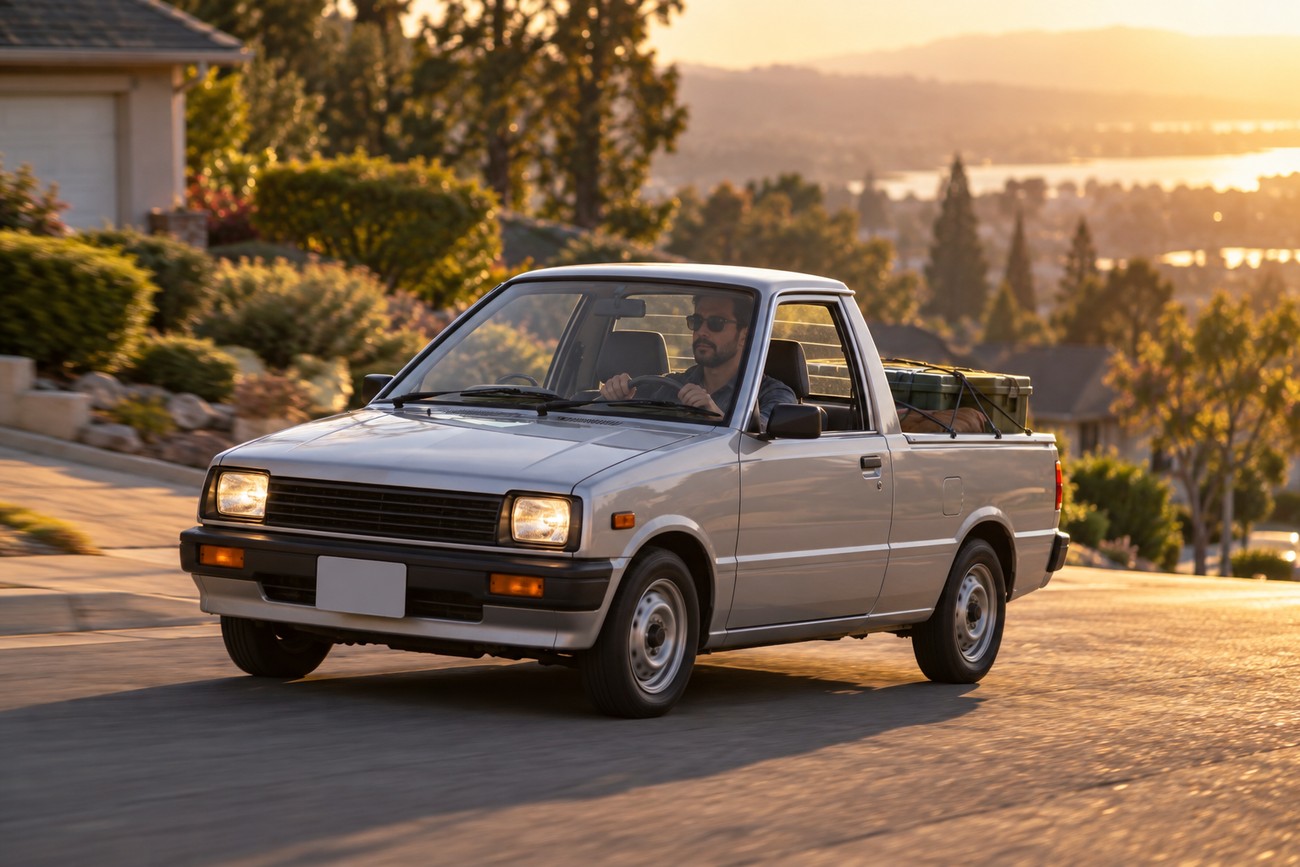
The stock, naturally aspirated 543 cc F5A suits gentle use better than demanding schedules. Hills, headwinds, and a loaded bed make its modest output apparent, so a driver should allow time to build speed. Comparisons with later turbocharged or 660 cc kei cars give a misleading impression of what an original Mighty Boy can do.
The four- and five-speed manuals let the driver choose a gear that keeps the small engine working comfortably. The available two-speed automatic has fewer ratios with which to respond to a climb or a change in load, and can make the car feel more strained. Gearbox choice is therefore a practical consideration, rather than a minor specification detail.
A 2,150 mm wheelbase helps the Mighty Boy turn and place easily in tight spaces, but uneven roads can feel busy. Weight in the short bed also deserves care: it can change how this light, front-wheel-drive car feels, particularly on rough surfaces. There is no established universal payload figure for the SS40T, and a modern kei-class 350 kg figure should not be assigned to it without vehicle-specific evidence.
Its small size also deserves perspective on safety. The Mighty Boy was built to 1980s standards and lacks the crash protection and assistance systems expected in modern cars. Sensible use means respecting its limited performance and treating its pickup body as a means of carrying modest loads, rather than an invitation to work it like a full-size hauler.
Rust and repairs: where ownership gets expensive
Structural corrosion is the central ownership risk. Inspect the floor, sills, suspension mounting points, and body around the cargo bed before judging a car by its exterior panels. Damage in these areas can affect the integrity of the vehicle and make repairs far more involved than surface rust suggests.
The open bed adds a route for water to reach the rear bodywork. Worn seals, trapped moisture, and old repairs can allow corrosion to progress out of sight, even when the visible bed looks presentable. Fresh coating underneath should prompt a close inspection of what it covers, rather than automatic reassurance.
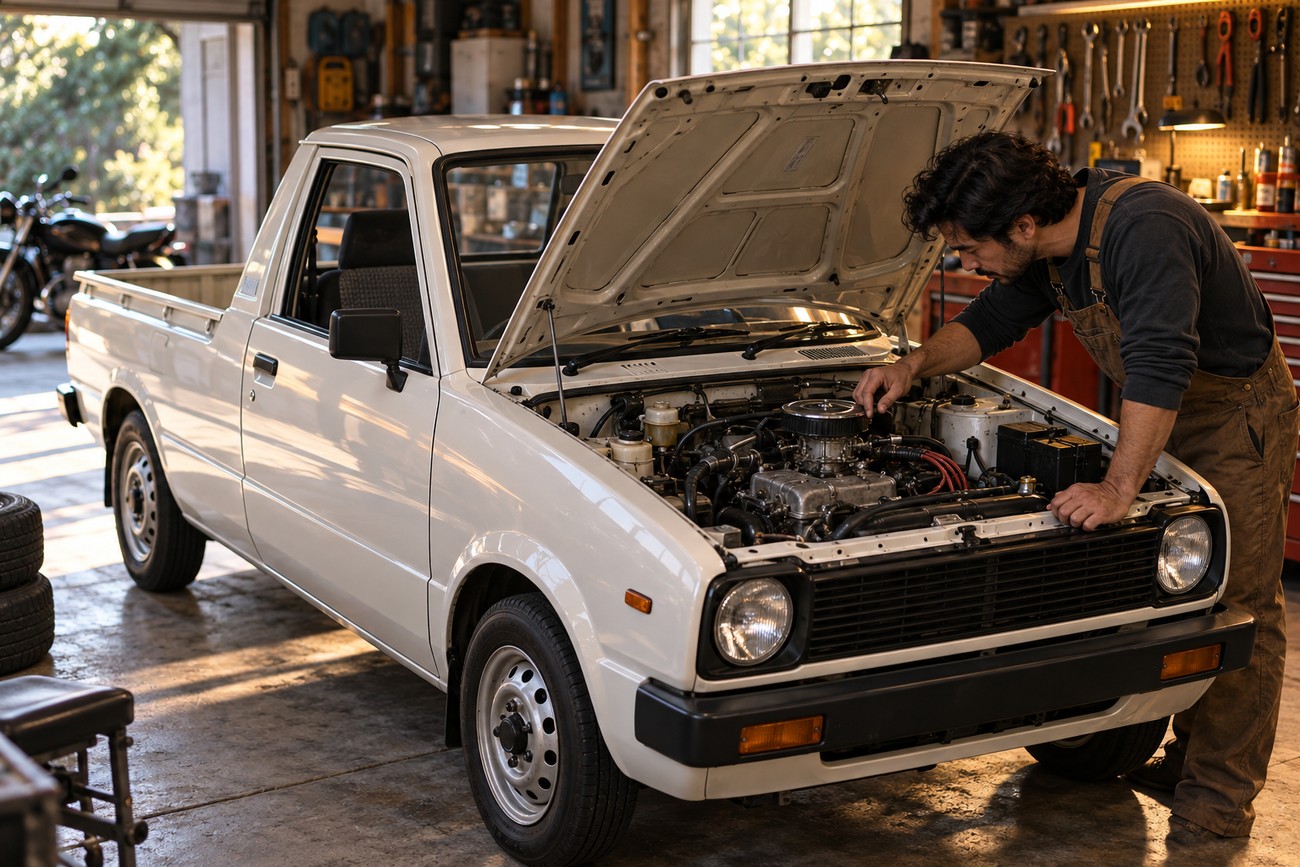
Past welding is worth examining for quality and extent. An engine swap, non-original carburetor, or altered wiring can also complicate diagnosis and change which replacement parts fit. Modifications are not necessarily a reason to walk away, but undocumented work adds uncertainty to a restoration budget.
Routine engine consumables may be easier to obtain than model-specific body panels, interior pieces, seals, and certain transmission parts. That imbalance makes a complete, structurally sound car particularly valuable: replacing a missing trim piece may take more effort than servicing the F5A. Specialist SS40T manuals and owner communities can help identify suitable parts, though compatibility still needs checking.
A small shell does not guarantee a small restoration bill. Fabricating sound repairs around suspension mounts or the bed takes work, while scarce replacement pieces can delay progress. Compare the cost and availability of what a car needs before treating a cheap-looking project as a bargain.
A buyer’s inspection that goes beyond a test start
Start with the car on a lift, before its paint and cabin influence the decision. Examine the underside, floor, sills, suspension mounts, and cargo-bed area for corrosion, patches, and distorted metal. If access to the underside is refused, a brief test start cannot compensate for the structural uncertainty.
Next, establish what has been repaired or replaced. Look for inconsistent welding and finishes, then compare the engine, carburetor, gearbox, and wiring with the vehicle’s records where available. This step helps separate normal age-related work from changes that may require a different maintenance plan.
Check ignition, air leaks, and carburetor fuel level before changing carburetor settings. An adjustment can mask a poor idle briefly while leaving its underlying cause untouched.
Run the engine from cold and observe starting, choke operation, and idle as it warms. Blocked jets, air leaks, and a faulty automatic choke can all cause difficult starting or unstable running, so avoid blindly adding fuel treatments or copying an adjustment from another car. A test drive should then reveal whether the engine pulls consistently and the fitted gearbox operates as expected.
Check charging, lights, instruments, and visible wiring as carefully as the engine. An aging alternator or poor electrical connection can produce symptoms that resemble an engine fault. Before ordering anything, confirm the car’s year, gearbox, market, and relevant component numbers; a part advertised simply for “Mighty Boy” may not fit that example.
Specifications and claims worth questioning
A listing that states every Mighty Boy makes 28 PS simplifies a more complicated record. An early specification reports 28 PS, while a separate 1987 card gives 19.2 kW, approximately 26 PS. Year, market, and measurement method need checking before either figure is applied to a particular car.
A stock SS40T has a carbureted 543 cc F5A, not a 660 cc engine. The 660 cc kei limit arrived in 1990, after production ended. If an advertisement claims a larger engine, establish whether the car has been modified and whether its documents reflect what is fitted.
Payload claims require the same discipline. The modern kei-class 350 kg figure is not a verified rating for every SS40T, so ask for documentation relevant to the individual vehicle before planning to carry heavy loads. A bed’s presence tells you little about an older car’s approved carrying capacity.
Weight figures also need their labels. One 1987 listing card states a gross weight of 930 kg, but that does not establish a universal SS40T figure; it should not be confused with the roughly 530–550 kg weight reported for early cars. Check what any quoted number measures, then compare it with the specific vehicle’s documentation.
Frequently asked questions
Price, paperwork, and fuel choice depend on the particular Mighty Boy and where it is used. A listing alone may not settle any of them, especially if the car has been modified. These checks are best made before purchase or, for fuel, before regular use.
What is the price of a Suzuki Mighty Boy?
There is no reliable universal price for a Suzuki Mighty Boy. Compare current asking prices in your local market for cars with similar structural condition, originality, documentation, and gearbox, then account for the repairs each one needs. A lower asking price can lose its appeal quickly if rust repair or missing model-specific parts are involved.
Can I import and register a Suzuki Mighty Boy where I live?
Import and registration eligibility depends on the rules where you live. Before paying for a car, check the applicable import requirements, registration documents, and any roadworthiness inspection with the relevant authorities or a qualified local specialist. Ask specifically how an engine swap or other modification affects eligibility, because paperwork for an original SS40T may not describe a modified one.
What fuel should I put in a Suzuki Mighty Boy?
Check the documentation for the engine and market of your particular car rather than relying on a universal fuel-grade claim. The stock engine is the carbureted 543 cc F5A, but a replacement engine or carburetor may change the requirements and the way the car is tuned. If its history is unclear, identify the fitted components and seek model-specific guidance before regular use.







