
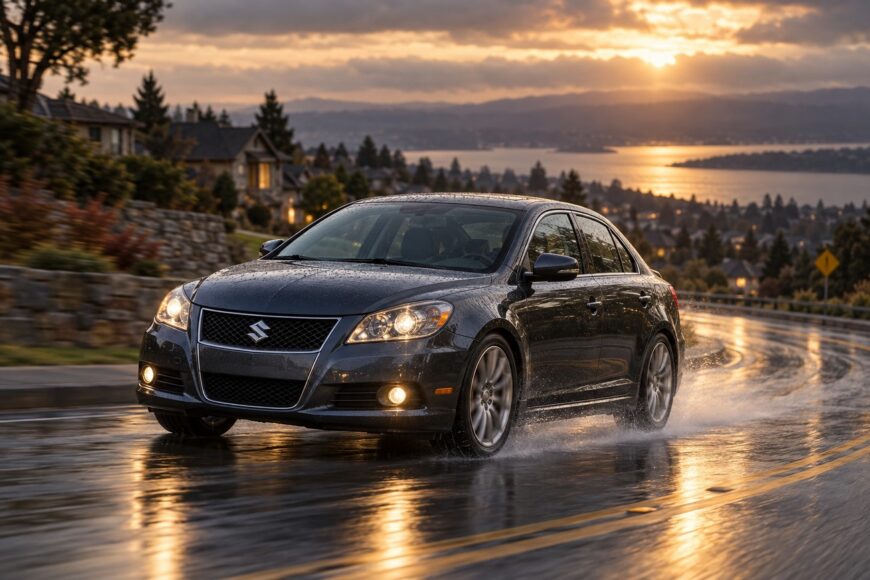
The Suzuki Kizashi was the final sedan Suzuki sold in America, arriving as an ambitious attempt to move beyond the brand’s small-car image. It brought a four-door D-segment body, composed road manners, available all-wheel drive, and a more upscale cabin to a market already crowded with established sedans.
Its appeal on the used market is inseparable from its risks. Sales were weak, Suzuki withdrew from the U. S., the CVT has a poor reputation under hard acceleration, and parts support can be slow. This is a guide for evaluating a used Kizashi as transportation, rather than a simple history lesson or a romantic case for an unusual car.
- Why the Kizashi Became Suzuki’s Final American Sedan
- One Engine, Two Transmissions, and an Unexpected AWD Option
- A Sport-Sedan Image with More Realistic Performance
- The CVT and AWD Are the Ownership Pressure Points
- What to Check Before Buying a Used Kizashi
- Is the Suzuki Kizashi Still Worth Owning?
- Frequently asked questions
- How rare is a Suzuki Kizashi?
- Why did Suzuki stop selling the Kizashi in America?
- What should you check before buying a used Suzuki Kizashi?
Why the Kizashi Became Suzuki’s Final American Sedan
The Kizashi was a four-door D-segment sedan with a front-engine layout. Suzuki presented it in North America in 2009, and U. S. sales began in late 2009. Its size and equipment placed it above the compact sedans that had traditionally defined the company’s American presence.
Production ran from 2009 to 2014/2015, depending on the market and source. That short run gave the car a distinctive place in Suzuki’s history: it is regarded as the company’s final sedan sold in America. The timing, however, worked against it. The model arrived during a difficult economic period, when buyers were increasingly cautious about midsize sedans and Suzuki’s dealer network was already under pressure.
Suzuki aimed for a more European character, with controlled handling, a substantial body, and a cabin intended to feel more mature than the badge suggested. That positioning gave the Kizashi a degree of individuality, especially beside ordinary rental-fleet sedans. It also meant buyers expected refinement and performance that the powertrain could not always deliver.
Sales remained weak, and Suzuki’s withdrawal from the U. S. market made the Kizashi a niche car almost immediately. The outcome does not prove that every Kizashi was mechanically unsuccessful. It does mean that ownership today depends more heavily on independent repair support, parts sourcing, and the condition of the individual car than it would with a mass-market rival.
One Engine, Two Transmissions, and an Unexpected AWD Option

The Kizashi used one naturally aspirated 2.4-liter J24B gasoline engine rather than a broad engine range. Published output varies from 178 to 188 hp depending on market, calibration, and source, while torque is commonly listed as 230 Nm at 4,000 rpm. Those figures can differ in online listings, so a seller’s specification should be checked against the vehicle identification number and market equipment.
Transmission choices were a six-speed manual or a CVT. Front-wheel drive was available, while some versions offered all-wheel drive marketed as 4WD or i-AWD. The manual gives the engine a more direct response and removes the CVT-specific concern, although it does not turn the car into a high-performance sedan. The CVT suits relaxed driving more effectively than repeated hard launches.
The all-wheel-drive system is useful in wet or snowy regions, yet it adds components and diagnostic work to an already uncommon car. Buyers should confirm the drivetrain rather than relying on a photograph or a generic advertisement. FWD and AWD versions can differ in weight, driving feel, and the pool of technicians able to diagnose them confidently.
Approximate dimensions are 4,650 x 1,820 x 1,480 mm, with a 2,700 mm wheelbase. The trunk holds approximately 461 liters, giving the Kizashi practical family-sedan capacity. These dimensions explain why it can feel more substantial on the road than its badge suggests, while the naturally aspirated engine has to move a relatively serious body.
A Sport-Sedan Image with More Realistic Performance
Suzuki marketed the Kizashi with a sporty, more premium image. The chassis supports that message better than the engine does. Steering confidence, body control, and a firm, tightly controlled suspension give the car a relatively European feel, particularly on a winding road or at highway speed.
The same suspension can feel firm over broken pavement. That is a deliberate compromise rather than an automatic defect, but it matters during a test drive. A car that feels composed on smooth roads may feel tiring if your daily route is dominated by patched asphalt and sharp expansion joints.
The naturally aspirated 2.4-liter engine does not provide turbo-sedan urgency. With the CVT, pressing hard on the accelerator commonly produces rising engine speed and a sustained mechanical sound before the car gathers speed. The result can feel slower than the power figure suggests, especially to a driver expecting a genuine sport sedan.
Published 0–100 km/h figures range from 7.8 to 8.8 seconds, depending on version, test, and source. That spread is a reminder to treat catalog performance claims cautiously. The Kizashi’s strength is balanced road behavior rather than spectacular acceleration, and a clean, well-maintained example can be rewarding without being genuinely fast.
The CVT and AWD Are the Ownership Pressure Points

A CVT-equipped Kizashi deserves a transmission-specific inspection before purchase. Owner discussions frequently criticize the unit as noisy or intrusive during hard acceleration, and the transmission is commonly identified in those discussions as the Jatco JF011E. Noise alone does not establish a failure, but changes in sound, hesitation, shuddering, warning lights, or inconsistent response should be treated as reasons for specialist diagnosis.
The test drive should include gentle cruising, moderate acceleration, a firm pull onto a faster road, and low-speed maneuvering. The transmission should respond consistently across those conditions. A short drive around the seller’s block is inadequate because it may never reveal behavior that appears once the drivetrain is warm or under sustained load.
Verify the drivetrain configuration and scan or test the CVT before ordering parts. Incorrect FWD/AWD assumptions and unfamiliarity with the model can turn a routine diagnosis into an expensive delay.
AWD adds another layer of service and diagnostic complexity. A technician must understand the actual equipment fitted to the car rather than assuming that every Kizashi uses the same drivetrain. That is why the VIN, equipment record, and a suitable scan should be part of the inspection, especially when the seller’s listing contains vague or conflicting information.
Service history matters more here than it does with a common sedan. The surviving fleet is small, and not every repair shop is familiar with Kizashi-specific CVT or AWD diagnosis. Before buying, identify a local facility that is willing to inspect the car and confirm whether it can source the required fluids, filters, sensors, and drivetrain components.
What to Check Before Buying a Used Kizashi
Begin with identity, not appearance. Confirm the VIN, transmission, drivetrain, and equipment, then compare those details with the advertisement. Incorrect listings for power, transmission, or FWD versus AWD are a recurring used-market risk, and the mistake can affect both the purchase decision and future repair planning.
Next, request documented maintenance records. Look for a coherent history rather than a folder containing isolated invoices. An attractive price cannot compensate for an unsupported example with unclear CVT care, unexplained warning lights, or a seller who cannot describe recent work.
Drive the car at different speeds and loads, with the engine and transmission fully warm. Pay attention to CVT response, unusual noises, hesitation, and warning messages. On an AWD car, have the inspection include the system’s operation and relevant driveline components rather than limiting the check to the engine and brakes.
Inspect the body carefully because replacement panels and trim may take longer to locate than parts for a common sedan. Ask local suppliers and repairers about availability before committing. Kizashi parts may require aftermarket or used components, and limited dealer support continued after Suzuki’s withdrawal from the U. S. market.
- Verify FWD or AWD by VIN and equipment details.
- Confirm that a nearby shop can diagnose the CVT or AWD system.
- Test the car beyond a brief low-speed drive.
- Check the maintenance history for continuity and credible documentation.
- Price the car together with likely parts delays, rather than judging the purchase price alone.
A well-kept Kizashi can justify this extra work. A cheap car with no records usually cannot, because the ownership risk lies in support and diagnosis as much as in the visible condition of the vehicle.
Is the Suzuki Kizashi Still Worth Owning?

The Kizashi makes sense for a buyer who wants an unusual, well-equipped sedan and is comfortable owning a niche model. Its final-sedan status in America adds enthusiast appeal, while the chassis and available AWD give it a character missing from many ordinary used sedans. Rarity can make the car interesting long after its original market position has disappeared.
It is a poor fit for someone prioritizing cheap, effortless ownership. Resale can be slow, dealer support is limited, and parts searches may take longer than expected. A mass-market sedan is usually easier to maintain when a repair shop, supplier, or future buyer needs familiar equipment and readily available components.
Buyers expecting a genuinely fast sport sedan should also look elsewhere. The Kizashi has confident handling and a controlled ride, yet its naturally aspirated engine and CVT deliver measured performance. The badge, styling, and marketing should not be allowed to outweigh the actual transmission behavior during a test drive.
The decision rule is simple: buy on condition, documented service, and local technical support rather than horsepower or badge enthusiasm. If a clean example has credible records and a nearby shop understands its CVT or AWD system, the Kizashi can be a distinctive used sedan. Without that support network, its rarity becomes a liability.
Frequently asked questions
The Kizashi’s rarity makes local market conditions and repair support especially important. The questions below focus on availability, Suzuki’s U. S. exit, and the checks that matter before purchase. They complement the inspection guidance above.
How rare is a Suzuki Kizashi?
Its rarity varies sharply by country and region, so a single global production figure would be a poor guide to ownership. In one area, several examples may still appear in classifieds; elsewhere, finding even one can be difficult.
Check nearby listings, call independent parts suppliers, and ask repair shops whether they have serviced the CVT and AWD versions. This local test is more useful than an unverified production number because it shows whether you can maintain and repair the car where you live.
Why did Suzuki stop selling the Kizashi in America?
Limited sales, the broader economic climate, and Suzuki’s withdrawal from the U. S. market combined to end the Kizashi’s American run. The car arrived without the volume or dealer strength needed to compete with established midsize sedans.
That market outcome should not be treated as proof that the Kizashi itself was mechanically unsuccessful. It explains why support became difficult: once Suzuki left the market, the supply of dealers, familiar technicians, and readily stocked parts contracted with it.
What should you check before buying a used Suzuki Kizashi?
Verify the VIN, transmission, drivetrain, maintenance history, and condition of the CVT or AWD system. A warm test drive should include gentle cruising, moderate acceleration, and a firm pull to reveal hesitation, shuddering, unusual noise, or warning lights.
Also confirm that a nearby repair shop can diagnose the car and that local suppliers can obtain likely replacement parts. These checks are especially important because support for the Kizashi is more limited than for common midsize sedans.







