

A tiny rear-wheel-drive roadster still has a particular appeal: low seating, direct controls, a manual gearbox, and enough mechanical feedback to make an ordinary back road feel like an event. The Suzuki Cappuccino delivers that experience in a package small enough for narrow streets and modest enough to feel playful at legal speeds.
The harder question is whether it is enough car for your life. Two seats, limited luggage space, a cramped cabin for taller drivers, and restricted motorway reserves are clear compromises. Age adds another layer: the condition of the shell, roof, turbo system, suspension, and seals matters more than the charm of the specification sheet.
That makes the Cappuccino an appealing enthusiast purchase, but a poor impulse buy. Its best qualities appear on winding roads and short trips; its weaknesses emerge during long commutes, bad weather, high-speed travel, and any inspection that starts with the engine while ignoring the structure.
- Why the Cappuccino feels like more than 64 PS
- Is it enough car for everyday use?
- EA11R vs EA21R: the differences that matter
- The buying mistake that matters most: inspecting the engine before the shell
- What a test drive and roof check can reveal
- The verdict: enough car for which driver?
- Frequently asked questions
- How many Suzuki Cappuccinos are left?
- Which should you choose: a Honda Beat or a Suzuki Cappuccino?
- How can you check whether a Cappuccino can be registered where you live?
Why the Cappuccino feels like more than 64 PS
The Cappuccino is a two-seat, rear-wheel-drive Japanese-market kei roadster produced from 1991. Its standard layout paired rear-wheel drive with a five-speed manual, giving the driver a direct role in managing the car’s modest output. On a narrow, winding road, the light controls and compact dimensions make small changes of line and throttle feel meaningful.
Early EA11R cars are often quoted at around 700 kg, while some references give around 725 kg. The difference depends on specification and measurement method, but either figure explains why the car can feel lively without large power reserves. Both the EA11R and EA21R were rated at 64 PS at 6,500 rpm, enough to make progress entertaining when the road keeps changing direction.
That agility should not be confused with outright speed. The small turbo engines have limited reserves for overtaking or climbing at motorway speeds, and the narrow body can react noticeably to ruts, crosswinds, and poor surfaces. A Cappuccino on old tires, tired dampers, or worn suspension bushes may feel nervous where a newer car would simply track straight.
The 64 PS figure also needs context. It was principally associated with an industry agreement rather than a universal statutory kei power limit for every historical period; the regulatory limits concerned the vehicle’s dimensions and engine displacement, among other requirements. The Cappuccino’s character comes from its size, weight, gearing, and rear-drive layout, rather than from the number alone.
Is it enough car for everyday use?
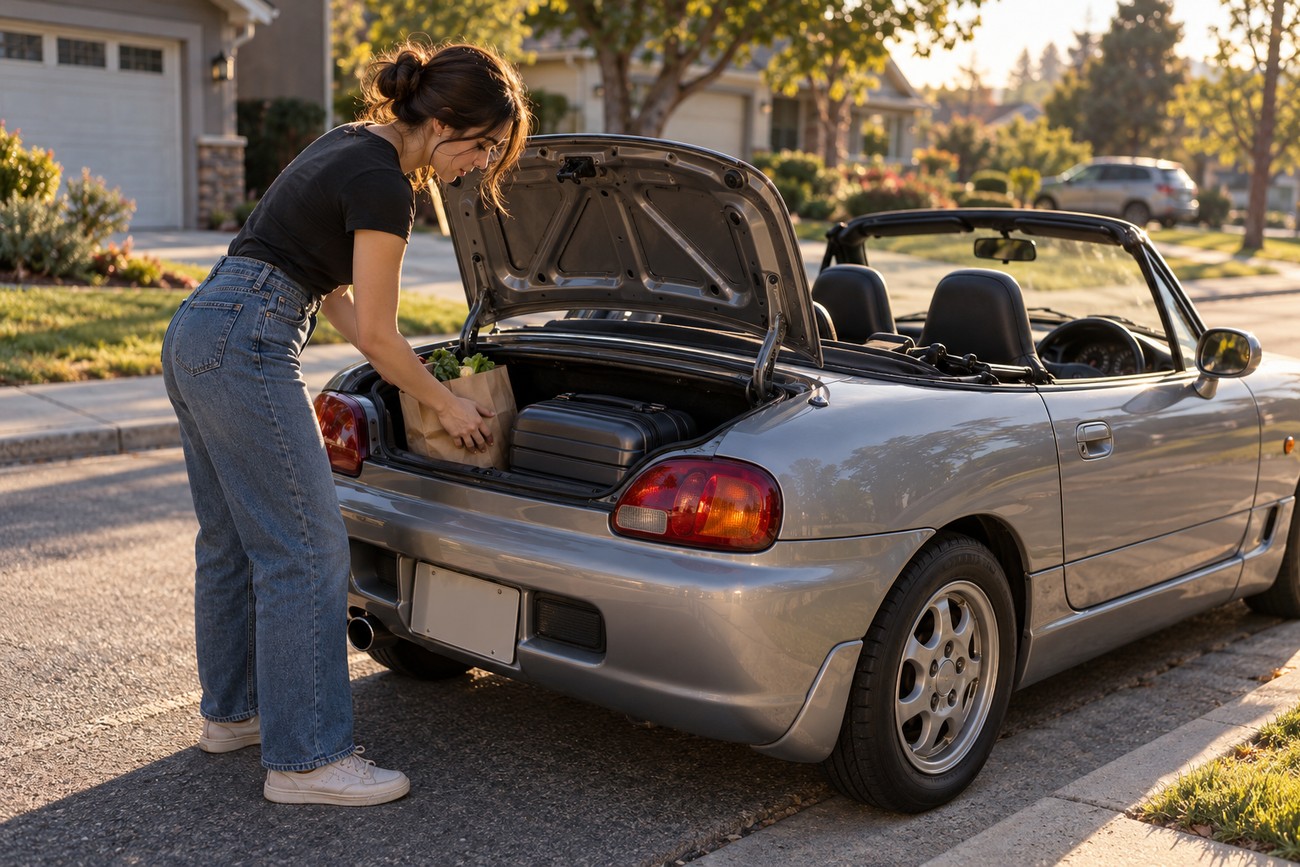
For daily driving, the Cappuccino’s dimensions are both its greatest advantage and its clearest warning. It measures approximately 3,295 × 1,395 mm, fitting within kei limits of 3,400 × 1,480 mm and up to 660 cc. That makes parking and narrow streets easy, while the two-seat cabin removes any possibility of carrying rear passengers.
Luggage space is limited by the roadster’s compact format, so even a routine airport run or shopping trip requires planning. Taller drivers may find the cabin cramped, particularly with the roof fitted and the seat adjusted for proper pedal control. An in-person fit check matters more than assuming that a small car will automatically suit every small-car enthusiast.
The removable roof can make short trips feel special, but it is only a practical advantage when the catches, seals, and drains work correctly. Water in the cabin can damage trim and create persistent dampness, while failed seals may bring wind noise and leaks that turn the car into a poor all-weather commuter. A roof that looks complete in photographs may still be expensive to put right.
Modern cars have a substantial advantage in safety equipment, sound insulation, climate control, refinement, and versatility. The Cappuccino can handle occasional motorway travel, but its power reserves and high-speed composure are limited compared with contemporary cars. It works best as a second vehicle or a deliberately chosen enthusiast car, rather than as an effortless replacement for a modern all-purpose hatchback.
EA11R vs EA21R: the differences that matter
The later EA21R has useful mechanical advantages, but the chassis code should not decide a purchase by itself. The table shows the main differences and their practical meaning.
| Item | EA11R | EA21R | What it means in practice |
|---|---|---|---|
| Engine | 657 cc turbocharged F6A | Aluminium 658 cc K6A | The K6A has a lighter front-end contribution, while the F6A is the earlier engine. |
| Rated power | 64 PS at 6,500 rpm | 64 PS at 6,500 rpm | The quoted output is the same, so condition matters more than the badge. |
| Quoted torque | Approximately 85 Nm | Approximately 103 Nm | The EA21R’s higher quoted torque can make everyday acceleration feel less strained. |
| Timing drive | Timing belt | Timing chain | An EA11R needs documented belt and tensioner maintenance; a chain is not a guarantee of neglect-free ownership. |
| Transmission | Five-speed manual was standard | Five-speed manual was standard; a three-speed automatic was offered on later versions | Choose the individual gearbox condition and intended use rather than assuming the later car is automatically superior. |
The aluminum K6A contributes to a lighter front end, and the EA21R’s quoted torque is higher. Those are worthwhile differences, yet corrosion, service history, turbocharger health, and the quality of previous repairs outweigh the engine code. A sound EA11R is a better purchase than a neglected EA21R.
The buying mistake that matters most: inspecting the engine before the shell
Structural corrosion deserves the first serious inspection. Check the sills, rear arches, floor, and the areas where the front suspension mounts to the body. Surface bubbling is already a reason to investigate; corrosion in the structural sills or suspension mounting areas can affect safety and turn an apparently affordable car into an uneconomic restoration.
Photographs rarely establish the condition of those areas. The underside needs to be viewed on a lift or securely raised, with attention paid to fresh underseal that may conceal older repairs. Probe suspicious sections carefully, inspect seams and drain areas, and look for mismatched metal, extensive welding, or corrosion spreading around mounting points.
A cheap imported car can become expensive after shipping, structural repair, paintwork, and the search for scarce body or roof-specific parts are added. Routine service items may be relatively accessible, while original panels, trim, and specialized roof components can be much harder to source. The purchase price is only the entry point to the calculation.
Use a simple inspection sequence: verify the documentation and identity, inspect the shell underneath, check for water ingress, then assess the engine, drivetrain, and suspension. If corrosion is suspected, pay for an inspection by someone competent in structural vehicle assessment. A seller’s assurance that the car is solid should not replace evidence from the metal itself.
What a test drive and roof check can reveal
A healthy test drive should show consistent boost rather than a brief impression of a dramatic turbo surge. Watch for smoke, delayed boost, uneven power delivery, or a clear loss of performance. These symptoms can point toward boost leaks, damaged hoses, turbocharger problems, or other faults that a 64 PS rating says nothing about.
Inspect the large engine-bay hoses, vacuum lines, and connections closely. Age, heat, and cold can leave rubber looking acceptable while making it brittle under load. Also listen around the turbocharger and exhaust flange for evidence of a leak; exhaust connections can loosen after repeated heat cycles, and a small leak may become a larger repair if ignored.
For an EA11R, ask for documentary proof of timing-belt and tensioner replacement. A running F6A is not proof that the belt has been maintained, and uncertainty should be treated as a maintenance requirement rather than a minor detail. The EA21R uses a timing chain, but that does not remove the need to investigate rattles, poor servicing, or general engine neglect.
Operate the roof while the car is stationary. Check every catch, seal, drain, and joint, then inspect carpets and trim for dampness or staining. Water in the cabin matters beyond comfort because it can indicate blocked drainage, failed seals, corrosion, or electrical trouble that may continue after the visible leak is fixed.
Finally, judge the chassis separately from the engine. Old tires, dampers, and suspension bushes can make a good Cappuccino feel unstable or harsh, while fresh components can transform its road manners. Check tracking, steering response, braking behavior, and noises over uneven surfaces before deciding whether the car’s handling character is genuinely appealing.
The verdict: enough car for which driver?

The Cappuccino is enough car for an enthusiast who values compact dimensions, rear-wheel drive, a manual gearbox, and short trips on winding roads. It can also suit occasional commuting when the route is moderate, the weather is manageable, and the owner accepts that luggage and passenger capacity are minimal.
It is a weaker choice for regular motorway travel, frequent long journeys, carrying passengers, or reliance on one vehicle in every season. Limited high-speed reserves, two-seat practicality, modest weather protection, and the safety and refinement gap between an early-1990s roadster and a modern car all impose daily compromises.
The right purchase starts with the shell and continues through the maintenance records, roof condition, turbo system, suspension, and local parts supply. Japanese-market specification alone does not establish suitability for local roads, climate, fuel, or registration requirements. Those questions need checking in the market where the car will actually live.
Choose the best individual car you can inspect, rather than automatically chasing the EA21R or dismissing the EA11R. A rust-free, documented example with available parts can deliver the Cappuccino experience convincingly. A cheaper car with structural corrosion or uncertain maintenance can consume the budget before the enjoyable driving begins.
Frequently asked questions
The Cappuccino’s suitability depends on the individual car, its condition, and how it will be used. The following questions address surviving examples, alternatives, and registration of imported cars.
How many Suzuki Cappuccinos are left?
No verified worldwide surviving-car count is established by the supplied facts. A number from a vehicle registry normally applies to a specific jurisdiction, registration system, and date; it should not be presented as a global total.
Before quoting a figure, check which cars the registry includes, whether it counts currently registered vehicles or all recorded vehicles, and when the data was collected. Exported, unregistered, dismantled, and privately stored cars may be treated differently, so the result can describe one market without representing the worldwide surviving population.
Which should you choose: a Honda Beat or a Suzuki Cappuccino?
Choose between them by starting with fit, intended roads, and the condition of the specific car. Sit in both if possible, confirm that you can operate the pedals and roof comfortably, and decide whether your driving favors the Cappuccino’s rear-wheel-drive character or the particular qualities of the Beat you are considering without relying on generic model claims.
Parts support can settle the decision. Compare local access to body panels, roof components, suspension parts, and engine-specific service items, then inspect both cars for corrosion and documented maintenance. A structurally sound example with a realistic parts supply is usually the safer enthusiast purchase than a theoretically preferable model in poor condition.
How can you check whether a Cappuccino can be registered where you live?
Contact the relevant registration or transport authority before paying a deposit. Ask which documents, emissions or safety checks, age rules, vehicle identification records, and import evidence apply to an imported Japanese-market car in your jurisdiction.
Then verify the seller’s title and export documents, confirm that the vehicle identification details match, and obtain a realistic estimate for shipping, inspection, taxes, compliance work, and registration. Written confirmation from the authority and a complete cost calculation are more reliable than assuming that a car legally sold in Japan will automatically qualify for use elsewhere.







