
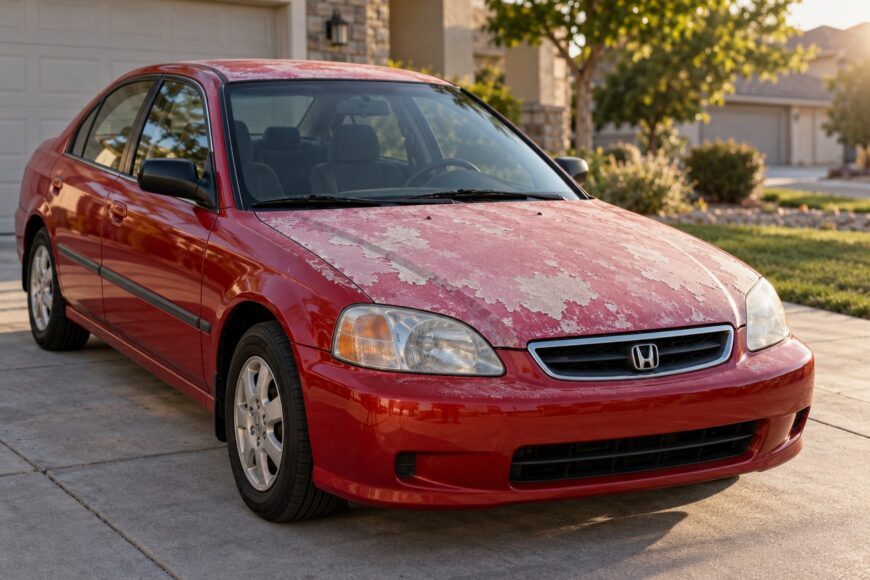
A sun-faded red Honda Civic often shows the same pattern: a pink or dull hood, roof, or upper door areas; peeling clear coat; and a darker, richer color in sheltered sections. The finish may look uniformly tired, or it may have cloudy patches and loose edges that catch your fingernail. Those symptoms point to a coating problem, although the required repair can range from controlled correction and protection to complete refinishing.
A Civic’s visible color may have changed because the clear coat is scattering light, because the red pigment has degraded, or because both layers have suffered. That distinction matters more than the paint name alone. Polishing can improve superficial oxidation, while cracked or delaminating clear coat and missing pigment require a different repair plan.
- What Sun-Faded Paint on a Red Honda Civic Really Means
- Why Red Honda Civic Paint Fades in the Sun
- Polish or Repaint? How to Diagnose the Civic’s Finish
- How to Fix Faded Red Car Paint on a Honda Civic
- Color Matching and Material Compatibility After Fading
- Mistakes That Make Faded Red Paint Worse
- How to Prevent More Fading on a Red Civic
- Frequently asked questions
- How long can I wait after the clear coat on my Civic starts peeling?
- How can I tell whether my Civic has been repainted before?
- How do you fix faded red car paint?
- Why does red car paint fade?
What Sun-Faded Paint on a Red Honda Civic Really Means
A typical Civic factory finish has three main layers: primer, colored basecoat, and clear coat. The primer supports adhesion and corrosion resistance, the basecoat provides the color, and the clear coat supplies gloss and much of the environmental protection. Damage in one layer can change the way the entire panel looks.
A clear coat that has started to fail may become cloudy, lose gloss, crack, or separate from the layers below it. Light entering this uneven surface is scattered, so the panel can appear pale or gray even when much of the underlying red basecoat remains. This is one reason a “faded” panel can improve dramatically during a careful test correction.
Other panels have genuine color loss. UV radiation can damage coating binders and some pigments, and some organic red pigments can shift toward a colorless form, making red appear pink. A new glossy surface over a weakened or depleted basecoat cannot recreate color that has disappeared from the material.
Look closely before choosing a treatment. Dull, uniform oxidation may be correctable, while milky patches, cracking, bubbles, raised edges, and peeling usually indicate that the panel needs refinishing. A panel can contain both conditions: a surviving section may respond to polishing while the surrounding loose clear coat continues to fail.
Why Red Honda Civic Paint Fades in the Sun
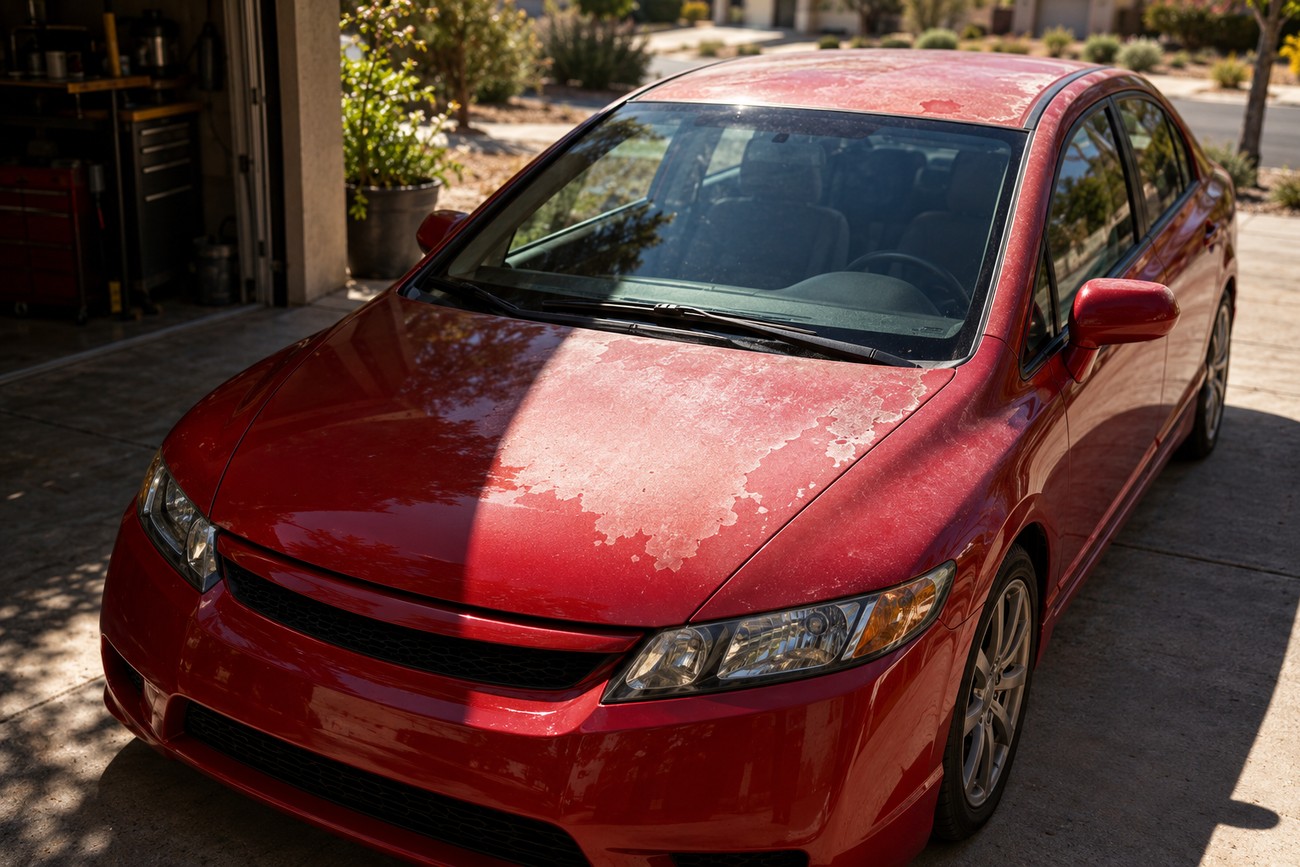
UV radiation causes photodegradation of coating binders and some pigments. Heat, moisture, airborne contamination, and repeated expansion and contraction can add stress to the finish, especially where the clear coat has already lost flexibility. The result may appear first as reduced gloss and later as visible discoloration or delamination.
Some organic red pigments are photochemically vulnerable. They can shift toward a colorless form, making a red finish appear pink or washed out. That explains why some older red cars show a striking difference between exposed and sheltered areas, although it does not mean every red Civic will fade faster than every other modern color.
Modern clear coats contain UV absorbers and light stabilizers, but they do not last indefinitely. Their condition, the amount of sun exposure, the vehicle’s maintenance, and the particular coating system all influence the result. The color name is therefore a useful clue rather than a complete diagnosis.
Hoods, roofs, and upper door areas generally age faster because they receive more direct sun exposure. A Civic parked outside every day may show a dull roof while the lower doors remain comparatively healthy. Shade changes the exposure pattern, which is why sheltered areas can retain a deeper color even when the upper panels look pink.
Polish or Repaint? How to Diagnose the Civic’s Finish
Start with a clean, dry vehicle and compare panels in consistent light. View the hood, roof, trunk, and upper doors from several angles, then compare them with shaded areas such as the lower doors or sections under weather seals. Gloss can make red appear darker, so inspect in both direct and diffuse light before judging the color.
Run your eyes and fingertips over the surface without forcing loose material down. Uniform dullness and fine oxidation may indicate usable clear coat. Milky areas, lifting edges, bubbles, cracks, and flakes indicate an unstable surface that polishing cannot make structurally sound.
A small test spot is safer than committing to the whole car. A detailer can use a controlled polish on a limited area and then inspect the change in gloss, color, and surface stability. Improvement shows that some superficial oxidation was present; it does not prove that the remaining clear coat is thick enough for repeated correction or long-term exposure.
A test spot should end the diagnosis when the clear coat begins to lift, crack, or reveal an unstable edge. Chasing a temporary gloss improvement can remove the remaining usable protection and turn a localized repair into a larger refinishing job.
Paint-thickness readings add useful evidence, especially if the Civic has had previous repairs. Typical factory clear-coat thickness is approximately 40–50 micrometers, but this is an orientation, not a universal Civic specification. Readings vary by panel and repair history, and a gauge usually measures the complete coating stack rather than identifying the clear coat by itself.
How to Fix Faded Red Car Paint on a Honda Civic
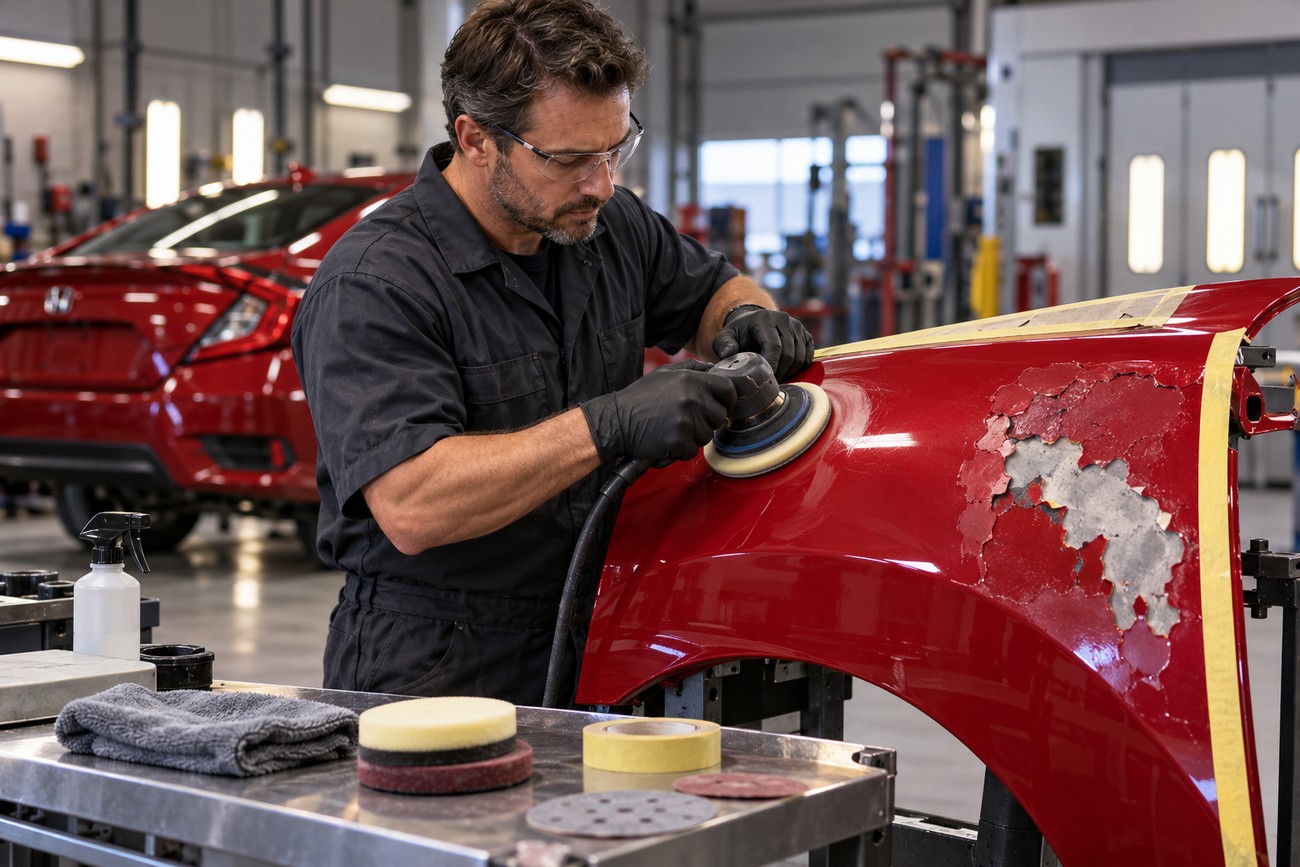
Light oxidation is the simplest outcome. After washing and decontamination, a technician can test a mild polishing process, refine the finish, and apply protection. The process removes part of the upper coating, so it should be limited to paint that remains stable and has enough usable material for correction.
Peeling, cracking, bubbling, or severely damaged panels normally require refinishing rather than polishing. The failed material must be removed or sanded back to a stable edge, followed by suitable surface preparation. Depending on the substrate, the repair may include primer, surfacer, basecoat, clear coat, and proper curing before the panel is returned to service.
A new clear coat alone cannot replace pigment that has been lost from the basecoat or substrate. If the exposed red has shifted toward pink, the damaged color layer must be prepared and recoated. Applying clear over an unstable or depleted surface can preserve the defect under a glossier film and may lead to early failure.
Localized repair is possible when the damage is contained, but color matching determines how far the work should extend. A faded neighboring panel may require blending rather than a simple one-panel color application. The repaired area should be checked after the coating has cured, since gloss and color perception can change as the finish settles.
For widespread fading across the roof, hood, and side panels, a broader repaint may produce a more consistent result than a series of isolated repairs. The correct scope depends on how much original finish remains, where the color has changed, and whether adjacent panels can accept a visually credible blend. A professional assessment should separate cosmetic oxidation from coating failure before estimating the work.
Color Matching and Material Compatibility After Fading
The factory color code identifies the intended original formula. It does not describe the current appearance of neighboring panels after years of sun exposure. A fresh panel mixed to that code can therefore look richer or darker beside a faded door, even when the formula is technically correct.
Color evaluation should include clean test cards or sample panels and checks under consistent lighting. Red can change noticeably with viewing angle because gloss and light scattering affect how much depth the eye sees. A repair that looks correct inside a paint booth may show a boundary outdoors if the surrounding panel has aged unevenly.
Blending into neighboring panels may be needed to make a localized repair visually consistent. That means extending the basecoat in a controlled manner and clearing the appropriate area, rather than stopping the new color at a sharp boundary on the damaged panel. The exact repair layout depends on panel shape, damage position, and the condition of adjacent paint.
Material compatibility also affects durability. Honda repair guidance calls for a compatible system of primer, surfacer, basecoat, and clear coat from an approved manufacturer, with the basecoat using the activator or hardener specified by the material manufacturer. Mixing products casually can create adhesion, curing, gloss, or color problems that are difficult to diagnose later.
Mistakes That Make Faded Red Paint Worse
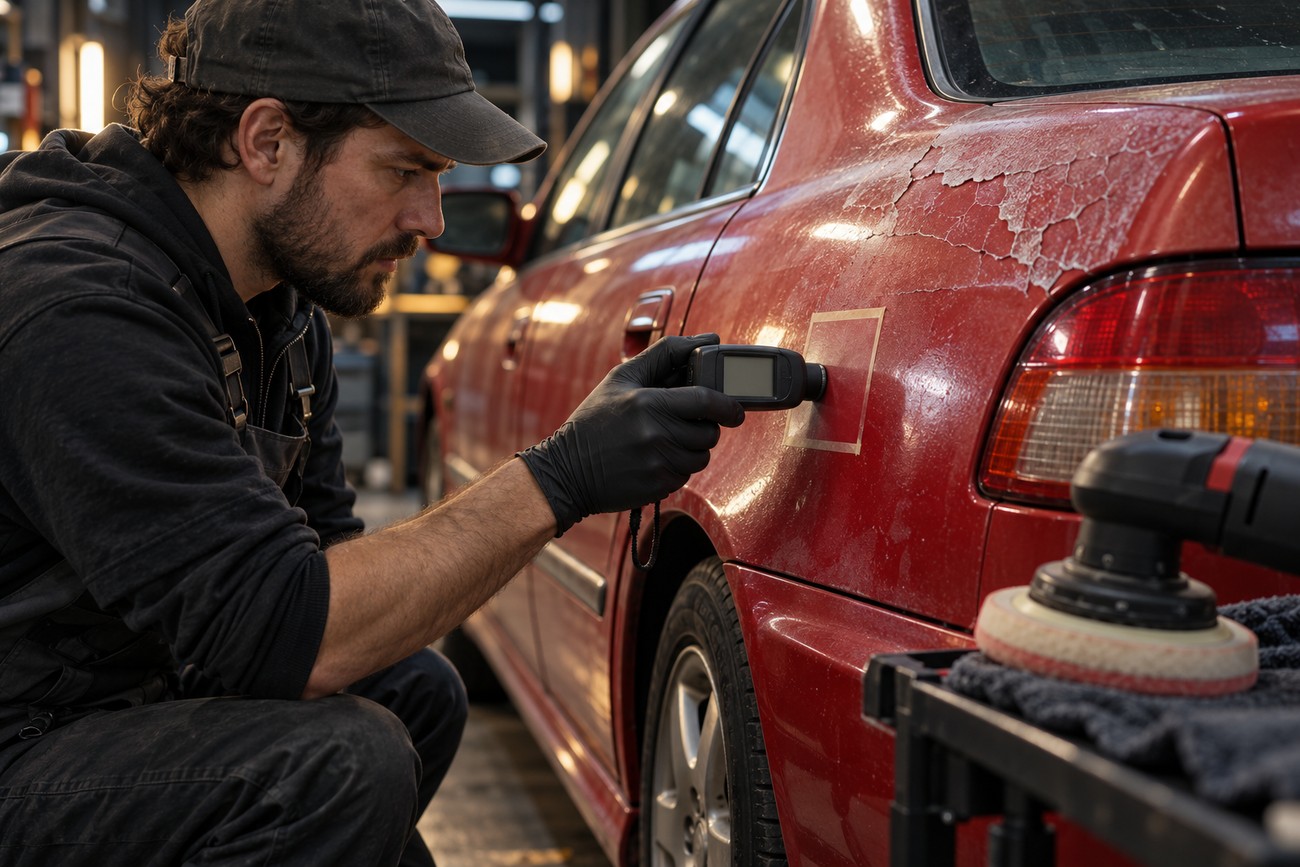
Aggressive machine polishing is a common response to a dull red panel. It can thin the remaining clear coat, particularly where a previous repair has already reduced the margin for correction. Use a paint-thickness reading and a small test area first, then stop if the surface shows cracking, lifting, or unstable gloss rather than repeatedly increasing pad and compound aggressiveness.
Wax, sealant, or ceramic coating cannot bond a failing finish back together or rebuild missing pigment. These products may temporarily deepen the appearance of a sound, oxidized surface, but they cannot stabilize loose edges or replace a depleted basecoat. The corrective step is surface repair; protection belongs after the finish is sound.
Regular washing removes dirt, road film, and bonded contamination, yet it does not replace UV protection. A clean Civic can still age quickly in direct sun. Wash with methods that reduce abrasion, remove contamination before it hardens, and combine cleaning with shade or a suitable protective product once the coating is stable.
It is also misleading to assume that red automatically fades faster than every modern color. Some red pigments are vulnerable, while modern coating design, clear-coat condition, and sun exposure often provide better practical clues. Diagnose the panel in front of you instead of choosing a repair solely because the car is red.
How to Prevent More Fading on a Red Civic
Prevention starts after the surface has been corrected or refinished. Shade or a ventilated car cover reduces direct UV exposure, with covered parking generally offering the most consistent protection. A cover should fit correctly and be used on a clean vehicle so trapped grit does not abrade the finish.
Regular washing helps prevent bonded contamination from remaining on the finish. Remove tree residue, bird droppings, and road film promptly using a method that limits rubbing. Contamination does not cause every case of fading, but it can hold moisture and chemicals against a coating that is already under UV stress.
Periodic UV protection is most useful after the clear coat and basecoat are intact. A wax, sealant, or other suitable coating can reduce exposure and make cleaning easier, depending on the product and preparation. Its role is protective, so it should be applied to a stable surface rather than used to conceal active peeling.
Ceramic coating protects an adequately prepared surface but does not repair peeling clear coat or restore missing pigment. If a panel has raised edges, cracks, or delamination, repair those defects first. A durable maintenance routine combines exposure control, careful washing, and inspection for early changes in gloss or adhesion.
Frequently asked questions
How long can I wait after the clear coat on my Civic starts peeling?
There is no dependable safe waiting period once peeling begins. Exposed edges allow moisture, dirt, and additional UV exposure to reach the weakened coating, and those forces can expand the damaged area beyond the original patch.
Arrange an assessment promptly, especially if the peeling is on a hood or roof. Avoid polishing or sealing the loose area while deciding, because abrasion can remove surrounding clear coat and make the eventual repair larger.
How can I tell whether my Civic has been repainted before?
Look for overspray on rubber seals or trim, masking edges, inconsistent surface texture, and a gloss level that differs from adjacent panels. Panel gaps and trim edges can also reveal where masking or dismantling was handled differently during a repair.
Unusually different paint-thickness readings between neighboring panels are another clue, although readings require context and do not identify every repair by themselves. Finding previous work before polishing matters because a repaired panel may have less usable clear coat or a different coating system.
How do you fix faded red car paint?
First determine whether the panel has superficial oxidation or failed clear coat and damaged color. A stable, dull surface may respond to controlled polishing and protection; peeling, cracking, bubbling, or significant pigment loss generally requires sanding or removal of failed material, color refinishing, and new clear coat.
Use a test spot and compare the repaired panel with its neighbors before choosing the final scope. A factory color code may require blending into faded adjacent panels, so a one-panel repaint is not always the most consistent visual repair.
Why does red car paint fade?
UV radiation causes photodegradation of coating binders and some pigments. Some organic red pigments can shift toward a colorless form, making red appear pink, while a cloudy clear coat can scatter light and make the same panel look faded even when the basecoat remains.
Red does not automatically fade faster than every modern color. Clear-coat condition, direct sun exposure, the coating design, and the specific pigment system all influence the outcome, with roofs, hoods, and upper doors commonly showing damage first.







