
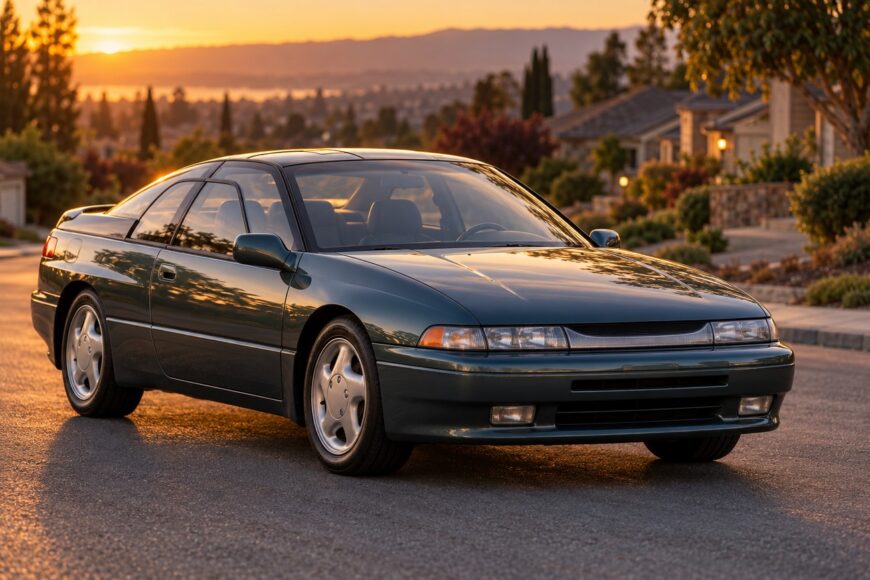
The Subaru SVX looks like a high-performance sports coupe, yet its grand-touring character, four-speed automatic, and aging specialist hardware require a different ownership mindset. It was designed to cover distance quickly and quietly, with a naturally aspirated flat-six and a long, low body rather than the sharp responses and mechanical simplicity expected of a track-focused car.
Its most famous feature, the glass-to-glass canopy with window-in-window doors, is functional engineering rather than decoration. The divided glass improves visibility, limits wind noise, and lets you ventilate the cabin in light rain. With correct adjustment and healthy seals, it remains one of the SVX’s strongest features; with crash damage or neglected hardware, it becomes an expensive source of leaks and noise.
The sensible choice is a complete, structurally sound example with documented cooling and transmission work. A cheap SVX can become a long-term project involving rare glass, EG33-specific parts, electrical faults, and a difficult automatic transmission. The car is remarkable when its support network is real; it is financially punishing when rarity is mistaken for simplicity.
- The Subaru SVX in Context: A Grand Tourer, Not a Track Car
- Subaru SVX Specifications and Market Variants
- Why the Window-in-Window Canopy Was More Than a Styling Trick
- The Real Ownership Risks: Transmission Heat, Parts, and Fuel
- Buying a Subaru SVX: What the Advertised Car May Hide
- What Can Be Fixed—and What Makes a Bad SVX a Bad Bet
- Why the SVX Failed—and Why It Still Matters
- Frequently asked questions
- How many Subaru SVX are left?
- Why did the Subaru SVX fail?
- How much is a Subaru SVX worth?
The Subaru SVX in Context: A Grand Tourer, Not a Track Car
The Subaru Alcyone SVX belonged to the early-1990s wave of ambitious Japanese grand tourers. Depending on the market, model years ran approximately from 1991 to 1997; global series production began in 1992 and ended in 1997. Its styling carried a strong ItalDesign influence, using a low roof, broad glass area, and sharply defined body surfaces to make the coupe look more exotic than its mechanical layout suggested.
Subaru positioned the SVX as a fast, refined coupe rather than a lightweight sports car. The cabin, permanent all-wheel-drive configuration on most cars, and automatic transmission favored stable high-speed cruising. The substantial curb weight also shaped the experience: the SVX gathers speed convincingly, then settles into a composed long-distance rhythm instead of encouraging repeated track sessions.
Power figures require careful wording. Most technical catalogs list approximately 220–230 hp, while other catalogs and owner sources cite 220–233 hp or 240–250 hp, depending on market and year. Those discrepancies reflect different specifications and reference methods, so a claimed power figure should be checked against the car’s market, identification documents, and engine-management hardware.
Published acceleration figures can make the SVX sound more overtly sporting than it feels in use. A healthy car can be quick by 1990s standards, but its character remains that of a comfort-oriented grand tourer. The four-speed automatic, weight, and touring-focused chassis make the condition of the drivetrain more important than a brochure number.
Subaru SVX Specifications and Market Variants
The core specification is consistent, although market, model year, and drivetrain differences affect quoted figures and replacement parts.
| Specification | Subaru SVX range or description |
|---|---|
| Engine | EG33, naturally aspirated 3.3-liter DOHC 24-valve horizontally opposed six-cylinder gasoline engine |
| Power | Most technical catalogs list approximately 220–230 hp; other catalogs and owner sources cite 220–233 hp or 240–250 hp, depending on market and year |
| Transmission | Four-speed automatic only |
| Drivetrain | Predominantly full-time 4WD, with rare front-wheel-drive versions, including Version L variants |
| Length | Approximately 4625 mm |
| Width | Approximately 1770 mm |
| Height | Approximately 1230–1300 mm, depending on the reference source |
| Curb weight | Approximately 1580–1610 kg |
| Gross vehicle weight | Approximately 2045 kg |
| Published top speed | Approximately 230–240 km/h |
| Published 0–100 km/h | Approximately 7.5–8.7 seconds, depending on year, market, and drivetrain |
Every SVX used the EG33 and a four-speed automatic, which simplifies the broad model description while making transmission condition central to any purchase. Most cars used full-time 4WD, but rare front-wheel-drive versions, including Version L variants, can differ in electronics, lighting, control systems, and parts compatibility. A seller’s generic “AWD SVX” description is therefore insufficient for ordering components.
Market origin can also explain apparently conflicting specifications. Cars from the United States, Japan, and other markets may use different control units, emissions equipment, lighting assemblies, safety equipment, and wiring. A part that fits an EG33-powered car in one market may still be wrong for a particular year or drivetrain configuration.
The dimensions show why the car feels substantial on the road, yet they do not guarantee family-car practicality. Rear seating is limited, and useful cargo space can feel smaller than the exterior length suggests, especially when the rear seats are occupied. This matters because the SVX’s size creates expectations that its low roof and grand-touring layout cannot fully satisfy.
Why the Window-in-Window Canopy Was More Than a Styling Trick
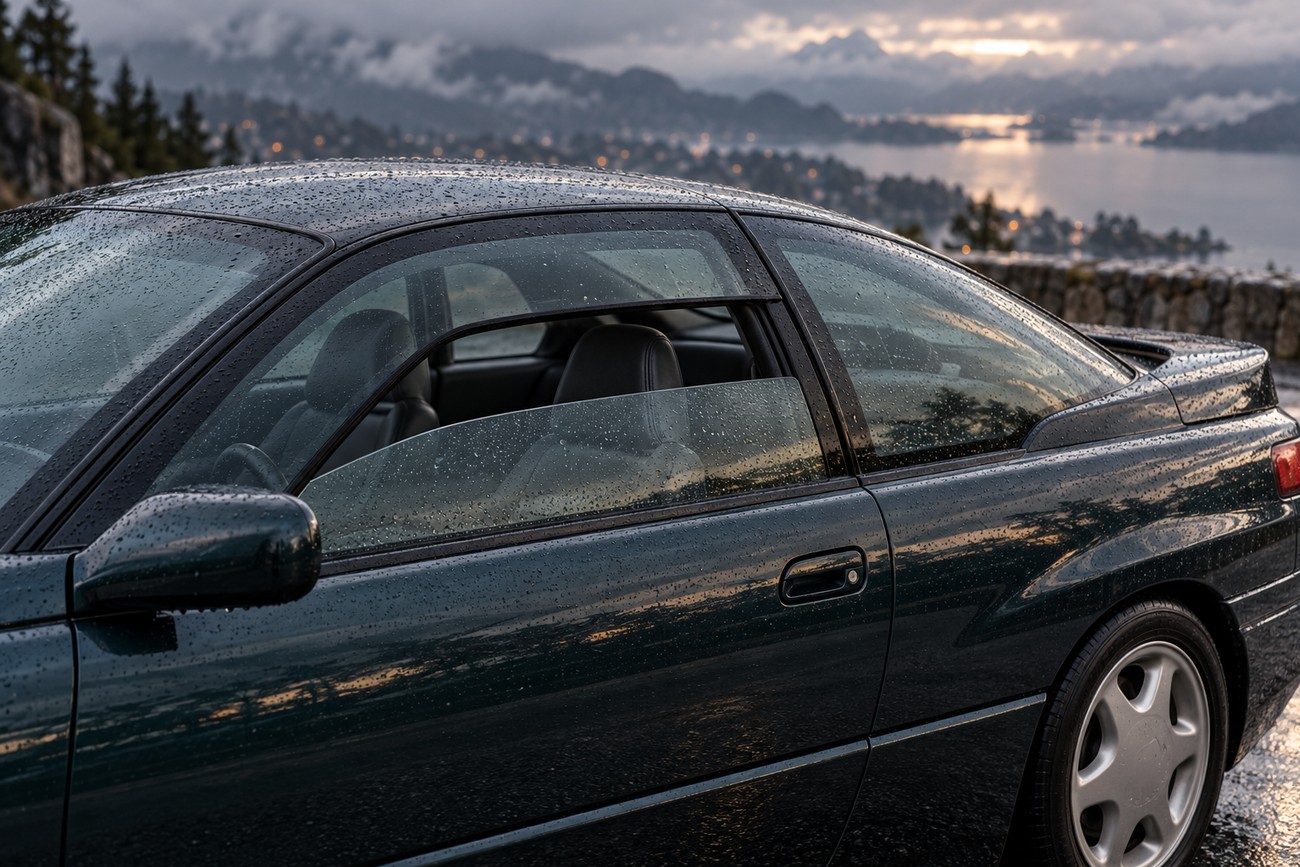
The SVX’s roof and door glass are commonly described as a glass-to-glass canopy. Its window-in-window door system divides the glass into upper and lower sections. The glass rises as a unit to close the opening, while only the lower section opens for ventilation.
This arrangement supports the car’s grand-touring purpose. The broad glass area gives the driver useful outward visibility, while the canopy shape helps control airflow around the doors and roof. Opening the lower section in light rain can provide ventilation without exposing the entire side opening, a small feature that makes sense on a long-distance coupe.
The same design creates demanding adjustment work. The glass, regulators, door frame, and seals must meet each other correctly, and a small error can produce wind whistle, water intrusion, or excess cabin noise. Old rubber also loses flexibility, while previous repairs may leave the glass sitting at the wrong height or angle.
Replacement is harder than on an ordinary Subaru. The unusual door frame, specialized glass, regulators, and seals can be difficult and expensive to source, especially when crash damage has distorted the surrounding structure. Paint may hide a repaired door, but it cannot reliably hide poor glass geometry once the car reaches highway speed or a heavy rainstorm.
The Real Ownership Risks: Transmission Heat, Parts, and Fuel
The four-speed automatic is the SVX’s main mechanical risk. It is vulnerable to overheating under high thermal load, and old automatic transmission fluid, restricted cooling airflow, aggressive driving, or towing can accelerate failure. A failed unit can require expensive rebuilding or a difficult search for a suitable replacement.
Cooling deserves inspection before cosmetic improvements. An auxiliary transmission cooler and a clean engine and transmission cooling system are strongly recommended by experienced owners. A car that has received fresh paint, wheels, or suspension work while retaining a neglected cooling system has its priorities reversed.
Before condemning an SVX automatic, check cooling airflow and the auxiliary cooler, inspect the fluid, and observe temperature behavior. Only then should electrical faults, engine-management problems, and genuine internal transmission damage be separated from one another.
The EG33 itself can be durable when oil service and temperature control have been maintained. Age-related neglect is responsible for many failures, and a long period of poor storage can affect sensors, intake and exhaust components, wiring, and cooling parts. EG33-specific components may require overseas sourcing, followed by a substantial wait before the car can return to the road.
Fuel consumption is another ownership constraint. City use can exceed 15–18 L/100 km, particularly in a healthy full-time 4WD car used for short trips. Electrical aging adds less visible expense: climate-control faults, inoperative window mechanisms, failing sensors, and unreliable control modules can consume diagnostic time even when the engine still starts and runs.
The specialist network is small. A general repair shop may understand individual Subaru components while missing the SVX’s particular wiring, glass adjustment, transmission cooling, or market-specific configuration. That gap can turn a manageable repair into repeated parts replacement and extended downtime.
Buying a Subaru SVX: What the Advertised Car May Hide
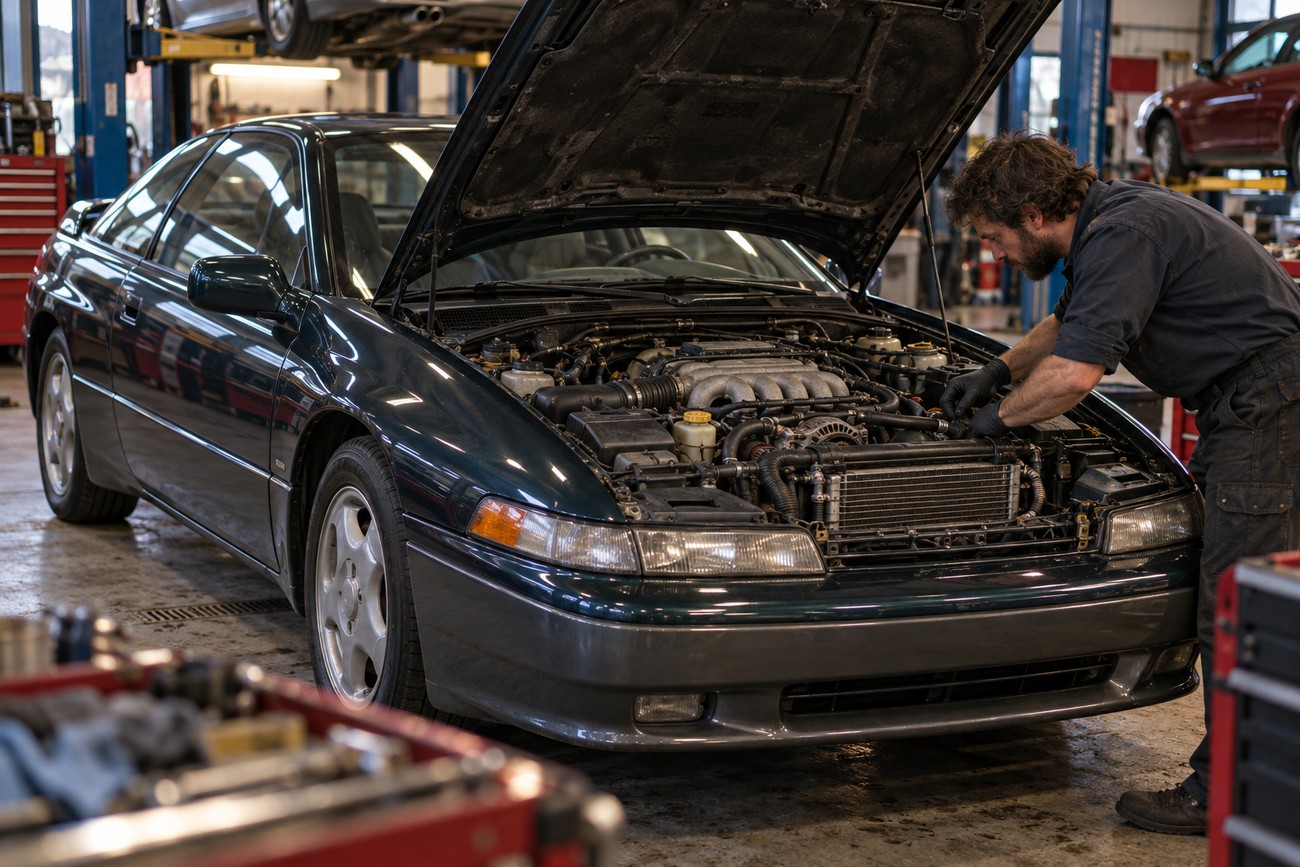
Begin with the transmission and cooling system, regardless of paint quality. Look for evidence of an auxiliary transmission cooler, inspect its installation and airflow, and check whether the main cooling system is clean and properly maintained. Test the automatic when fully warm, paying attention to shift quality, slipping, delayed engagement, and behavior under sustained load.
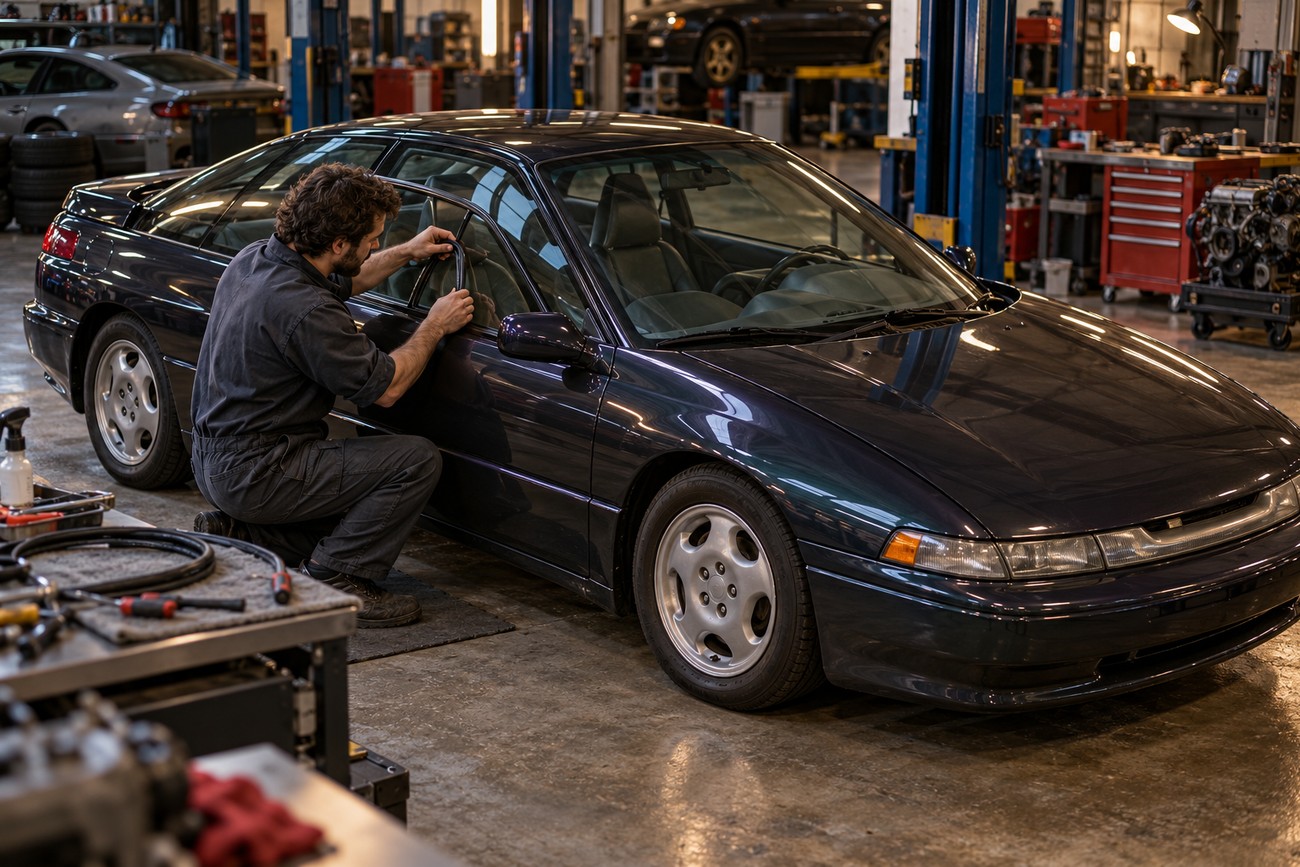
Operate every window and listen carefully around the doors and canopy. The glass should move smoothly, reach its correct position, and seal without excessive force. Check the headliner, carpets, door cards, and trunk area for signs of water intrusion, then inspect the seals for shrinkage, hardening, or improvised repairs.
Corrosion deserves inspection below eye level. Examine the sills, wheel arches, floor areas, and other poorly protected sections rather than relying on an attractive exterior finish. A vehicle that has been cosmetically restored may still contain structural rust or previous patchwork beneath the surface.
Crash repairs around the doors and glass are especially serious. Even when the panels match and the paint is polished, distorted door apertures or roof edges can leave permanent wind noise and leaks. Check panel gaps, glass alignment, door closing effort, and evidence of repairs around the frame before treating the car as a usable grand tourer.
Confirm the drivetrain specification and market origin through identification documents, wiring, lighting, and control units. FWD and AWD versions may require different parts, and imported cars can carry market-specific electronics. Service records should show cooling-system work, transmission-fluid attention, and electrical repairs; without that evidence, keep a separate parts and repair budget and accept that the car may sit for months while components are found.
What Can Be Fixed—and What Makes a Bad SVX a Bad Bet
Age-related work is manageable when the body is straight and the car is complete. Some suspension, brake, and consumable components can be selected through compatible Subaru applications, which reduces the burden of maintaining the chassis. This cross-compatibility does not extend to every component, so each proposed substitute still needs confirmation against the exact market and model year.
Specialized glass, seals, regulators, electronics, and transmission work remain a different category. Their scarcity can make a technically repairable car uneconomic, particularly when several systems have been neglected at once. A complete car with a sound structure is therefore more valuable than a cheaper example missing rare trim or glass.
Modifications can make the situation worse. Excessive lowering may alter suspension geometry, reduce usable travel, and introduce vibration, while improvised exhaust work can create noise and fitment problems. Power tuning is equally questionable because the AWD drivetrain and four-speed automatic were not designed around aggressive increases in output.
Low liquidity adds a final practical concern. A healthy SVX may still take a long time to sell outside enthusiast circles, and buyers will usually examine corrosion, glass, transmission health, and documentation closely. Treating the car as an easily reversible purchase can lead to a large loss of time and money even when the underlying vehicle is fundamentally sound.
Why the SVX Failed—and Why It Still Matters
The SVX combined exotic styling with a single four-speed automatic, high fuel consumption, and a specialist repair burden. Its limited practicality made the ownership proposition harder to justify beside more conventional coupes and sedans. The car looked like a performance statement while demanding the operating budget and patience of a rare touring machine.
Its unusual classwork added engineering interest and visual identity, yet it also raised the cost of body repairs and weather sealing. EG33-specific parts, aging electronics, and the limited specialist network enlarged the gap between routine service and serious restoration. Rarity created enthusiast interest without automatically creating a reliable supply chain.
The cabin and cargo area reinforce the same tension. The SVX is large on the outside, but rear-seat room and useful cargo capacity are less generous than the body suggests. It works best when its owner values its design, cruising ability, and technical character more than maximum practicality or low running costs.
The verdict is straightforward: the SVX is compelling as a preserved grand tourer or a supported enthusiast project. It is a poor choice as an inexpensive daily driver, especially without access to parts, diagnostic expertise, and a reserve for transmission or glass work. A good example can be deeply rewarding; a neglected one can remain immobilized while its most unusual components are located.
Frequently asked questions
Survivor counts are hard to pin down because no authoritative worldwide registry exists. The SVX’s commercial difficulties reflect its unusual mix of design, practicality, and ownership costs. For buyers, condition and completeness matter more than rarity alone.
How many Subaru SVX are left?
No authoritative worldwide survivor registry exists for the Subaru SVX. Country-by-country registration records cover different periods and legal categories, while imported cars may appear in more than one market’s records. Dismantled, exported, abandoned, and unregistered cars further weaken any attempt to create a reliable global total.
Claims that the SVX is definitively Subaru’s rarest model should therefore be treated cautiously. Its scarcity is clear in many markets, but there is no universally accepted official ranking or complete worldwide database. For a buyer, the condition and completeness of an individual car matter more than an unsupported survivor count.
Why did the Subaru SVX fail?
The SVX paired exotic design with limited practicality, one automatic transmission, high fuel consumption, and specialist ownership costs. Buyers had more conventional alternatives that were easier to service, easier to use every day, and less dependent on rare glass, EG33-specific parts, and specialist knowledge.
The car’s grand-touring strengths did not fully compensate for that ownership equation. Its rarity and distinctive engineering later created a devoted following, yet those qualities also make neglected examples expensive to restore. The commercial outcome reflects the difficulty of selling an unusual, high-cost coupe to a broad market.
How much is a Subaru SVX worth?
SVX value is driven more by condition, completeness, corrosion, glass, and transmission health than by rarity alone. A straight, rust-free car with working window mechanisms, documented cooling work, and reliable drivetrain support belongs in a different category from a cosmetically attractive project with leaks, damaged glass geometry, or a failing automatic.
Assess the car as a complete system before comparing asking prices. Missing trim, unavailable seals, electrical faults, and an uncertain transmission can outweigh fresh paint or an attractive interior. Local parts availability and the time required to obtain specialist repairs also affect the practical value of the car.







