
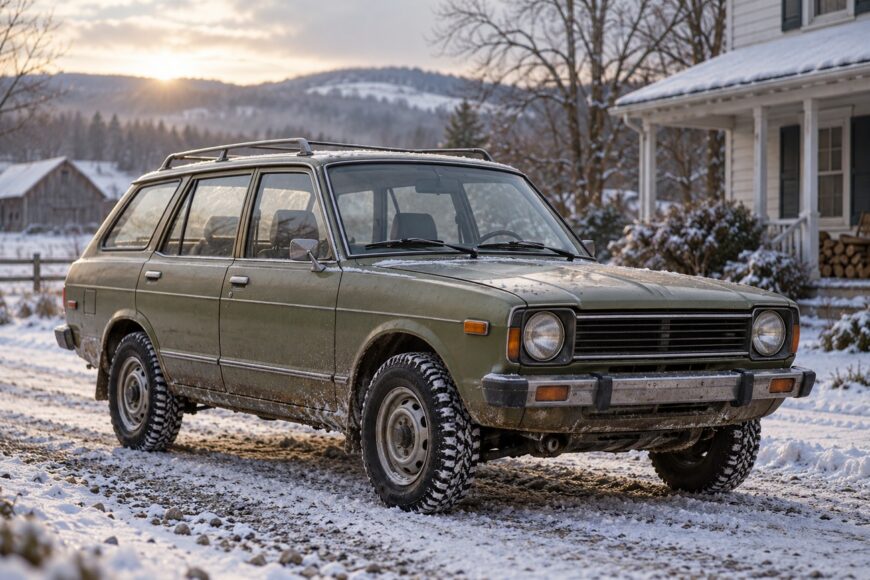
The Subaru Leone is remembered as the car that helped make four-wheel drive part of Subaru’s passenger-car identity. That reputation is justified, especially because the four-wheel-drive wagon arrived in September 1972. The less romantic reality is equally important: the Leone was an aging compact, many examples were front-wheel drive, and its early system was a basic part-time arrangement rather than modern permanent Symmetrical AWD.
That distinction changes how the car should be understood and bought. A four-wheel-drive Leone could give a family wagon useful traction on snow, mud, and rough roads, yet it was not an SUV and did not offer the effortless behavior of a later Subaru. Its historical importance lies in the direction it established, while its ownership appeal depends almost entirely on body condition, specification, and maintenance history.
- Why the Subaru Leone Wagon Changed the Conversation
- Early AWD Was Not Modern Symmetrical AWD
- Three Generations, Many Leones: Bodies, Engines, and Markets
- What the Four-Wheel-Drive Wagon Was Actually Good At
- Buying a Surviving Subaru Leone: Inspect the Shell Before the Story
- Living With the Leone—and Understanding Its Legacy
- Frequently asked questions
- When did Subaru start using AWD?
- Which Subaru has the best AWD system?
- What was the name of the 1989 Subaru wagon?
- What is the rarest Subaru car?
Why the Subaru Leone Wagon Changed the Conversation
Subaru introduced the Leone in 1971, beginning with a front-wheel-drive coupe. Over its 1971–1994 production run, the model passed through three generations and expanded into a much broader family of sedans, wagons, coupes, and three-door hatchbacks or liftbacks. The important change came in September 1972, when Subaru added a four-wheel-drive wagon.
The wagon mattered because it connected traction with ordinary transport. A coupe could demonstrate engineering ambition, but a wagon carried passengers, tools, and cargo while dealing with snow-covered roads and imperfect rural surfaces. That made four-wheel drive easier to understand as a practical passenger-car feature rather than a specialist arrangement reserved for trucks or work vehicles.
Leone is often called one of the first, or the first, Japanese four-wheel-drive passenger cars. That description needs qualification. The answer depends on whether commercial vehicles and pickups are included, and on which launch date is being compared. The defensible point is that the Leone was an early and influential Japanese passenger-car application of four-wheel drive, with the 1972 wagon providing the clearest milestone.
Subaru’s later AWD identity can make the early history look more complete than it was. The Leone did not arrive as a finished version of the systems associated with later Subaru models. It was an evolutionary step: a compact front-drive platform adapted to offer selectable traction, with compromises in refinement that become obvious once you drive an old example.
Early AWD Was Not Modern Symmetrical AWD
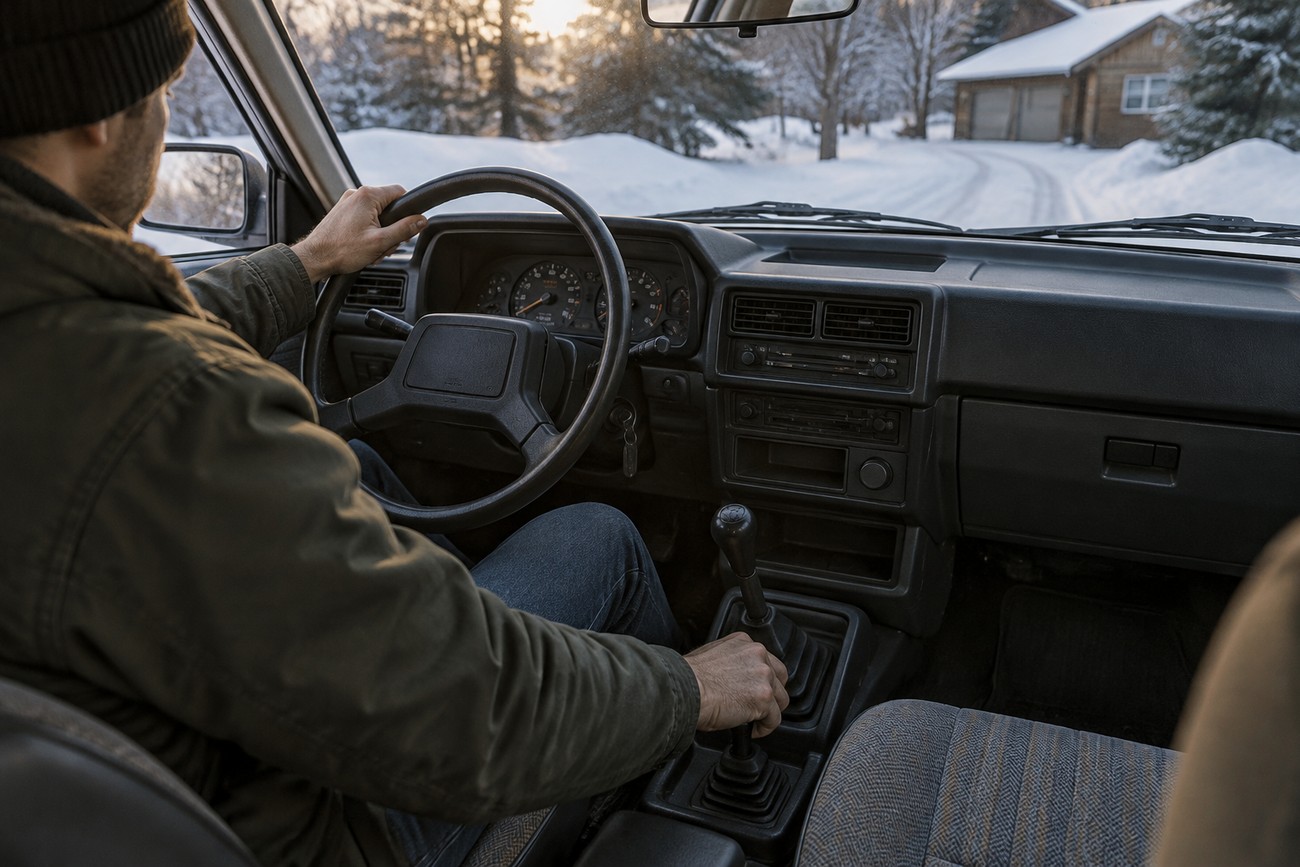
The early four-wheel-drive Leone used a part-time system. In practical terms, the driver selected rear-axle engagement rather than relying on a permanently active, automatically managed AWD system. That arrangement could be effective on loose or slippery surfaces, but it required the driver to understand when the additional traction was appropriate.
Depending on the version, the drivetrain could provide front-wheel drive, selectable four-wheel drive, a low range, and front differential locking. Those features gave some Leones useful ability on steep, slippery, or uneven roads. They also added mechanisms that needed correct adjustment, lubrication, and inspection decades later.
This is different from later permanent Symmetrical AWD. The modern term describes an integrated drivetrain; early Leone four-wheel drive was a manually selected mechanical tool. Using it on the wrong surface or assuming it would compensate for worn tires, damaged differentials, or poor maintenance is a fast way to expose expensive faults.
Subaru did continue developing the concept. In Japan in November 1981, it introduced a four-wheel-drive passenger car with an automatic transmission using a hydraulic multi-plate clutch. That was a significant technical milestone because it reduced the need for manual engagement, but it should not be confused with the arrival of the later Subaru AWD formula. The Leone’s versions varied considerably by market and equipment level.
Three Generations, Many Leones: Bodies, Engines, and Markets
There is no single Leone specification that represents the entire nameplate. Across three generations, buyers could encounter a sedan, wagon, coupe, or three-door hatchback or liftback. The body alone does not establish the drivetrain, transmission, equipment, or intended market, so photographs and familiar trim names are poor substitutes for documentation.
Power outputs also covered a wide range, approximately from 61–66 hp to 136 hp, depending on engine, market, and body. That spread explains why driving impressions can conflict sharply. A light, modestly powered early car and a later, more powerful version may share the Leone badge while offering very different acceleration, gearing, noise levels, and road manners.
Front-wheel-drive and four-wheel-drive versions coexisted. Some overseas markets received particular four-wheel-drive versions later than Japan, and equipment could change with export requirements. A listing that says “Leone AWD” therefore still needs confirmation of the actual chassis specification, transmission controls, and identification details.
Collectors should judge a car by its generation, drivetrain, originality, and condition rather than by the model year alone. A rare body with the wrong engine or missing four-wheel-drive hardware may be less useful than a less fashionable version with sound structure and complete documentation. Parts interchange is also less predictable than the shared name suggests.
What the Four-Wheel-Drive Wagon Was Actually Good At
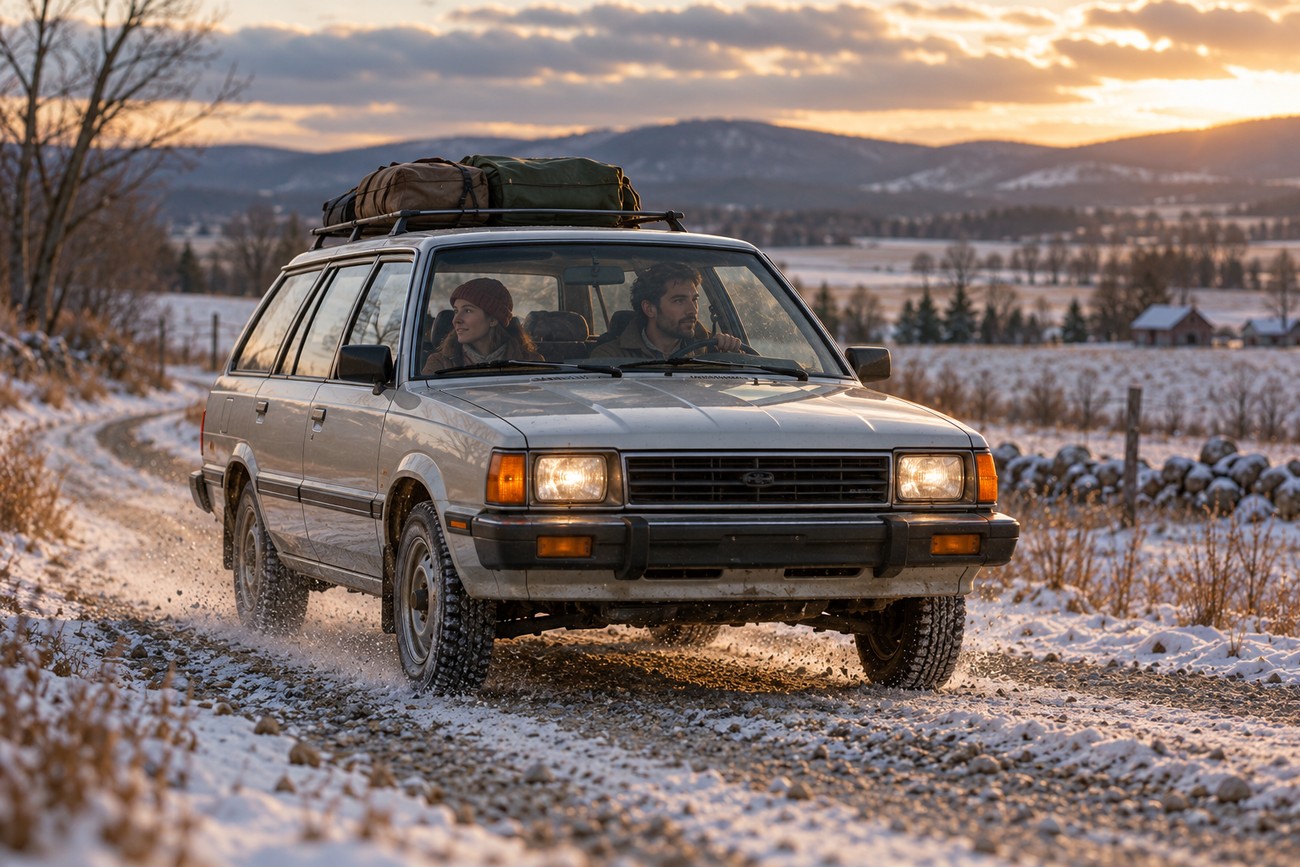
The four-wheel-drive wagon’s strength was practical traction in a compact passenger car. It could combine family seating and cargo space with more useful grip on snow, loose gravel, and rough access roads than an equivalent front-drive car. That made it relevant to ordinary owners who needed dependable mobility rather than an off-road recreation vehicle.
Its limits were just as important. The Leone remained a compact car with car-like ground clearance, suspension, comfort, and durability expectations. Selectable four-wheel drive could help the tires find traction, but it did not turn the wagon into a full SUV, nor did it make damaged roads harmless to the body, suspension mounts, or underbody.
One account links the model’s development to a request from Tohoku Electric for use in mountainous areas. That is best treated as an unconfirmed anecdote, not as the established sole reason for the Leone’s design. The broader engineering logic is easier to support: a lightweight wagon with a mechanically straightforward traction system suited markets where winter roads and rural surfaces mattered.
Mechanical simplicity was part of the appeal, but it came with a trade-off. The driver had more responsibility, the system was less smooth and automatic, and old components can transmit vibration and noise directly into the cabin. The wagon was useful because it was adaptable, not because it delivered the isolation or convenience expected from a contemporary crossover.
Buying a Surviving Subaru Leone: Inspect the Shell Before the Story
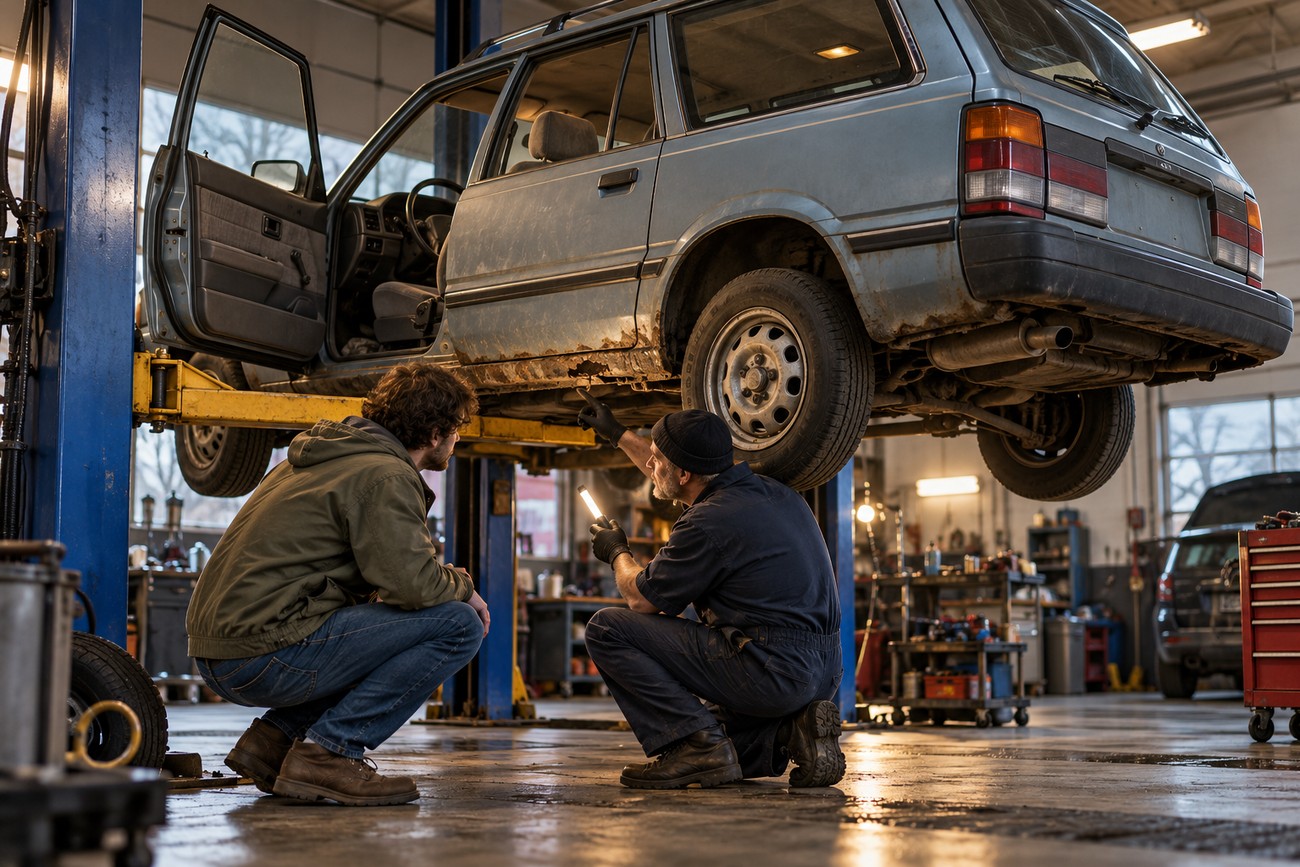
Start with the body, not the engine bay or the seller’s description of rare equipment. Inspect the floor, wheel arches, sills, underbody, suspension mounting points, and structural attachment areas from above and below. Corrosion in a cosmetic panel is repairable; corrosion around load-bearing structures can determine whether the project is financially sensible.
Look for fresh underseal, thick paint, and recent welding that may conceal rather than solve rust. Check drain areas, seams, inner arches, and the places where suspension loads enter the shell. A clean-running engine cannot compensate for a weakened body, and welding access may be difficult when replacement panels are unavailable.
Once the shell is understood, confirm whether the car is front-wheel drive or four-wheel drive and establish how its controls are supposed to operate. Test engagement mechanisms, clutch operation where fitted, differentials, reduction gearing, and the condition of the relevant linkages. Do not assume that a lever moving through its positions means the rear axle is actually receiving drive.
Parts supply can turn a seemingly cheap project into a long-term storage problem. Many original components are discontinued, while used parts may be scarce and market-specific. Before buying, record the chassis and drivetrain details, inspect the transmission and differential for leaks or abnormal noise, and identify likely sources for service items, body panels, and four-wheel-drive hardware.
The individual owner-maintained car matters more than its badge, advertised rarity, or model year. A documented, structurally sound front-wheel-drive Leone may be a more realistic ownership proposition than an incomplete four-wheel-drive wagon with an attractive story. Set aside a realistic welding budget before negotiating around trim or collector language.
Living With the Leone—and Understanding Its Legacy
Driving an old Leone can reveal the engineering compromise immediately. Boxer-engine and drivetrain noise, vibration, modest insulation, and basic suspension behavior may be normal for an aging example, yet normal does not mean pleasant. On a short rural drive those traits can feel characterful; during daily commuting they may become fatigue rather than charm.
Performance also varies too much for broad claims. The lower-powered versions can feel slow in modern traffic, while later or stronger variants may be easier to use. Even a healthy car will not necessarily match the comfort, acceleration, braking feel, or refinement that a modern driver expects, and a romantic reputation should not be treated as evidence of everyday usability.
The most useful way to value the Leone is as a working stage in Subaru’s development. It helped make four-wheel-drive practicality part of a passenger-car identity and gave Subaru experience with selectable systems, automatic engagement, packaging, and market demand. Later permanent AWD systems were an evolution from this history, not a feature that every Leone already possessed.
That makes the best surviving examples especially interesting, but it also makes careless buying dangerous. The car rewards an owner who values mechanical history, unusual engineering, and hands-on preservation. It punishes anyone who assumes that “AWD,” “rare,” or “classic Subaru” automatically means capable, comfortable, or easy to repair.
Frequently asked questions
The questions below clarify the Leone’s place in Subaru’s four-wheel-drive history, its differences from later models, and the factors that matter when evaluating a surviving example.
Early selectable systems, later automatic engagement, market differences, and vehicle condition all affect how these cars should be understood.
Model identity and documentation are especially important when comparing specifications, parts, and rarity.
When did Subaru start using AWD?
Subaru’s key passenger-car four-wheel-drive milestone was the September 1972 introduction of the Leone wagon with selectable, part-time four-wheel drive. This was not modern permanent Symmetrical AWD; the rear axle was manually engaged on early versions.
A separate milestone came in Japan in November 1981, when Subaru introduced a four-wheel-drive passenger car with an automatic transmission using a hydraulic multi-plate clutch. Therefore, 1972 identifies the early wagon breakthrough, while 1981 identifies an important step toward automatic four-wheel-drive operation.
Which Subaru has the best AWD system?
There is no universal winner because the systems serve different purposes. The Leone’s selectable part-time arrangement suits historical interest and certain rough or slippery-road tasks, while later permanent systems offer a different balance of continuous traction, refinement, and driver convenience.
The best choice depends on road use, maintenance access, tolerance for mechanical involvement, and whether originality matters. A well-maintained later Subaru may be more practical, while a sound Leone can be the more meaningful choice for someone specifically interested in the development of Subaru four-wheel drive.
What was the name of the 1989 Subaru wagon?
There was no single name for every 1989 Subaru wagon. The Leone wagon was still in production, while the newer Legacy wagon arrived in some markets in 1989. Names and availability differed by market, so the year alone does not identify the model.
That distinction matters because a seller or parts catalog may use “Subaru wagon” loosely. Confirm the model, generation, engine, and market before assuming that a Legacy component fits a Leone.
What is the rarest Subaru car?
There is no universally agreed rarest Subaru. Rarity depends on the market, body style, drivetrain, surviving examples, originality, and documentation, so a limited-production version in one country may be common elsewhere.
A rare Leone specification should be judged by the same evidence. A documented, original four-wheel-drive wagon with complete equipment may be more significant than a car described as rare simply because few examples remain visible. Condition and verifiable identity are essential parts of rarity.







