
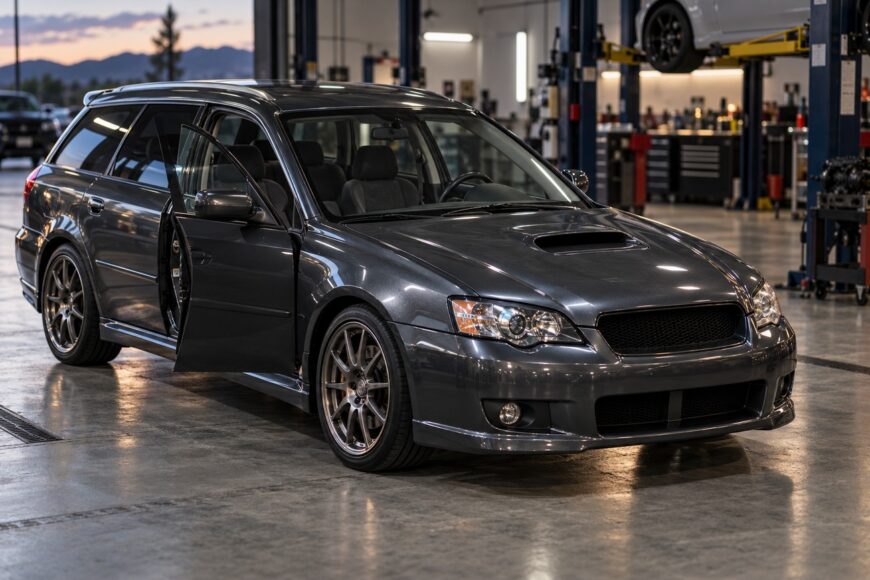
A manual, turbocharged all-wheel-drive wagon has an appeal that survives changing fashions: it can carry luggage and passengers, then make a winding road feel worth taking. The BP/BL-generation Subaru Legacy spec. B is one route to that combination, with a chassis tuned more sharply than an ordinary Legacy. Finding the right car, however, takes more work than finding the right badge.
“Spec B” does not describe the same engine, body style, or gearbox in every market. The U. S. Legacy GT spec. B was a sedan, while factory turbocharged spec. B wagons appeared in markets including Japan. For a buyer seeking the manual turbo wagon, the real task is to establish what the car was when it left the factory—and whether its engine, cooling system, and modifications still make it a sound purchase.
- Why the manual turbo wagon is hard to pin down
- Spec B by market: which versions fit the brief?
- What the Spec B chassis adds to the wagon
- The turbo engine: condition matters more than claimed power
- How to inspect one before buying
- Living with it—and modifying without costly shortcuts
- Frequently asked questions
- How many Subaru Legacy spec. B wagons were made?
- What year of Subaru Legacy should I avoid?
- What is spec. B on a Subaru Legacy?
- How many Subaru Legacy spec. B models were made?
- Which year of Subaru Legacy should I stay away from?
Why the manual turbo wagon is hard to pin down
The BP/BL-generation Legacy was sold in different configurations across markets, and the spec. B designation followed those local model ranges. In the United States, the Legacy GT spec. B was offered as a sedan for 2006–2009. A listing for a “U. S. spec. B wagon” therefore deserves scrutiny before its claimed rarity becomes part of the price.
Factory turbocharged spec. B wagons did exist, notably in Japan. They are the cars that best fit the manual turbo wagon brief, provided the particular year and specification actually came with a manual gearbox. Import paperwork, model codes, and original equipment matter more here than a seller’s shorthand description.
A manual turbo Legacy wagon is not automatically a factory spec. B. It might be another Legacy GT variant, or it might have acquired spec. B trim and a six-speed through a conversion. Such a car can still be enjoyable, but its identity affects how you assess its value, parts compatibility, and the quality of the work done to it.
The badge alone also guarantees neither a turbo engine nor a six-speed manual across all markets and years. Treat “spec. B” as the start of a specification check, not the end of one. That distinction keeps an interesting imported wagon from being judged against specifications it never had.
Spec B by market: which versions fit the brief?
The versions below show why market and year must accompany any spec. B claim. Quoted outputs are approximate, and the gearbox fitted to an individual car still needs verification.
| Market and version | Body style | Engine and approximate quoted output | Manual-gearbox availability |
|---|---|---|---|
| U. S. Legacy GT spec. B, 2006–2009 | Sedan | Turbocharged EJ255, approximately 243–250 hp depending on year and quoted specification | Manual; transmission specification varies by year. Not a U. S.-market spec. B wagon. |
| JDM turbocharged Legacy GT spec. B | Wagon, among other configurations | Turbocharged 2.0-litre EJ20X/Y-family engine, approximately 260–280 hp depending on year and configuration | Manual examples exist; confirm the gearbox fitted to the specific car. |
| Non-turbo Legacy spec. B variants in some markets | Market- and year-dependent | Naturally aspirated engine; check the local factory specification | Market- and year-dependent. The badge does not establish a manual turbo configuration. |
What the Spec B chassis adds to the wagon
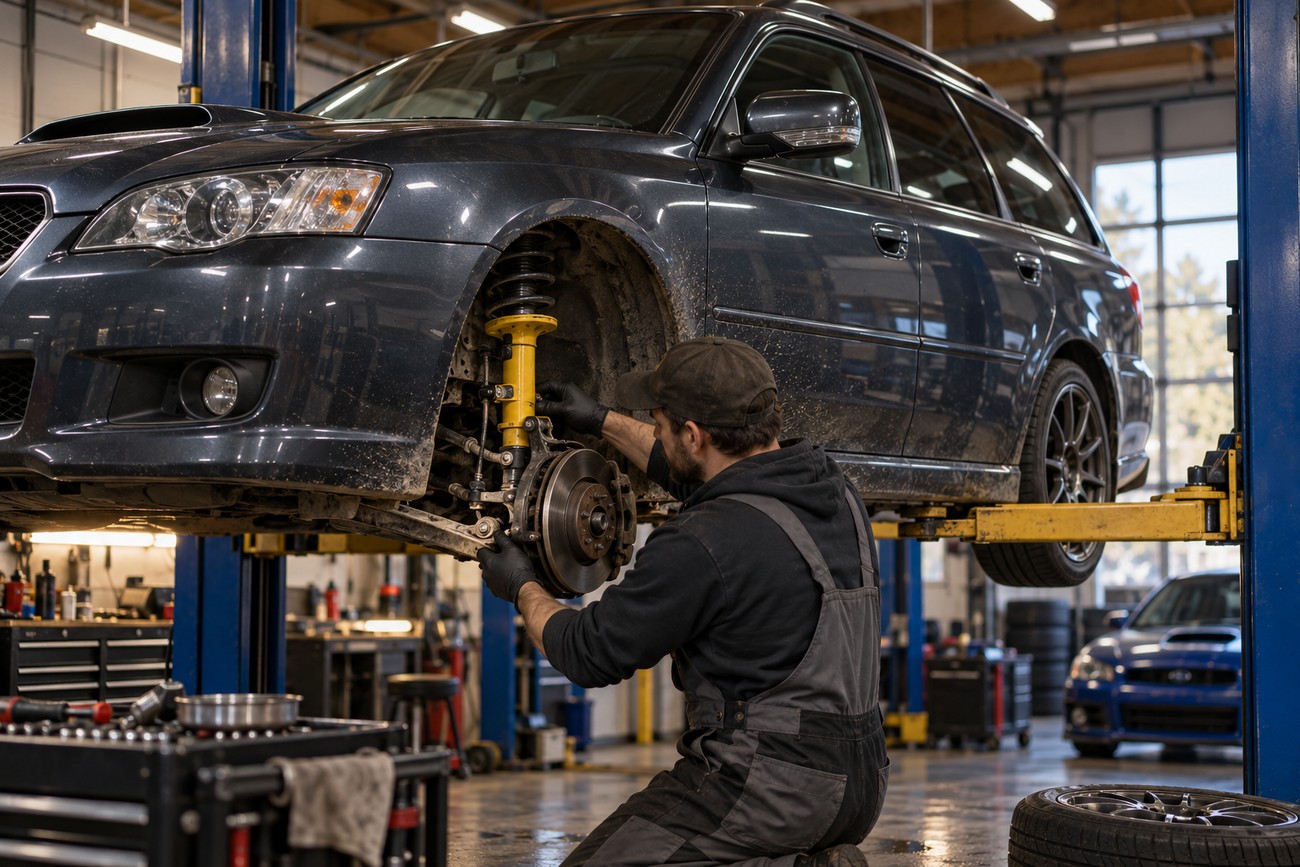
The appeal goes beyond engine output. Depending on market and year, spec. B equipment includes Bilstein-type dampers and other suspension and trim differences from a standard Legacy GT. A well-sorted car feels controlled through successive bends while retaining the enclosed load space and everyday usefulness of a Legacy wagon.
Manual shifting and all-wheel-drive traction give the qualifying turbo wagons much of their character. The drivetrain helps the car put power down on a wet exit, but it does not make every example mechanically identical: gearbox ratios and differential arrangements vary. Check the fitted transmission and differential codes before ordering parts or assuming a particular driving feel.
Owners often describe the combination as closer to a sporting wagon than the phrase “family car” suggests. That impression comes with a trade-off. The firmer ride and relatively modest clearance are more noticeable on broken pavement and steep entrances than they are on a smooth test-drive route.
Stock brakes also deserve realistic expectations. They may be adequate for ordinary road use yet fade under repeated hard braking, particularly on a long mountain descent or a track session. Brake condition, tires, and fresh fluid are better starting points than assuming the spec. B chassis makes the whole car ready for sustained hard use.
The turbo engine: condition matters more than claimed power
The U. S. Legacy GT spec. B used the turbocharged EJ255, quoted at approximately 243–250 hp depending on year and specification. A JDM turbocharged spec. B wagon instead used a 2.0-litre EJ20X/Y-family engine, depending on year and configuration, with approximate quoted output of 260–280 hp. Those figures identify different factory starting points; they say little about the health of a car now.
Fuel quality and ECU calibration matter on a turbocharged Legacy, particularly after changes to boost or hardware. An undocumented remap can leave a buyer guessing which fuel the engine was tuned for and whether its supporting components match. Even a car advertised as stock deserves a close look for removed aftermarket parts, disturbed plumbing, and gaps in its service history.
Diagnose a suspected cooling fault from temperature behavior, coolant loss, pressure-test results, and related evidence. A seller’s claim that every EJ turbo needs head gaskets is no substitute for testing this engine.
Overheating, low fluid levels, poor fuel, and unsuitable tuning increase the risk of expensive engine trouble. Oil consumption and signs of coolant loss warrant investigation, but neither head-gasket failure nor a fixed failure mileage can be assumed from the model name. A properly maintained stock car can still develop faults; a modified car can only be assessed against the quality of its parts, calibration, and records.
Running costs reflect how the car is used. Owners report roughly 13–15 L/100 km in town and 9–10 L/100 km on a gentle highway run, with substantially higher consumption possible under boost or in demanding conditions. Those are owner reports rather than guaranteed factory figures, but they are a useful check on anyone expecting economy-car fuel bills.
How to inspect one before buying
Start with identity before discussing performance claims. Compare the VIN or chassis identification with market-specific factory records, then check the transmission code and installed components against that specification. A badge, desirable interior, or six-speed conversion can make a car look convincing without proving that it left the factory as a spec. B wagon.
Next, reconstruct what has changed. Ask for service invoices, ECU calibration information, and documentation for any turbo, intercooler, fuel-system, or cooling upgrades. If parts have been returned to stock, establish what was fitted previously; a standard-looking engine bay does not erase its tuning history.
See the engine start cold, check fluid levels and condition, and watch how it reaches and holds operating temperature. Look for oil use, coolant loss, leaks, rough running, and warning lights rather than accepting an explanation for each symptom in isolation. Compression or leak-down testing is worthwhile when symptoms or history justify it, with results interpreted by someone familiar with the engine.
Inspect the gearbox, clutch, differentials, driveshaft, and wheel bearings during a proper road test and workshop check. On cars from salted-road regions, examine rear arches, sills, and suspension mounting areas closely; corrosion there can matter more than worn bolt-on parts. Finish with the dampers, suspension joints, tires, and brakes, then get a specialist inspection before committing to a car whose repairs could exceed the attraction of its badge.
Living with it—and modifying without costly shortcuts
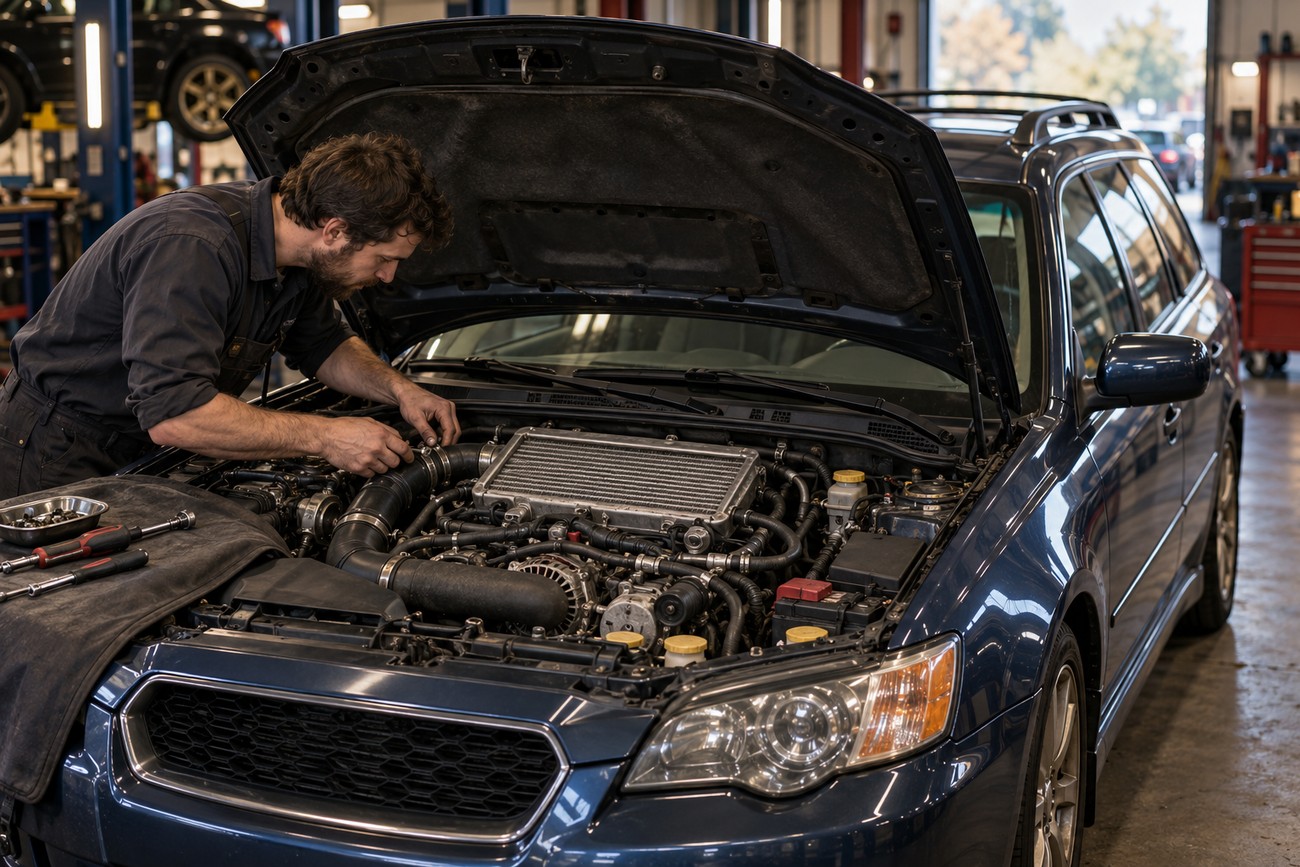
A healthy manual turbo wagon can handle commuting and travel while making an ordinary drive engaging. It asks more of its owner than an ordinary Legacy: the ride is firm, reported urban fuel use is roughly 13–15 L/100 km, and the all-wheel-drive drivetrain adds components to maintain. Depending on where the car is registered, insurance and tax can add to that difference.
Age brings smaller expenses alongside the obvious engine risks. Faulty sensors can cause poor running or warning lights, while some spec. B-specific suspension components are difficult to source. Parts from another Subaru or the aftermarket may solve a problem, but fitment and the resulting suspension balance need checking rather than assuming the pieces interchange.
More boost is rarely a cheap shortcut. A larger turbo or intercooler calls for checking fueling, cooling, and ECU calibration, with the engine’s current condition established first. Before repeated mountain or track driving, give the brakes the same attention as the powertrain; additional power does nothing to prevent fade.
The best buyer values the wagon’s particular mix of space, traction, manual control, and sharper handling enough to budget for specialist care. Someone who chiefly needs a comfortable, low-effort family wagon will likely be happier in an ordinary Legacy. The spec. B is most rewarding when bought for its verified specification and condition, rather than a promise attached to the badge.
Frequently asked questions
Production claims and year-based buying advice can sound precise while leaving out the market and configuration that make them meaningful. These answers separate what can be established about a particular Legacy from what cannot be inferred from the spec. B name alone.
How many Subaru Legacy spec. B wagons were made?
No verified worldwide factory spec. B wagon production total is available here. The limited U. S. GT spec. B run covered sedans, so it cannot be used as a wagon total. If a seller cites a rarity figure, ask which market, years, body style, and factory records it covers; an unsupported number should not outweigh condition or provenance.
What year of Subaru Legacy should I avoid?
There is no substantiated single worst Legacy year across all markets and configurations. A well-documented car from a year you have heard criticized may be a better purchase than a newer example with an unexplained remap, cooling symptoms, or structural rust. Narrow the search by market and engine first, then judge each car on records and inspection results.
What is spec. B on a Subaru Legacy?
Spec. B is a market-dependent Legacy specification associated with chassis, equipment, and trim changes; it is not a universal engine or body-style designation. To establish what it means on one car, use its year and original-market specification. Its badge alone cannot tell you whether that car was built as a turbocharged manual wagon.
How many Subaru Legacy spec. B models were made?
A single worldwide number for all Legacy spec. B cars is not established by the information available here. The name appeared on different configurations in different markets, making an unqualified total easy to misinterpret. A production claim is useful only when its source and the exact model range being counted are clear.
Which year of Subaru Legacy should I stay away from?
Avoid choosing—or rejecting—a Legacy on model year alone. For the manual turbo wagon in particular, factory identity, modification history, cooling behavior, and corrosion are more discriminating than a blanket year ranking. If those points cannot be verified, walking away from that individual car is the safer decision, whatever year is on its registration.







