
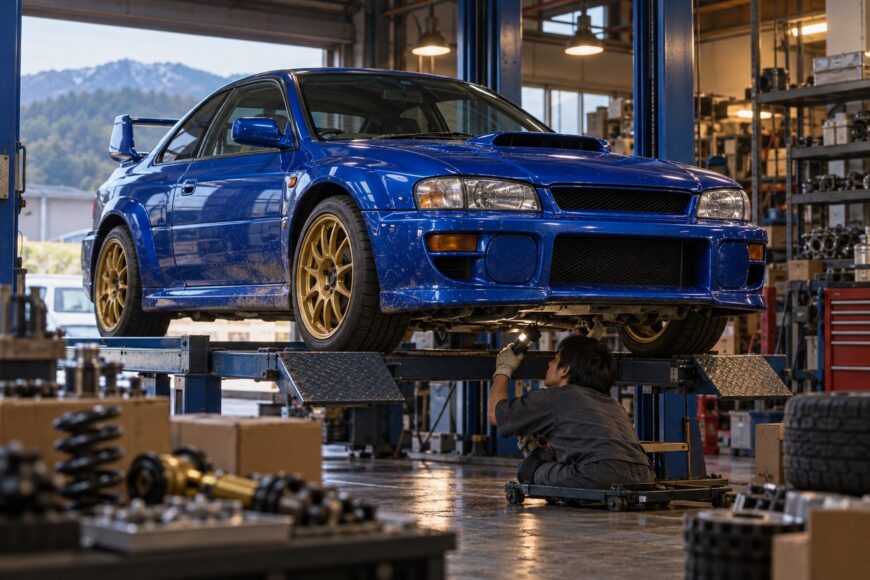
The Subaru Impreza 22B STI occupies an awkward place between rally mythology and collector-car reality. Its widebody silhouette suggests a road-going WRC weapon, yet the actual car is a limited-production 1990s Subaru with aging electronics, vulnerable engine components, scarce body panels, and a value that can make ordinary road use uncomfortable.
Authenticity, condition, and usability matter more than the visual impact of the flared arches. An original car may deserve preservation, careful driving, or both; a replica can deliver much of the mechanical entertainment at a fraction of the cost, provided it is bought as a modified GC8 rather than misrepresented as factory history.
- Why the Subaru Impreza 22B Became a Legend
- What the 22B Changed Under the Widebody
- The 22B and the Replica Problem
- The 22B STI Versus a 22B-Style Replica
- Ownership Reality: Rust, Heat, Parts, and Service
- Driving the Legend: Fast, Focused, and Less Comfortable Than Expected
- How to Buy and Preserve an Original 22B
- Value, Rarity, and the Price of Provenance
- Frequently asked questions
- How many Subaru 22Bs are left?
- Why do sources disagree about how many 22Bs were built?
- What is the rarest Subaru Impreza?
Why the Subaru Impreza 22B Became a Legend
The Subaru Impreza 22B STI was created to celebrate Subaru’s WRC victories and the company’s 40th anniversary. Its timing connected a successful competition program with the road-going Impreza’s growing reputation, giving the car a symbolic importance beyond its production numbers.
The main production figure is commonly reported as 400–424 cars, with approximately 25–30 additional cars associated with UK, prototype, or other export-market allocations. The car was initially sold only in Japan, which made its later appearance in overseas collections more unusual and complicated.
That scarcity helped turn the 22B into a cultural shorthand for Subaru’s rally era. The blue paint, gold wheels, hood scoop, large rear spoiler, and broad arches made the connection immediately legible, even to people who had never followed the World Rally Championship closely.
The comparison with a factory WRC car needs restraint. The 22B was a rally-influenced road car, not a stock 400-hp WRC machine or a road-legal Group A competition car. Its legend comes from the combination of timing, rarity, engineering changes, and visual identity rather than from direct equivalence with a works rally chassis.
What the 22B Changed Under the Widebody
The 22B’s identity begins with the EJ22G, a 2.2-liter turbocharged flat-four. Its factory rating was 280 hp, with approximately 363 N·m at 3,200 rpm, reflecting Japan’s gentleman’s-agreement era. Real output may be somewhat higher, but that does not turn the car into a WRC-specification machine.
The engine’s exact lineage remains disputed. Some sources describe the EJ22G as a 22B-specific engine, while others describe it as a heavily revised or enlarged EJ20-family unit. Limited official technical documentation prevents a definitive simplified conclusion, so claims about a wholly separate engine design should be treated carefully.
Its bodywork was more substantial than a cosmetic conversion. Factory-specific widebody panels increased track width, while the aluminum hood, specific bumpers, and distinctive rear spoiler completed a shape that does not match the geometry of an ordinary GC8 with bolt-on extensions. Those panels are part of the car’s identity and are now among its most difficult parts to replace.
Underneath, Bilstein adjustable dampers worked with reinforced suspension components, 22B-specific springs, anti-roll bars, and alignment tuning. The drivetrain combined a five-speed manual transmission, DCCD-equipped all-wheel drive, and an uprated rear differential. The result was a tightly integrated package rather than a standard Impreza with a larger engine and wider fenders.
Stock mass is approximately 1,270–1,300 kg. That low figure helps explain the car’s response, but it also means the 22B depends heavily on tire condition, alignment, damping, and driver inputs. Age, incorrect replacement parts, or an indiscriminate suspension setup can erase much of the character that made the original valuable.
The 22B and the Replica Problem
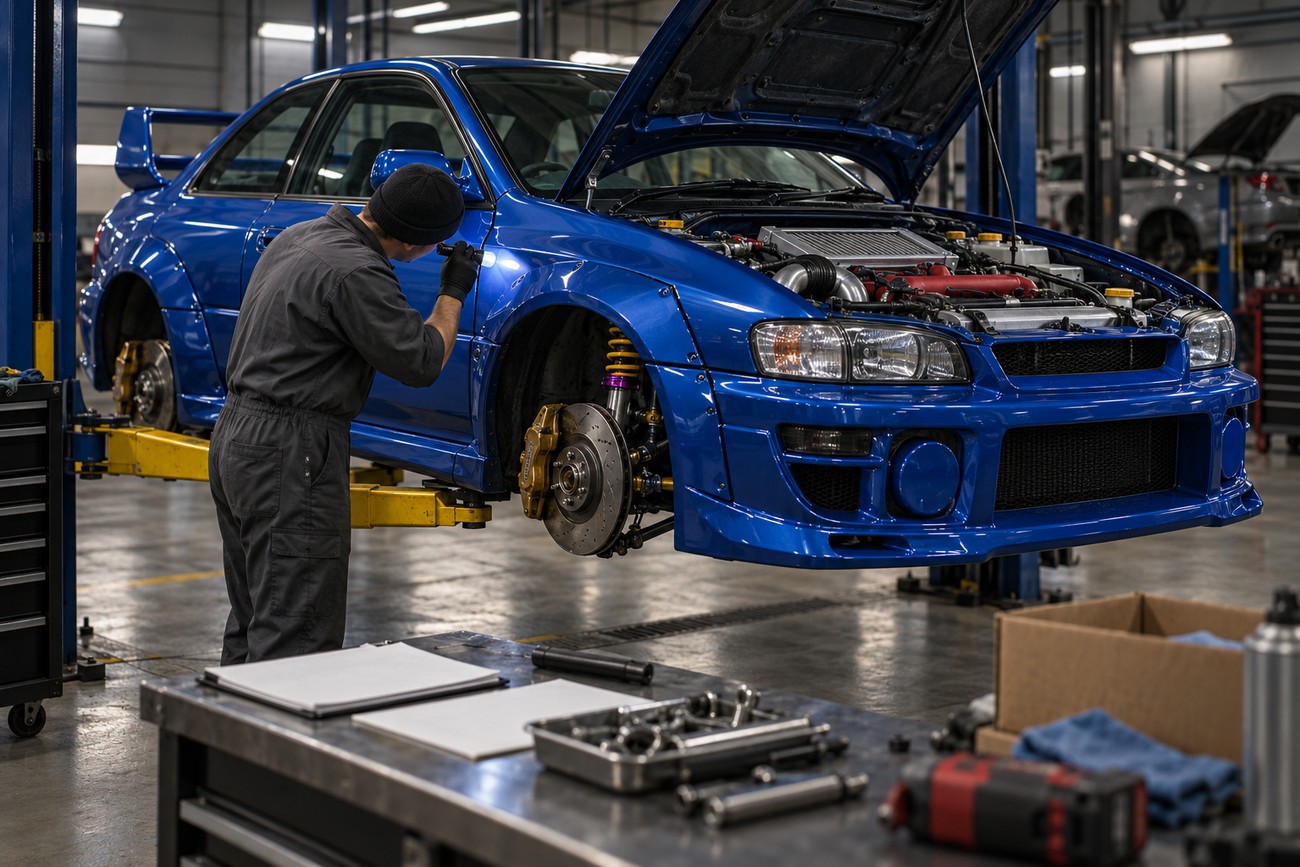
A widebody outline is not proof of identity. Most widebody GC8 cars on the market are replicas or modified cars rather than original 22Bs, often built from ordinary WRX or STI models using aftermarket panels, later engines, and updated suspension.
Authentication requires several independent checks. The chassis or VIN identity, engine markings, model-specific body components, and historical documents should agree with one another. A seller’s claim, a blue paint finish, or a set of gold wheels is weak evidence on its own.
The cabin provides additional clues. Specific upholstery, instruments, badges, steering wheel, and seats can distinguish an original car from a convincing conversion. These details are easy to overlook during a quick inspection, yet collectors often use them to identify missing, substituted, or incorrectly restored components.
A factory certificate, original paperwork, auction history, and low mileage can materially increase collector value. The practical rule is simple: treat a 22B-style kit as evidence of appearance only. It may create an excellent driving car, but it does not create the provenance of a factory 22B.
The 22B STI Versus a 22B-Style Replica
An authenticated 22B and a visually similar GC8 can both be rewarding, but they answer different priorities. The original carries documented historical identity; the replica may offer easier servicing, more replaceable parts, and greater freedom to modify without endangering a rare car.
| Area | Authenticated Subaru Impreza 22B STI | 22B-style GC8 replica |
|---|---|---|
| Provenance | Factory identity supported by chassis or VIN records and a documented history | Usually based on another GC8, with identity determined by its donor-car records |
| Body panels | Factory-specific widebody panels, increased track width, aluminum hood, specific bumpers, and rear spoiler | Aftermarket or adapted panels that reproduce the appearance without proving factory construction |
| Engine | EJ22G, a 2.2-liter turbocharged flat-four, with a factory rating of 280 hp | May retain an EJ20, use another EJ-family engine, or carry a modified powertrain |
| Suspension | Bilstein adjustable dampers, reinforced components, and 22B-specific spring, anti-roll-bar, and alignment tuning | May use standard GC8 parts, aftermarket coilovers, or a mixture of components |
| Drivetrain | Five-speed manual, DCCD-equipped all-wheel drive, and an uprated rear differential | May share the GC8 platform while lacking the 22B’s exact drivetrain specification |
| Interior | Model-specific upholstery, instruments, badges, steering wheel, and seats | Often uses standard WRX/STI trim or replacement parts selected for appearance |
| Documentation | Factory paperwork, auction trail, service records, and provenance can support authenticity | Documentation usually describes the donor car and subsequent modifications |
| Collector value | Driven heavily by originality, verified provenance, condition, mileage, and preserved parts | Primarily reflects build quality, mechanical specification, and driving appeal |
Ownership Reality: Rust, Heat, Parts, and Service
Corrosion is one of the first risks to investigate. Owners report rust in sills, wheel arches, and welded areas, particularly in wet or salted regions. A repaired arch or fresh paint can conceal damage that extends into seams and structural metal, so inspection should include lifting trim and examining the underside where practical.
Original fenders, bumpers, and spoilers are scarce, expensive, and difficult to replace. Damage to a rare panel can turn a minor road incident into a major sourcing problem, especially if an insurer or repairer treats the car like an ordinary GC8. The same concern applies to original suspension, interior, and trim components removed during modification.
Cooling-system history, oil temperatures, fastener practices, and EJ22G-specific service records deserve attention before any search for extra power. Expensive failures often begin with ordinary EJ maintenance being applied incorrectly.
The EJ22G can be durable when correctly maintained, but it retains typical EJ-family risks, including head-gasket failure, oil consumption, and cracked heads under poor maintenance. A neglected cooling system can lead to overheating during hard driving or track use, while an old or unsuitable tuning setup may increase thermal stress.
Age-related wiring, connectors, and sensors become more problematic after tuning or ECU conversion. A car that starts and drives well can still contain brittle wiring repairs, incompatible sensors, or calibration issues that appear only under load. Insurance may also be unavailable on normal terms or unusually expensive in some markets, limiting practical use.
Driving the Legend: Fast, Focused, and Less Comfortable Than Expected
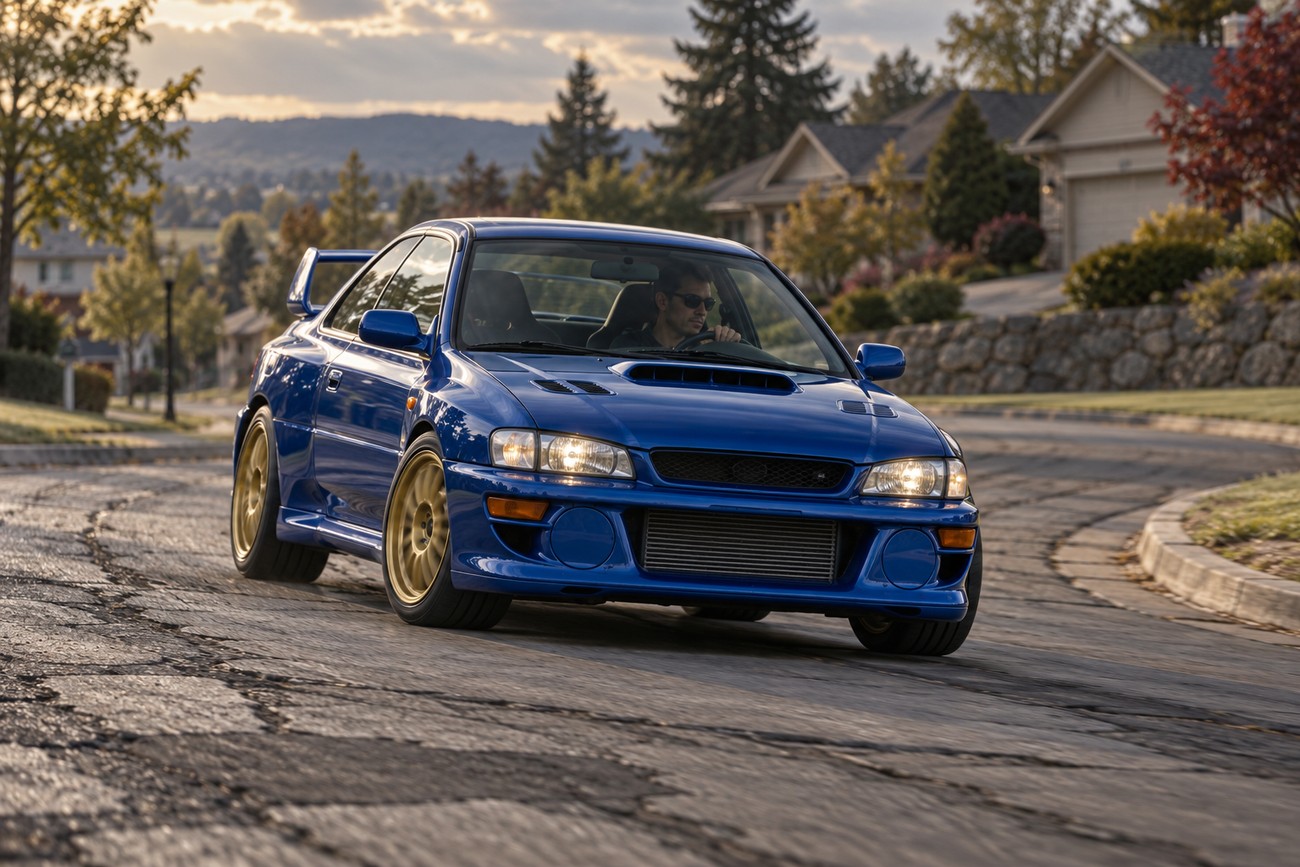
The 22B is tuned closer to a rally-influenced road car than to a comfort-oriented Impreza. Wide wheels, firm suspension, and relatively focused alignment settings give it immediate responses, but they also make uneven public roads feel busy and sometimes harsh.
Factory alignment settings differ from ordinary Impreza settings and are important to the intended handling balance. A generic alignment or a set of replacement dampers chosen solely for availability can make the car tramlines, lose composure, or feel strangely reluctant to rotate.
Braking performance can feel modest by modern standards during repeated hard use. Owners may choose upgraded pads, rotors, lines, or complete brake systems, but each change raises a preservation question: improving the car for real driving can reduce mechanical originality unless the removed parts are stored and documented.
The 22B’s factory rating is 280 hp, not 400 hp, and it remains substantially different from a WRC competition car. Its appeal lies in light weight, traction, response, and mechanical character. Treating it as a miniature rally-stage car encourages modifications that may make the car faster in one context while making it less coherent and less valuable overall.
How to Buy and Preserve an Original 22B
Begin with provenance rather than appearance. A complete auction trail, service records, previous tuning history, chassis documentation, and evidence of original parts should be assembled before a purchase is agreed. A cheaper car with weak provenance can cost more than a documented example once authentication, corrosion repair, and missing components are priced properly.
Mechanical inspection should include a cold start, compression evidence, oil pressure and cooling-system checks, and a careful search for leaks or overheating history. The engine, turbocharger, transmission, differentials, and DCCD operation all deserve specialist attention. Correct 22B suspension geometry and replacement parts may require knowledge that a general performance shop does not have.
Rust inspection must go beyond paint quality. Examine sills, arches, weld seams, floor areas, suspension mounting points, and repaired sections. Cosmetic work can conceal structural corrosion, and an apparently tidy restoration may become expensive if the metal underneath was never properly opened, treated, and documented.
Avoid high-power tuning that ignores EJ-series durability and cooling limits. Aggressive engine modifications can reduce durability and increase thermal stress, particularly when oil cooling, calibration, fasteners, or service intervals are treated as secondary concerns.
Preserve every original component that is removed. Exhaust systems, suspension parts, seats, steering wheels, instruments, and trim may become important to future value even if a modern replacement improves use. Labeling and storing those parts protects the option to return the car closer to factory specification.
Value, Rarity, and the Price of Provenance
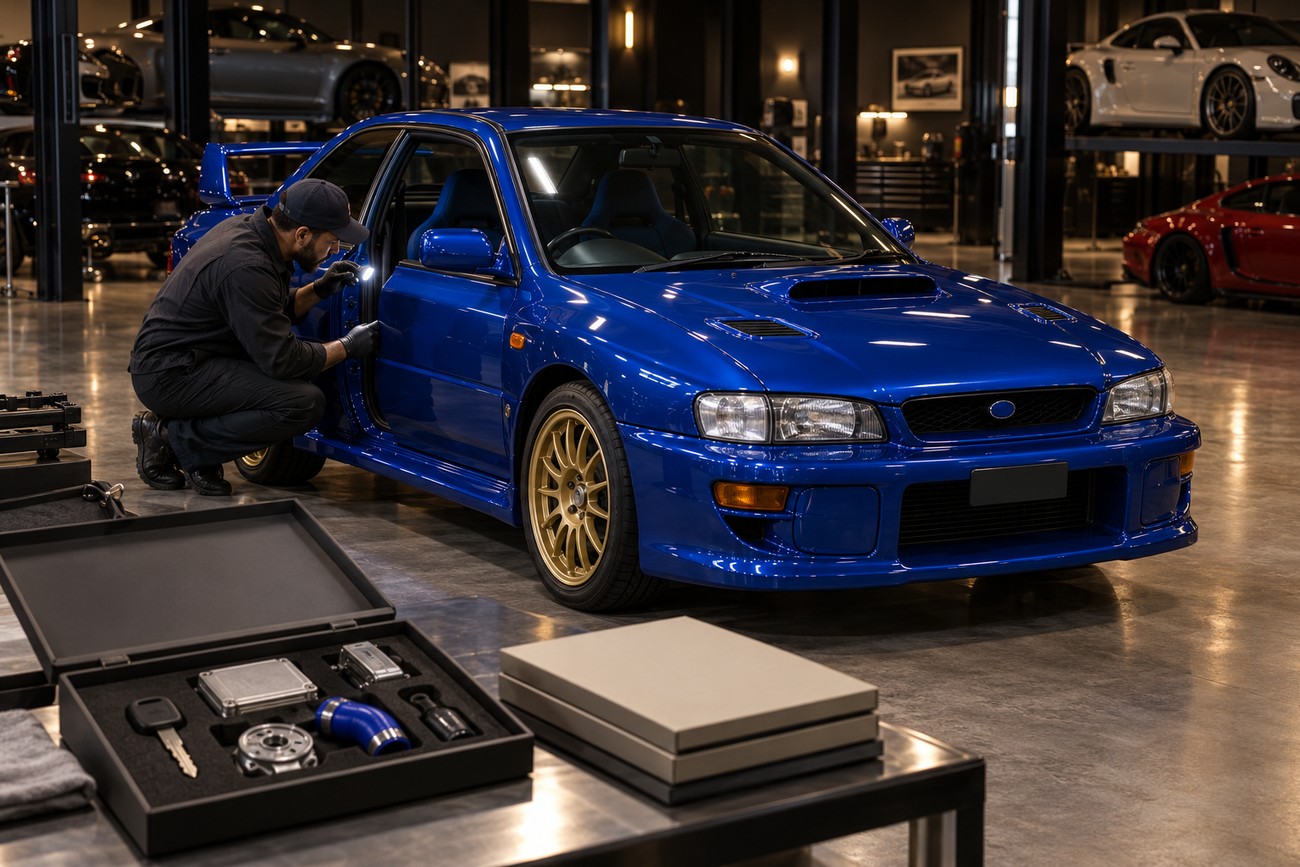
Strong original examples can trade above $250,000–$300,000 at auction, but there is no universal 22B price. Condition, originality, documentation, mileage, market, import status, and legal registration can alter the result substantially.
Production-count reporting is also not perfectly uniform. Commonly cited totals are 400–424 Japanese-production cars plus approximately 25–30 cars associated with UK, prototype, or other non-Japan allocations. Those figures describe how cars were counted and allocated; they do not establish how many remain today.
Low mileage helps, but it is not a substitute for correct preservation. A lightly used car with corrosion, poor storage, or undocumented engine work may be less desirable than a higher-mileage example with an honest history and original specification.
A visually convincing 22B-style conversion does not command the same collector value as an authenticated 22B. It may be a better choice for someone who intends to drive hard, modify freely, or avoid risking irreplaceable bodywork. Its value is then primarily mechanical and experiential rather than historical.
Frequently asked questions
How many Subaru 22Bs are left?
No authoritative public worldwide census establishes how many Subaru Impreza 22B STI cars remain. Original production and export figures show how many were built or allocated, while surviving documented cars form a smaller and less clearly defined group.
Some cars are privately held, stored, modified, exported, or recorded under incomplete histories. A survivor count would also need to separate authenticated cars from replicas and incomplete projects, so claims of a precise worldwide total should be treated cautiously.
Why do sources disagree about how many 22Bs were built?
The commonly cited Japanese-production figure is 400–424 cars, while approximately 25–30 additional cars are associated with UK, prototype, or other non-Japan allocations. Sources may therefore be counting the main Japanese run, export-related cars, prototypes, or different administrative categories.
These figures should not automatically be treated as a simple contradiction. The safest description is that the Japanese production total is commonly reported as 400–424 cars, with additional non-Japan allocations discussed separately.
What is the rarest Subaru Impreza?
The 22B is commonly regarded as the rarest and most collectible mainstream Impreza variant. Its limited production, factory-specific bodywork, EJ22G, distinctive suspension, and WRC-era significance give it a stronger collector identity than ordinary GC8 WRX and STI models.
Prototype and competition cars may be rarer in absolute terms, but they belong to a different definition of rarity. For a production-based, road-oriented Impreza that is recognized by collectors and traded publicly, the 22B is the usual reference point.







