
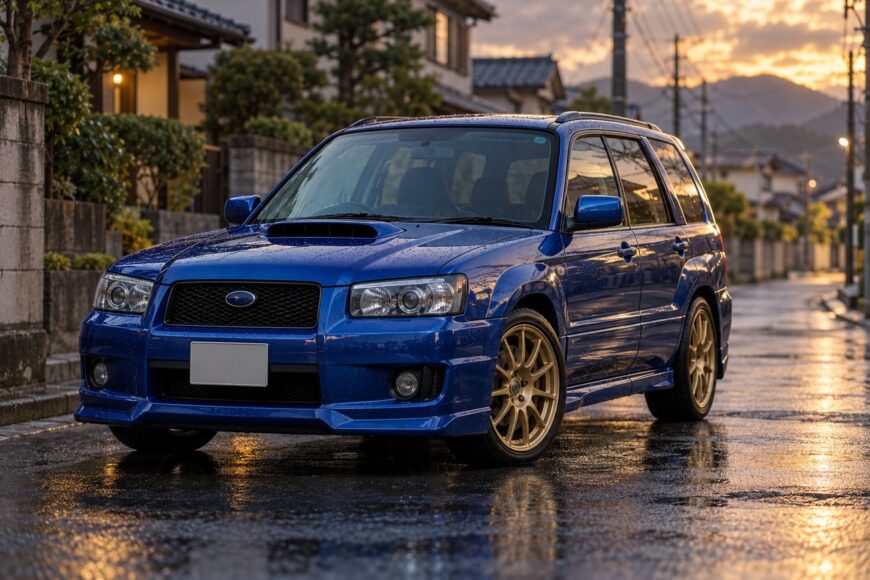
An STI-badged Forester offers an unusual mix of performance hardware and everyday utility. It can carry passengers and cargo while delivering the traction, manual control, braking capacity, and turbocharged response associated with Subaru’s performance range. That combination gives the model genuine appeal among JDM enthusiasts.
The badge alone, however, does not identify the car. Similar STI graphics can appear on very different Forester generations, while age can make an attractive purchase price misleading. The SG9 matters because its identity is tied to a Japanese-market model, a turbocharged EJ25, a six-speed manual, limited-slip differentials, and performance-oriented chassis hardware.
- What Makes the SG9 Forester STI a Genuine JDM Hot SUV
- The Hardware Behind the Badge—and the Driving Trade-Off
- SG9 Forester STI vs SH tS vs SJ STI Suspension Package
- The Ownership Costs Hidden Behind SG9 Rarity
- How to Verify and Inspect an SG9 Before Buying
- Is a Forester STI Worth Buying Today?
- Frequently asked questions
- Can a JDM Forester STI be imported and registered where I live?
- How can you find the correct replacement part for an SG9?
- What is the rarest Subaru STI model?
- What year STI to stay away from?
What Makes the SG9 Forester STI a Genuine JDM Hot SUV
The Japanese-market SG9 Forester STI was produced from 2004. Its defining mechanical package centers on a turbocharged EJ25 flat-four with a displacement of 2457 cm³ and a six-speed manual transmission. Factory output was 265 PS at 5600 rpm and 378 N·m at 3600 rpm.
Those figures are often written as 265 PS or approximately 261 mechanical hp. They describe the same stated output in different measurement units, rather than two separate factory power ratings. This distinction matters when comparing Japanese specifications with listings written for English-speaking markets.
The SG9 is more than a standard Forester XT wearing STI bodywork. Its six-speed manual, limited-slip differential hardware, Brembo brake components, and chassis tuning give it a different engineering purpose. The exact condition of an individual car still matters more than its brochure figures, especially after years of modifications or incomplete maintenance.
Its relationship with the WRX STI is close enough to explain the appeal, but the cars are not mechanically identical. The SG9 is heavier and more practical, with a taller, more useful body and its own suspension calibration. It delivers a performance-oriented Forester experience rather than a WRX STI with an SUV body.
The Hardware Behind the Badge—and the Driving Trade-Off
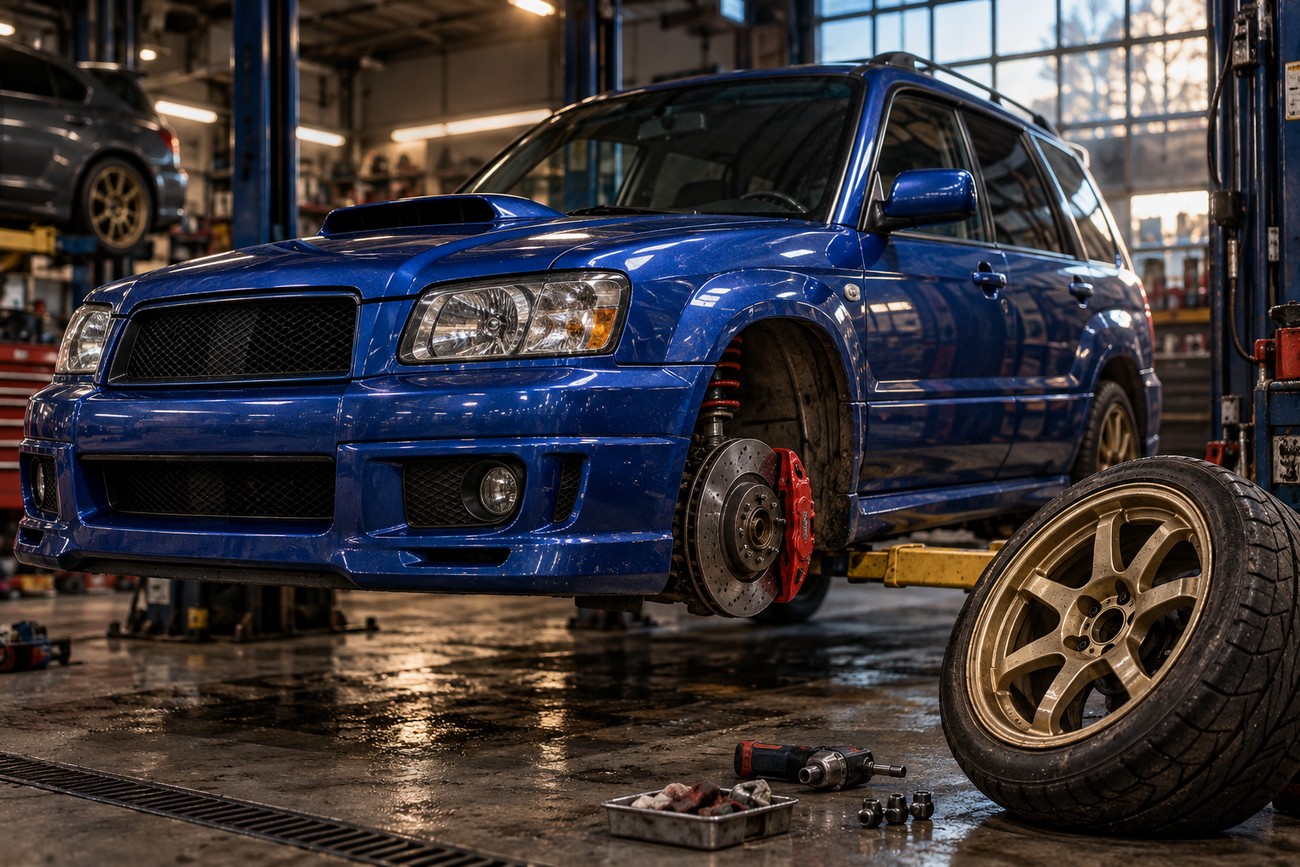
The six-speed manual gives the SG9 a more deliberate driving character than an automatic Forester. Its all-wheel-drive system is supported by front and rear limited-slip differentials, so the drivetrain specification is not the ordinary automatic AWD arrangement associated with less specialized Forester versions.
Brembo brake components provide useful thermal and stopping-capacity advantages, particularly during repeated hard use. The factory wheel and tire specification is also purposeful: 18-inch wheels with 225/45R18 tires. That combination supports sharper response, although it leaves less sidewall to protect the wheels and absorb poor road surfaces.
Firm suspension tuning helps the SG9 feel controlled through corners, but it also transmits more road texture into the cabin. On damaged pavement, low-profile tires increase the chance of bent wheels or sidewall damage. Replacement tires, brake parts, and suspension components also cost more than the equivalents on an ordinary Forester.
The practical body changes how you use the car. You gain cargo space and a more versatile seating position while accepting additional mass and different weight transfer from a lower WRX STI. The result can be highly capable on real roads, but it should not be judged by the assumption that it will turn, stop, or feel exactly like a WRX STI.
A useful ownership distinction is that performance hardware creates both capability and maintenance exposure. The limited-slip differentials, six-speed transmission, Brembo components, and larger wheels are part of the SG9’s value, yet each adds specialized parts or service requirements. A cheaper-looking standard Forester may therefore be easier to keep on the road even when it is less interesting to drive.
SG9 Forester STI vs SH tS vs SJ STI Suspension Package
These three identities should be separated before comparing specifications. The SG9 is a Japanese-market Forester STI model, the SH tS was a limited-run later-generation version, and the SJ reference concerns a specific STI suspension package rather than every STI-badged Forester.
| Version | Generation and documented hardware | Claim that must not be transferred |
|---|---|---|
| SG9 Forester STI | Japanese-market SG9; turbocharged EJ25, six-speed manual, front and rear limited-slip differentials, Brembo brake components, and 18-inch wheels with 225/45R18 tires | Do not assume its engine output, transmission, or differential specification applies to later STI-branded Foresters. |
| SH Forester STI tS | SH-generation limited run of 300 examples; special dampers and springs, 19-inch forged BBS wheels, and Brembo components | Do not assign SG9 engine, six-speed transmission, or differential specifications to the tS. |
| SJ STI suspension package | A specific SJ-generation STI suspension package with approximately 15 mm less ride height | The approximately 15 mm reduction does not describe every STI-badged SJ Forester, and it is not an SG9 specification. |
The SH tS has a documented production run of 300 examples, which makes its equipment and provenance relevant to collectors. That figure does not establish an SG9 production total. It also should not be used to rank the rarest Subaru STI model without broader, verified production data.
Later STI branding can indicate meaningful suspension or brake upgrades, but the badge does not turn every generation into the same car. Check the generation, factory documentation, and fitted hardware before using an SG9 comparison to evaluate an SH or SJ.
The Ownership Costs Hidden Behind SG9 Rarity
An SG9 can be desirable and expensive to maintain at the same time. Owners report costly repairs after overheating, including head-gasket damage, while higher-mileage turbocharged EJ25-family engines may show oil consumption. These are inspection risks rather than inevitable failures, and the condition of the specific engine matters more than the STI emblem.
The turbo system and cooling system deserve particular attention because a previous overheating event can affect the engine long after the original symptom disappears. A car that starts cleanly and produces its advertised power may still have consequences from neglected cooling, detonation, poor tuning, or excessive oil use. Regular oil changes reduce risk, but they cannot prove that the engine is healthy.
Age adds another layer of cost. Even a low-mileage example may need attention to rubber components, seals, hoses, wiring, and brake lines. Import records can also be incomplete, leaving mileage, accident repairs, and previous modifications difficult to establish.
Rare trim can turn a minor accident into a long parts search: a damaged SG9 bumper, interior panel, or specific mechanical component may require specialist sourcing rather than a routine catalog order.
Original SG9-specific body, interior, and mechanical parts can be difficult to source. The six-speed manual, limited-slip differentials, and Brembo hardware may also cost more to service than ordinary Forester XT components. If cooling, turbo, suspension, and drivetrain work arrive together, the restoration budget can quickly exceed the purchase price.
How to Verify and Inspect an SG9 Before Buying
Begin with identity, not appearance. Check the SG9 model code, vehicle documentation, engine identification, and evidence that the claimed drivetrain is still fitted. STI badges, wheels, bumpers, and a clean exterior can be added to another Forester or mixed with WRX and aftermarket parts.
Next, reconstruct the service history as far as possible. Look for evidence of oil changes appropriate to a turbocharged engine, cooling-system work, turbocharger replacement, tuning, and previous overheating. Imported cars may have uncertain mileage or incomplete records, so paperwork should support the physical condition rather than replace inspection.
Check tire circumference as a drivetrain issue, not merely a tire-shopping detail: mismatched sizes or substantially different wear can create binding and noise that may be mistaken for a failed differential.
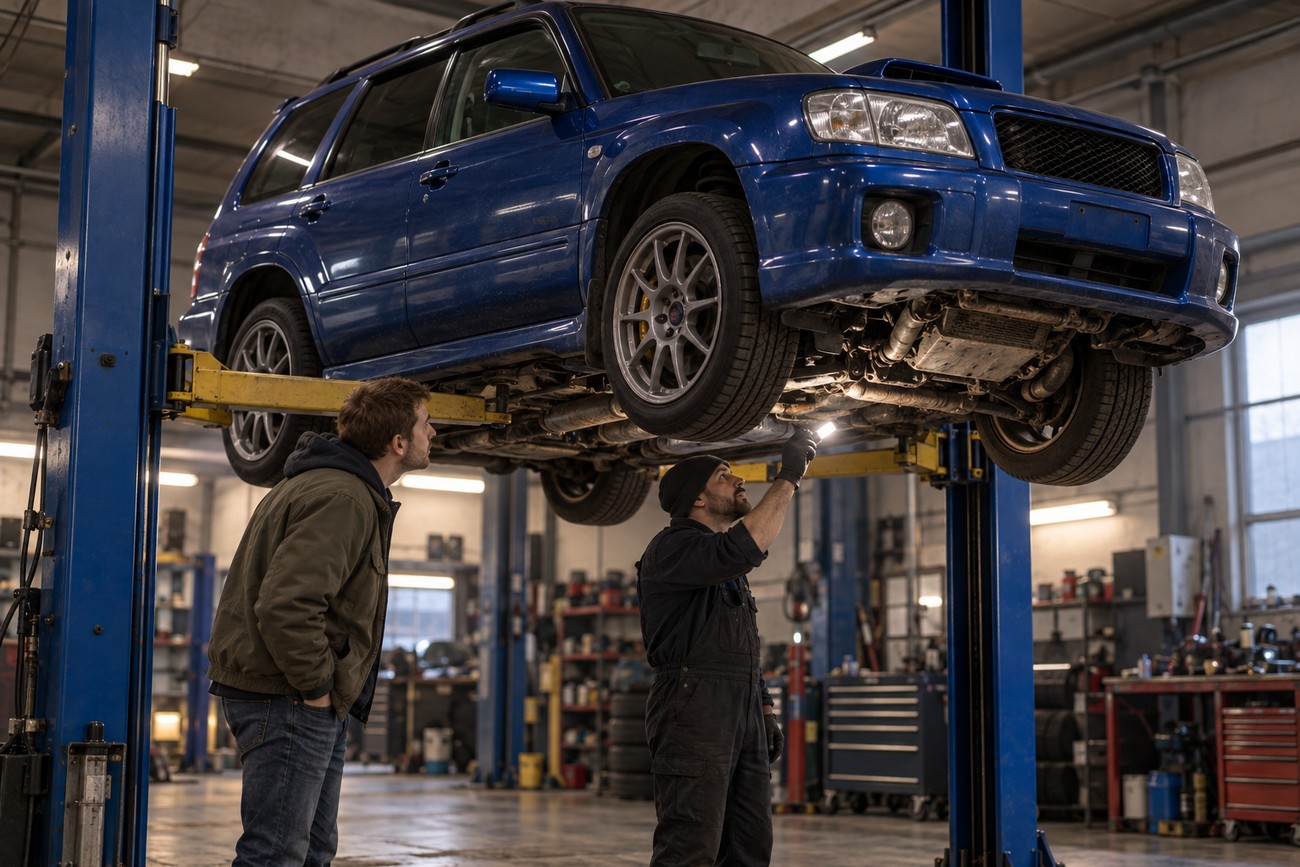
Use compression or leak-down testing where appropriate, alongside checks for cooling-system pressure loss, exhaust contamination, oil-consumption symptoms, and turbocharger shaft or boost-control problems. A specialist should assess the transmission for abnormal noise, clutch behavior, driveline play, and the operation of the limited-slip differentials.
Inspect all four tires for matching size and similar wear, then examine wheels, suspension joints, brake lines, and underbody damage. The SG9’s permanent all-wheel-drive hardware makes tire mismatch more consequential than on a simple front-wheel-drive car. A car that passes a short test drive can still need deeper inspection before purchase.
Oil-change receipts are useful evidence, but they do not establish authenticity or rule out mechanical damage. A proper decision combines chassis identification, documentation, mechanical testing, and confirmation that the fitted parts match the SG9 specification.
Is a Forester STI Worth Buying Today?
The SG9 is worth considering if you specifically want practical Forester bodywork with a turbocharged EJ25, six-speed manual, limited-slip differentials, and Brembo brake components. That combination is unusual and gives the car a purpose beyond cosmetic STI styling.
The trade-off is ownership complexity. Firm suspension, 18-inch low-profile tires, specialized drivetrain parts, and scarce SG9-specific components can make routine repairs more expensive. Rarity increases appeal, but it does not guarantee appreciation or protect an unrestored car from age-related failures.
A documented, structurally sound example with a healthy engine can justify a higher purchase price than a questionable bargain. Conversely, a car with uncertain mileage, mixed parts, tuning history, or cooling-system concerns may require a restoration reserve large enough to erase the initial saving.
Buy the SG9 for its verified engineering and usable performance, not for the badge alone. If the priority is an easier-to-maintain turbo Forester, a less specialized model may be the more rational choice. Condition and documented maintenance are stronger buying criteria than stated factory output.
Frequently asked questions
Buying or importing an SG9 requires more than confirming the STI badge. Model identity, documentation, mechanical condition, and parts compatibility all affect the decision. The answers below address common questions about registration, replacement parts, rarity, and model-year selection.
Can a JDM Forester STI be imported and registered where I live?
Possibly, but eligibility depends on the buyer’s jurisdiction. Before purchasing, check import-age rules, title and registration requirements, emissions compliance, inspection procedures, and any restrictions affecting right-hand-drive vehicles.
Those rules can apply differently to the vehicle’s age, market origin, engine, and safety equipment. Confirm the requirements with the relevant local authorities or an established import specialist before paying for the car or arranging shipment.
How can you find the correct replacement part for an SG9?
Start with the chassis identification, vehicle documentation, engine information, and the relevant Japanese parts catalog. Use the original part number where possible, then confirm fitment with the supplier rather than assuming a WRX STI or Forester XT component interchanges.
Some parts may share a family resemblance while differing in dimensions, calibration, mounting, or specification. For rare body and interior pieces, photographs, catalog diagrams, and measurements can help identify mixed or previously replaced components.
What is the rarest Subaru STI model?
There is no definitive ranking established here for the rarest Subaru STI model. The SH Forester STI tS has a documented limited run of 300 examples, while no SG9 production total is established in the available information.
Rarity claims should therefore be tied to verified production records and correct model identification. A scarce car can be valuable to enthusiasts, but rarity alone does not confirm condition, originality, or future appreciation.
What year STI to stay away from?
No universal SG9 year is identified here as one to avoid. The more useful filter is the individual car’s condition, including overheating history, oil consumption, tuning, cooling-system health, drivetrain wear, and documentation.
A well-maintained example with credible records can be a better purchase than a lower-mileage car with an uncertain history. Treat each vehicle as an inspection case rather than rejecting or selecting it by year alone.







