
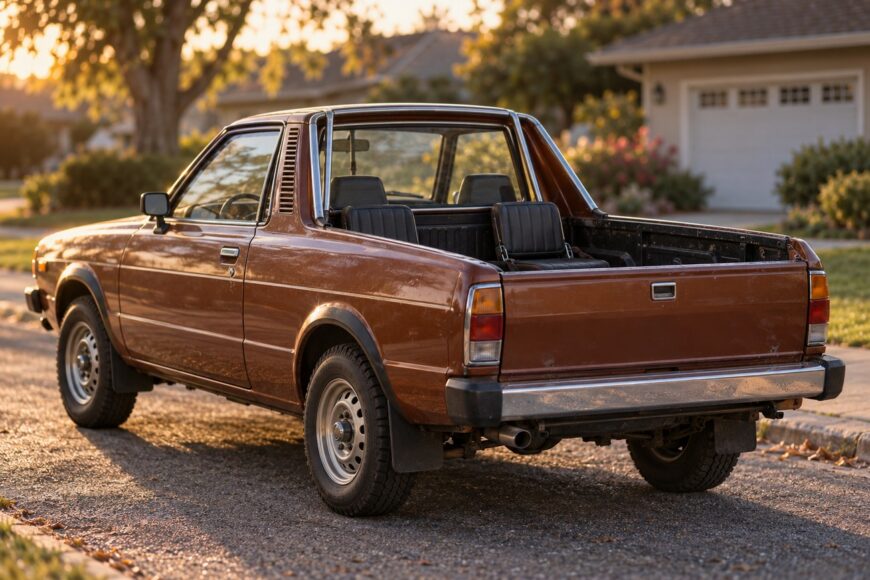
The Subaru BRAT is a compact four-wheel-drive pickup whose defining feature was never its cargo capacity. It was the pair of rear-facing seats mounted in the open bed, a layout that made the BRAT instantly recognizable and gave it a recreational identity unusual for a small utility vehicle.
That novelty also exposes the model’s central contradiction. The BRAT is an ingenious Subaru Leone derivative and an early expression of Subaru’s four-wheel-drive identity, yet it is cramped, generally slow, exposed to weather, and subject to the structural, electrical, safety, and parts problems of a very old vehicle. Its appeal is real, but it rewards careful buying rather than blind enthusiasm.
- Why the Subaru BRAT Had Rear-Facing Seats
- BRAT Generations, Engines, and Market-Specific Specifications
- What the BRAT Is Like to Drive and Use Today
- Buying a Subaru BRAT: Condition Matters More Than the Badge
- BRAT Myths: Production Years, Power, and Practicality
- Should You Own a Subaru BRAT Today?
- Frequently asked questions
- What Subaru pickup truck has seats in the back?
- How much is a Subaru BRAT worth today?
- What are the differences between the Subaru BRAT and the Brumby?
Why the Subaru BRAT Had Rear-Facing Seats
BRAT stands for Bi-drive Recreational All-terrain Transporter. Subaru introduced the model in 1977 as a compact four-wheel-drive pickup derived from the Subaru Leone 4WD platform. That origin matters: the BRAT followed the engineering logic of a small passenger car adapted for light utility work, rather than the proportions and carrying capacity of a conventional full-size pickup.
The cab was fundamentally designed for two people. The extra seats were rear-facing jump seats installed in the open cargo-bed area, behind the cab. They became the model’s visual signature, allowing Subaru to market a small pickup as a recreational vehicle while preserving a compact footprint and the traction benefits associated with the Leone-based drivetrain.
In practical terms, those seats were a compromise. Passengers in the bed had limited protection from weather, road debris, and the consequences of a crash, while the arrangement provided none of the comfort or security expected from an enclosed rear passenger row. Local rules may also affect whether such seats can be used on public roads, so the vehicle’s paperwork and registration status deserve attention.
The layout can make sense for occasional recreation, especially for an owner who values the BRAT’s unusual character more than its load capacity. It does not turn the vehicle into a four-passenger family truck. The open bed remains small, the cabin remains fundamentally two-person, and the rear seats are best understood as the BRAT’s defining novelty rather than a practical substitute for a second row.
BRAT Generations, Engines, and Market-Specific Specifications
BRAT specifications vary by generation, market, year, and trim. The following comparison uses commonly cited catalog patterns rather than treating every vehicle as mechanically identical.
| Specification area | Early versions | Later or selected versions |
|---|---|---|
| Engine family | 1.6-liter EA71 boxer engine | 1.8-liter EA81 boxer engine on later versions |
| Commonly cited power | Approximately 67–68 hp | Later versions reached up to 94 hp, depending on specification |
| Turbo availability | Generally associated with non-turbo early specifications | A 94-hp turbo engine was listed for selected 1983–1984 versions and was market-dependent |
| Drive layout | Compact four-wheel-drive pickup derived from the Subaru Leone 4WD platform | Four-wheel drive remained central, with equipment varying by market and trim |
| Ground clearance | Approximately 210 mm in frequently cited catalog data | Approximately 210 mm in frequently cited catalog data |
| Dimensions | About 3390 mm long and 1415 mm high in commonly cited first-generation data | A 2370 mm wheelbase is listed in commonly cited second-generation catalogs |
The early 1.6-liter EA71 and later 1.8-liter EA81 engines are both horizontally opposed four-cylinder units, and the engine bay reflects the Leone family relationship. A listed 94-hp turbo version exists for selected 1983–1984 vehicles, but it should never be assumed from a model year alone. Market-specific equipment and catalog conventions create genuine confusion in online listings.
Power figures also need context. Early specifications commonly quote approximately 67–68 hp, while later versions reached up to 94 hp. That upper figure may describe a selected turbo configuration rather than the typical BRAT available in every country, so an engine code, vehicle identification, and original market are more useful than a generic advertisement headline.
The same caution applies to production dates and dimensions. A first-generation listing may show approximately 3390 mm in length and 1415 mm in height, while second-generation catalogs commonly list a 2370 mm wheelbase. These figures help identify the type of vehicle, but they do not replace checking the specific year and market specification.
What the BRAT Is Like to Drive and Use Today
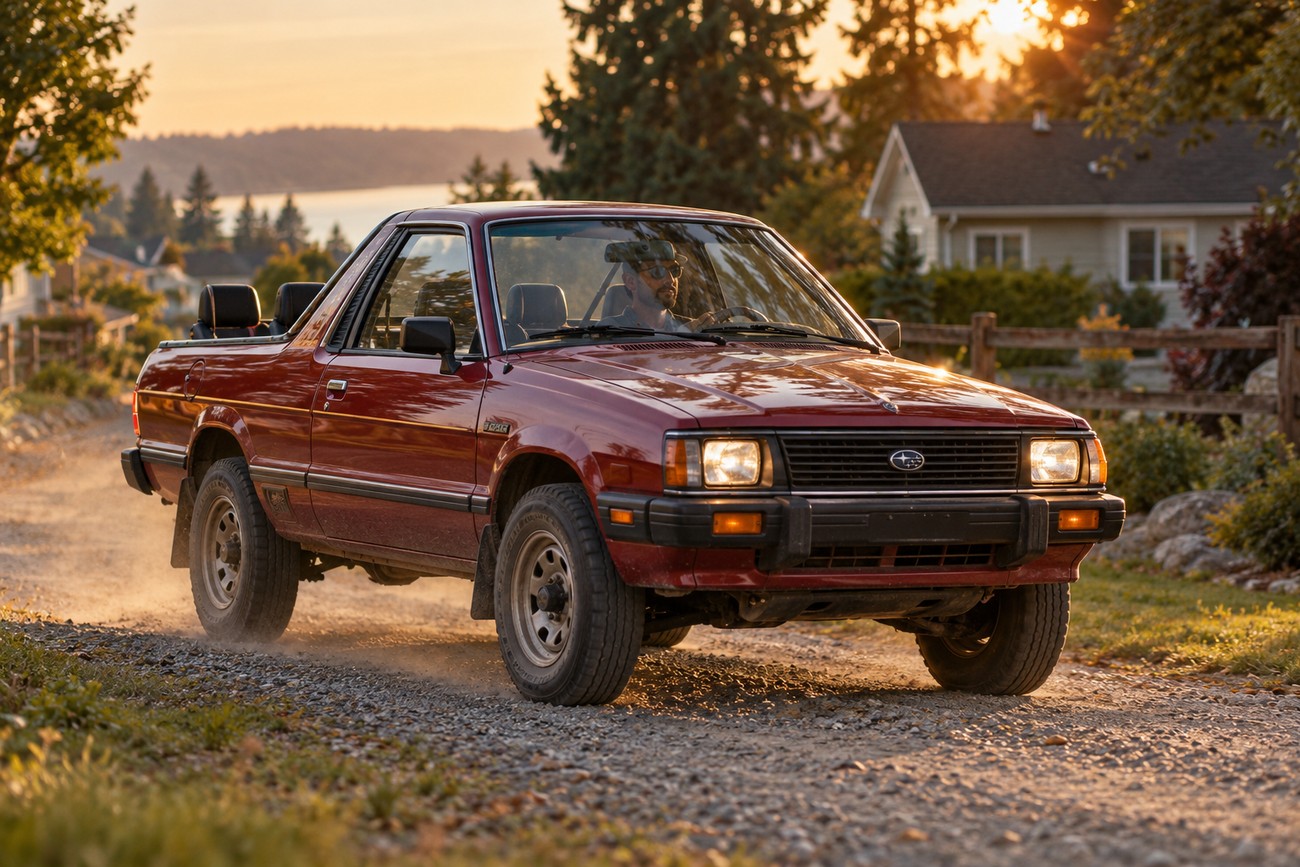
The BRAT’s compact size is one of its practical strengths. It is easier to place on narrow roads and in small parking areas than a large pickup, while four-wheel drive gives it useful traction on loose or uneven surfaces. Catalog specifications often list approximately 210 mm of ground clearance, although the condition of the suspension and the vehicle’s actual configuration matter more than a number copied from a listing.
The boxer-engine layout keeps the center of mass relatively low and follows Subaru’s established Leone engineering approach. That does not make the BRAT quick. Early and non-turbo engines are generally described as slow, and acceleration can feel inadequate when the vehicle is loaded or used on faster roads. The turbo version improves the specification, but its rarity and market dependence make it a poor assumption when evaluating an unidentified truck.
Utility is equally limited. The bed can carry light recreational equipment, but the BRAT is too compact to behave like a modern work pickup, and the two-person cab rules out ordinary family use. The rear-facing bed seats are memorable, yet they add exposure and legal or registration questions rather than creating a genuinely useful enclosed passenger area.
Safety is a decisive part of the modern ownership calculation. The BRAT lacks the crash protection, restraint systems, and driver-assistance technology expected from a contemporary vehicle. It can be enjoyable as a slow classic used selectively, but it is difficult to justify as the only vehicle for regular commuting, long-distance travel, or heavy work.
Buying a Subaru BRAT: Condition Matters More Than the Badge
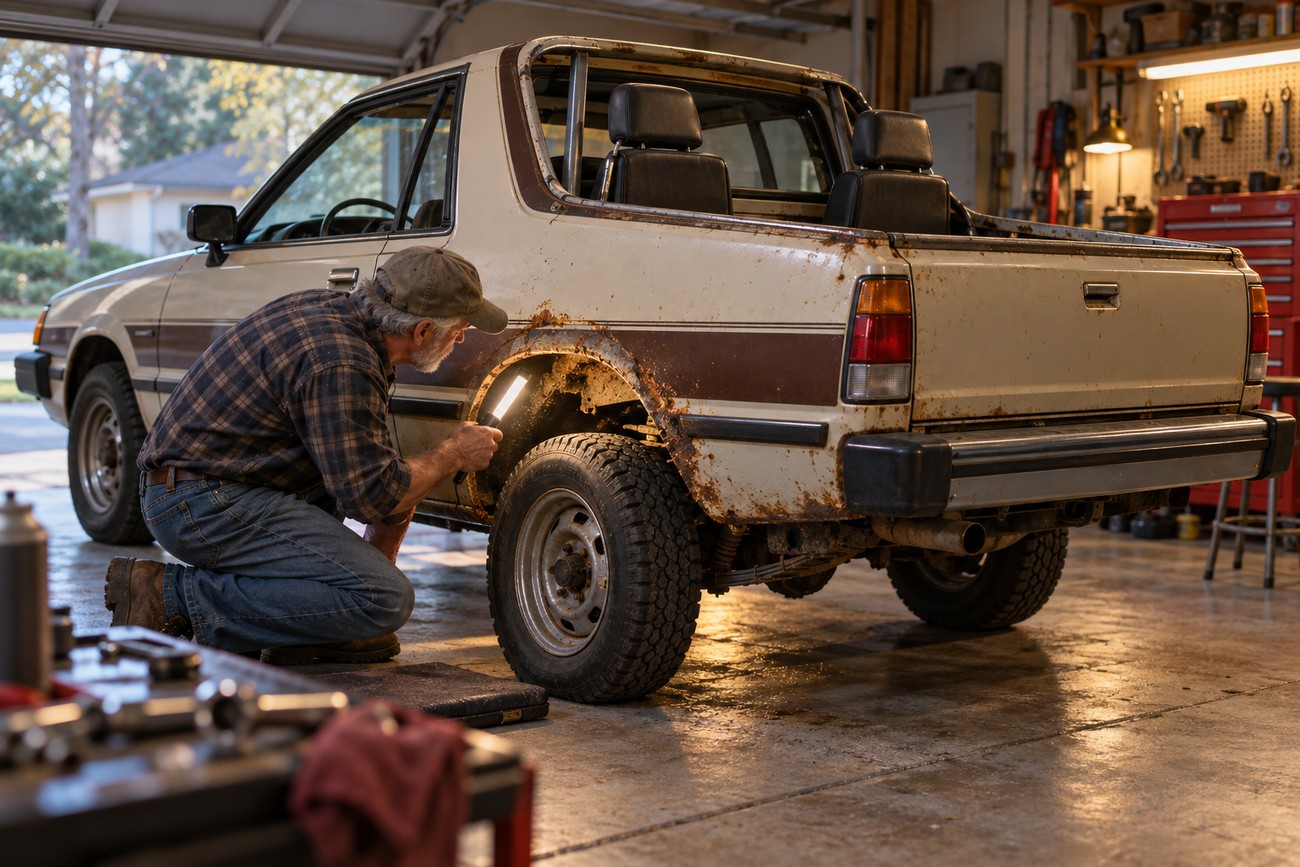
Start with metal, not paint. Corrosion in the floor, cargo-bed area, body seams, suspension mounting points, and other structural locations can turn an attractive BRAT into a major restoration project. Open-bed exposure and decades of repairs create risk even when the exterior looks straight in photographs.
Inspect the wiring and suspension with the same seriousness. Age-related electrical faults, worn suspension components, and incomplete repairs can consume more time than the purchase inspection suggests. Check the drivetrain for evidence of neglect, but remember that a sound engine cannot compensate for a weakened body or missing structural metal.
Inspect the floor, bed mounts, wiring, and parts completeness before negotiating over a rare engine or attractive paint. A scarce specification has little practical value if the supporting hardware and documentation are missing.
Completeness is especially important because replacement parts can be difficult to locate. A vehicle assembled from donor cars may have mixed trim, nonstandard repairs, or incompatible components that are hard to identify until restoration begins. The apparent bargain often disappears when rare details, electrical pieces, interior parts, or bed components must be sourced separately.
Verify the VIN, engine code, model year, and original market before relying on the listing title. BRAT and Brumby references can reflect different markets, and catalog descriptions sometimes combine generations or trim levels. A good-looking example with clear documentation and a structurally sound body is usually a stronger purchase than a rarer badge with uncertain identity.
BRAT Myths: Production Years, Power, and Practicality
The model’s documented starting point is 1977, but the later endpoint is less consistent across published sources. Some references extend the history through 1994, while others describe different production periods by market or generation. That does not establish one uninterrupted global run with identical specifications.
Powertrain assumptions cause similar mistakes. The BRAT was not uniformly fitted with a 1.6-liter engine: commonly cited versions include the 1.6-liter EA71, the later 1.8-liter EA81, and selected turbo versions. The advertised power depends on that combination of engine, year, market, and equipment.
Calling the BRAT a pickup is technically correct, but describing it as a full-size or conventional pickup is misleading. It is a compact two-person light pickup with an open bed and rear-facing seats. Its carrying role is modest, and its design makes more sense as a recreational vehicle than as a substitute for a larger work truck.
Rarity is another misleading shortcut. A scarce vehicle can be collectible, yet scarcity can also mean harder parts searches, higher restoration costs, and fewer opportunities to compare an incomplete example with a known original one. The rarest trim is not automatically the best buy if its identity cannot be documented or its missing components cannot be obtained.
Should You Own a Subaru BRAT Today?
The BRAT suits an owner who values unusual design, early Subaru four-wheel-drive identity, and the experience of driving a small historical vehicle. Its rear-facing seats give it a character that few other compact pickups share. That character is strongest when the owner treats the truck as a retro toy, project, or collectible rather than expecting ordinary modern transport.
Daily use demands more tolerance. Limited seating, modest power, age-related repairs, weak contemporary safety protection, and parts scarcity all restrict the BRAT’s usefulness. Even a mechanically healthy example may require patience with slow acceleration, limited weather protection, and a supply of age-specific maintenance work.
The sensible target is a complete, structurally sound truck with documentation. Originality is useful, but structural condition and parts completeness matter more than a rare trim badge. A properly identified non-turbo example with a solid body can be easier to own than a more desirable version requiring extensive reconstruction.
Avoid the BRAT if you need dependable family transportation, substantial payload capacity, or modern crash protection. Pursue one if you accept its limitations, have access to specialist parts research, and can inspect the body before purchase. The best example is the one whose identity, structure, drivetrain, wiring, and history can be verified—not necessarily the one with the most impressive advertisement.
Frequently asked questions
The questions below cover the BRAT’s signature bed seats, present-day value, and regional naming. In each case, the specific vehicle’s condition, documentation, and market remain important.
The model’s unusual layout explains much of its appeal, but it also creates practical and legal limitations. Engine, trim, and equipment details should be confirmed rather than inferred from a listing title.
A careful inspection is essential before purchase, especially for corrosion, missing parts, and undocumented modifications.
What Subaru pickup truck has seats in the back?
The Subaru BRAT is the Subaru pickup associated with rear-facing jump seats in the open cargo bed. These are exposed bed-mounted seats, rather than a normal enclosed rear passenger row like the one found in a family car or crew-cab pickup.
The arrangement is the BRAT’s signature feature, but it also limits comfort, weather protection, and practical passenger use. Whether those seats may legally be used on public roads depends on local rules and the vehicle’s registration or paperwork.
How much is a Subaru BRAT worth today?
A BRAT’s value depends primarily on structural condition, completeness, originality, documentation, and restoration needs. A sound, complete vehicle with a verifiable identity can be worth substantially more to a collector than a visually attractive truck with corrosion, missing parts, or undocumented modifications.
There is no reliable universal value based only on year or trim. Inspect the floor, bed, mounting points, wiring, suspension, drivetrain, and parts availability before comparing prices. Restoration costs can exceed the purchase price, particularly when rare components or donor-car repairs are involved.
What are the differences between the Subaru BRAT and the Brumby?
BRAT and Brumby references are closely related market names for Subaru’s compact four-wheel-drive pickup, with naming and equipment varying by region. The name in an advertisement does not by itself establish the exact engine, trim, safety equipment, or production specification.
Check the year, original market, VIN, engine code, and vehicle documentation before treating a BRAT and a Brumby as mechanically identical. The rear-facing bed-seat concept is central to the model family, while the details of a particular vehicle remain market- and specification-dependent.







