
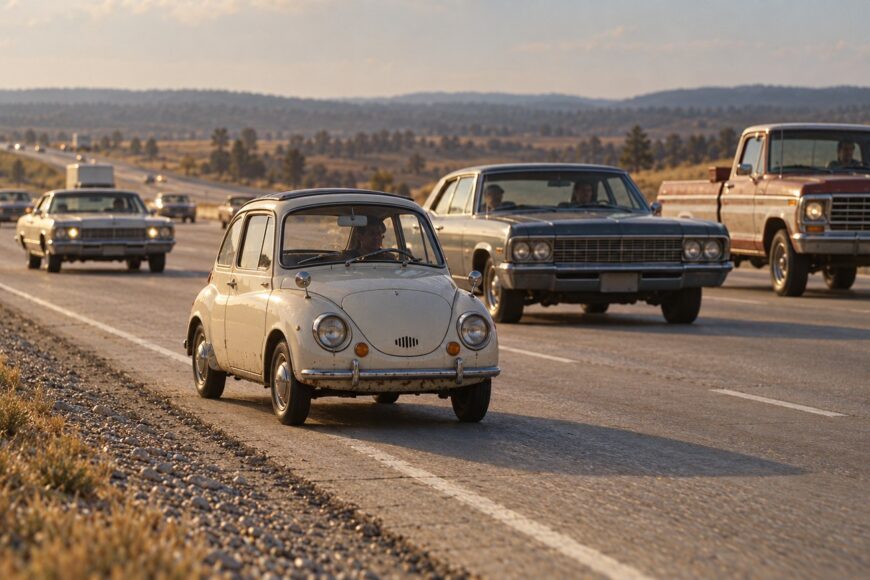
The Subaru 360’s rounded shape earned it the “Ladybug” nickname, but Consumer Reports gave it a harsh assessment in 1969. The criticism was more than a clash of tastes: a car built for Japanese streets was being judged against American traffic and expectations of speed and protection.
That distinction matters. The 360 deserves credit for the job it was designed to do, while its limitations deserve equal weight if you are considering one now.
- A car built for Japan, not the American highway
- What Consumer Reports actually objected to
- Why not every Subaru 360 drives alike
- The charming classic with demanding ownership trade-offs
- Frequently asked questions
- How can a buyer check whether a car is a genuine Young SS?
- Which cars should I avoid according to Consumer Reports?
- Which Subaru should I stay away from?
- What is the stereotype for Subaru owners?
A car built for Japan, not the American highway
Produced from 1958 to 1971, the 360 was Subaru’s first production passenger car. It was a two-door, rear-engine city car, approximately 2.99 m long and 1.30 m wide. Those dimensions suited a small car intended for everyday travel in Japan.
Its light construction was central to that purpose. Published weights differ by source, ranging approximately from 385 to 450 kg; one figure should not be treated as correct for every version. A small engine could move a car this light, though there was little power in reserve.
In US traffic, the same proportions and performance felt different. Early cars in particular had limited scope for keeping pace with faster vehicles or completing an overtake. Small size itself was not a design mistake; the problem was asking this particular city car to meet a different road environment.
What Consumer Reports actually objected to
Consumer Reports criticized the Subaru 360 in 1969 for its speed, handling, and passive safety. Its assessment addressed how the car behaved and how much protection its construction appeared to offer. The available report specifically noted very low bumpers and described the construction as flimsy.
Those concerns were consequential in traffic shared with much larger cars. Low bumpers may meet another vehicle at an unfavorable height, while a light body offers limited reassurance in a collision. The review’s objections were specific to the 360; they were not a verdict on Japanese cars as a group.
The review is often credited with ending US sales. That familiar account goes further than the supplied evidence supports: it does not establish the review’s sole or measurable effect on sales. What can be said with confidence is that the car’s engineering compromises were especially exposed in the American market.
Why not every Subaru 360 drives alike
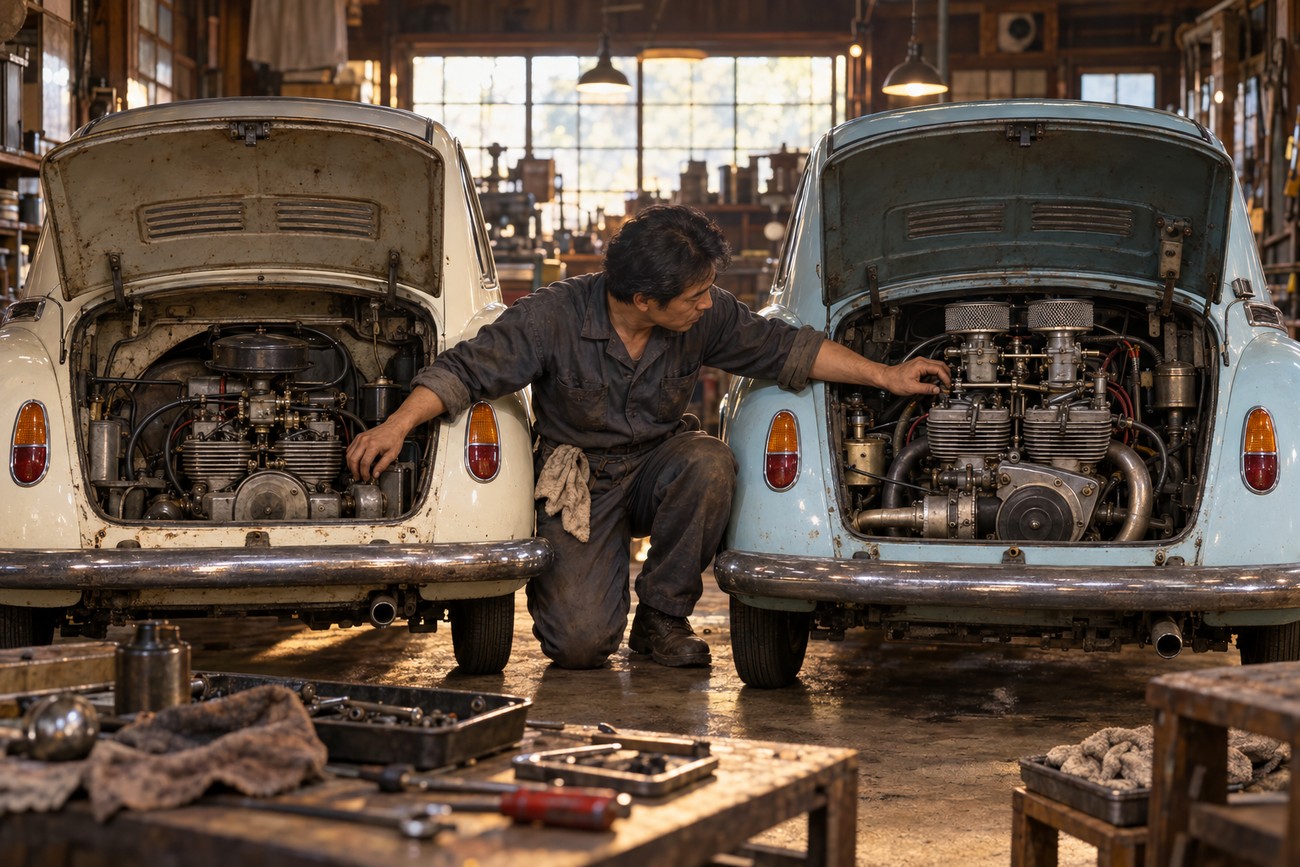
The standard engine was a 356 cc, air-cooled, two-stroke inline twin. Early versions produced 16 hp, while later cars were rated at 18, 20, or 25 hp, depending on the year and specification. A buyer should identify the version before treating a road test as representative.
The Young SS belonged to a distinct factory sports branch. It is described with a 423 cc engine and 36 hp; those figures do not apply to an ordinary 360. Its greater output changes the performance comparison without removing the basic car’s protection concerns.
Published top-speed estimates around 95–102 km/h vary by version, and early cars were slower. Even a later car’s quoted maximum says little about how comfortably it can accelerate with traffic or overtake. Engine condition matters too, making a drive in the individual car more useful than a single headline figure.
The charming classic with demanding ownership trade-offs
A Subaru 360 makes more sense as a carefully maintained classic than as an assumed substitute for a modern runabout. Its limited overtaking ability calls for suitable roads and deliberate route choices. Low weight and light construction also mean substantial protection compromises among larger vehicles.
The standard two-stroke engine needs correct lubrication and servicing appropriate to its specification. Later cars may differ from early ones in their lubrication arrangements, so an owner should understand the actual setup rather than rely on a general description of the model.
Before ordering parts or planning service, confirm the individual car’s engine and lubrication setup against its documentation. Treating every Subaru 360 as the same mechanical specification can create avoidable problems.
Parts availability and the condition of an aging car can turn a purchase into a prolonged restoration. Inspect the body, mechanical completeness, and paperwork before committing, especially if regular use is the goal. A sound example can be enjoyed on roads that suit it, provided its maintenance and traffic limitations remain part of the plan.
Frequently asked questions
For a prospective buyer, a model name or an old review is only a starting point. Check the identity and condition of the particular car, then consider the roads on which you intend to use it. Broad claims about a brand are less useful than those checks.
How can a buyer check whether a car is a genuine Young SS?
Compare its documentation and engine details with reliable model records. Badges or an advertised power figure alone cannot establish that a car is the distinct factory Young SS variant.
Which cars should I avoid according to Consumer Reports?
In the context of this article, the documented 1969 criticism concerns the Subaru 360. It is a reason to examine that model’s suitability and condition, not a current avoid-list for other cars or a legal ban on the 360.
Which Subaru should I stay away from?
Avoid buying a 360 that you cannot identify, assess, or maintain properly, particularly if you need it for fast roads. That is a buying decision about a specific car and intended use, not a judgment on every Subaru model.
What is the stereotype for Subaru owners?
There is no useful owner stereotype for deciding whether to buy a 360. Documentation, mechanical condition, parts access, and your intended routes offer a firmer basis. Highway access rules vary by jurisdiction, and legal access does not necessarily mean the car is well suited to that road.







