
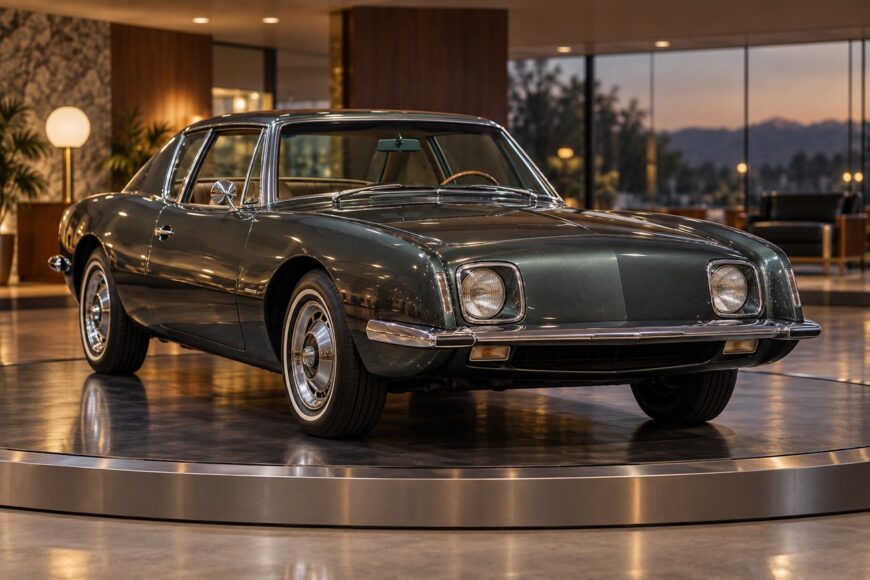
The Studebaker Avanti was conceived as a last, ambitious performance statement from a company already under severe financial pressure. It debuted for the 1962 model year with dramatic Raymond Loewy styling, a fiberglass body, and, in R2 form, a Paxton-supercharged V8 that gave it genuine period pace. The car looked like a clean break from conservative Studebaker practice, yet its maker could not turn that attention into the sales volume needed for survival.
That failure is only half the story. Studebaker stopped automobile assembly at its South Bend plant in December 1963, while the Avanti continued under new ownership and remained in production in changing forms into the early 2000s. Enthusiasts are drawn to the rarity, the design, and the mechanical character. Ownership brings a harder set of facts: the fiberglass body can conceal a rust-prone frame, later cars vary substantially in specification and finish, original trim is scarce, and restoration costs are difficult to predict. A fresh paint job can therefore describe the least important part of an Avanti’s condition.
- The Avanti Was Studebaker’s Last Great Gamble
- What Makes the Avanti Fast—and What Its Numbers Really Mean
- How the Avanti Outlived Studebaker
- Original Studebaker Avanti vs. Avanti II: What Buyers Are Actually Comparing
- What a Studebaker Avanti Is Worth Today—and Why Condition Is Not Enough
- The Hidden Ownership Problems: Frame Rust, Fiberglass, Wiring, and Superchargers
- The Buying Mistakes That Turn an Avanti Into a Bad Project
- Why the Avanti Still Matters—Without Believing Every Avanti Myth
- Frequently asked questions
- How much is a Studebaker Avanti worth today?
- Was the Studebaker Avanti the fastest car ever made?
- How many Studebaker Avantis are left?
- Which Studebaker Avanti parts interchange with other Studebakers?
The Avanti Was Studebaker’s Last Great Gamble
The Avanti arrived at a moment when Studebaker needed attention, margin, and a reason for buyers to enter its showrooms. The company had a long engineering tradition, yet it was competing against manufacturers with greater production scale and stronger financial reserves. A conventional facelift would have offered little strategic advantage. The Avanti was intended to function as a halo car: an expensive, distinctive performance model that could improve the image of the entire Studebaker range.
Its significance therefore went beyond the shape of the body. The project combined a low, aerodynamic-looking fiberglass shell with a separate chassis, a sophisticated interior, and available supercharged performance. The approach gave Studebaker a car that appeared modern and technically serious even though many underlying components came from existing company hardware. That mixture of new design and familiar mechanical architecture helped make production possible, while also limiting how completely the Avanti could escape the compromises of the Lark-based platform.
The Studebaker Avanti debuted for the 1962 model year. Production at Studebaker’s South Bend plant continued until automobile assembly stopped in December 1963. Approximately 4,643–4,700 original Studebaker Avantis were built; the exact figure varies among clubs, registries, and sources. That total is small enough to make every surviving car relevant to the marque, yet it also indicates why the Avanti could not carry a mass-market business on its own.
Production delays and quality problems damaged the launch. Fiberglass body construction required careful finishing and alignment, and a low-volume assembly process offered little tolerance for inconsistent supply or rework. Sales expectations proved too optimistic, while the company’s financial problems were already too deep for one specialty model to reverse them. The Avanti did not rescue Studebaker; sales, delays, and quality issues prevented it from changing the company’s financial direction.
What Makes the Avanti Fast—and What Its Numbers Really Mean
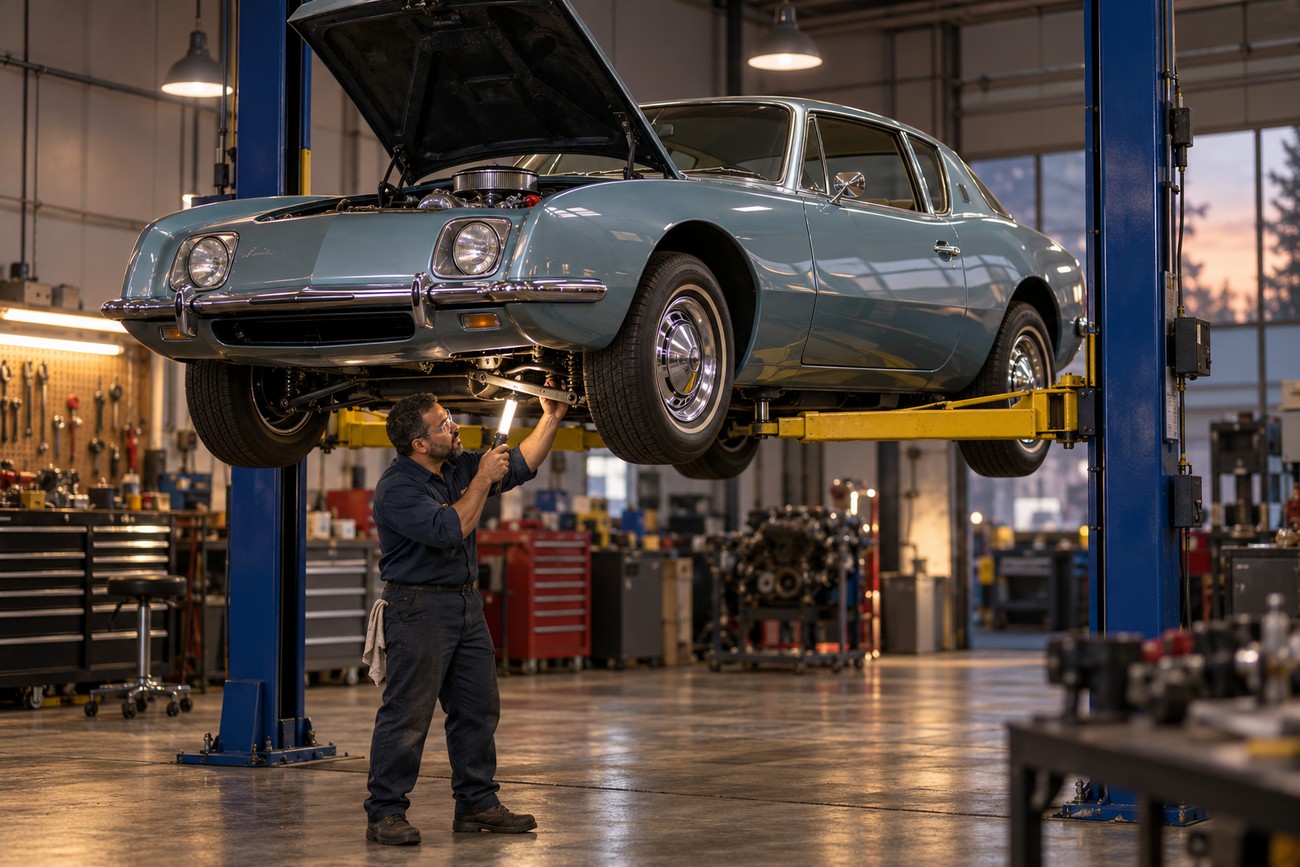
The Avanti uses a separate frame derived from the Studebaker Lark rather than a unitized body. Its body is fiberglass, the front suspension is independent, and the rear axle uses leaf springs. That construction explains both the car’s appeal and several ownership realities. A damaged body panel can sometimes be repaired without dealing with conventional steel-panel rust, while a neglected frame or suspension attachment can compromise the entire project beneath an apparently attractive shell.
The base engine was a 289-cubic-inch Studebaker V8. R1 versions were rated at approximately 240–250 hp, while R2 versions used a Paxton supercharger and were rated at approximately 290 hp. R3 and R4 versions were exceptionally rare and associated with approximately 335 hp or more, depending on specification and source. These categories matter to collectors because the engine designation is part of the car’s identity, although surviving cars can have changed engines, altered induction systems, or incomplete documentation.
The R2 is the version that most clearly established the Avanti’s performance reputation. Period tests placed production R2 cars at approximately 200–210 km/h and 0–60 mph in approximately 7–8 seconds. For an American production car of its period, those figures were serious. The supercharger gave the engine a stronger upper-range character and made the Avanti feel substantially different from an ordinary naturally aspirated example, especially during passing and sustained acceleration.
Brochure horsepower also requires careful interpretation. Factory horsepower ratings and real dyno results are not necessarily identical; measured output can be lower. Engine condition, testing method, ignition timing, fuel quality, exhaust restrictions, and decades of repairs all affect what reaches the rear wheels. A seller’s claim that a car is an R2 should therefore lead to verification of the hardware and history, rather than an assumption that the advertised specification remains intact.
R1 cars can provide a more straightforward ownership experience because they avoid the Paxton system’s additional maintenance demands, although they do not become ordinary cars. The chassis, brakes, cooling system, and electrical equipment still require age-appropriate inspection. A naturally aspirated Avanti may also feel slower than a healthy period test suggests because modern traffic expectations expose its gearing, tire limitations, and power delivery. The R-series hierarchy is useful for understanding the model; it should not replace a condition assessment.
How the Avanti Outlived Studebaker
Studebaker’s withdrawal from automobile production did not end the Avanti story. Avanti II production began around 1965–1966 under Nate Altman and Leo Newman, using the design and related rights. This preserved the basic concept at a time when the original manufacturer no longer had the resources to build it. The continuation also created a second major category of car, one that shares the body shape and name while differing in engine, trim, documentation, and production context.
Avanti II and later cars commonly used Chevrolet small-block V8s, including 327, 350, 305, and 400 engines. Other GM V8 configurations and, in some cases, turbo-diesel installations also existed. This engine flexibility made it possible to keep the car viable through changing emissions rules, supplier relationships, and ownership. It also means that the phrase “Avanti” alone says less about a later car’s mechanical specification than many buyers expect.
Avanti Motors and later owners continued producing Avantis in different locations into the early 2000s. The cars were assembled in low volumes, and later production was variable. Fit and finish, wiring practices, identification, and the relationship between installed equipment and surviving paperwork can differ substantially from one car to another. Marketing may describe this as hand-built exclusivity; a buyer should also understand it as a potential documentation and repair problem.
The result is a long-lived design with an unusually fragmented technical history. A later Avanti can be an enjoyable, usable specialty car with more familiar GM service parts than an original Studebaker. It can also contain improvised electrical work, unusual engine combinations, or regional details that complicate diagnosis. Treating every Avanti II as interchangeable with every other Avanti II is as misleading as treating it as an original 1962 car.
Original Studebaker Avanti vs. Avanti II: What Buyers Are Actually Comparing
The first task is to establish which car is being offered. Appearance alone cannot settle the question, and a later Avanti should not be represented as an original Studebaker Avanti. The categories overlap in shape, yet their history, mechanical parts, collector audience, and ownership expectations are materially different.
| Category | Original Studebaker Avanti | Avanti II and later cars |
|---|---|---|
| Production period | Built at South Bend through December 1963; approximately 4,643–4,700 were built. | Production began around 1965–1966 and continued through later ownership changes into the early 2000s. |
| Engine families | Studebaker 289-cubic-inch V8 variants, including R1, R2, and exceptionally rare R3/R4 specifications. | Commonly Chevrolet small-block V8s such as 327, 350, 305, and 400, with other GM and occasional turbo-diesel installations. |
| Identity | Original Studebaker production identity and period build details are central to its value. | Identification may involve later serial systems, unusual VIN formats, and mixed old/new documentation. |
| Collector perception | Early cars and documented R2/R3 examples generally receive the strongest historical and collector interest. | Values vary widely with specification, condition, originality, and provenance; ordinary examples are judged differently from rare Studebaker cars. |
| Parts and information | Shared Studebaker mechanical components can help, while Avanti-specific trim and body parts remain scarce. | GM engine parts may be easier to source, but body, interior, wiring, and late-production information can be inconsistent. |
| Ownership expectation | Requires careful preservation, period-correct research, and close attention to frame and original equipment. | May be easier to use as a driver, yet low-volume assembly and varied modifications demand a car-by-car inspection. |
The table is a starting point rather than a value verdict. Some later cars are better sorted and more usable than neglected originals. Conversely, an original car with an altered engine, missing trim, and weak documentation may have less practical appeal than a sound Avanti II. The buyer’s decision should match the intended use: historical collecting, touring, mechanical experimentation, or simply ownership of a distinctive fiberglass coupe.
What a Studebaker Avanti Is Worth Today—and Why Condition Is Not Enough
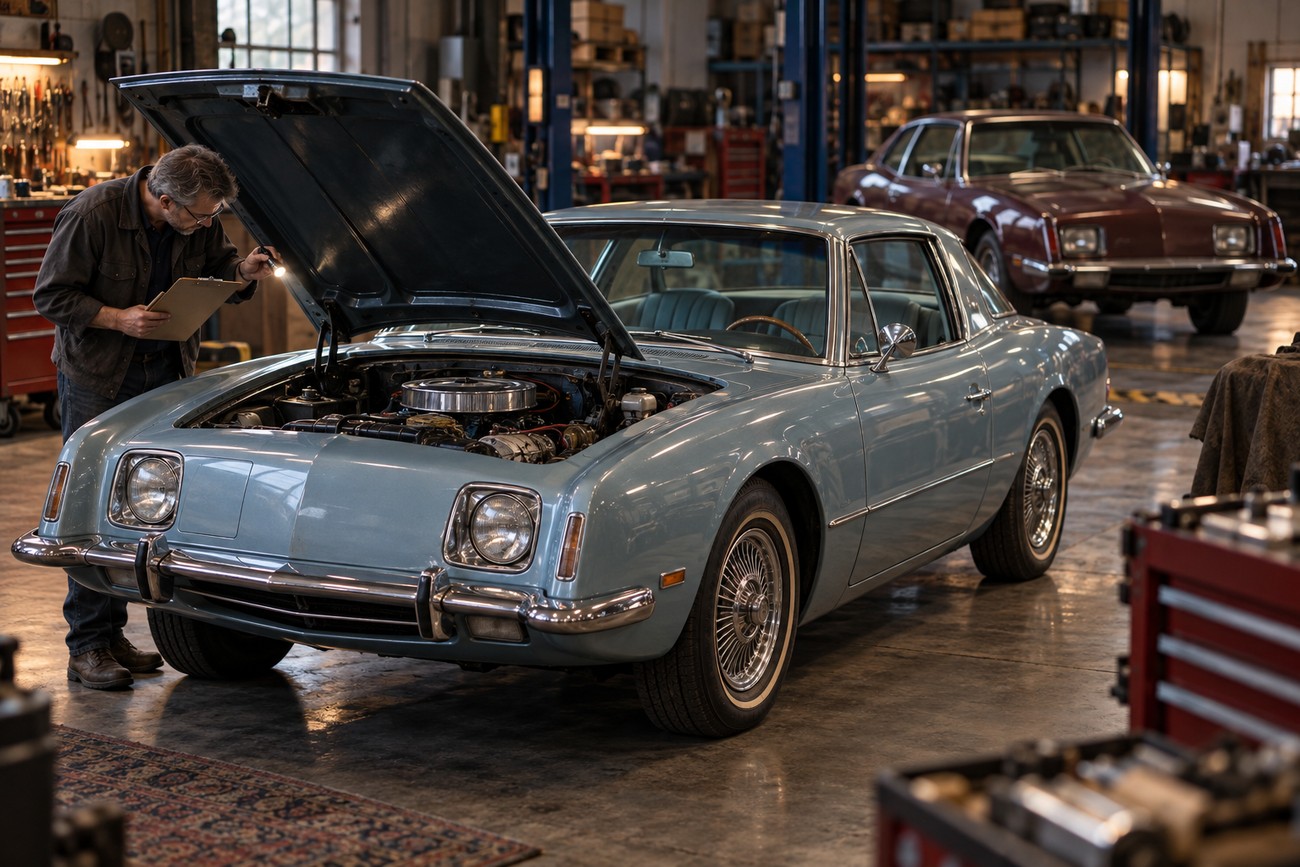
Avanti values are best understood as a set of overlapping markets rather than one dependable price. Usable or running Avanti IIs may fall around $15,000–$25,000, while excellent rare R2 or R3 examples can exceed $60,000. Exceptional documented competition-history cars may sell higher. These figures describe broad market territory, not an automatic valuation for a car with a particular color, engine, or advertised restoration.
Original Studebaker identity is one of the first filters. Correct R-series equipment, early production details, complete trim, and credible documentation generally matter more than a glossy repaint. A car identified as an R2 needs evidence supporting that designation, including appropriate supercharger hardware and a coherent history. The same caution applies to R3 and R4 claims, where rarity makes incorrect or incomplete information especially consequential.
Structural condition often changes the financial calculation more than cosmetic condition. A sound frame, usable suspension attachment points, and complete interior or exterior hardware may justify a stronger price than a visually restored car with hidden corrosion and missing parts. Fiberglass repair and repainting can be expensive, while replacing a scarce molding, wheel, instrument component, or interior detail can consume disproportionate time. The cheapest-looking car is frequently the one with the least predictable final cost.
Documentation has a practical value beyond collector prestige. It can establish whether a car began as a Studebaker Avanti or an Avanti II, explain an engine change, clarify unusual trim, and support registration where identification formats are inconsistent. It also helps a future owner avoid paying twice for the same research. A folder containing old titles, build information, club records, restoration invoices, and photographs is more useful than a seller’s unsupported description of “rare factory specification.”
A proper valuation should therefore be adjusted after a specialist inspection. Begin with the category and realistic market range, then deduct for corrosion, missing parts, uncertain identity, poor repairs, and nonfunctional systems. Add value cautiously for documented provenance and correct rare equipment. The distinction between asking price and supported collector value is especially important with Avantis because ambitious restorations can remain unfinished for years and exceed the owner’s original budget.
The Hidden Ownership Problems: Frame Rust, Fiberglass, Wiring, and Superchargers
Fiberglass resists body-panel corrosion, but the frame, suspension mounts, body mounts, and fasteners can corrode severely. The steel structure deserves inspection from below, with attention to frame rails, spring mounts, front suspension attachments, body-mount areas, and any places where trapped moisture or road debris has remained. A clean exterior can conceal a car that needs substantial structural work before it is safe or economically sensible to restore.
The body itself has its own failure modes. Poor fiberglass finishing can lead to microcracks, peeling clear coat, and expensive repainting. Repairs may have been made with incompatible materials or insufficient attention to panel alignment, leaving stress marks that reappear after paint. Original body panels and interior trim can be difficult to locate, with searches sometimes lasting months, so missing pieces should be priced as major restoration items rather than minor inconveniences.
Electrical diagnosis is another recurring ownership burden. Aged wiring harnesses and decades of undocumented modifications commonly cause shorts, unreliable instruments, and difficult diagnosis. An additional fuse, an aftermarket radio, a replaced gauge, or a repair made without a wiring diagram can affect several circuits at once. The sensible approach is to trace the system methodically and document each correction, rather than adding another bypass that makes the next fault harder to find.
R2 and R3 cars add the Paxton supercharger to the inspection list. Poorly maintained or incorrectly tuned Paxton systems can contribute to overheating, detonation, power loss, belt problems, and expensive repair. Ignition timing, fuel delivery, octane, belt condition, seals, and cooling performance must be considered together. A car that runs strongly for a short test drive may still have a problem that appears under sustained load or once heat builds in the engine compartment.
Wheels and tires introduce a quieter expense. Original-style tires and wheels can be difficult and expensive to source, especially for an owner trying to preserve a period appearance. Substituting modern parts may improve availability, yet the change can affect clearance, ride, gearing, steering feel, and visual correctness. The same principle applies to instruments, trim, door hardware, and upholstery: a functional substitute may be sensible for a driver, while a collector restoration requires a different budget and tolerance for delay.
The Buying Mistakes That Turn an Avanti Into a Bad Project
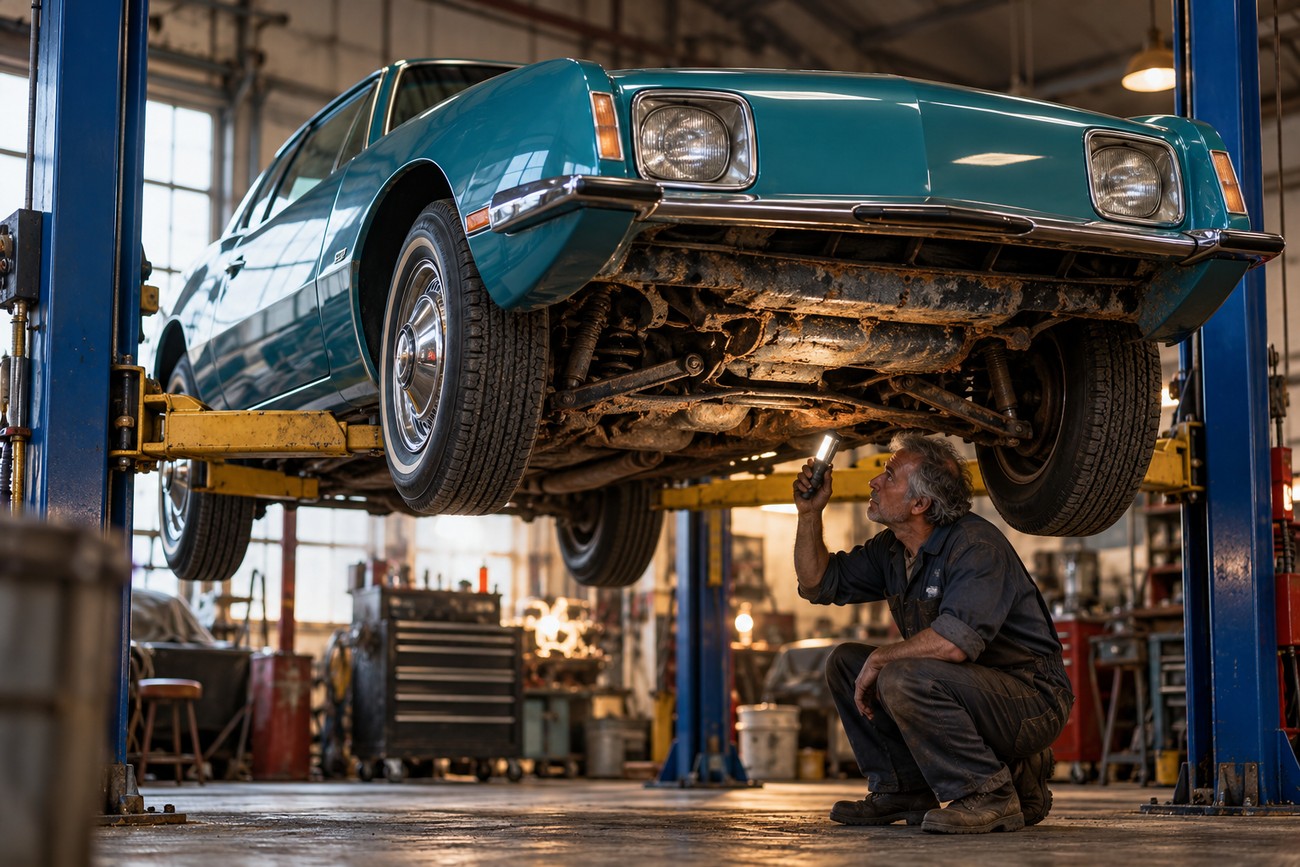
The first mistake is buying by paint and appearance alone. Walk around the car, inspect the panel surfaces, and assess the interior, but place the frame and attachment points ahead of cosmetic enthusiasm. A vehicle with a bright finish, complete-looking glass, and a running engine can still require structural repairs that exceed the difference between its asking price and a better example. A lift inspection by someone familiar with older Studebaker chassis is money spent before the purchase, not after the damage is discovered.
Identity should be checked before parts are ordered or value is discussed. Confirm whether the car is an original Studebaker Avanti or a later Avanti II, then compare the identification marks, title, engine, trim, and production records. Late VIN and registration formats can be unusual and require careful provenance checks. Cars associated with Florida, Ohio, or Mexico may also reflect different production circumstances, wiring practices, finish quality, and corrosion histories; location alone proves nothing, but it should prompt more questions.
Power modifications create a second predictable trap. Installing a more powerful engine without upgrading brakes and chassis can produce poor handling, brake fade, and structural stress. The separate frame does not make the car immune to age or load, and the fiberglass body does not compensate for weak suspension attachments. A buyer considering an engine swap should evaluate braking, cooling, steering, axle condition, tires, and frame integrity as one system before celebrating the horsepower figure.
Concours originality can be equally misleading when pursued without research. Some small details are genuinely rare, while others can be sourced or substituted without materially changing the car’s historical meaning. Spending heavily on a reproduction emblem while postponing frame repairs is poor prioritization. Tall drivers may also find the cabin tight, with a low roof and restricted rear or diagonal visibility, so a long test drive matters. The Avanti lacks modern airbags, modern side-impact protection, and contemporary crash structures; period safety claims should not be treated as present-day crash equivalence.
Before committing to an unusual car, involve a marque specialist and consult the Avanti Owners Association or a similar club. Club records can help identify correct details, locate parts, interpret serial information, and distinguish a plausible R-series car from a later conversion. The goal is not to turn every purchase into a museum exercise. It is to learn which compromises are acceptable before money is spent on a car whose repair path is already uncertain.
Why the Avanti Still Matters—Without Believing Every Avanti Myth
The Avanti remains important because it captured a difficult moment in American automotive history with unusual clarity. Studebaker attempted a modern image, a high-performance flagship, and a technically distinctive body while operating under financial pressure. The result was too limited in volume to save the company, yet strong enough in design and character to support decades of continuation. That survival gives the car historical importance even when a particular example is mechanically ordinary.
Its fiberglass construction is often treated as a promise of permanence. Fiberglass body panels resist the type of rust that destroys steel fenders, but the frame, suspension, mounts, fasteners, and mechanical components continue to age. The shell can crack, distort, or show poor previous repairs. Owners who understand this distinction tend to spend inspection money in the right places and avoid mistaking surface condition for structural health.
Every Avanti also does not carry the same collector weight. Original R2/R3 cars, early examples, and cars with documented history are generally more collectible than ordinary later Avanti IIs. The Avanti was quick for its era, but it was not the fastest car ever made. Later marketing claims of modern-level reliability also sit uneasily beside recurring owner reports of electrical, documentation, parts, and supercharger issues.
The right buyer is someone who values design and history, accepts specialist ownership, and is willing to choose documentation and structural health over superficial rarity claims. Avanti Owners Association and similar marque clubs can be essential sources for parts, records, identification, and specialist knowledge. With that support, the car’s contradictions become manageable: it is an ambitious Studebaker that failed commercially, a performance car that needs careful setup, and a discontinued manufacturer’s product that survived because the design was worth carrying forward.
Frequently asked questions
Avanti questions usually concern value, performance, surviving production numbers, and parts interchange. The answers depend heavily on whether the car is an original Studebaker Avanti or a later Avanti II. Condition, documentation, and specification remain essential in every case.
How much is a Studebaker Avanti worth today?
Usable or running Avanti IIs may fall around $15,000–$25,000, depending on condition, specification, and market. Excellent rare R2 or R3 examples can exceed $60,000, and exceptional documented competition-history cars may sell higher. Those ranges become meaningful only after the car’s identity, structure, equipment, and documentation have been established.
A practical valuation separates three cases. A documented original R-series car is judged through authenticity, correct components, completeness, and provenance. A usable Avanti II is judged more through mechanical condition, quality of repairs, usability, and the consistency of its later production history. A visually restored car with a compromised frame should be valued as a structural project regardless of paint quality. A specialist inspection should then adjust the initial range for corrosion, missing trim, wiring faults, incorrect engines, and evidence of a credible restoration.
Was the Studebaker Avanti the fastest car ever made?
No. The Avanti was fast for its era, especially in R2 form, and period tests placed production R2 cars at approximately 200–210 km/h and 0–60 mph in approximately 7–8 seconds. That made it unusually quick among American production cars of its period, which is a more accurate and useful description than the claim that it was the fastest car ever built.
The distinction also protects buyers from treating a specification as a guarantee. Factory horsepower ratings and real dyno results are not necessarily identical, and an old supercharged engine may have lost performance through wear, poor tuning, fuel problems, or a damaged Paxton system. Performance claims should be supported by the actual car’s mechanical condition.
How many Studebaker Avantis are left?
No single authoritative count of surviving Studebaker Avantis exists. Approximately 4,643–4,700 original Studebaker Avantis were built, but clubs and registries record only cars that have been reported, identified, or documented. Some cars change ownership without updating a registry, while others may be dismantled, misidentified, or recorded under incomplete information.
Club registries and marque records remain valuable because they can connect a car to earlier owners, specifications, photographs, or restoration work. They should be treated as useful but incomplete records rather than a complete census. Original production totals cannot be converted directly into a reliable present-day survivor count.
Which Studebaker Avanti parts interchange with other Studebakers?
Some mechanical components can be sourced through the Avanti’s Lark-derived architecture and shared Studebaker systems, including certain chassis-related and running-gear parts. That cross-compatibility is one reason specialist knowledge matters: a part may be available through another Studebaker model even when an Avanti-specific catalog listing is scarce.
The fiberglass body, trim, glass, interior pieces, instruments, wheels, and supercharger components require more caution. They may be specific to the Avanti, difficult to reproduce, or dependent on year and specification. Avanti Owners Association and similar clubs can help identify suitable substitutions, locate scarce parts, and verify whether a proposed replacement preserves the car’s original configuration.







