
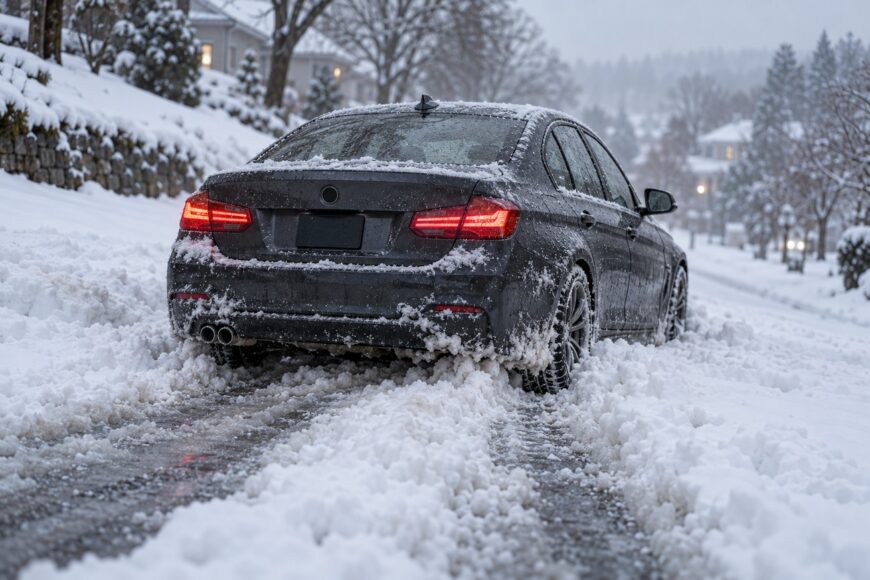
A rear-drive BMW 3 Series can feel composed on ordinary winter roads, then lose traction abruptly in deep snow, on a hill, or in a rutted driveway. The driven rear axle is relatively unloaded during acceleration, so rear-wheel drive is more traction-limited during acceleration in deep snow and on uphill starts.
Recovery depends on four things working together: tire grip, smooth driver inputs, electronic assistance, and enough clearance beneath the car. No driving technique alone can free a BMW that is resting on compacted snow, and no electronic system can create traction where the tires have none.
- Why a Rear-Drive BMW 3 Series Gets Stuck in Deep Snow
- Check the Tires, Pressure, and Clearance Before Trying Again
- The Best Way to Move a Stuck RWD 3 Series
- What to Do During a Slide—and When to Stop
- Common Winter Mistakes and the drive Myth
- A Realistic Winter Strategy for a Rear-Drive BMW
- Frequently asked questions
- Should you turn traction control off when a BMW is stuck in snow?
- How can you tell whether the BMW is traction-limited or high-centered?
- When should you stop trying to free the car yourself?
Why a Rear-Drive BMW 3 Series Gets Stuck in Deep Snow
Deep snow changes the problem from ordinary winter driving to a fight for both grip and clearance. As you accelerate, weight transfers rearward, but the driven rear axle can still lack the load needed to bite into loose snow. This is why a rear-drive 3 Series may struggle to start on an incline even when it handles a lightly covered road well.
Packed snow and ice reduce the available friction for every drivetrain. Wet, heavy snow is more difficult because it resists the tires and can build up around the bumper, rocker panels, and underbody. Abrupt throttle changes then make the rear tires spin before they can roll forward.
Ruts create a second problem. A tire can climb one side of a rut while the body moves in another direction, producing sudden changes in steering and traction. Sharp inputs are especially difficult for a rear-drive car in this situation, and a small slide can quickly become a sideways position in the track.
The car can also stop moving because the chassis is grounded. Limited ground clearance, poor approach or departure geometry, and compacted snow beneath the underbody can lift the driven tires or hold the car in place. That is a clearance failure, not simply a lack of engine power, and more throttle usually makes it worse.
Check the Tires, Pressure, and Clearance Before Trying Again
Start with the tires. Real winter tires with usable tread are critical on packed snow and ice; summer tires or nearly worn winter tires can make a functioning BMW appear helpless. Check that all four tires are inflated consistently and close to the vehicle maker’s specified cold pressure.
Some practical advice suggests a modest pressure reduction to increase the tire’s contact patch in loose snow. There is no universal rule to deflate heavily. If you choose to reduce pressure, do so cautiously and temporarily, never below 1 atmosphere, and restore the specified pressure before normal road driving.
Put the steering straight before trying to move. Straight wheels generally offer the best chance of rolling forward, while fully turned wheels increase resistance and can encourage the tires to dig into the snow. Remove snow from in front of the tires and behind them, creating a short, level path rather than trying to overpower a wall of snow.
Inspect the underside as well. Snow packed beneath the bumper, rocker panels, differential area, or center of the car may be carrying the vehicle’s weight. Clear the exhaust outlets and check that the body is not resting on a hard ridge before applying power again.
The Best Way to Move a Stuck RWD 3 Series
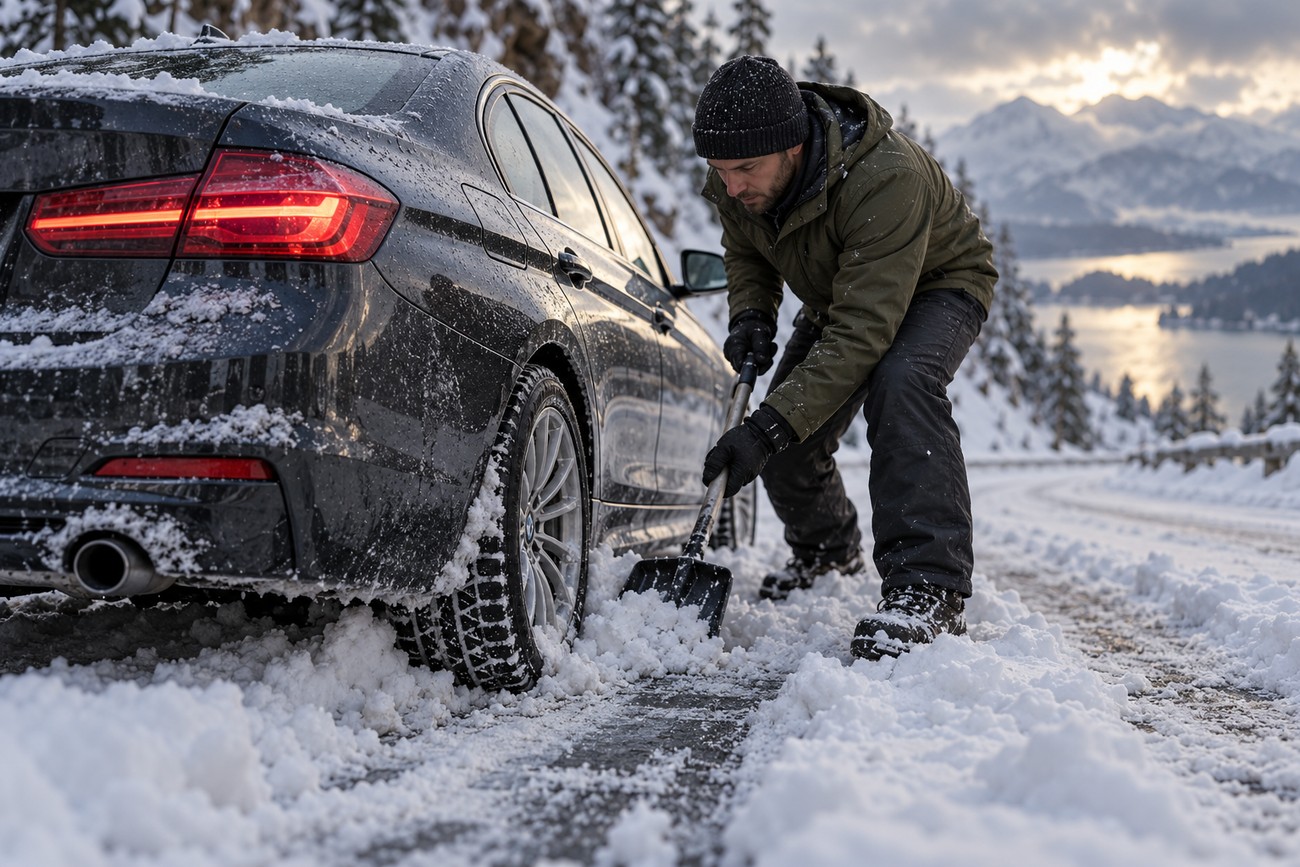
Begin by clearing the tires and choosing the least aggressive available drive setting. Keep the steering as straight as possible, select a higher gear if the transmission allows it, and use a smooth start with gentle throttle. Starting in 2nd gear can reduce wheel torque and help limit wheelspin in deep snow.
Apply power gradually enough that the tires continue to roll. The aim is to preserve the grip already available, not to create dramatic momentum. If the rear tires spin, lift off the throttle, let the tires stop polishing the surface, and reset the path before trying again.
Once the rear tires begin digging holes or polishing the snow, adding throttle usually removes the last useful layer of grip. Straighten the wheels, clear the path, and reset the car instead of chasing momentum.
Use only a short, controlled attempt. Prolonged wheelspin can deepen the ruts, heat the tires, and pack snow into a harder surface beneath the car. Gentle rocking may help if there is room, but it should be slow and deliberate, with enough pause between directions to avoid shock loads to the drivetrain.
If the car moves, keep the throttle steady and the steering quiet until it reaches firmer ground. Avoid stopping halfway up a slope, and avoid a sudden burst of power when the tires find a small patch of grip. The key skill in rear-wheel-drive winter driving is preventing wheelspin so the tires can keep rolling and preserve available traction.
What to Do During a Slide—and When to Stop
If the rear of the BMW steps out, ease off the throttle and make a controlled steering correction toward the direction of the skid. Keep the correction short and precise, then return the steering toward neutral as the car straightens. Avoid sharp braking and fast steering inputs, which can make the slide harder to control.
A rear-end slide at low speed often begins with an abrupt throttle input, especially on packed snow or in a rut. Do not respond by stabbing the brakes or rapidly sawing at the wheel. Reduce the force that caused the slide, allow the tires to recover their rolling grip, and keep your eyes on the intended path.
A failed uphill launch is a signal to stop and reassess. Repeated spinning, worsening ruts, or snow collecting under the car means the next attempt should involve clearing the route, changing direction, or arranging recovery. Stability electronics may limit the consequences of lost grip, but they cannot create traction where the tires have none.
If the car is high-centered, smoother inputs will not solve the problem. Stop applying power, clear compacted snow from beneath the chassis if it is safe to do so, and use suitable recovery equipment or assistance. Continuing to spin can damage tires and drivetrain components while leaving the vehicle more firmly supported by the snow.
Common Winter Mistakes and the drive Myth
The most common mistake is using too much throttle at the moment of launch. The rear tires break loose, the surface becomes polished or excavated, and the driver then has less grip than before. A second mistake is trying to escape with the steering sharply turned, which increases resistance and makes it harder for the tires to roll cleanly.
Braking during a developing skid is another instinct that can work against the driver. Abrupt braking and fast steering inputs can reduce stability just as the tires are trying to regain traction. Smooth control of throttle, steering, and braking gives the tires a better chance to remain within their limited grip.
drive can improve traction and control on poor roads compared with a conventional rear-drive configuration, but it does not eliminate tire, clearance, or surface limitations. Modern BMW 3 Series versions may offer xDrive, yet an xDrive car is a different configuration from a rear-drive model and is not proof that every 3 Series can handle deep snow.
Marketing language about handling cannot change the contact between the tire and the surface. Summer tires or nearly worn winter tires can overwhelm the benefits of working electronics, while deep ruts or high-centered snow can stop a car regardless of drivetrain. Treat drive and stability assistance as tools for managing available grip, not as substitutes for grip.
A Realistic Winter Strategy for a Rear-Drive BMW
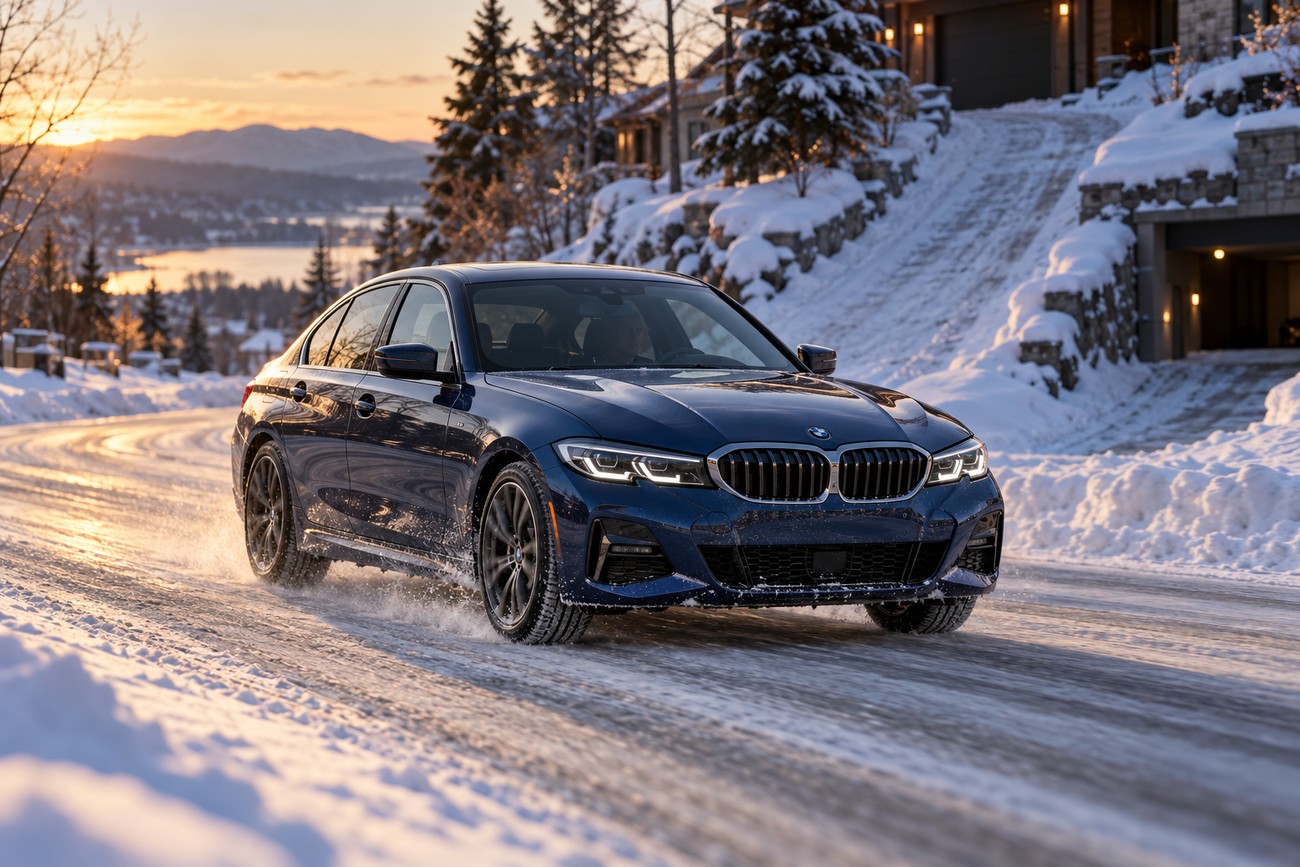
For city driving, route selection is part of vehicle control. An uncleared hill, deep driveway, or heavy-snow parking area may exceed the traction and clearance available to a rear-drive 3 Series. Avoiding that section before entering it is often safer than relying on a recovery technique after the car has stopped.
Choose routes with packed, cleared surfaces and leave extra space for smooth braking and steering. Winter tires, correct pressure, and conservative inputs matter more than trying to imitate an all-wheel-drive vehicle. Keep the wheels straight when starting, especially on an incline, and avoid unnecessary stops in deep snow.
Packed snow that allows the tires to roll is usually manageable with gentle inputs and a clear escape route. Loose or wet deep snow, steep starts, severe ruts, and snow that reaches the underbody require a different decision: reverse out, clear the route, use recovery equipment, or wait for conditions to improve.
Many rear-drive BMW owners simply avoid deep snow rather than attempting to solve every traction problem after entering it. That is sound winter judgment. No electronic assistant can overcome a tire with no usable grip or a car resting on compacted snow.
Frequently asked questions
Should you turn traction control off when a BMW is stuck in snow?
Keep stability assistance active for most recovery attempts, especially if the car is sliding or the surface is uneven. The system can reduce excessive wheelspin and help maintain directional control, although it cannot create grip.
Some BMW systems may allow limited wheel movement in a specific traction or dynamic setting, which can help a carefully controlled escape when the car is moving slightly and the driver can use gentle throttle. Use that option only if you understand the vehicle’s controls, and return to the normal setting once the car is free. Turning assistance off does not solve a high-centered car or a tire that cannot grip.
How can you tell whether the BMW is traction-limited or high-centered?
A traction-limited car usually responds to gentle throttle with some wheel movement, slight forward or backward motion, or changing grip as the surface is cleared. Free-spinning tires, polished snow, and deepening holes indicate that the tires are losing contact with the usable surface.
A high-centered car may show little movement even with the wheels straight and may feel as if the body is resting on a hard ridge. Snow packed beneath the center, differential area, rocker panels, or bumper supports that diagnosis. In that case, shoveling and physical recovery are more useful than further throttle.
When should you stop trying to free the car yourself?
Stop after repeated wheelspin fails to produce movement, the ruts are getting deeper, or the car begins to settle onto compacted snow. Also stop if the underbody contacts the surface, the exhaust outlets become blocked, or the vehicle starts moving in an uncontrolled direction.
Further attempts can damage tires, drivetrain components, or the underside while making recovery harder. Clear the route, use appropriate recovery equipment, or request assistance before the car becomes more deeply buried.







