
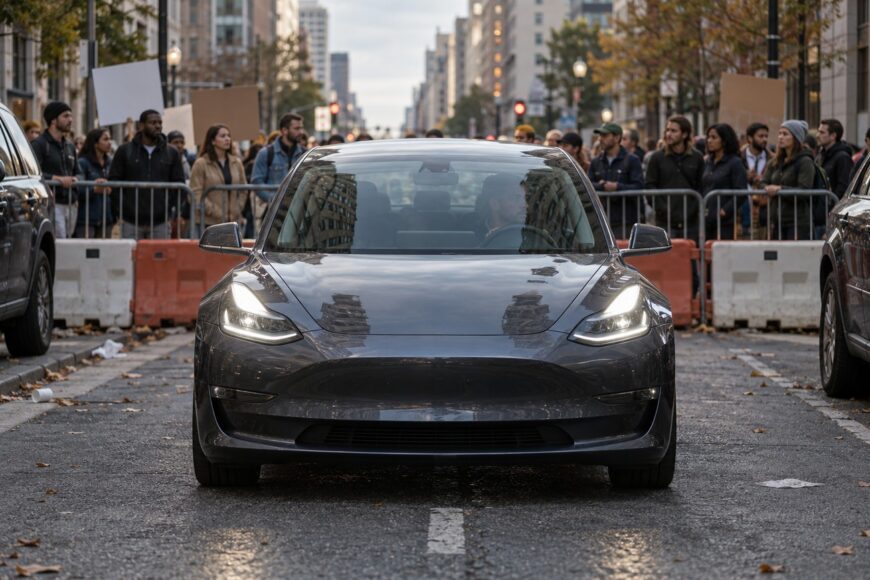
Your Tesla is stationary, the road is blocked, and the battery is still being used. Climate control, defogging, lights, screens, Sentry Mode, and battery conditioning can reduce the available charge while the car goes nowhere. Improvised pushing or towing can also damage motors or reduction gears.
Personal safety and de-escalation come before preserving your route or the car’s exact position. Assess whether the crowd is moving, whether a clear exit exists, how much space and charge remain, and whether police or authorized recovery assistance can reach you. The practical choice is usually to wait safely, create a coordinated exit, or request controlled removal.
- First Priorities When the Road Is Blocked
- How Much Battery a Stationary Tesla Can Use
- Neutral, Transport Mode, and Safe Vehicle Movement
- Why Improvised Towing Can Damage a Tesla
- Leaving the Car or Waiting Out the Blockade
- The Tesla Blockade Myths That Cause Expensive Mistakes
- Frequently asked questions
- Why are people protesting at Tesla locations?
- Why are direct Tesla sales restricted in some states, including Texas?
- What should I do if my Tesla’s 12V battery warning appears while I am still blocked?
First Priorities When the Road Is Blocked
Start with the people around the vehicle, then assess the car. Keep doors locked when appropriate, avoid confrontational exchanges, and watch for changes in the crowd, nearby traffic, smoke, debris, or emergency access routes. A navigation app may show an alternative road while every usable exit is physically blocked, so verify the actual path before moving.
Check the remaining charge, weather, cabin temperature, visibility, and the vehicle’s position. A slope, loose surface, narrow shoulder, or blocked turning area can make a seemingly simple maneuver unsafe. If the Tesla is on an incline, selecting Park does not replace physical wheel restraint or a secure curb position where those protections are needed.
Contact local emergency services or police when there is an immediate danger, a medical need, fire risk, or an obstructed emergency route. Local traffic rules and police traffic-control powers may authorize removal when a vehicle obstructs a roadway or creates a safety risk; Tesla status does not create a special exemption. The exact authority and procedure depend on the jurisdiction.
Do not make a sharp move into a crowd because a gap appears for a moment. Move only with a clear route and a safe way to coordinate with police, organizers, or other people directing traffic. If the vehicle must be relocated, ask for an authorized recovery operator and explain the Tesla model, charge level, wheel position, and any 12V warning.
How Much Battery a Stationary Tesla Can Use

A stopped Tesla does not burn fuel through engine idling, yet it still consumes electricity. Climate control, windshield defogging, battery conditioning, displays, lights, alerts, and other electronics can materially reduce charge during a long standstill. The effect becomes more consequential when the battery is already low.
Camp Mode and Keep Climate On can maintain cabin conditions, which may be important in dangerous heat or cold. They also consume noticeable energy and do not guarantee endurance during a prolonged blockade. Use the lowest safe climate setting, reduce unnecessary screen and lighting activity, and reassess the charge rather than assuming the displayed range represents waiting time.
Cold weather can reduce available range and increase the practical impact of heating and battery-conditioning demand. Sentry Mode may add meaningful electrical load, especially when the vehicle detects activity and generates repeated alerts. Disable nonessential features only when doing so does not compromise personal safety or the security of the vehicle.
There is no fixed number of blockade hours that can be predicted from the advertised range. Temperature, software, battery condition, climate settings, Sentry Mode, and the vehicle’s activity all affect stationary demand. If the charge is falling faster than expected, request assistance early, while the car can still communicate and be moved using the prescribed procedure.
Neutral, Transport Mode, and Safe Vehicle Movement
Neutral, drive-disabled status, towing mode, and Transport Mode are distinct practical states. They should not be treated as interchangeable labels or as automatic permission for ordinary wheel-lift towing. The correct state depends on the Tesla model, the vehicle’s condition, the wheel position, and the recovery method.
For most Tesla models, selecting Neutral normally requires a live 12V system and access to the vehicle controls, menu, or selector. A live 12V system can also be critical for unlocking the car and enabling recovery functions. If the vehicle is fully unpowered, a model-specific mechanical release or emergency procedure may be required.
Tesla manuals distinguish towing procedures, Transport Mode, manual releases, and wheel-chock requirements by model. There is no universal button sequence that safely applies to every Tesla. Use the owner’s manual for the exact vehicle, or provide the model and condition to a qualified recovery operator before anyone attempts to move it.
Recovery operators verify 12V status, wheel position, and the exact model before choosing equipment because Neutral alone does not authorize ordinary wheel-lift towing.
Before movement begins, confirm that the vehicle can be controlled, that the wheels can roll as required, and that the recovery team understands any locked-wheel or slope condition. Keep the key or phone available if the model expects it for unlocking or driving functions. If the screen is unavailable, do not improvise with random controls or force a selector.
Why Improvised Towing Can Damage a Tesla
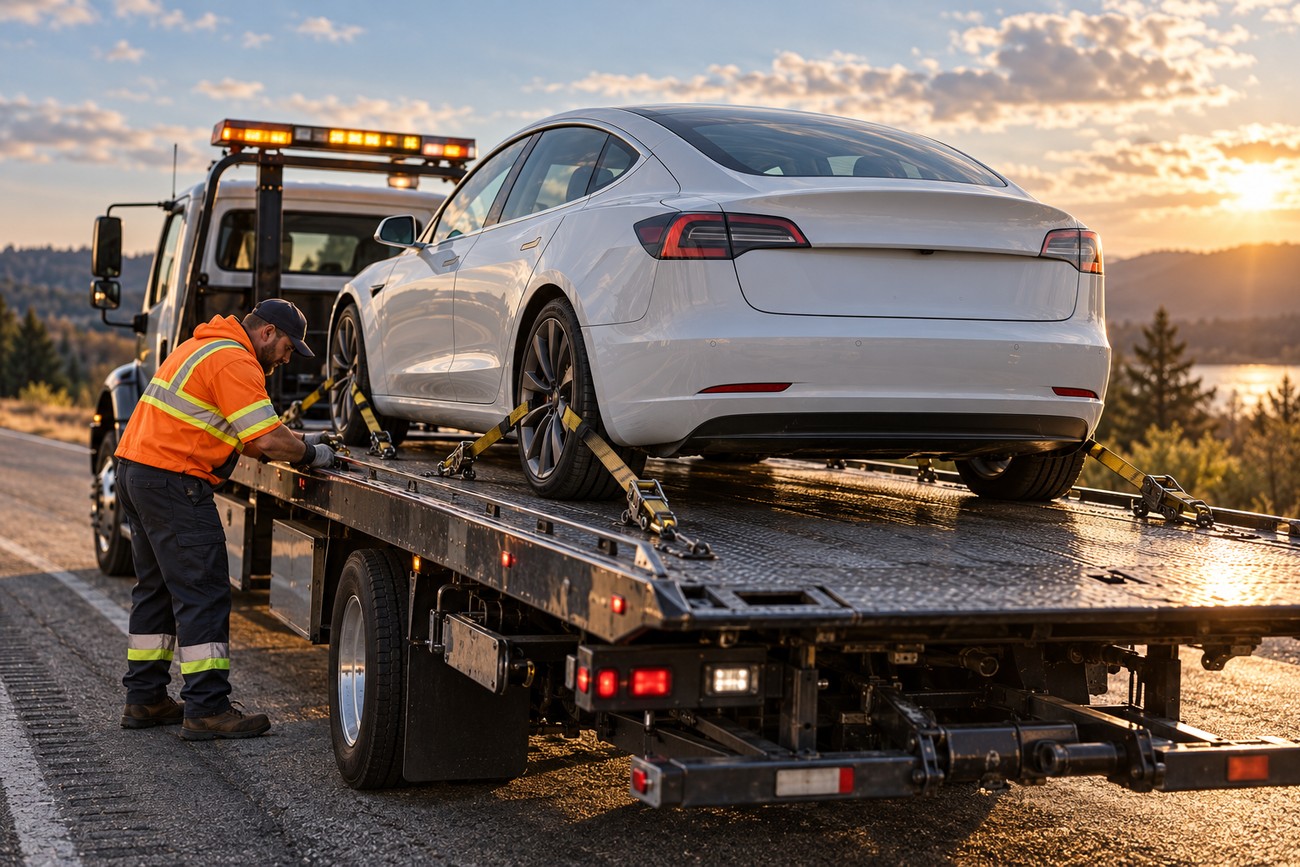
A Tesla should not be towed like a conventional automatic-transmission vehicle unless the applicable model instructions permit that exact method. Towing on driven wheels without following Tesla’s procedure can damage motors or reduction gears. The vehicle’s electrical systems and drivetrain require recovery steps that vary by model and condition.
Many scenarios require Transport Mode, prescribed towing equipment, or flatbed transport. A flatbed may be the required or safest method when the car cannot enter the appropriate transport state, when the 12V system is unavailable, or when wheel position and road conditions create additional risk.
The Tesla’s weight makes manual movement difficult, particularly with locked wheels, poor pavement, or a slope. Several people pushing may lose control, damage bodywork, or place themselves in the vehicle’s path. Wheel chocks and secure positioning matter whenever the car is stopped on an incline or unstable surface.
Give the recovery operator the exact model, whether the vehicle powers on, whether Neutral is available, the condition of the 12V system, and which wheels are accessible. Follow the applicable owner’s manual rather than generic roadside advice. If local authorities order removal, ask that the recovery method be documented and suitable for the vehicle.
Leaving the Car or Waiting Out the Blockade
Remaining inside may be safest when the crowd is unstable, the route is unclear, or the vehicle could be moved without you. Keep your phone charged and preserve enough vehicle charge for climate protection and vehicle communications. Avoid leaving active climate or Sentry Mode running without considering the remaining reserve. A short delay can become a recovery problem if the battery falls too low.
If you leave temporarily, secure the vehicle according to the model’s normal locking procedure and keep the phone key or physical key within the expected communication range when unlocking or driving functions may be needed. A phone key does not eliminate every communication or power limitation. Confirm that you can access the car again before moving away from it.
Know the location and operation of any model-specific manual door, frunk, or trunk releases before a 12V problem occurs. These procedures differ between models and may have safety limitations. They are emergency access provisions, not substitutes for the normal controls or a complete recovery plan.
Coordinate any departure with police, organizers, or recovery personnel when possible, and never assume protesters will create a safe path on demand. A sharp turn or sudden reverse in a crowd can injure people and leave the vehicle trapped in a worse position. If no clear route exists, request controlled traffic management or authorized removal.
The Tesla Blockade Myths That Cause Expensive Mistakes
The first myth is that an EV uses almost no energy while stopped. A Tesla can use substantial energy while climate control, battery conditioning, Sentry Mode, alerts, lights, or other electronics remain active. Charge loss depends on conditions, so the percentage on the screen should be treated as a changing reserve rather than a guaranteed waiting period.
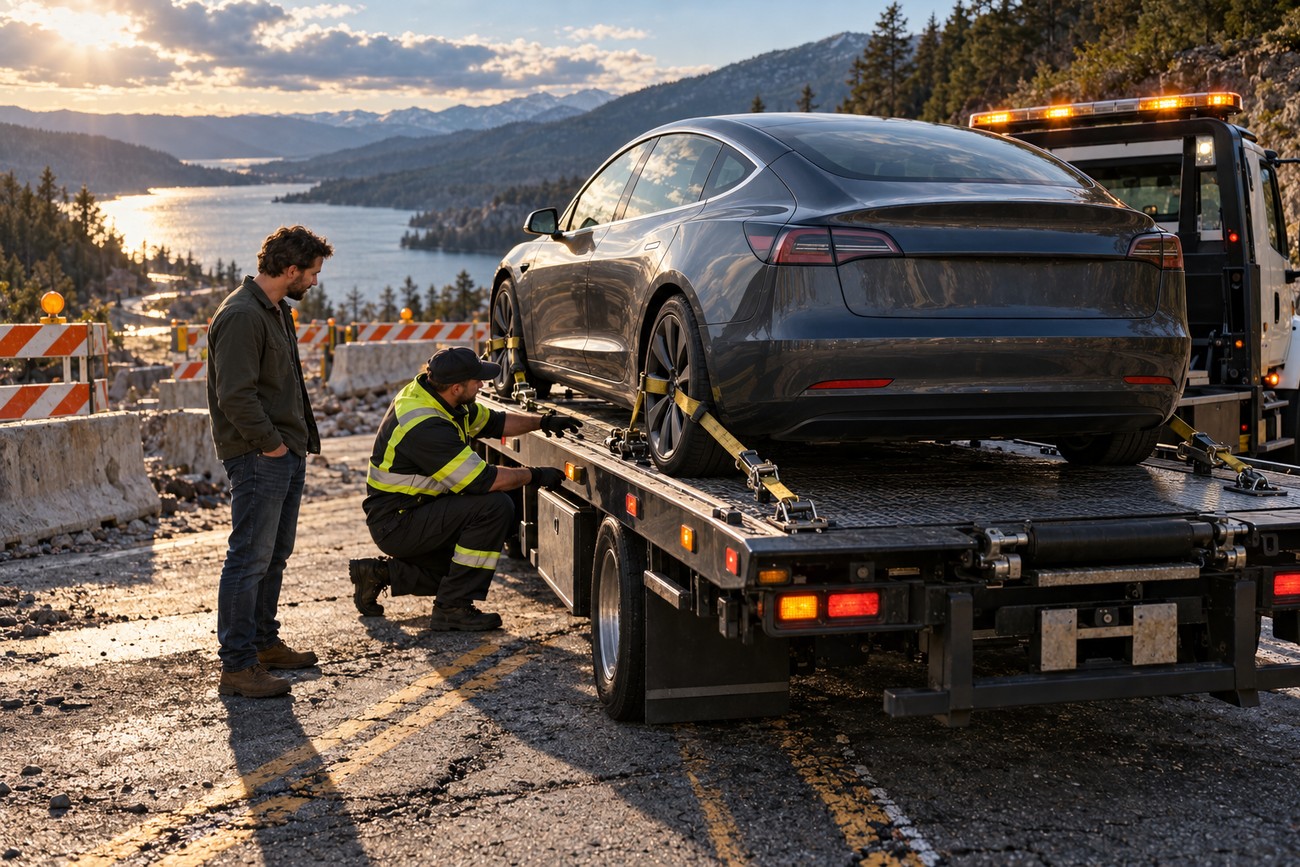
The second myth is that any Tesla can be towed like an automatic-transmission car. There is no universal safe towing method across Tesla models and conditions. Flatbed transport or a prescribed Transport Mode procedure may be required, especially when the 12V system is weak, the wheels are locked, or the vehicle cannot enter the required state.
A dark or failed screen does not necessarily eliminate every recovery option. Model-specific mechanical or emergency procedures may still provide access or allow controlled recovery, although they require the correct instructions. Repeatedly cycling locks, screens, or controls can consume remaining power and complicate diagnosis.
Owner reports of unexpected 12V battery warnings after prolonged blockade-like standing are anecdotal community cases, not evidence of a widespread failure. Treat such a warning as a reason to contact roadside assistance, preserve access, and avoid unnecessary electrical activity. It is not, by itself, proof that the high-voltage traction battery has failed.
Frequently asked questions
The questions below cover the reasons protests may occur at Tesla locations, how local sales rules differ from roadside safety rules, and what to do when a 12V warning appears during a blockade.
In every case, verify the local situation, prioritize personal safety, and use model-specific recovery guidance rather than assumptions.
When the route remains blocked or the vehicle’s condition changes, contact the appropriate local authority or qualified recovery provider.
Why are people protesting at Tesla locations?
Protests at Tesla locations can involve grievances about company leadership, labor, environmental issues, politics, or consumer concerns. The specific motive depends on the event and should be confirmed through reliable local reporting or official statements rather than assumed from the location alone.
The protest’s motive does not determine the driver’s safe response or automatically change traffic law. Keep distance, avoid confrontation, and follow lawful directions from police or authorized traffic personnel. Vehicle removal authority generally depends on roadway obstruction and safety conditions, not on agreement with the protest.
Why are direct Tesla sales restricted in some states, including Texas?
Restrictions on direct vehicle sales are jurisdiction-specific legal and commercial rules. They may involve dealership laws, manufacturer-franchise rules, delivery arrangements, or service structures, and they differ between states and countries. Texas vehicle sales rules and Tesla’s direct-sales model should therefore not be generalized to every market.
Those rules are separate from an immediate roadside blockade. Whether a vehicle may be removed from a dangerous or obstructed roadway is governed by local traffic-control authority and safety requirements, regardless of how the vehicle was sold or delivered.
What should I do if my Tesla’s 12V battery warning appears while I am still blocked?
Contact roadside assistance or local emergency services if the warning is accompanied by loss of access, unsafe traffic conditions, or an inability to move the vehicle. Tell the operator the exact model, charge level, whether the car still powers on, and whether the road is obstructed. Keep the vehicle accessible and avoid repeated lock-unlock cycles or unnecessary screen activity.
A 12V warning does not prove total traction-battery failure. It does mean that normal unlocking, control access, Neutral selection, or recovery functions may become unreliable. Do not attempt improvised towing; ask for a qualified operator who can follow the model-specific recovery procedure.







