
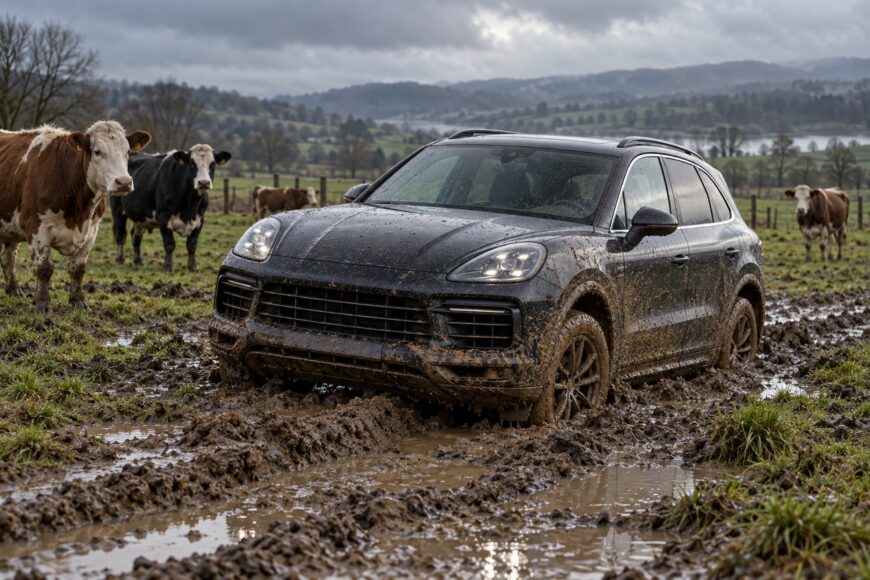
A powerful Porsche Cayenne can look strangely helpless among cattle, on a muddy lane, or across wet pasture. The engine may have ample power, yet the vehicle can sit spinning its wheels while a lighter SUV passes through. That apparent contradiction comes from weight, tire grip, ground geometry, and the consequences of a failed recovery attempt.
A Cayenne weighs approximately 2.1–2.5 tonnes, depending on version. Its normal ground clearance is typically about 190–210 mm, and some versions can raise the body through selectable air-suspension modes. Those features help on uneven access roads, though they do not remove the risks created by road tires, low-profile wheels, soft ground, or a narrow farm track with no safe turnaround.
The sensible decision is made before the first deep rut. Inspect the surface, judge the exit, and turn around while that remains easy. Once the tires are spinning or the underbody is resting on a ridge of clay, the problem becomes recovery rather than driving.
Why a Cayenne Can Get Stuck Where It Looks Capable
The Cayenne is a road-oriented luxury crossover and sport SUV, not a direct equivalent of a heavy-duty body-on-frame off-roader. Its mass gives it stability on pavement, but it also increases the load on each tire and adds momentum on slippery ground. Braking, steering, and changing direction become harder once the surface stops supporting the vehicle evenly.
Clearance can be adequate for a gravel road while still being insufficient for a deep agricultural rut. The normal setting is typically about 190–210 mm, with limited additional lift available on air suspension in selected modes. That extra height may help with a ridge or shallow depression, but it cannot prevent the belly from contacting a sharply shaped rut or a raised center section.
Many factory tire setups prioritize road handling and comfort. Road tires can lose grip sharply on wet grass, clay, manure, and soft ground, even when the tread appears usable. Large wheels with low-profile tires respond well on asphalt, yet tolerate hidden potholes, rocks, ruts, and sidewall impacts poorly.
AWD and electronic traction aids distribute the grip that the tires can find; they cannot create usable contact on a sliding surface. Engine power can then deepen the holes faster. Pneumatic height adjustment and expensive tires improve particular aspects of the vehicle, but neither guarantees traction in a cow yard or muddy field.
The Terrain Traps That Catch Drivers Out
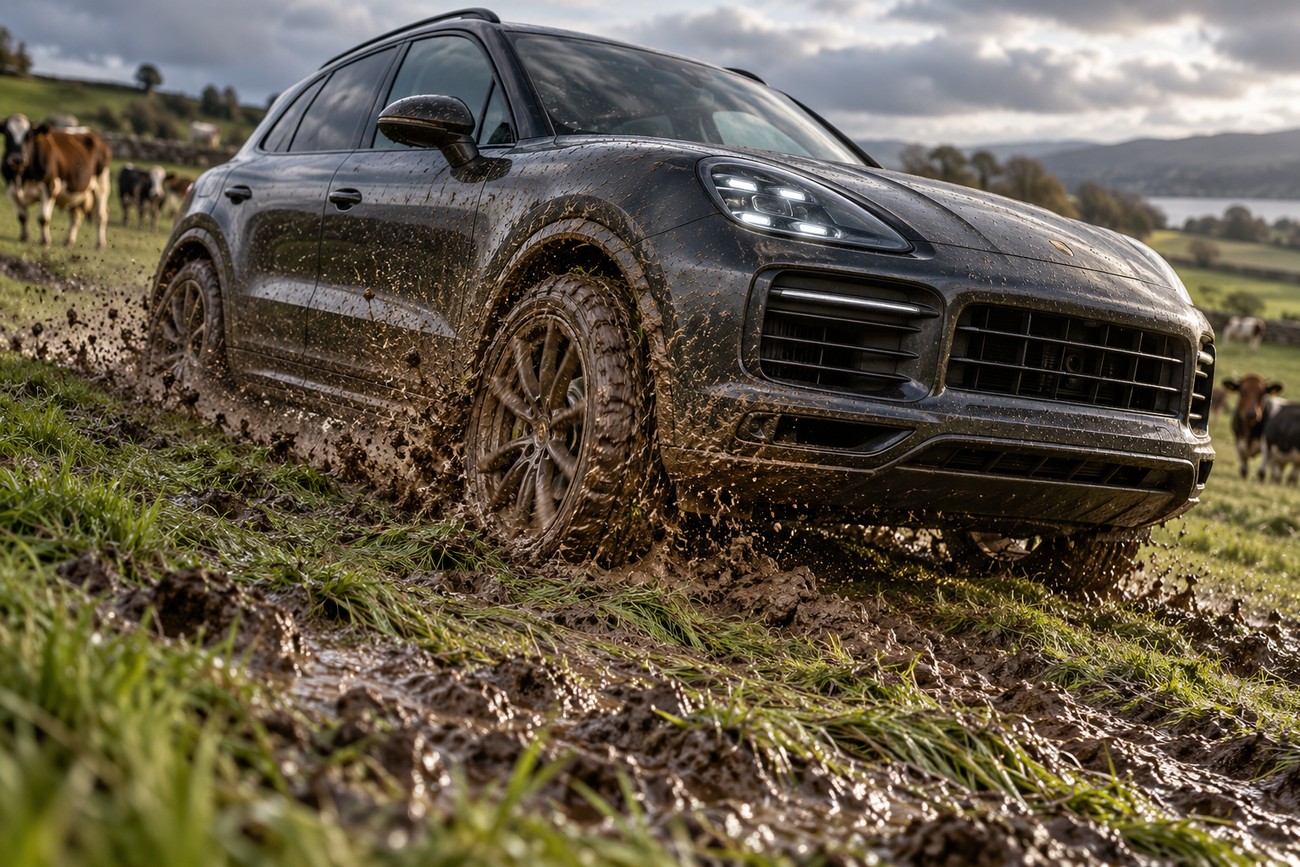
Wet grass is a frequent trap because it looks firm and harmless. Its surface can be more slippery than dry, loose soil, especially where cattle have compressed the ground underneath. A Cayenne may begin moving smoothly and then lose lateral grip as soon as the tires cross a damp slope or a polished patch.
Manure slurry and wet clay create a similar failure. The tires may clear the first few meters before filling their tread and sliding together. A vehicle weighing 2.1–2.5 tonnes carries more momentum than a lighter vehicle at the same speed, so a small amount of speed can make stopping or redirecting difficult near fencing, animals, drainage channels, or a ditch.
Grass also hides the shape of the ground. A rut may be deep enough to trap one wheel, while the raised center contacts the underbody. That is why the practical limit is often tire support and geometry, especially belly contact, rather than engine output or the published clearance figure.
Damage can continue after the vehicle is moving again. Mud, stones, and organic material can load the wheel arches, brakes, sensors, radiators, cooling airflow, underbody components, and decorative trim. Large wheels can suffer unseen impacts, while cameras and other driver-assistance sensors may become dirty and less useful.
How to Cross a Farm Track Without Making It Worse
Begin on foot when conditions are doubtful. Check the soft section, drainage, rut depth, wheel placement, and the point where you could turn around. A route that looks passable from the driver’s seat may narrow quickly beside a hedge or fence, leaving no practical exit once the Cayenne has entered it.
Stop before the first visible rut, walk the soft section, and arrange an extraction option before committing a heavy vehicle. That small delay is cheaper than recovering a vehicle from a deeper hole.
Choose the firmest line and keep the wheels as straight as the terrain allows. Use smooth throttle and modest speed, allowing the tires to maintain contact instead of asking them to overcome the surface with force. For short field crossings, suitable tires, appropriate pressure, and careful throttle matter more than extra horsepower; pressure changes should follow the tire and vehicle guidance rather than guesswork.
Deep slurry is a poor place to build momentum. Heavy throttle excavates the surface, deepens the ruts, and can leave the vehicle resting on its underbody. Off-road modes and traction simulations operate within limited speed and load ranges, so their activation does not justify continuing into ground that has already shown inadequate support.
If there is a credible chance of getting stuck, bring a companion vehicle, suitable recovery equipment, or a winch arrangement before entering. Keep people clear of animals, fences, tensioned straps, and possible vehicle movement. Turning back at the first doubtful section is a successful decision, not a failure of the Cayenne.
If the Cayenne Is Already Stuck
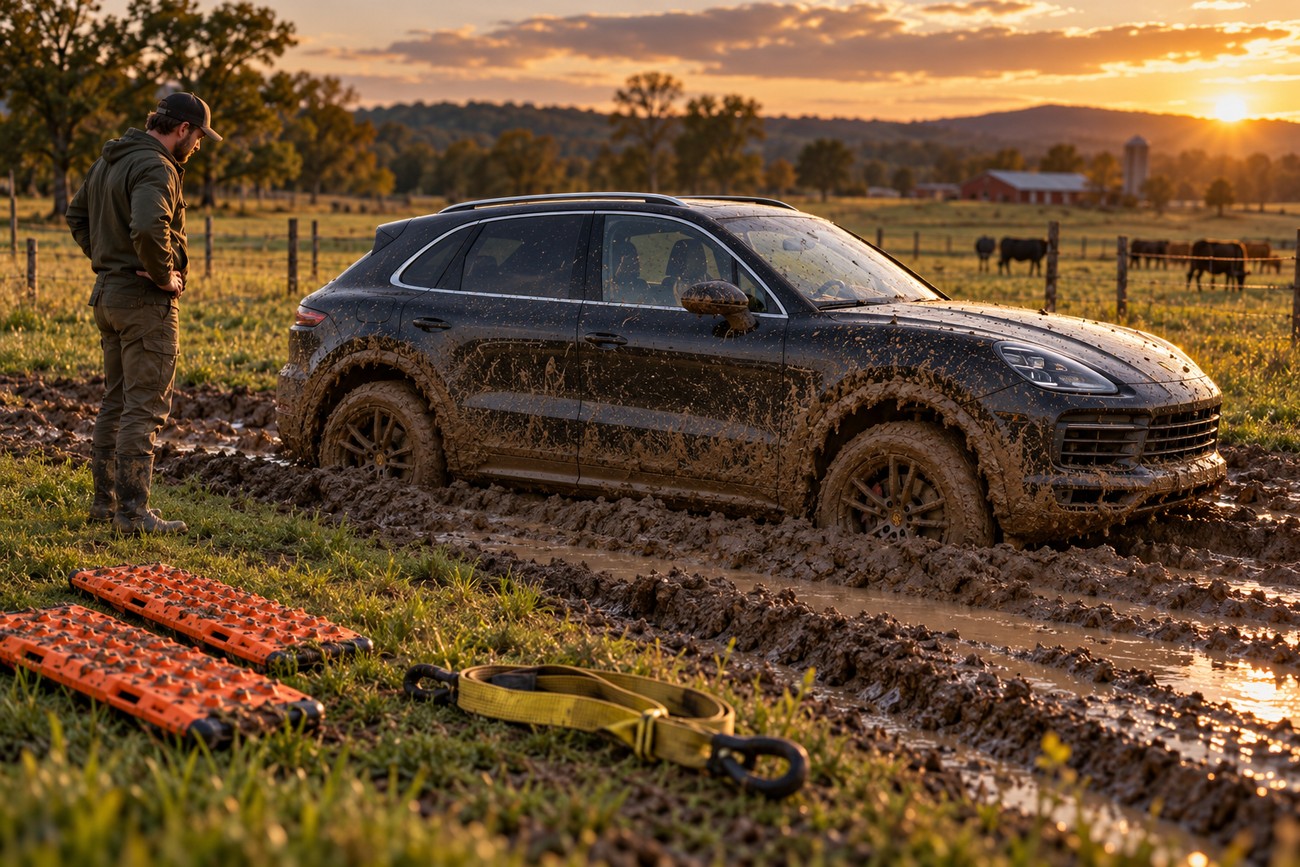
Stop spinning the wheels and release the throttle. First establish whether the vehicle is simply short of grip or high-centered on a rut, ridge, or hidden obstacle. Look beneath the vehicle only from a safe position, and clear loose material by hand only when there is no risk from movement, unstable ground, or trapped components.
If the tires still have support, one controlled, gentle attempt may be reasonable after straightening the wheels and removing an obvious obstruction. Repeated attempts under power usually make the hole deeper and reduce the chance of a clean extraction. A Cayenne can appear to have clearance while the center of the vehicle is already carrying part of its weight.
Use assessed recovery points and suitable equipment. Do not attach a strap to bumper plastics, decorative trim, suspension parts, or an improvised point because it looks solid. A sudden pull can damage the bumper, bodywork, underbody, or recovery equipment, turning a muddy delay into an expensive repair.
Recovery should be controlled, aligned, and coordinated between the people involved. A gradual extraction is preferable to repeated acceleration followed by an abrupt tow. Some owners report that a Cayenne on standard summer or road tires can clog with mud more easily on wet grass or manure slurry than a lighter SUV on all-terrain tires; that observation is anecdotal, but it reflects the central limit: once tire contact or underbody support disappears, power offers little help.
Frequently asked questions
Post-drive care matters because agricultural contamination can remain in places that are difficult to see. A short inspection after the crossing can prevent a minor muddy trip from becoming a brake, cooling, sensor, or corrosion problem.
What should I do after driving through manure and mud?
Rinse the wheel arches, wheels, visible underbody areas, and lower bodywork as soon as practical, using care around electrical connectors and sensitive components. Remove packed material from the cooling airflow path and check that radiator openings are not obstructed. Manure and wet soil can retain moisture and organic contamination, so leaving them in seams or behind trim increases the chance of persistent odor and material damage.
After cleaning, check the brakes for reduced response, unusual noise, or contamination around the calipers and discs. Inspect the tires, sidewalls, rims, bumper edges, sensors, cameras, and underbody for impact or trapped debris. If a warning appears, steering feels abnormal, braking changes, or cooling performance seems different, stop using the vehicle until it has been assessed.







