
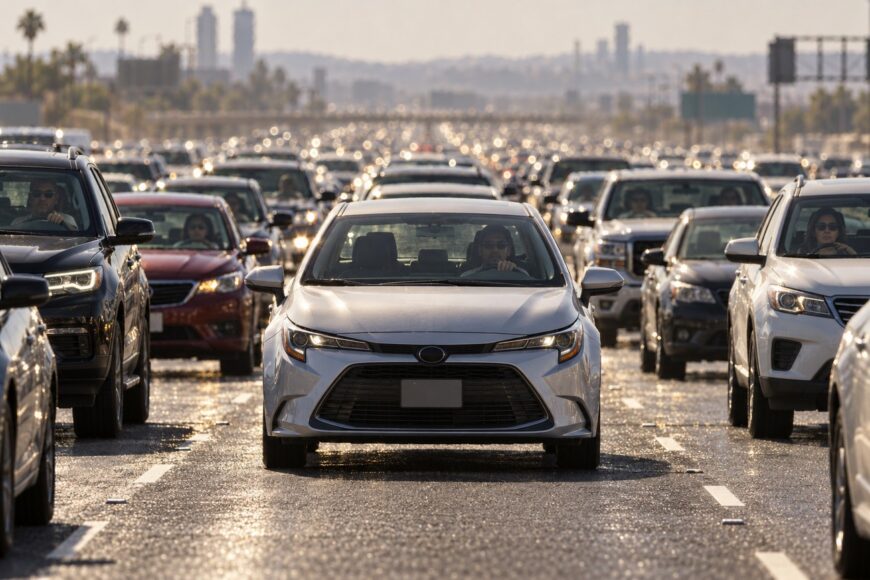
A 60-mile traffic queue can leave a Toyota Corolla barely moving while the engine, climate system, driver, and fuel supply remain under pressure. The vehicle may spend long periods idling, then make repeated short advances that add heat and wear without providing the cooling airflow of normal road speed.
Those 60 miles describe the length of the traffic jam, not a distance the Corolla continuously travels at idle. The practical decision is to balance safe positioning, cabin comfort, fuel use, and mechanical warning signs without trying to convert the queue into an exact number of idling hours.
- What a 60-Mile Traffic Jam Really Means for a Corolla
- The First Decision: Keep Idling, Move, or Shut Down?
- How to Prevent Overheating in Stop-and-Go Traffic
- What to Do If the Temperature Rises or Steam Appears
- The Hidden Costs of Creeping Forward for Hours
- Common Myths and Mistakes in a Corolla Traffic Jam
- Frequently asked questions
- What mileage is too high for a Toyota Corolla?
- How can I estimate whether my fuel will last through a 60-mile traffic jam?
- What should I keep in a Corolla before a prolonged traffic delay?
What a 60-Mile Traffic Jam Really Means for a Corolla
Queue length cannot be converted into a precise fuel range because the Corolla may move intermittently, stop for long periods, or face changing traffic conditions. Fuel use depends on the vehicle’s generation, engine, temperature, air conditioning, load, vehicle age, and time spent stopped.
Steady driving benefits from continuous airflow and a predictable engine load. Long idling removes much of that airflow, while repeated short movements add acceleration, braking, transmission activity, and frequent changes in engine speed. The result can differ substantially from the vehicle’s advertised or EPA fuel-economy figures.
Air conditioning is an important variable. In hot weather, the engine may run more often to power the climate system, while electrical loads, cooling-fan operation, and passenger demand place additional work on the vehicle. An older Corolla may also use fuel differently because of its maintenance condition, sensor faults, or reduced system efficiency.
Traffic duration matters as much as distance on the road sign. A queue described as 60 miles might contain periods of movement and periods of near-zero progress, so the fuel gauge, warning indicators, and actual vehicle condition provide more useful information than a highway fuel-economy estimate.
The First Decision: Keep Idling, Move, or Shut Down?
Toyota recommends switching the engine off during prolonged waiting outside active movement when doing so is safe. That guidance does not mean shutting down automatically in every traffic lane. Your position, surrounding vehicles, visibility, cabin temperature, battery condition, and ability to restart must all be considered.
If traffic is moving in short bursts, leave a useful gap ahead and avoid rushing into every small opening. When the Corolla is safely stationary and a longer wait is clear, an automatic model should be placed in P with the parking brake applied. Constant P–D cycling adds activity without replacing a safe following distance.
A manual Corolla requires a different stationary habit. Holding the clutch pedal down or keeping the car against the clutch for prolonged periods can increase heat and wear. Use the vehicle’s proper neutral-and-parking-brake procedure when stopped safely, while remaining ready to move if traffic or road conditions require it.
Repeated restarts can reveal a weak battery or starter, particularly in an older vehicle. If the car is in an exposed or unsafe lane, keeping it running may be the safer temporary choice. If it is safely out of active traffic and the wait is prolonged, shutting down can reduce unnecessary fuel use and engine heat.
How to Prevent Overheating in Stop-and-Go Traffic
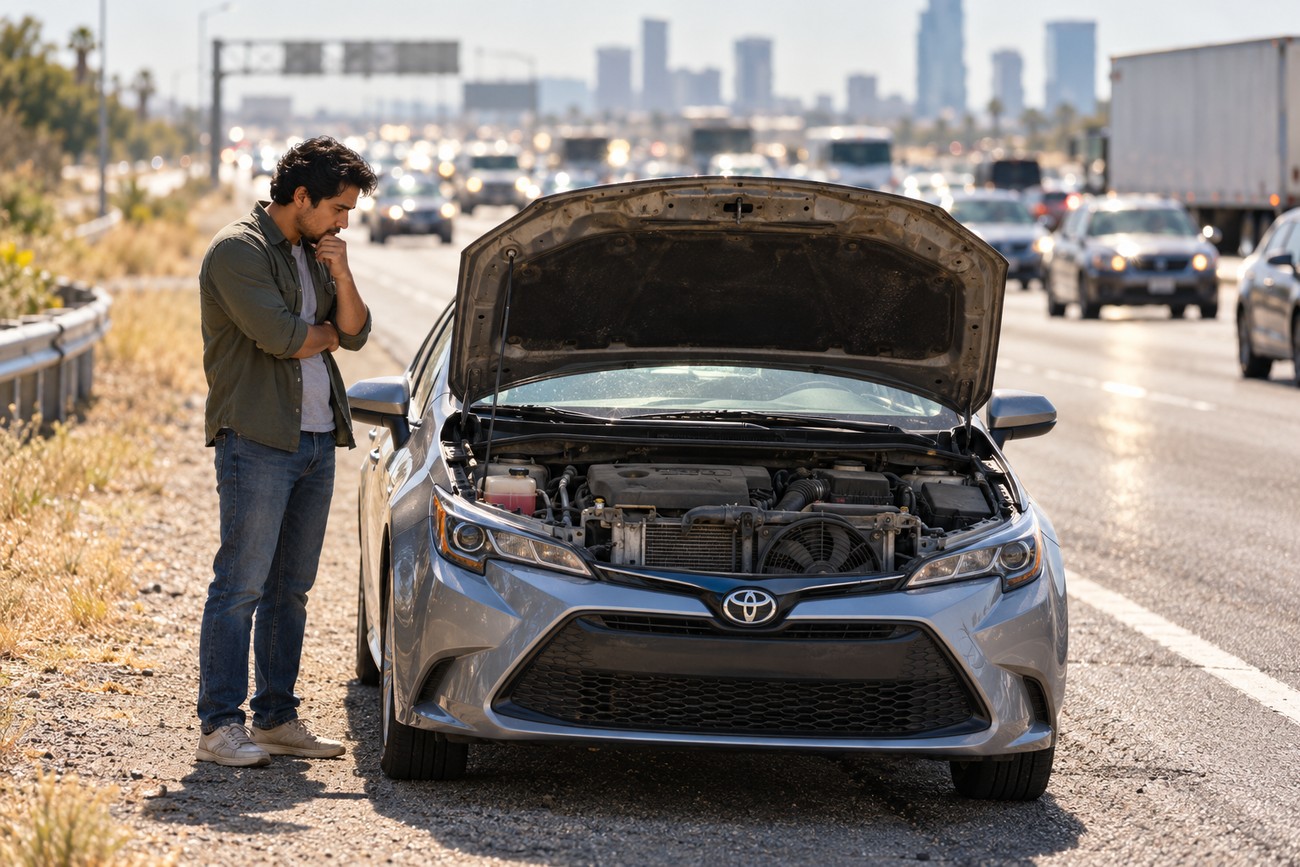
A healthy Corolla should normally cope with ordinary congestion, but slow traffic can expose weaknesses that steady highway airflow conceals. The key risk combination is high ambient temperature, air conditioning, low vehicle speed, and reduced airflow, rather than queue length alone.
A faulty cooling fan, low coolant, clogged radiator, or another cooling-system defect can become apparent when the car spends hours creeping forward. Toyota warns that prolonged idling, particularly with air conditioning in stop-and-go conditions, can contribute to overheating when the cooling system has a fault.
Technicians check the cooling fan, coolant level, and radiator airflow before blaming the traffic jam itself. Slow congestion often exposes a marginal cooling system that normal road speed has been masking.
A temperature reading that remains in its normal range is reassuring, but it does not cancel other warnings. Steam, loss of power, a high-temperature warning, or a gauge entering the red zone requires a safe stop rather than an attempt to reach the next exit.
The exact gauge behavior and cooling procedure vary by model year, so the owner’s manual is authoritative. Do not assume that a familiar-looking dashboard symbol or a nearly unchanged needle has the same meaning across every Corolla generation.
What to Do If the Temperature Rises or Steam Appears
Turn off the air conditioning and reduce the load on the engine. If possible, leave the moving traffic stream and stop in a safe position, then activate the hazard lights. Follow the model-year owner’s manual and wait for the vehicle to cool before attempting further checks.
Steam, loss of power, a red-zone temperature reading, or a high-temperature warning means the Corolla should be stopped rather than driven to an exit. If the hood is steaming, approach it cautiously and do not fully open or handle the engine compartment until the steam has stopped and the area is safe.
Never open a hot radiator cap or coolant reservoir. The cooling system may be pressurized, and escaping coolant or vapor can cause serious burns. Do not pour water into a hot radiator.
A visible coolant leak requires professional service. Even if the temperature later returns to normal, continuing to drive can turn a manageable cooling-system fault into major engine damage. Arrange assistance when the vehicle cannot maintain a safe temperature or the source of the problem is unclear.
The Hidden Costs of Creeping Forward for Hours
Repeated micro-movements can impose more brake, transmission, and clutch stress than smooth, steady travel. Automatic transmissions generate heat through repeated engagement and disengagement, while constant braking keeps friction components working with little opportunity for cooling.
Manual drivers can accelerate clutch wear by holding the clutch partially engaged or balancing the car on the clutch during each small movement. Automatic drivers should avoid pressing the accelerator against the brakes and should use the manufacturer’s proper stationary procedure when the car is safely stopped.
Turning the engine off can quickly reduce air-conditioning performance in hot weather. That creates a comfort and occupant-safety consideration, especially for children, older passengers, or anyone vulnerable to heat. Cabin comfort must be balanced with safe shutdown conditions and the vehicle’s ability to restart.
A hybrid Corolla may periodically stop its gasoline engine as part of normal operation. That does not remove the need to monitor traction-battery charge, temperature, and system warnings. Leave extra space ahead where traffic conditions allow; fewer unnecessary starts and stops reduce braking, acceleration, and repeated engine cycling.
Common Myths and Mistakes in a Corolla Traffic Jam

The claim that a Corolla cannot overheat in traffic is false. A healthy vehicle should normally cope with congestion, but cooling-system faults can cause overheating in stop-and-go conditions, especially when high temperature, air conditioning, low speed, and reduced airflow occur together.
Advertised or EPA fuel-economy figures do not predict prolonged idling, repeated starts, or severe stop-and-go traffic. There is no reliable conversion from remaining fuel to a fixed number of idling hours because the engine, climate system, weather, load, age, and traffic pattern all affect consumption.
A gauge that has not reached the red zone is not permission to ignore steam, loss of power, or a high-temperature warning. These signs can require a safe stop before the gauge reaches its most obvious indication, so continuing in the hope of reaching an exit is an avoidable risk.
Other common mistakes include opening a hot cap, holding the brake or clutch continuously for hours, and shutting down in an unsafe lane without considering surrounding traffic. If the vehicle must stop, choose the safest available position, use the hazards when appropriate, and keep enough space and visibility to respond to surrounding traffic.
Frequently asked questions
These answers apply broadly to Corolla ownership, but equipment, warning messages, and operating procedures vary by model year and trim. The owner’s manual remains the final reference for the specific vehicle.
What mileage is too high for a Toyota Corolla?
There is no universal mileage number that makes a Toyota Corolla too high-mileage. Service records and present condition are more informative than the odometer alone.
For traffic-jam reliability, check the cooling system, battery, charging system, transmission behavior, and current warning lights. A well-maintained higher-mileage Corolla may be a safer prospect than a lower-mileage car with neglected coolant service, a weak battery, or unresolved faults.
How can I estimate whether my fuel will last through a 60-mile traffic jam?
Queue length alone cannot determine whether the remaining fuel will last through the delay. The queue may involve long stops, intermittent movement, or changing weather and climate demands, so there is no fixed idle-hour estimate that applies to every Corolla.
Use the fuel gauge, any low-fuel warning, current vehicle information, and the specific engine and model year. Advertised highway or combined fuel economy is unsuitable for calculating prolonged idling. If fuel is low and a safe opportunity exists, refuel before entering a long, stationary queue.
What should I keep in a Corolla before a prolonged traffic delay?
Carry drinking water for the occupants, a phone charger or jump starter, and a way to make the vehicle visible if it becomes disabled. A reflective vest or warning device can help other drivers see the car, subject to local road-safety rules.
Keep the vehicle’s manual accessible, and check the coolant level, tire condition, battery condition, and warning lights before a long journey. Do not carry out a hot cooling-system inspection at the roadside; allow the vehicle to cool and seek service when a leak or overheating fault is suspected.







