
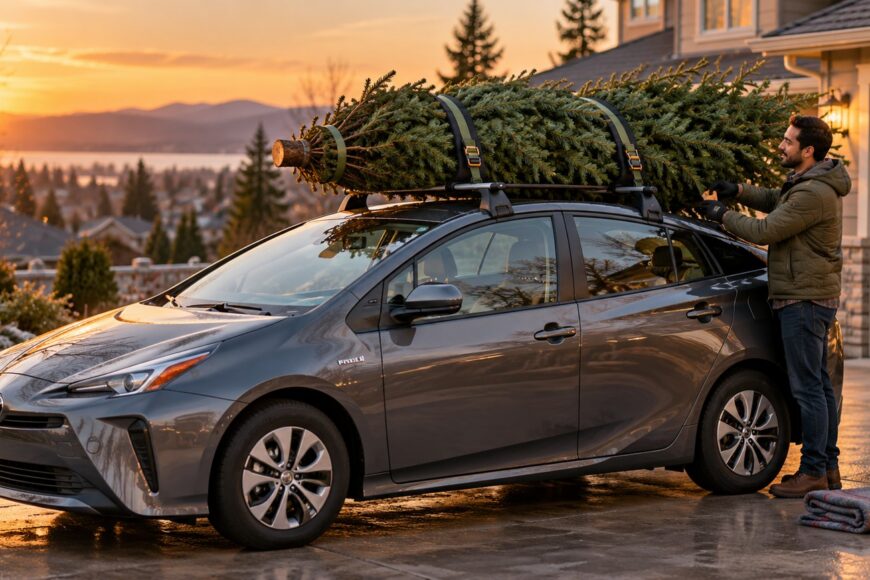
A 10-foot Christmas tree may fall within the weight range of a passenger-car roof rack yet still be a poor load for a Prius if the wind area, length, or attachment points are wrong. A fresh tree often weighs 25–45 kg, and a wet or netted tree may be noticeably heavier. Its crown acts like a sail, while shifting branches and a long overhang create leverage that a scale alone does not show.
The plan depends on a properly rated roof rack, rails, or crossbars. A bare painted roof, door-frame improvisation, and window-seal anchors do not provide a controlled load path. Before you drive, confirm that the rack fits your exact Prius, that its dynamic capacity is adequate, and that the tree can be restrained without blocking required lights, the license plate, windows, or your view. If those checks fail, delivery or another vehicle is the safer decision.
- Can a Prius Safely Carry a 10-Foot Christmas Tree?
- Build a Stable Roof Load Before Lifting the Tree
- How to Strap the Tree to a Prius
- Choose the Tree’s Position for Length and Wind
- The First-Miles Check: Driving, Laws, and Warning Signs
- Common Failures: Scratches, Loose Straps, and Lost Visibility
- When Not to Use the Prius: Safer Alternatives
- Frequently Asked Questions
- How do I check whether a roof rack fits my specific Prius year?
- What should I do if the tree’s netting tears before I reach home?
- How do I strap a Christmas tree to a car?
- How do I secure wood on top of a car?
Can a Prius Safely Carry a 10-Foot Christmas Tree?
A 10-foot tree is often within the physical length that a Prius can carry externally, but compatibility depends on the complete system. Fresh trees often weigh 25–45 kg; a wet or netted tree may be noticeably heavier. That figure must be compared with the vehicle’s permitted roof load and the capacity of the rack, feet, crossbars, and fasteners.
Passenger-car roof racks or crossbars may commonly be rated around 50–75 kg, but this is only a typical range, not approval for a particular Prius or tree. The weakest component controls: the vehicle, feet, crossbars, or fasteners. A rack with a high rating cannot increase the vehicle’s own permitted roof load, and a strong vehicle cannot compensate for weak attachment hardware.
Weight is only one part of the risk. The crown area can create lift and vibration, while the tree’s length increases leverage during braking, turning, and crosswinds. A relatively light tree can therefore be harder to control than a compact, heavier load. The load must stay stable during sudden braking and must not transfer force into the painted roof at isolated points.
Check the owner’s manual and the rack manufacturer’s instructions for the exact Prius year and body style. Vehicle manuals may not specifically approve a 10-foot Christmas tree, so the owner remains responsible for confirming compatibility. If the rack system, attachment points, or allowable roof load cannot be verified, do not treat the trip as a routine cargo run.
Build a Stable Roof Load Before Lifting the Tree
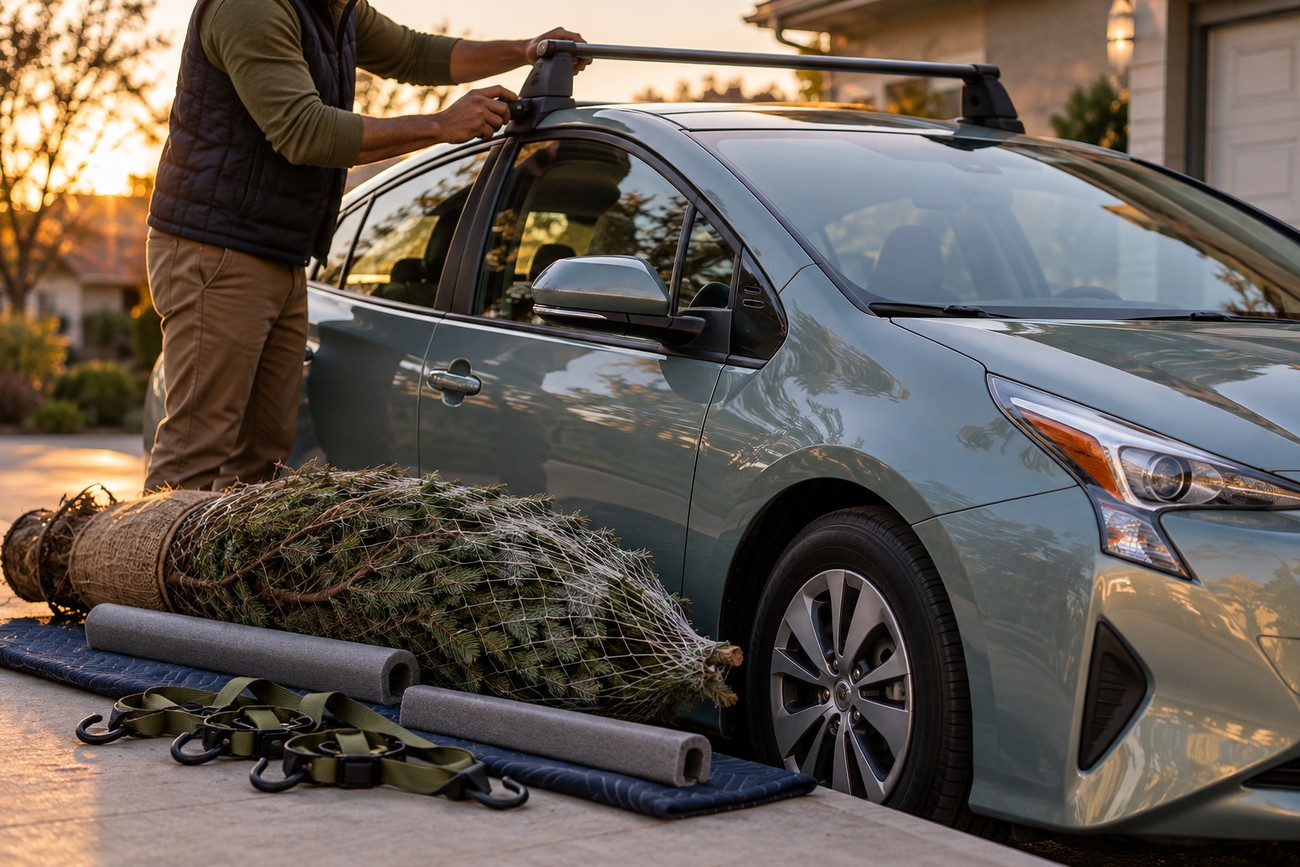
Start with the rack, not the tree. Confirm that the Prius-compatible rails, feet, or crossbars are installed at the approved attachment points and that every fastener is tightened as directed. Inspect the bars for movement, damaged pads, cracked plastic, or contact with the roof. The load should be carried through the rack system rather than point-loaded onto painted metal.
Prepare the complete load package on the ground. Net the branches, place protective padding where the tree and hardware could rub, and lay out 2–3 nonelastic tie-down straps. Use straps suitable for outdoor cargo, with edge protection where a sharp branch or rack corner could cut into the webbing. Avoid elastic cords as the primary restraint because they can stretch and allow the tree to move.
Build and inspect the padded, netted, strapped package before lifting it onto the car. This prevents rushed choices at the roof, where a branch, strap, or anchor can be damaged while someone is trying to hold the tree in place.
Netting keeps the branches together and reduces the crown’s loose profile, but it does not stop the tree from sliding across the rack or lifting in the wind. The straps must connect the tree to the rack through approved or suitable anchor locations. Do not assume that a tightly wrapped net is a structural tie-down.
How to Strap the Tree to a Prius
Inspect the tree before loading. Remove loose branches that could catch the wind or cut the strap, and check that the trunk is sound where the restraint will pass. Place the tree so the rack carries its weight across the available support points. Follow the rack and strap manufacturer’s anchor guidance rather than copying a universal layout.
Use 2–3 nonelastic tie-down straps distributed across the tree’s body. Route them around the trunk and branches in a way that holds the load down without crushing the crown or pulling all the force into one point. The straps should lie flat, remain accessible for inspection, and avoid knots or twists that make tension difficult to judge.
Use padding between the tree, rack hardware, and painted surfaces wherever rubbing or contact could occur. Keep the straps clear of the antenna, wipers, sunroof, spoiler, rear door, and window seals. A strap that looks secure may still press against a moving hatch, distort a seal, or pull on a component that was never designed to anchor cargo.
Tighten the straps until the tree cannot slide, roll, or lift, then test the load with firm hand pressure from several directions. Do not crush the branches to achieve a false sense of security. Close and reopen the hatch if access is part of your plan, check the mirrors and forward view, and make sure no strap tail can reach a wheel or moving door.
After loading, inspect every connection again from both sides of the Prius. The trunk should remain supported by the rack, the straps should not cut into sharp surfaces, and the tree should not touch the roof where movement could wear through the protection. If the tree shifts during the test, unload and correct the arrangement rather than compensating with extra tension at one point.
Choose the Tree’s Position for Length and Wind
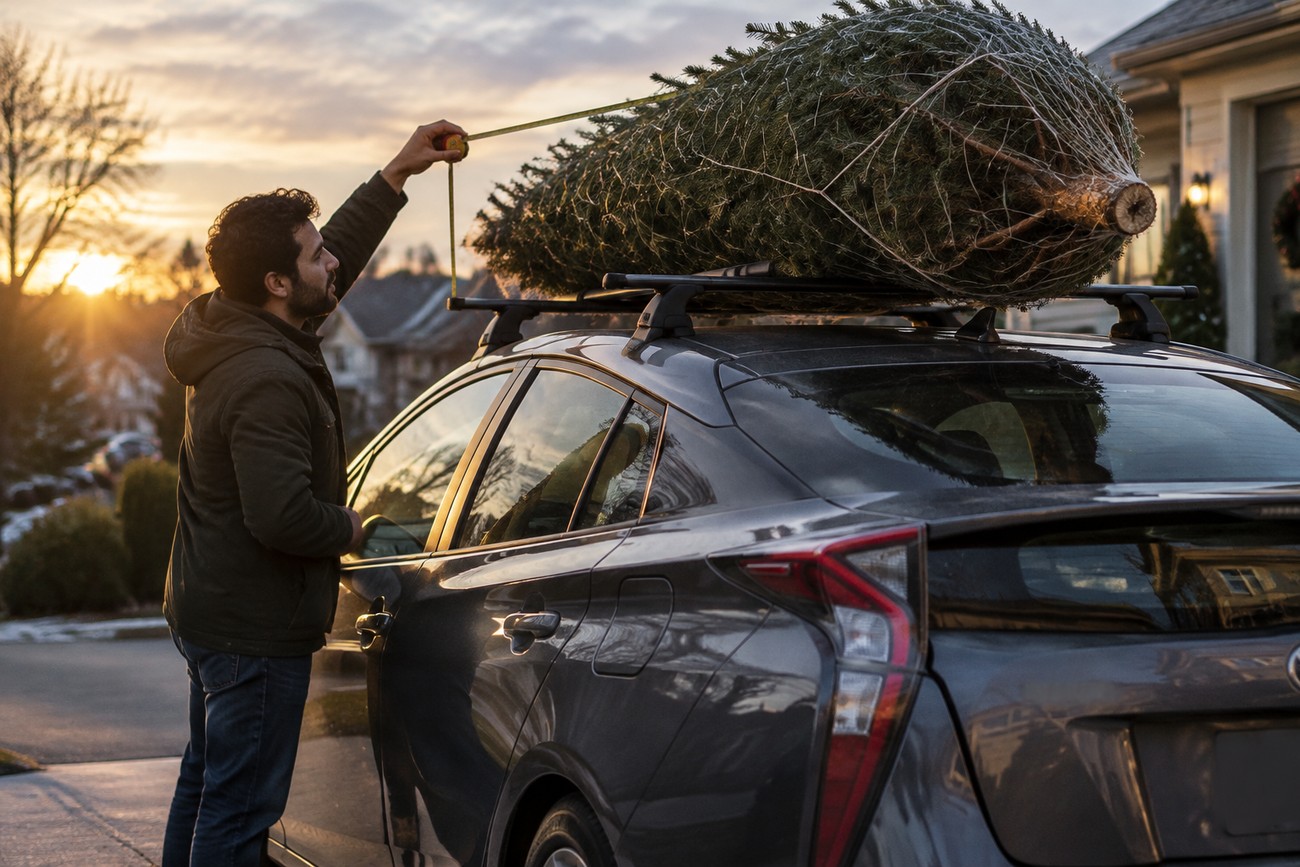
Position should balance support, visibility, hatch access, and aerodynamics. The broad crown creates a large sail, so wind can produce lift, vibration, and leverage that exceed what the tree’s mass suggests. A well-netted and reasonably shaped tree usually behaves better than a loose crown with many branches exposed to the airflow.
An empirical planning guide suggests keeping the tree roughly 30–60 cm shorter than the roof or cargo-carrying length. This is not a universal legal or vehicle standard. The actual overhang must still be compatible with the rack, the vehicle’s permitted load, local rules, and the need to keep lights, the license plate, windows, and the driver’s view clear.
If the tree is shorter than the available roof length, a slightly diagonal position may reduce the need to sharply bend the tip. That can reduce damage to the top and limit the leverage created by a long, straight overhang. Do not angle the tree so far that it loses support, blocks a mirror, reaches the road, or makes the straps pull sideways off the bars.
Check the hatch before final tightening. A tree or strap that prevents the rear door from closing can tempt you to drive with an unsecured opening or to force the hardware against the spoiler. Keep enough access to inspect the load at the roadside, because a setup that cannot be checked is difficult to manage safely.
The First-Miles Check: Driving, Laws, and Warning Signs
Begin with a gentle drive on local roads. Avoid abrupt acceleration, hard braking, sharp turns, and high speeds while you confirm that the tree stays centered and the straps remain flat. Listen for new rattling, roof noise, or vibration; these can indicate movement even when the load still looks intact.
Stop after the first few kilometers in a safe location and recheck every strap, anchor, pad, and net. Netting and branches settle, straps can lose tension, and the tree’s shape can change under airflow. Retighten only as needed, without crushing the branches or pulling a strap over an unsuitable vehicle component.
Continue checking if the weather is windy or the route is long. A loose crown, a strap tail near a wheel, a shifting trunk, or contact with the roof is a stop signal. If the load cannot be restored to a stable condition in a safe place, abandon the trip rather than continuing to the destination.
In the United States and Canada, external cargo generally must be secured and must not obscure required lights, the license plate, windows, or the driver’s view. Exact requirements vary by jurisdiction, and unsafe-load rules can lead to penalties. Check the rules for the route, especially if the tree extends beyond the vehicle or affects rear lighting and visibility.
Common Failures: Scratches, Loose Straps, and Lost Visibility
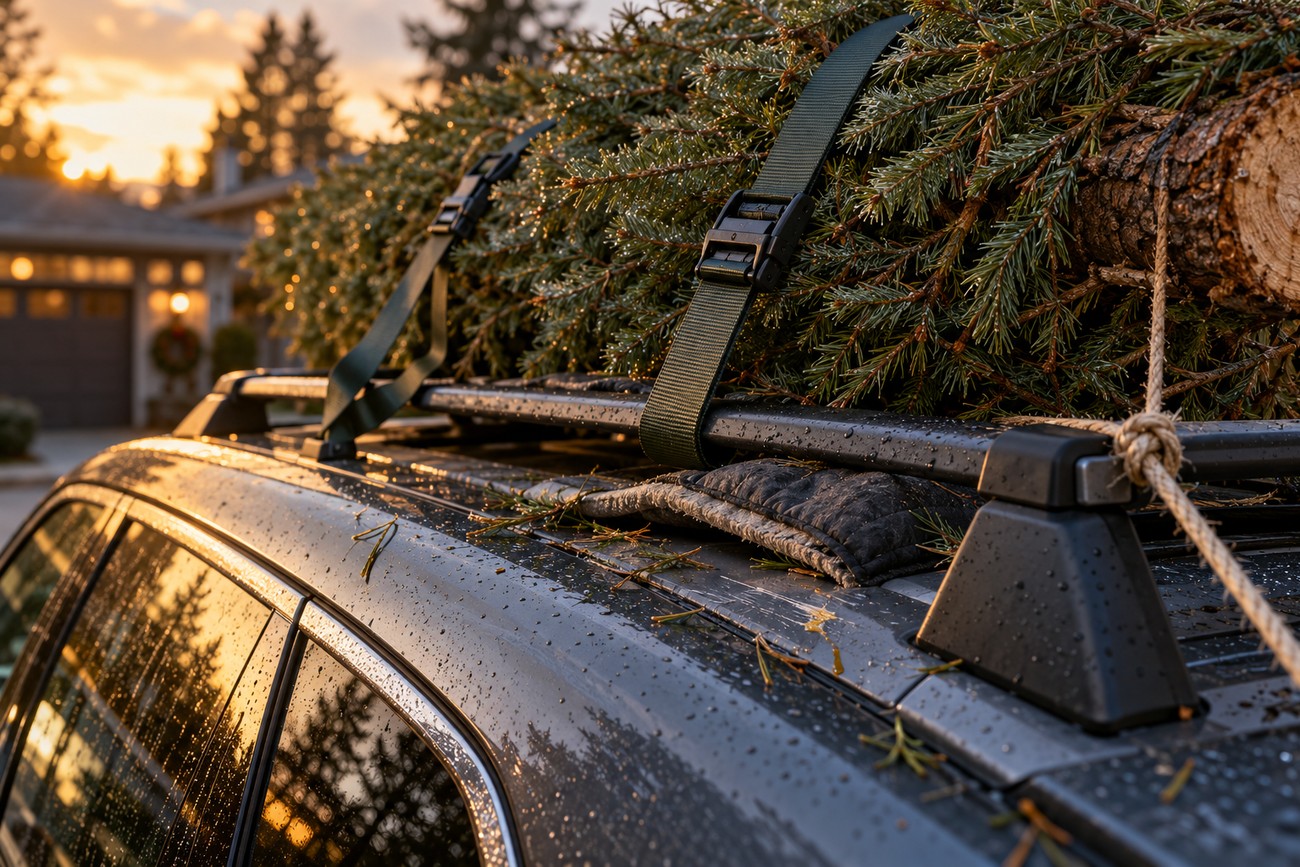
Bare paint is an easy way to turn a short trip into a repair problem. Dirt and wet needles work under moving padding, while resin can bond to paint, rack pads, straps, and upholstery. Even a correctly tightened tree can rub if the protective layer is thin, displaced, or wet.
Thin rope tied at one point is difficult to tension consistently and can concentrate force on a branch or rack edge. Appropriate tie-down straps are easier to inspect and adjust. A rope may still be useful for a secondary purpose if it is suitable and properly attached, but it should not replace the primary restraint system.
Netting is another common source of false confidence. It gathers the branches but does not prevent sliding or lift. A light tree is not automatically safe, and slow driving does not cancel the forces produced by sudden braking, a sharp maneuver, or a gust of wind.
Before leaving, look through the windshield and mirrors, verify that required lights and the license plate are visible, and confirm that the hatch and doors operate as intended. If the tree looks unstable to people in nearby traffic, that is useful feedback rather than a cosmetic concern. A load that appears dangerous is more likely to attract emergency braking, distraction, or a roadside stop.
When Not to Use the Prius: Safer Alternatives
Do not use the Prius without a properly rated roof rack or crossbars. Door frames, window seals, grab handles, and improvised hooks are not a safe substitute for a system designed to carry external cargo. They can damage the vehicle while providing no reliable control of sliding or lift.
Choose delivery, a pickup, a trailer, or another suitable vehicle when the tree exceeds the available support length, its geometry blocks visibility, or the weather is windy. The same decision applies when the rack rating, fasteners, or attachment points cannot be confirmed. A delivery charge or different vehicle is usually a smaller problem than a tree coming loose in traffic.
Inspect the tree’s condition as well as the car. A saturated tree may be noticeably heavier than the fresh-tree estimate, and a broad, damaged crown can generate more wind load than its appearance suggests. If the trunk cannot sit securely across the rack or the straps would touch vulnerable Prius components, the geometry is wrong for that trip.
The practical rule is simple: proceed only when the vehicle, rack, fasteners, straps, weather, visibility, and tree shape can all be verified. The weakest component controls the result. If one of those conditions remains uncertain, delivery, a pickup, or a trailer is the safer answer.
Frequently Asked Questions
These edge cases often decide whether a roof load remains manageable after leaving the tree lot. Use the specific vehicle and rack instructions as the final reference, because a general method cannot confirm the capacity of an individual Prius.
How do I check whether a roof rack fits my specific Prius year?
Confirm the exact model year and body style, then match them with the rack maker’s fit guide. Check the approved attachment points, the rack’s dynamic load rating, the vehicle’s roof-load limit, and the installation instructions for that specific vehicle. A rack that looks identical may use different feet or mounting positions on another Prius version.
After installation, verify that the feet sit evenly, the crossbars cannot slide, and the doors, hatch, antenna, and sunroof operate without contact. The usable capacity must account for the rack itself and the tree; compare all limits and apply the weakest-link principle.
What should I do if the tree’s netting tears before I reach home?
Stop in a safe location and reassess the exposed branches, strap paths, and contact points. Netting can be replaced or secured only if the primary restraint remains structurally sound and the tree can still be held without loose cord, sharp edges, or pressure on the roof.
If the torn net changes the tree’s shape, lets branches interfere with the straps, or prevents a stable attachment, do not continue by improvising a repair. Unload or replace the tree, or arrange another way to transport it.
How do I strap a Christmas tree to a car?
Use a properly rated roof rack or crossbars, net the branches, add protective padding, and secure the tree with 2–3 nonelastic tie-down straps attached according to the rack and strap instructions. Keep the straps away from seals, wipers, the antenna, spoiler, sunroof, and moving doors. Check the load after the first few kilometers because branches and netting settle.
The tree must remain stable during firm hand testing and must not block required lights, the license plate, windows, mirrors, or the driver’s view. If those conditions cannot be met, use delivery or another vehicle.
How do I secure wood on top of a car?
Use a rated roof rack with padding and straps designed for external cargo. Place the wood across the supported bars, distribute the pieces so they cannot roll, and use enough nonelastic straps to prevent forward, sideways, and upward movement. Follow the rack’s anchor guidance rather than attaching cargo to door frames or window seals.
Check the rack capacity against the combined weight and apply the weakest-link rule. Recheck after the first few kilometres, and stop if the load shifts, rubs the roof, blocks visibility, or affects required lights or the license plate.







