
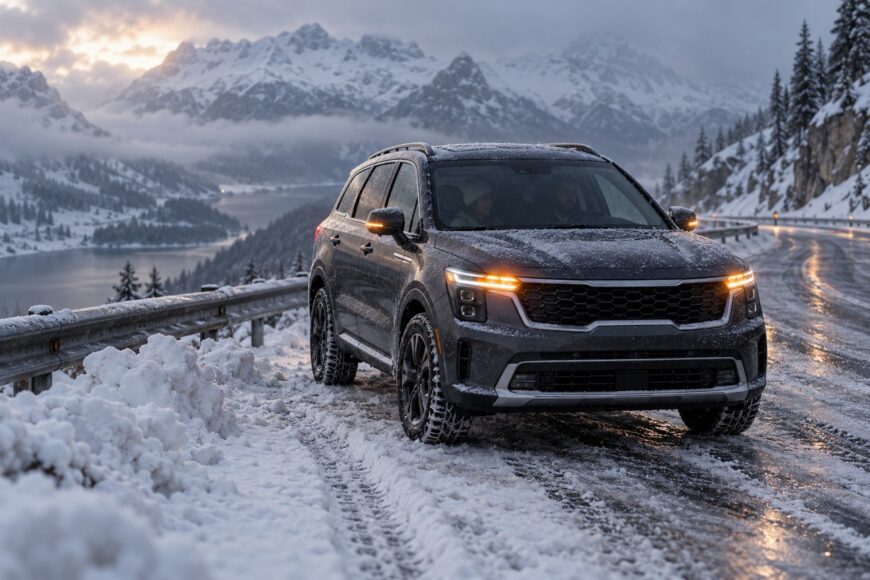
Stopping on a snowy or icy mountain road can become dangerous quickly. A vehicle may be partly in traffic, exposed to falling temperatures, or positioned where another driver cannot see it in time. Protect the occupants first, then make the Sorento visible and arrange help before the battery or weather makes the situation worse.
AWD can improve acceleration traction, but it does not shorten braking distance or overcome unsuitable tires, deep snow, low clearance, or polished ice. Drive modes may help manage wheelspin on some versions, yet they cannot turn a road-focused crossover into a deep-snow recovery vehicle. Use power sparingly, protect the drivetrain, and avoid an improvised tow.
- First: Make the Stranded Sorento Safe
- Try Self-Recovery Without Burying the Vehicle
- Know When to Stop and Arrange the Right Recovery
- What the Sorento’s Specifications Really Mean
- Frequently asked questions
- What should I do if my Kia Sorento is stranded on the side of a mountain road?
- How can I preserve the Sorento’s battery while waiting for recovery?
- What should I check before driving a Sorento on a remote mountain road?
First: Make the Stranded Sorento Safe
Turn on the hazard flashers and assess the vehicle’s position before attempting to move it. If traffic can pass safely, remain belted inside with the doors locked; if the Sorento is exposed to a collision or can be reached safely from the road edge, move occupants well away from traffic. Keep warm clothing available and avoid standing downhill from the vehicle.
Call roadside assistance or emergency services when the road is hazardous, visibility is poor, someone is injured, or the Sorento is near a drop-off. Share the road name, direction of travel, nearest marker, GPS location, and whether the vehicle is AWD. Mountain coverage may be weak, so send a text or location message when possible and conserve the phone’s battery.
Do not repeatedly press the accelerator after the Sorento loses momentum on a climb. Prolonged wheelspin can polish snow into ice, overheat the drivetrain, and bury the vehicle deeper. Snow, Mud, and Sand modes are available only on some generations and trims; they do not replace winter tires, suitable speed, or safe technique.
Limit the heater, interior lights, heated accessories, and hazard-flasher use to what safety requires. Extended operation of the heater, lights, and hazard flashers can discharge the battery while stranded. Keep the engine running only when conditions and exhaust clearance make it safe, and check that snow has not blocked the tailpipe.
Try Self-Recovery Without Burying the Vehicle
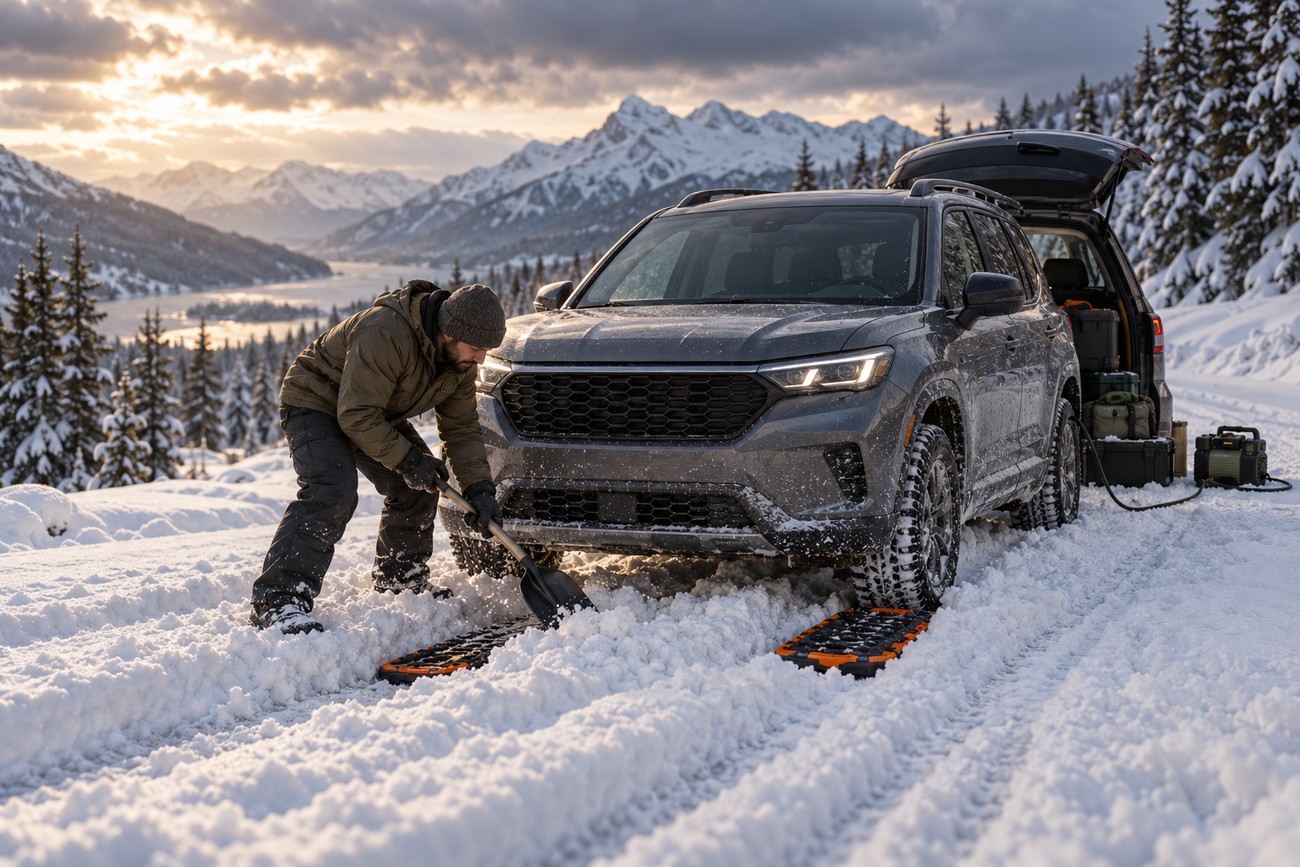
Self-recovery is reasonable only on a stable, visible section of road with no immediate drop-off or traffic risk. Select the appropriate low-speed setting or drive mode if the vehicle has one, keep the wheels straight, and use gentle, steady power. A smooth exit along the original track usually needs less traction than a sharp turn or a high-speed attempt.
Stop applying power as soon as the tires spin continuously. Clear snow ahead of the driven wheels and beneath the underbody, then flatten the route with a shovel. Traction boards can help under the tires, while a compressor can restore pressure after a controlled recovery if the tire maker’s limits are followed.
Chains should be fitted before the trip whenever possible. If installation is necessary roadside, use a level area away from traffic, switch to Park, apply the parking brake, turn off the engine, and use hazard lights. Chains must match the tire size, available wheel-arch clearance, and the specific trim; check the owner’s manual before buying or fitting them.
After clearing the route, apply power gradually and stop if the Sorento climbs onto its underbody or the tires begin digging again. Repeated forward-and-reverse rocking can increase damage and deepen the rut. Leave space for a professional recovery vehicle rather than turning a manageable immobilization into a buried crossover.
Know When to Stop and Arrange the Right Recovery
End the self-recovery attempt near a precipice, on a steep cross-slope, in deep snow, or when the vehicle is resting on its underbody. A shovel cannot solve a loss of ground clearance, and extra throttle can push snow under the chassis. Keep people clear of wheels, cables, and straps while help is arranged.
A controlled winch recovery uses suitable equipment, a rated attachment point, and a steady pull directed along the vehicle’s path. Do not apply shock loads to a tow eye unless the owner’s manual explicitly permits that use. A sudden pull from an improvised tow strap can damage the bumper, recovery point, suspension, or drivetrain.
Kia prohibits towing an AWD Sorento with its wheels on the ground. Tell the recovery operator immediately that the vehicle is AWD, and request a flatbed or wheel dollies in line with Kia guidance. Give the operator the vehicle’s position, direction, road conditions, and whether it is loaded with passengers or equipment.
What the Sorento’s Specifications Really Mean
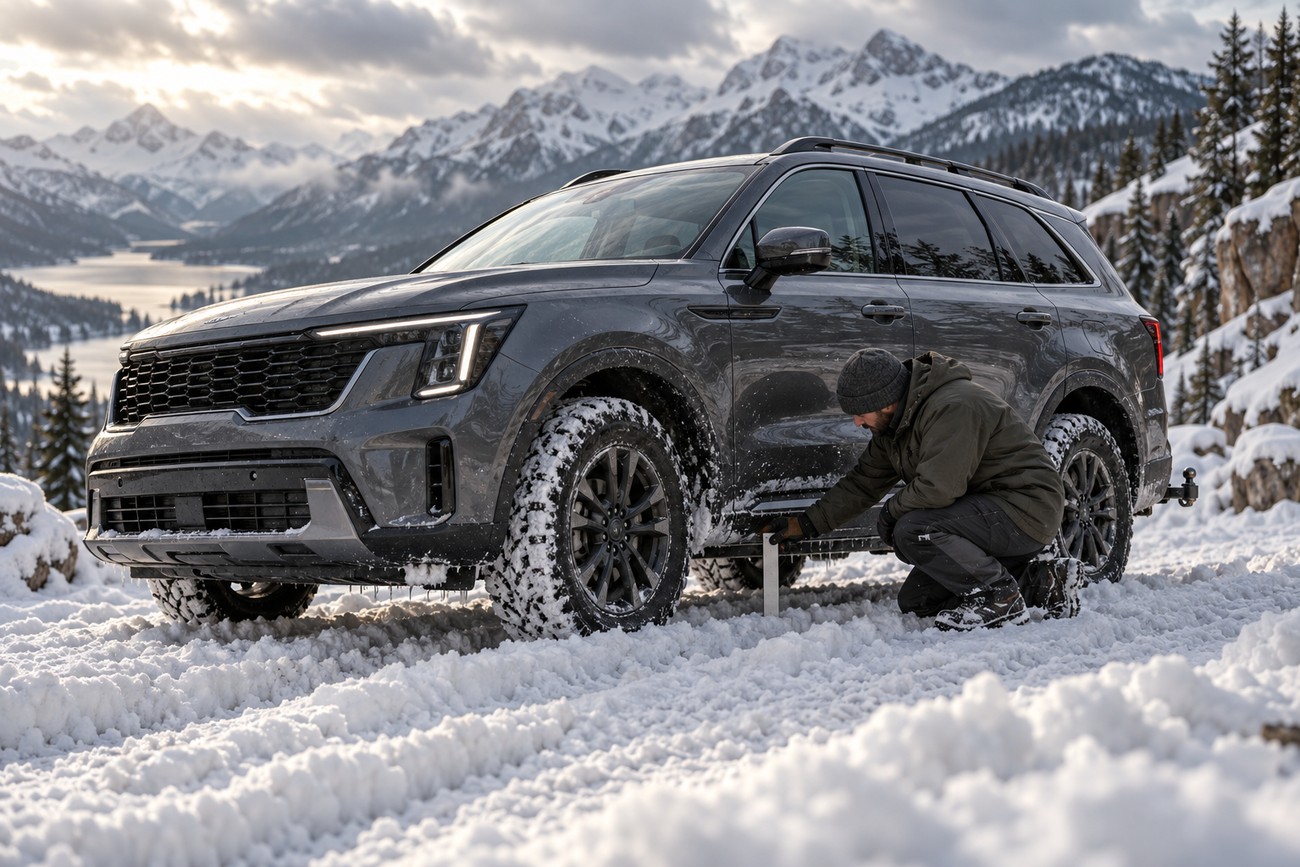
Ground clearance varies by market, drivetrain, trim, and equipment. Some Sorento specifications list about 176 mm (6.9 in), while specified U. S.-market X-Line/X-Pro versions are advertised at 8.3 in; the latter is not a universal Sorento figure. In a deep snow rut, the lower clearance can make underbody contact the limiting factor before AWD runs out of traction.
Towing figures also depend on the exact vehicle. In the U. S., some AWD configurations reach a maximum towing rating of 4,500 lb with the required equipment. Some other-market specifications list up to 2,000 kg with brakes, but neither figure applies to every Sorento, engine, hybrid system, or market.
The actual towing limit depends on the VIN, engine, transmission, drivetrain, required equipment, and trailer brakes. A maximum rating also assumes the manufacturer’s conditions and does not confirm that every mountain gradient, surface, or load is suitable. Check the vehicle documentation before towing, especially after importing or buying a used Sorento.
Electronic drive modes change how the vehicle manages available traction; they do not remove limits imposed by tires, ice, slope, vehicle mass, or ground clearance. Winter tires and conservative route choices usually matter more than selecting an aggressive mode after the road has already become impassable.
Frequently asked questions
The safest decision depends on the vehicle’s position, weather, communications, and available equipment. These checks help reduce secondary risks while recovery is being arranged.
What should I do if my Kia Sorento is stranded on the side of a mountain road?
Move occupants away from traffic when that can be done safely, then share the exact location, direction of travel, road name, and nearest landmark with assistance. Include a GPS pin or coordinates because mountain roads may have poor signage. If cell coverage is weak, try a text message, move only to a safe point with a signal, and avoid leaving the vehicle alone near a hazard.
How can I preserve the Sorento’s battery while waiting for recovery?
Use heat and lighting for safety, while switching off unnecessary electrical loads such as seat heaters, screens, chargers, and interior lights. Keep warm clothing and blankets ready before the battery becomes weak, and check that the exhaust remains clear whenever the engine runs. A nearly discharged battery can prevent a later restart even after the road is cleared.
What should I check before driving a Sorento on a remote mountain road?
Save an offline map, share the route, check the forecast and road closures, and confirm local chain rules. Inspect tire condition and pressure, then carry a shovel, traction boards, a compressor, warm clothing, and a reliable means of communication. Verify the Sorento’s clearance, AWD equipment, and recovery instructions for its exact trim before choosing a route with steep grades or deep snow.







