

Storing a Ford Mustang for five years is a preservation project, not simply a matter of parking the car and pulling a cover over it. A Mustang can look clean when uncovered while hidden corrosion advances underneath, fluids age, brakes seize, wiring attracts rodents, and tires deform without adding a mile to the odometer.
The storage environment, fuel strategy, and starting routine all affect the result. A covered car in a damp garage may suffer more than one kept in a plain but ventilated, dry indoor space. Likewise, brief garage warm-ups can create condensation, while the wrong fuel treatment may leave deposits in the pump, injectors, or carburetor-equipped system.
- Choose the Right Storage Environment
- Prepare the Mustang Before It Goes Into Storage
- Fuel, Fluids, Engine, and Exhaust: Resolve the Preservation Choices
- Protect the Battery, Tires, Brakes, and Wiring
- Cover, Cabin, Convertible Top, and Rodent Protection
- Inspection Schedule and the Five-Year Wake-Up
- Frequently asked questions
- What is the safest way to move a Mustang that has been stored for five years?
- What should you do when a car has been sitting for five years?
- What’s the average lifespan of a Mustang?
- How long can a car be stored without starting?
- What happens if a car is not driven for three years?
Choose the Right Storage Environment
The preferred long-term location is a closed, ventilated indoor space protected from direct sunlight. Security matters, but a premium-sounding storage label does not prove that humidity, condensation, or temperature swings are controlled. Ask what the building actually measures rather than relying on its marketing description.
A useful target is relative humidity of 40–70% and a temperature of approximately +4 to +7 °C. The aim is stability as much as a particular reading: repeated movement between cold and warm conditions can produce condensation on metal surfaces, inside the cabin, and around electrical connectors. Direct sunlight through windows also damages paint, leather, plastic, and soft-touch interior panels over time.
Inspect the space before the Mustang arrives. Look for roof leaks, standing water, salt stored nearby, exposed soil, poor air movement, rodent openings, and evidence of previous condensation. Check whether the floor stays dry after rain and whether the facility has actual humidity or temperature monitoring; paid storage may provide security without either form of environmental control.
- Confirm that doors and seals keep out rain while ventilation prevents stagnant damp air.
- Keep the car away from windows, heaters, plumbing, and chemical storage.
- Use a humidity monitor rather than judging the air by feel.
- Seal obvious rodent entry points and remove food, cardboard, and nesting material.
Prepare the Mustang Before It Goes Into Storage
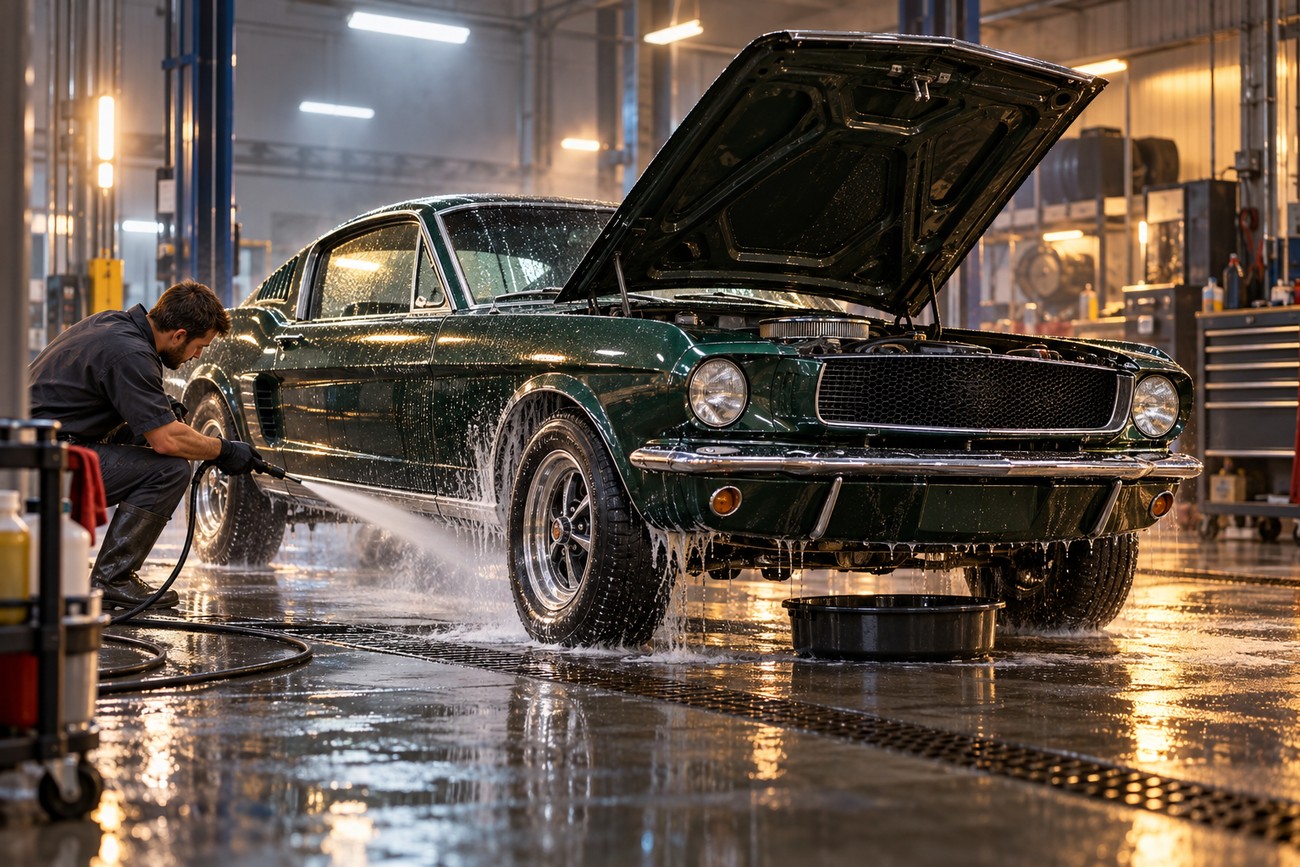
Begin with a thorough wash of the body, wheel wells, underside, seams, and drain areas. Road salt and chemical residue left behind on a parked car continue attacking seams and fasteners, especially around the underside, wheel arches, sills, and suspension-related structural areas. Rinse carefully, then allow the Mustang to dry completely before covering it.
Replace the engine oil before five-year storage, and inspect for existing leaks or corrosion while the underside is accessible. A suitable wax or corrosion-protection treatment can help exposed metal and vulnerable seams, provided it is compatible with the surface and does not conceal an active problem. Cleaning is more important than applying a thick product over dirt.
Photograph the car from all sides and record the condition of the arches, sills, floor, suspension mounting areas, wheels, and interior. Note the date, oil specification, coolant condition, brake-fluid condition, fuel treatment, battery removal, and any plugs or covers fitted to the engine or exhaust. A storage log prevents guesswork five years later, when memory is an unreliable maintenance record.
Preserve the service history with the log, including receipts and photographs. Mark or photograph any connection, hose, intake opening, or exhaust outlet that has been disturbed. This small step reduces the risk of starting the engine with a forgotten plug in place or overlooking a fastener that was removed during preparation.
Fuel, Fluids, Engine, and Exhaust: Resolve the Preservation Choices
There are two defensible fuel strategies for a five-year storage period, and neither is universally correct. One is fresh gasoline in a full tank with fuel stabilizer, which reduces air space and condensation. The other is to completely drain and flush the fuel system, then store it dry. The second approach requires proper servicing; simply running a tank nearly empty does not create a reliably dry system.
Fresh stabilized fuel can be practical when the tank, pump, lines, and injectors are in good condition and the product is used according to its instructions. A dry system can be preferable when the car will receive professional preservation and the owner wants to avoid aged fuel entirely. Stale gasoline may contribute to varnish-like deposits and sticking in the pump, injectors, or carburetor-equipped systems, so the decision should reflect the quality of the preparation rather than a fixed slogan.
Brief periodic garage starts can leave the engine warm before the oil and exhaust have fully dried. That moisture may promote corrosion instead of providing meaningful preservation.
Short warm-ups are generally discouraged during long-term storage because incomplete warm-up can leave condensation in the oil and exhaust. Either drive the car long enough to reach full operating conditions, where it is legal and safe, or do not start it during storage. Classic Mustangs may also need separate protection for the intake and exhaust to limit internal corrosion; any plugs or covers must be removed before starting.
Coolant and brake fluid age by time as well as mileage. Have both assessed during preparation and plan on replacing time-aged fluids after five years, even if the Mustang has not moved. The same principle applies at recommissioning: old fuel, suspect fluid condition, and contamination around the hydraulic system deserve attention before the first road test.
Protect the Battery, Tires, Brakes, and Wiring
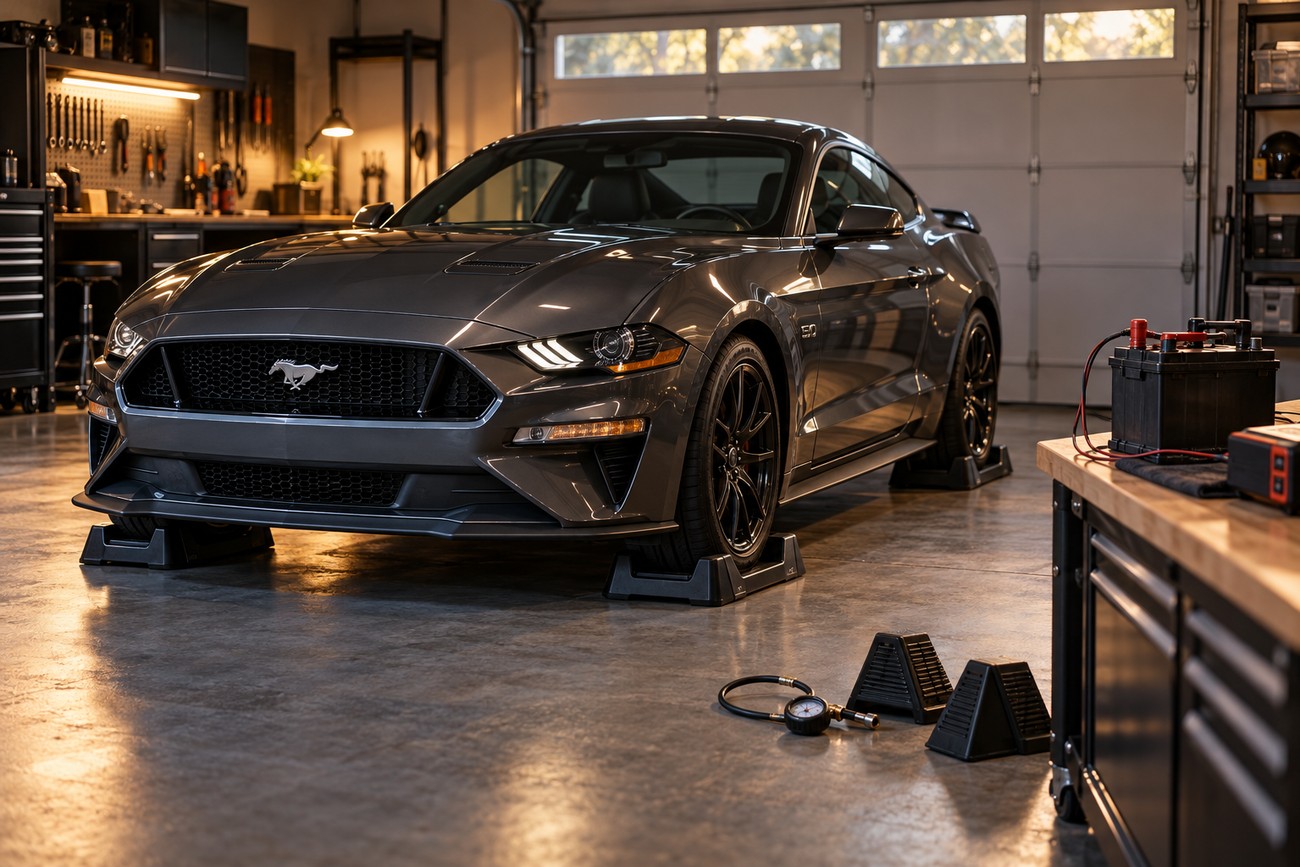
For five-year storage, remove the battery and keep it in a dry, warm place with periodic charging using equipment suitable for that battery. Disconnecting it and forgetting it for five years is unlikely to preserve it. Many owners replace a battery after such a storage period rather than attempting to revive one that has been deeply discharged or has developed unstable performance.
Do not leave the parking brake applied for years. The shoes or pads can seize to the braking surfaces, making the first movement difficult and potentially damaging components. Use Park or a suitable transmission gear with wheel chocks as appropriate, and make sure the car cannot roll before lifting or settling it into its storage position.
Long stationary periods can cause flat spots, carcass deformation, and cracking despite low mileage. If suitable stands and a safe lifting plan are available, some owners remove the wheels and store them separately in controlled conditions. Otherwise, maintain the correct pressure, check it at every inspection, and treat any cracking, distortion, or uncertain tire condition as a safety issue rather than a cosmetic defect.
Rodents may damage insulation, wiring, sound-deadening material, hoses, and under-hood components. Inspect the engine bay and cabin for droppings, nesting, chewed material, and disturbed insulation. Pay particular attention to electrical connectors and sensors: oxidized contacts can affect ABS, airbag, and stability-control systems, so visible cleanliness does not confirm electrical reliability.
Cover, Cabin, Convertible Top, and Rodent Protection
Fit the cover only after the Mustang is clean and dry. A fitted, breathable cover with a soft inner lining protects the paint from dust and incidental contact while allowing moisture to escape. A cheap impermeable cover can trap condensation against the finish and accelerate corrosion, especially in a garage with changing temperatures.
Windows and garage doors do not eliminate ultraviolet exposure. Protect the cabin from light, and avoid applying products that leave leather or plastic greasy and able to attract dust. Light ventilation can help, but the interior should remain protected from insects, rodents, and uncontrolled damp air. Check mats, seat seams, the trunk, and the area beneath the dashboard before closing the car for storage.
A convertible requires extra preparation. Clean the top using a product intended for its material, treat the seals, and store the fabric without unnecessary tension. Excess tension during a long stationary period can contribute to creasing and cracking; the roof should be properly closed or positioned according to its design rather than forced into an unnatural shape.
Use traps or other suitable pest-control measures around the storage space, while keeping chemicals away from paint, wiring, children, and animals. Do not rely on a strong scent alone to protect the car. Rodent prevention is a building and inspection task, and it works best when combined with sealed entry points and regular checks.
Inspection Schedule and the Five-Year Wake-Up
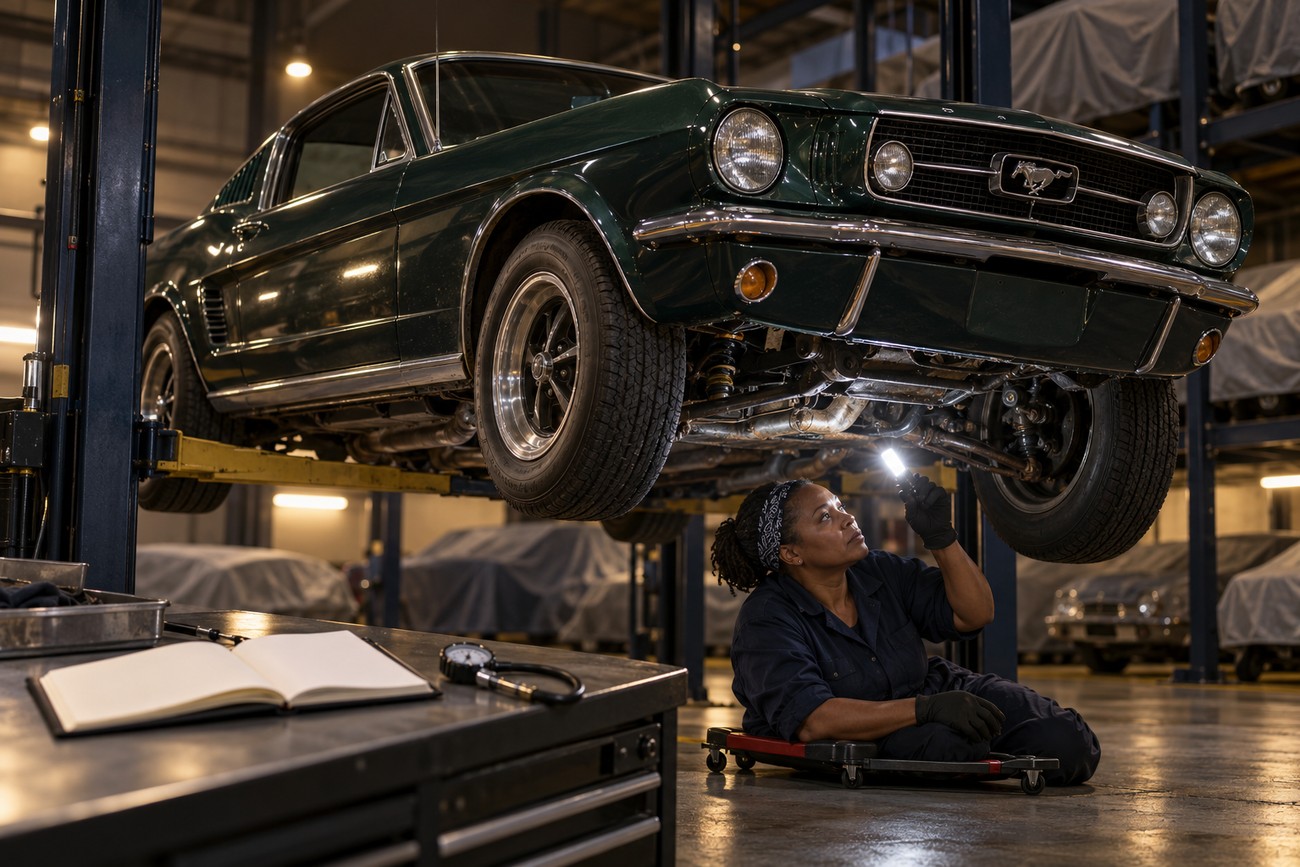
Inspect the stored Mustang every six months. Check corrosion on the underside, wheel arches, sills, and suspension-related structural areas; inspect fluid levels and visible leaks; measure tire pressure and look for cracking or deformation; and search for moisture, nests, droppings, and damaged wiring. Record each inspection in the storage log, including anything that changed since the previous visit.
Some owners manually turn the engine at six- to twelve-month intervals as an optional enthusiast practice. It may distribute oil, but it is not a substitute for correct preservation, safe access, or professional recommissioning. Do not turn an engine with an unsafe setup or use this practice as a reason to conduct repeated short starts.
After five years, treat the Mustang as a vehicle requiring time-based recommissioning. Expect the battery to be suspect, fuel to require assessment, brake discs to show rust, and fluids to need service. Remove the cover, wheel chocks, intake protection, and exhaust plugs, then inspect for leaks, nests, seized components, and fluid contamination before attempting to start the engine.
Check the fuel system, brakes, tires, steering, electrical systems, and drivetrain in a controlled setting. Replace damaged or unsafe tires, test the braking system rather than assuming surface rust will clear, and investigate warning lights or unstable electrical behavior. Only after these checks pass should the Mustang be started and taken on a cautious, brake-tested drive.
The first drive should remain close to a safe return point, with attention to pedal feel, steering response, temperatures, leaks, vibration, and warning lights. Normal road use should wait until the car proves reliable under inspection. A low odometer reading does not cancel the effects of five years of calendar time.
Frequently asked questions
What is the safest way to move a Mustang that has been stored for five years?
Use a trailer or recovery service if the brakes, tires, steering, fuel system, or drivetrain cannot be verified before movement. A tow strap or short drive can turn a hidden seized brake, cracked tire, or leaking fuel system into a larger failure.
If the car must be moved within the storage area, inspect the tires and release the parking brake only after confirming that the vehicle can roll safely. For public-road transport, recommission the essential systems first, or have the Mustang transported without relying on its own power.
What should you do when a car has been sitting for five years?
Begin with a documented inspection rather than an immediate start. Check for rodents, corrosion, leaks, old fuel, damaged wiring, tire cracking, seized brakes, and battery condition, then address time-aged fluids and the fuel system before testing the engine.
The order matters because starting a neglected car can circulate contaminated fuel or expose a weak lubrication and cooling system to load. After the static inspection, use a controlled start and a cautious brake-tested drive only when the safety-critical systems have passed inspection.
What’s the average lifespan of a Mustang?
There is no dependable single lifespan for every Mustang. Rust exposure, maintenance, storage quality, accident history, engine specification, and the quality of previous repairs can matter more than the model name or mileage alone.
For a stored car, calendar age is a separate concern from engine life. A well-preserved Mustang may remain structurally valuable, while a neglected example can require substantial work after a few years of standing still. Condition and inspection should guide the decision.
How long can a car be stored without starting?
A car can be stored without starting for five years if it is deliberately conserved and inspected during storage. Starting it occasionally is not automatically safer; short warm-ups may leave condensation in the oil and exhaust.
For long storage, choose either complete non-use with scheduled inspections or a genuine full operating drive when the car is roadworthy. Repeated brief starts provide little benefit and can create additional wear, moisture, and exhaust corrosion.
What happens if a car is not driven for three years?
It can develop aged fuel, rusty brakes, flat spots, tire cracking, battery failure, rodent damage, and oxidized electrical contacts even with no mileage added. Corrosion may remain hidden around the underside, arches, sills, and suspension-related structural areas.
Before driving, inspect and recommission the car as a time-aged vehicle. Verify the fuel system, brakes, tires, steering, leaks, and electrical systems first; a low odometer reading is not evidence that the car is ready for normal use.







