
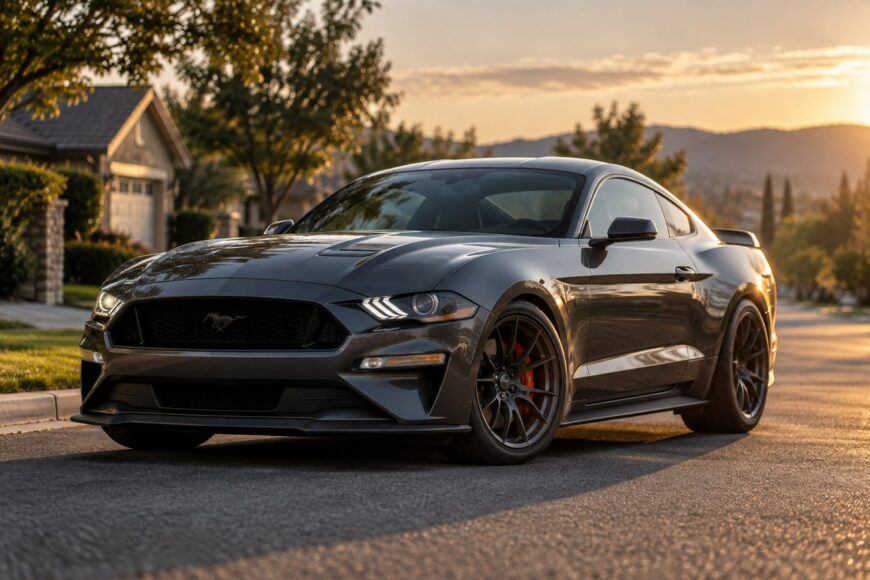
A Ford Mustang can slow and stop using its parking brake, but that does not make the parking brake a second brake pedal. Its main job is to hold the car stationary. Applied abruptly while the car is moving, it can lock the rear wheels and turn a braking problem into a skid or spin.
The controls also depend on the Mustang. Model years 2009–2014 are described as having a cable-operated system with a separate manual control, while some newer versions use an electronic parking brake (EPB) with different control logic. The distinction matters in an emergency: the safest response is to preserve steering control, find room to stop, and avoid adding brake damage or a loss of control to the original fault.
- Can a Ford Mustang Stop Using Only the Parking Brake?
- Cable Handbrakes and Electronic Parking Brakes Behave Differently
- What to Do if the Brake Pedal Fails
- The Damage Caused by Driving with the Parking Brake On
- Why a Mustang Parking Brake Fails to Hold on a Hill
- Common Parking-Brake Mistakes and Safer Choices
- Frequently asked questions
- How do you turn off the parking brake on a Ford Mustang?
- When should you use the parking brake in an automatic Mustang?
- What should you do after the Mustang smells like burning brakes?
Can a Ford Mustang Stop Using Only the Parking Brake?
Yes, a working parking brake can apply braking force to the rear wheels and bring a moving Mustang to a stop. How predictably it does so depends on the brake’s condition, the road surface, the vehicle’s equipment, and how the control is applied. It is intended mainly to secure a parked car, so it should not replace the service-brake pedal during ordinary driving.
The service brakes are designed to manage repeated stops through the normal brake pedal. A parking brake acts primarily at the rear, where a sudden increase in braking force can overwhelm available tire grip. If the rear wheels lock, the car may skid sideways or spin, particularly while turning or on a slippery surface.
There is no useful universal speed at which this becomes safe. Some popular advice cites an emergency-use limit around 40 km/h, but the supplied Ford materials do not establish that as an official threshold for every Mustang. Road grip and the particular parking-brake system matter too much for a single number to serve as permission to use it.
Moving use can also generate heat in components meant chiefly to hold the car at rest. Repeated or prolonged application may accelerate wear of rear pads or shoes, discs, cables, and related hardware. The fact that a parking brake stops the car once does not establish that it is undamaged or suitable for another attempt.
Cable Handbrakes and Electronic Parking Brakes Behave Differently
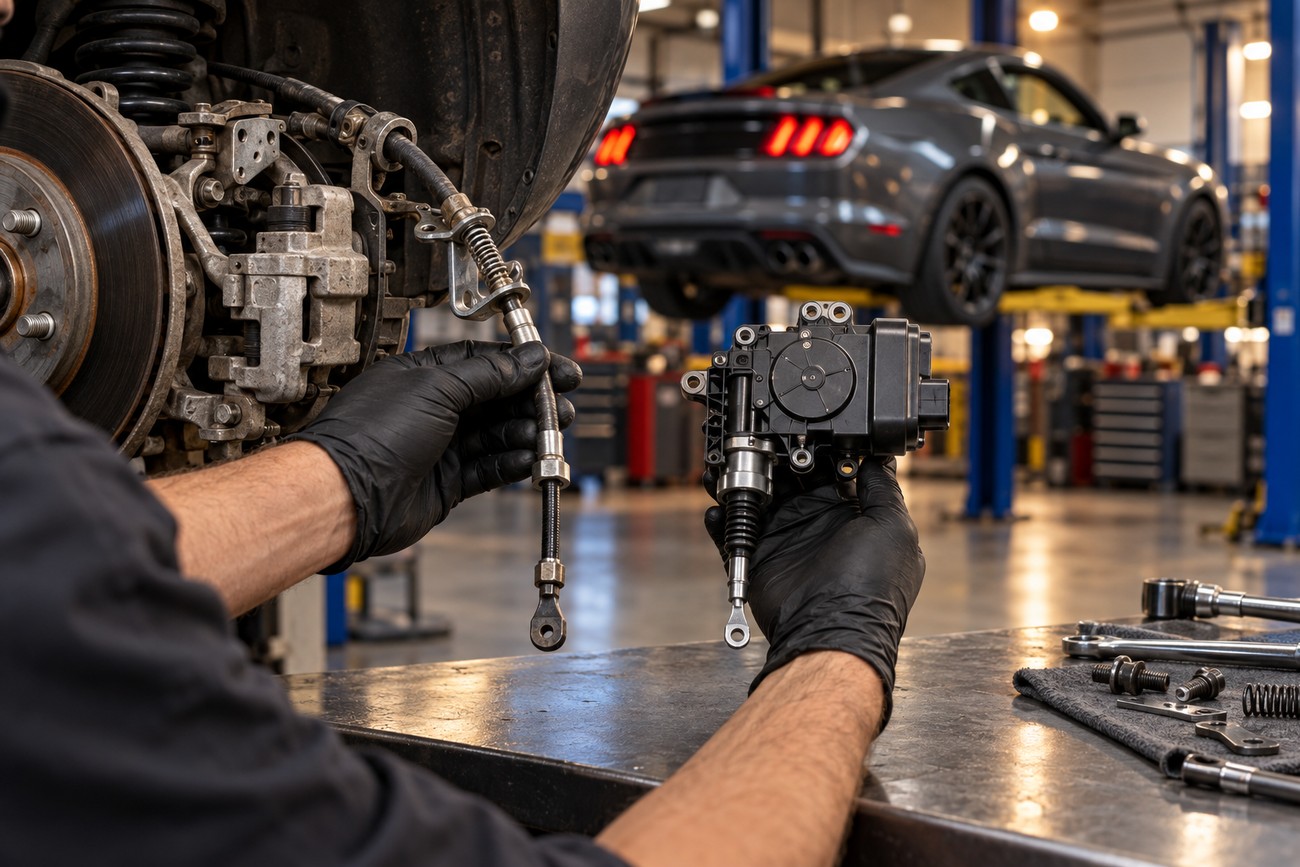
Mustang model years 2009–2014 are described in the supplied material as using a cable-operated parking-brake mechanism with a separate manual control. Moving that control tensions a mechanical system at the rear brakes. Cable condition, adjustment, and the state of the rear brake hardware all affect how much force reaches the wheels.
Some newer Mustang versions instead have an EPB. Its control sends a request to electronic actuators and vehicle control logic, rather than simply pulling a cable in direct proportion to lever movement. Advice written for an older handbrake therefore cannot be assumed to describe what a newer car will do when its control is raised or held.
Ford has provided special drift-oriented logic on some EPB-equipped Mustangs: raising the lever can command the rear brakes through that system. This feature is not an emergency-stopping endorsement. A driver dealing with brake failure still has to account for traffic, limited grip, and the possibility of losing rear-wheel traction.
On EPB-equipped cars, the parking brake generally releases automatically when starting to move, subject to operating conditions. It can also be released manually. Because controls and release conditions vary with generation and equipment, the owner’s manual for the specific Mustang is the right reference before a problem occurs.
What to Do if the Brake Pedal Fails
Brake-pedal failure calls for space and control, not an attempt to make the parking brake produce a sharp stop. Ease off the accelerator, keep steering inputs smooth, warn other road users when appropriate, and look for a safe place to leave the traffic lane. Keep the car pointed as straight as circumstances allow while it slows.
If the service brake still provides some response, use the braking that remains. A lower gear may help reduce speed where it can be selected without upsetting the car; follow the vehicle’s instructions and avoid abrupt shifts. Do not select Park or Reverse while moving, and do not switch off the vehicle in a way that could compromise steering or other assistance.
If parking-brake use becomes unavoidable, apply the input progressively rather than making a sudden full-force pull. On a cable-operated car, that means avoiding a sharp yank that could lock the rear wheels. On an EPB-equipped Mustang, do not assume the control will behave like a cable lever; its emergency operation is model-specific.
Steer toward a clear escape area as speed falls, while allowing for other vehicles and pedestrians. If the rear begins to slide, avoid increasing parking-brake force and focus on regaining directional control. The exact response depends on the failure, Mustang generation, road surface, and available space; no quoted speed limit removes those variables.
Once stopped, secure the car, request assistance, and have the braking system inspected before driving again. A parking brake is an emergency fallback when normal braking is unavailable, never a technique to rehearse at speed on a public road.
The Damage Caused by Driving with the Parking Brake On
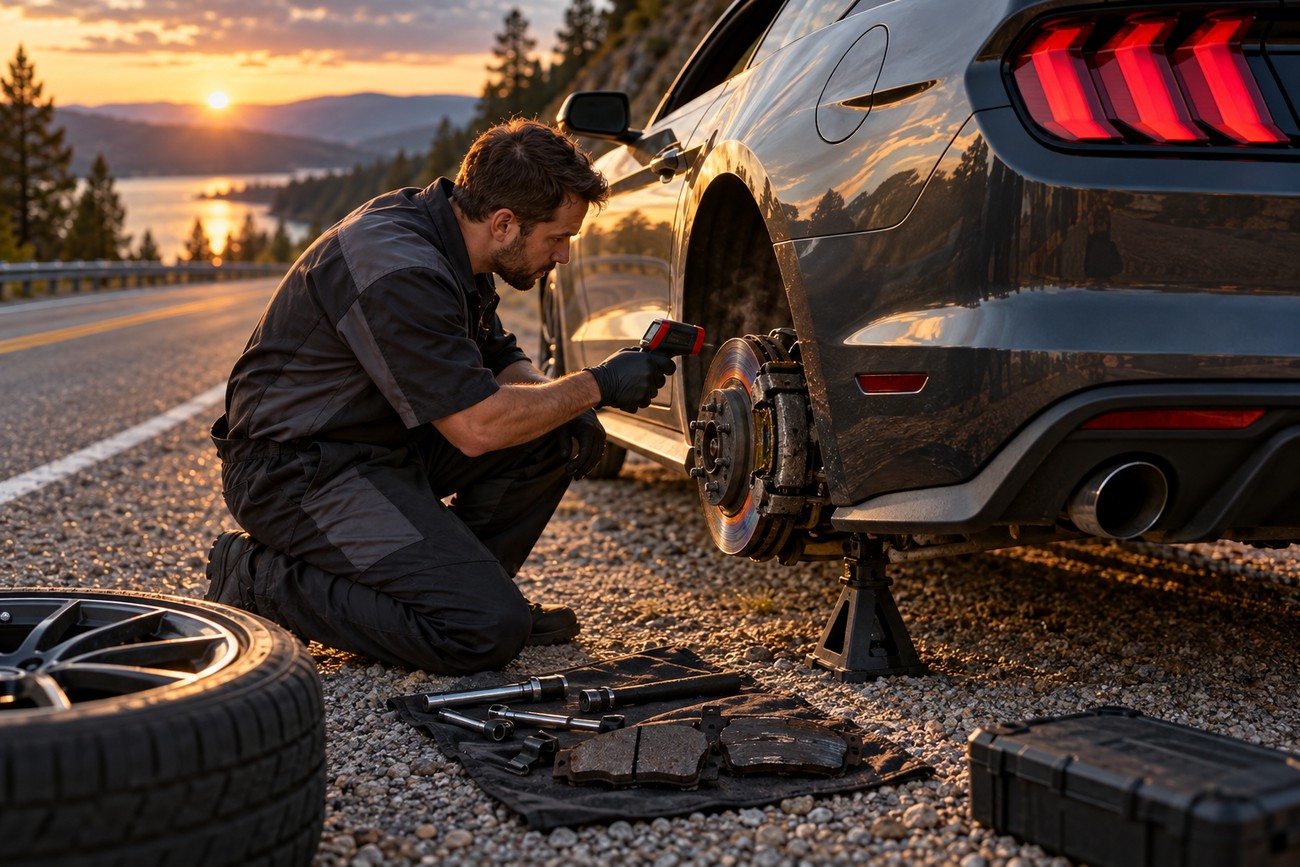
Forgetting to release the parking brake may first feel like reduced acceleration or unusual resistance. Continued driving makes the rear brakes work against the engine, generating heat even if the car still moves. A burning smell, scraping noise, vibration, or abnormal heat near the rear wheels is a reason to stop as soon as it is safe.
Heat can wear or damage pads or shoes, discs, and actuating hardware. On a cable system, binding or stressed components may also need attention; an EPB-equipped car has its own actuating parts to check. Continuing the trip because the Mustang can still accelerate risks turning a minor mistake into a more extensive repair.
A brief parking-brake warning does not, by itself, prove that parts have been damaged. Check that the brake has released using the procedure for your car, and pay attention to how it behaves afterward. Persistent smell, heat, noise, vibration, a pull to one side, or reduced braking calls for inspection rather than another drive to see whether the symptom disappears.
Why a Mustang Parking Brake Fails to Hold on a Hill
A lever that reaches the end of its travel does not prove the rear brakes are holding firmly. In a cable-operated system, a stretched cable, lost adjustment, seized hardware, or a binding mechanism can reduce effective force. Worn or contaminated friction surfaces can also leave the car able to roll despite a fully raised control.
If a Mustang moves after the parking brake is set on an incline, do not rely on pulling the lever harder next time. Secure the car with the service brake and the appropriate transmission position, then arrange an inspection of the parking-brake mechanism and rear brakes. Avoid leaving a car in a location where it may roll while the fault remains unresolved.
Handle feel is only one clue: cable travel, free movement of the rear hardware, adjustment, and the condition of the friction surfaces all matter. Tightening a control until it feels firmer can leave a binding or worn component undiscovered.
On older Mustangs, diagnosis or adjustment may require access around the center console as well as the rear brake mechanisms; it is not necessarily a simple external cable tweak. Inspection figures sometimes quoted for vehicle-holding ability should not be treated as confirmed Ford Mustang specifications. The practical test is whether the correctly operated system holds your car reliably under the conditions in which you park it.
Common Parking-Brake Mistakes and Safer Choices
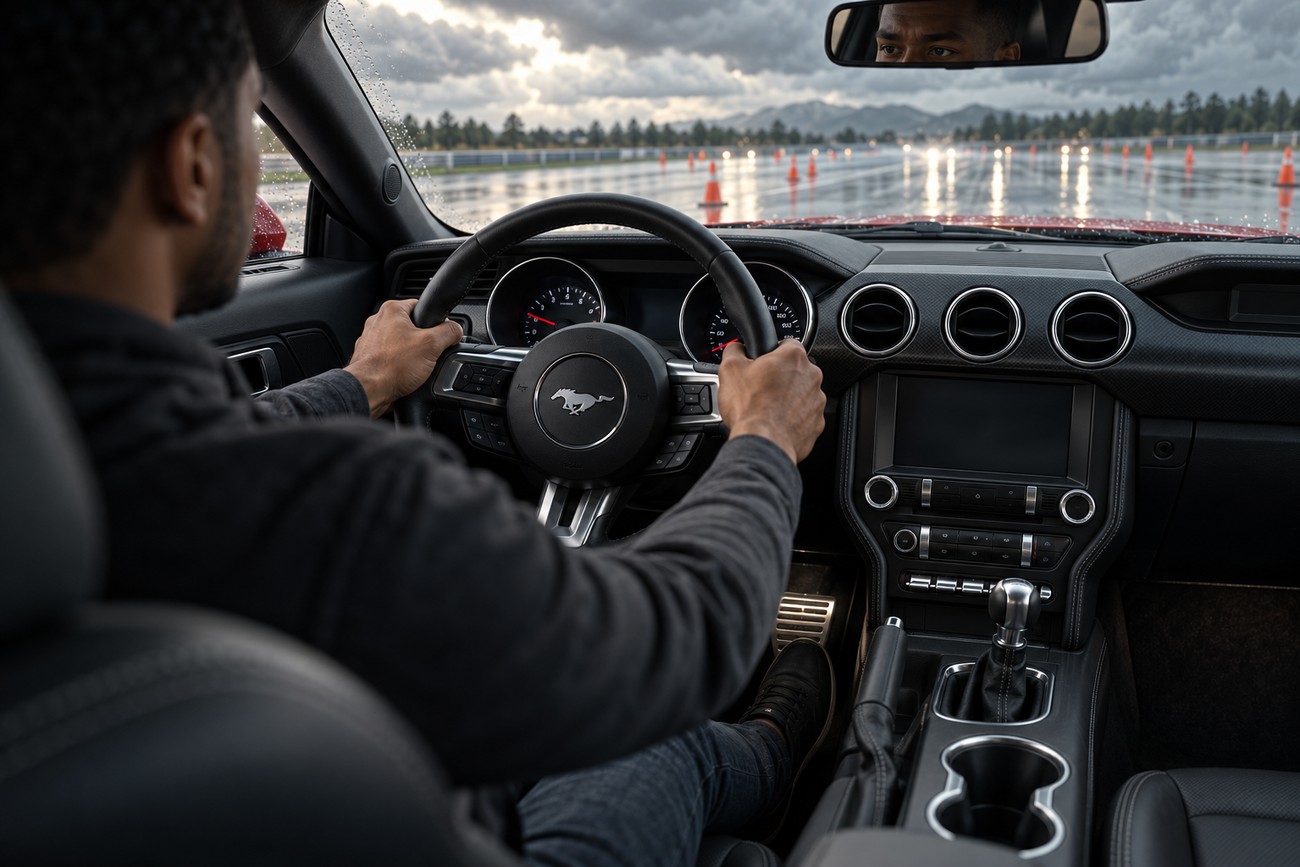
Using the parking brake for routine stops is a poor substitute for repairing weak service brakes. It concentrates the task at the rear and can add heat and wear to components intended mainly to hold a stationary car. If the brake pedal feels wrong, arrange diagnosis rather than changing how you normally stop.
A sudden pull is especially hazardous on wet, loose, or otherwise slippery pavement. Rear-wheel lockup can remove the grip needed to keep the Mustang aligned with its direction of travel. Keeping the wheels straight and applying an emergency input progressively reduces that risk, though neither step guarantees control.
Another mistake is treating every Mustang control as the same mechanical lever. Some newer EPB systems interpret driver input electronically, and a drift-oriented function does not make that input suitable for an emergency stop. Learn the controls from the manual for the specific car, without trying them at speed on a public road.
Finally, do not repeatedly adjust a brake that fails to hold or ignore one that smells hot, vibrates, or makes the car pull. Those symptoms need inspection of the full mechanism and affected rear brakes. Use the parking brake normally to secure a parked Mustang; treat moving use as an emergency-only measure with serious control risks.
Frequently asked questions
Parking-brake controls vary between cable-operated and EPB-equipped Mustangs. These answers cover the general parking routine and the signs that call for inspection; use your car’s owner’s manual for its specific control sequence.
How do you turn off the parking brake on a Ford Mustang?
With the vehicle stationary, hold the service-brake pedal and release the parking brake using the control markings and instructions for your Mustang. Confirm that the parking-brake warning indicator clears before moving. An EPB may also release automatically when starting to drive if its operating conditions are met, but do not rely on that behavior without checking your manual.
Do not force an electronic control that does not respond or assume that an older cable-handbrake procedure applies to it. If the indicator stays on or the car resists movement, stop and resolve the fault rather than driving against the brake.
When should you use the parking brake in an automatic Mustang?
Use it when parking, alongside the transmission’s Park position. Hold the service-brake pedal while you bring the car to a stop, set the parking brake, select Park as directed by your owner’s manual, and release the pedal only after the car is secured. On an incline, this helps prevent the car’s weight from resting solely on the transmission’s parking mechanism.
Park and the parking brake serve different holding functions, so neither should be treated as an excuse to ignore a brake that fails to hold. If the car shifts or rolls after you park, keep it secured and have the cause checked.
What should you do after the Mustang smells like burning brakes?
Stop in a safe place, check whether the parking brake is fully released, and allow the brakes to cool without continuing the trip. Avoid touching the wheels or brake components to judge their temperature; they may be hot enough to cause injury.
If the smell persists, a wheel remains unusually hot, or you notice scraping, vibration, pulling, or reduced braking, arrange an inspection before driving again. A brief warning with no continuing symptom does not confirm damage, but lingering signs should not be dismissed as normal cooling.







