
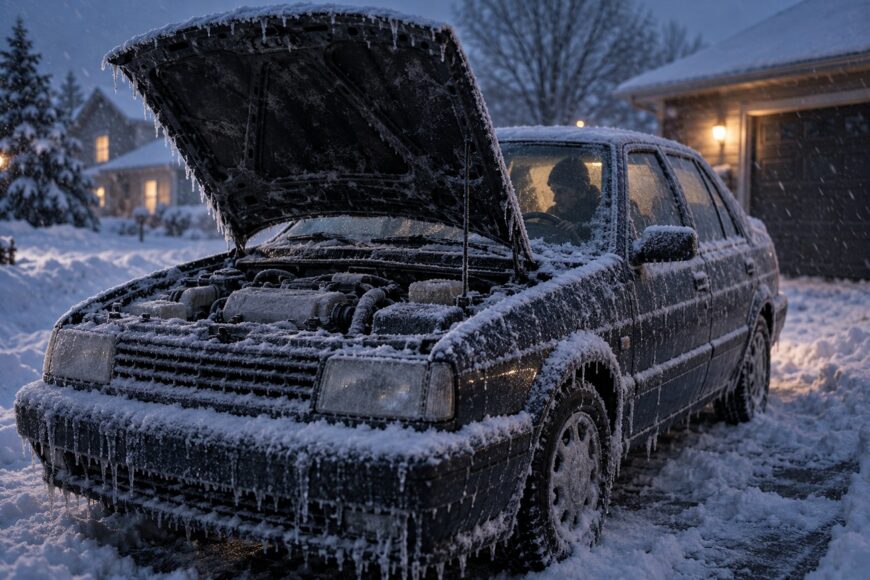
At -40°F/-40°C, a Volkswagen Jetta TDI can have a charged battery and working glow plugs yet still fail to start. Diesel may have thickened in the filter, cold oil may be slowing the starter, or the fuel specification may be unsuitable for the actual temperature. A starting problem at this temperature needs diagnosis before repeated cranking.
Prepare the fuel, oil, battery, starter, and glow-plug system as one group. Avoid long starter runs, improvised gasoline mixing, and the assumption that any product labeled winter diesel guarantees operation at -40°F/-40°C. The safest approach is to restore heat and fuel flow first, then make a controlled starting attempt.
- What Has to Be Right Before a Jetta TDI Can Start at -40°F
- Fuel: The Failure That Looks Like a Dead Battery
- Prepare the Car Before the Overnight Freeze
- The Correct Cold-Start Sequence
- If It Cranks but Does Not Start: Diagnose Before Trying Again
- Cold-Start Mistakes and Myths That Make the Problem Worse
- Frequently Asked Questions
- Why is my VW TDI hard to start when it is warm?
- How cold is too cold for a diesel Jetta?
- When should I stop trying to start the car in extreme cold?
What Has to Be Right Before a Jetta TDI Can Start at -40°F
Fuel is the first requirement. No. 2-D diesel can thicken at -40°F/-40°C as paraffin crystallizes, restricting the filter and reducing delivery to the injection system. A winter blend or No. 1-D arctic fuel is preferable when its low-temperature specification is confirmed by the supplier.
ASTM D975 sets diesel-fuel requirements but does not guarantee that every engine will start at -40°F/-40°C. Actual suitability depends on the fuel’s cloud point and cold filter plugging point. A station’s “winter diesel” label may reflect regional practice or a blended batch without proving that the fuel will remain usable at this temperature.
Oil selection is generation-dependent. Oil viscosity and VW approval must match the specific Jetta TDI generation and owner’s manual; there is no universal grade that should be prescribed for every Jetta TDI. At the same time, severe cold reduces battery output and starter speed, while cold oil increases mechanical resistance.
The glow-plug system must also be complete. Healthy TDI glow plugs can heat to approximately 850°C, but the plugs are only part of the circuit. Their power supply, relay, wiring, harness, and control unit must operate correctly for the engine to receive the heat needed for reliable ignition.
Fuel: The Failure That Looks Like a Dead Battery
A fuel problem can sound like an electrical problem because the starter may continue turning while fuel delivery has stopped. If paraffin restricts the filter, the engine may crank at a normal speed without receiving enough fuel to start. This is especially likely after filling with unverified No. 2-D fuel before a sharp temperature drop.
Cloud point describes when wax crystals begin to form, while cold filter plugging point indicates when those crystals can restrict fuel flow through a filter. These properties matter more than the word “winter” on a pump sign. A winter blend, No. 1-D arctic fuel, or supplier-confirmed low-temperature specification gives you a better starting position.
A nearly empty tank adds another risk during temperature swings because it increases the opportunity for condensation. Keep adequate fuel in the tank before an extreme freeze, and avoid assuming that topping up with any available diesel will correct fuel that has already waxed.
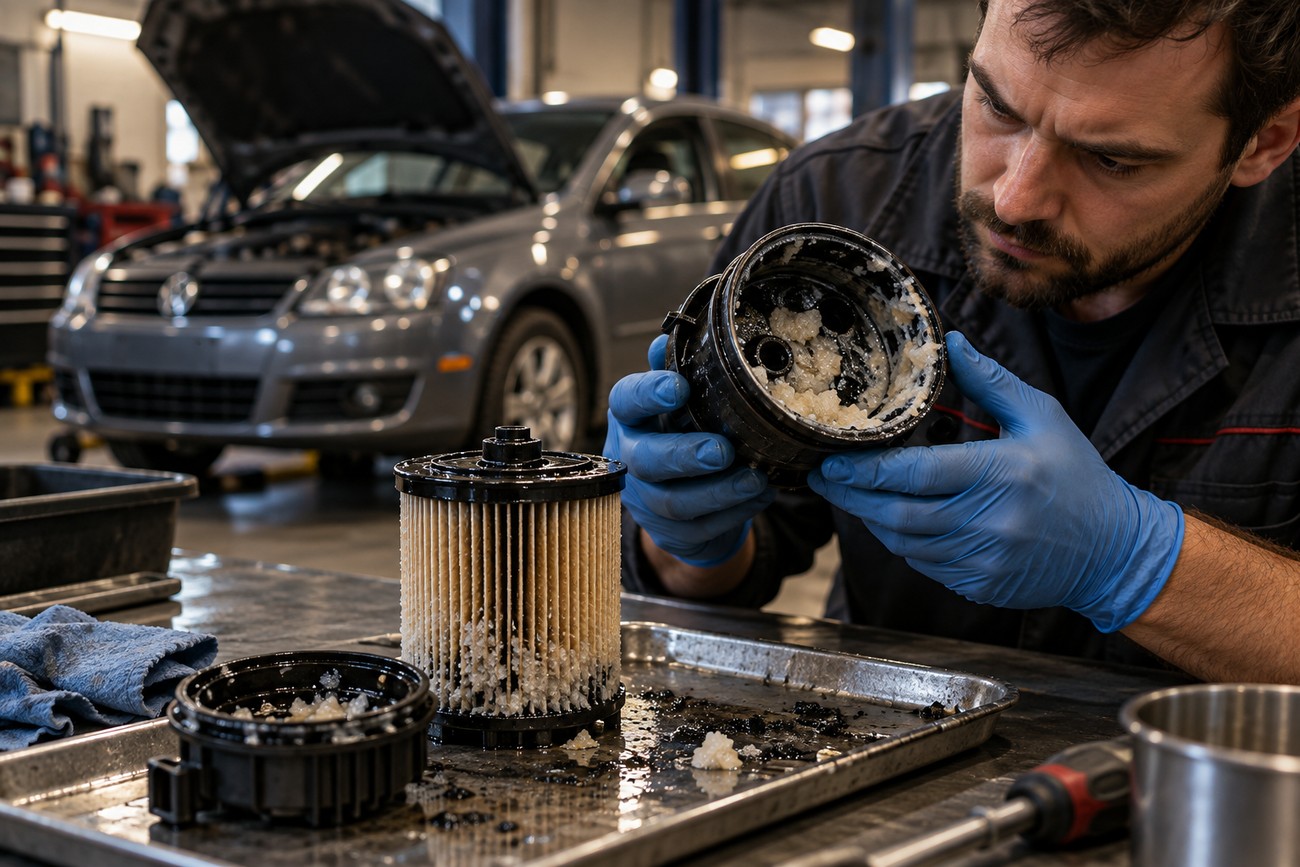
Anti-gel works best when mixed before the fuel waxes. It may not dissolve paraffin that has already formed, especially inside a restricted filter. If fuel restriction is suspected, warm the vehicle and filter safely, inspect the filter and fuel supply, and avoid endless cranking or pouring in additional additive while the system remains cold.
Prepare the Car Before the Overnight Freeze
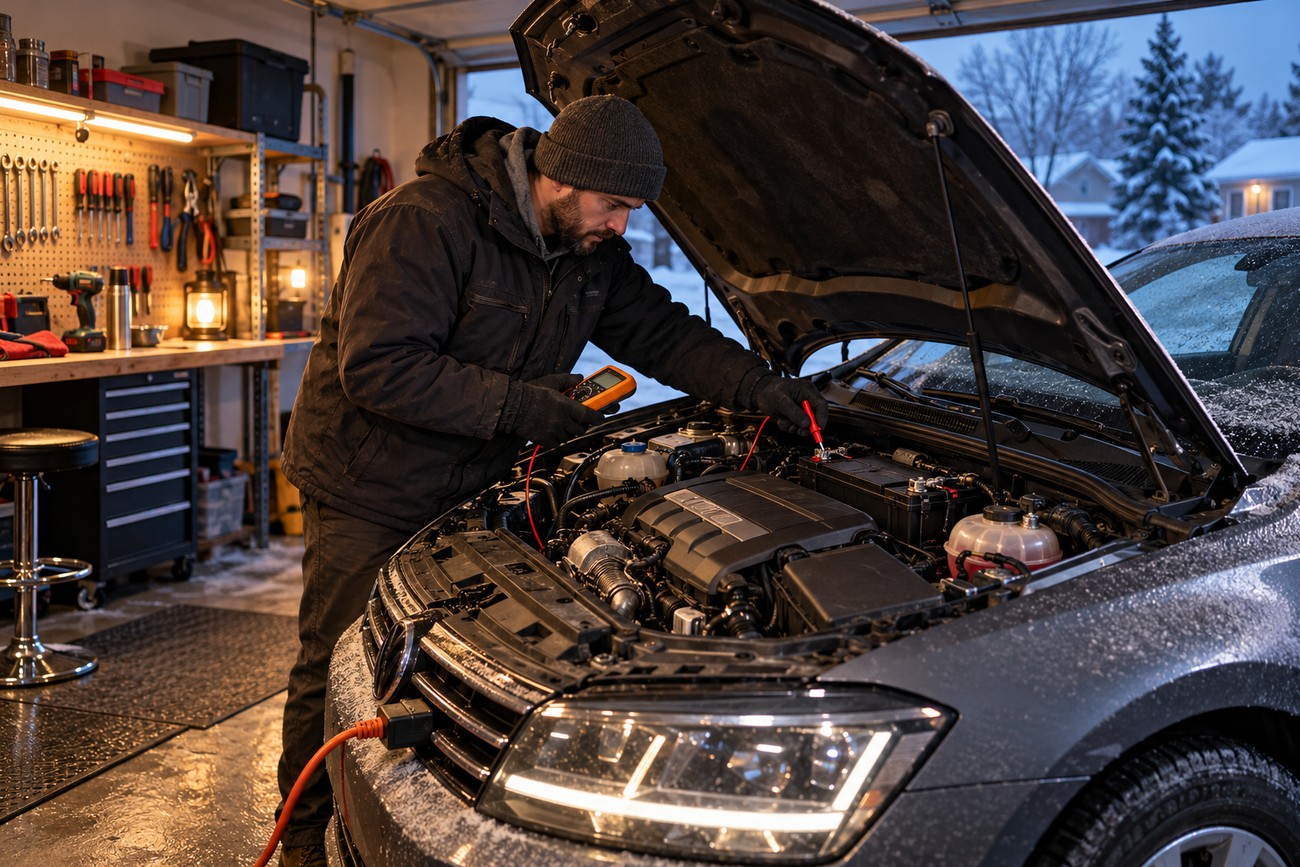
Preparation should begin before the temperature falls. Verify battery condition, charging-system operation, starter performance, glow-plug circuit integrity, and fuel-system sealing while the vehicle can still be serviced normally. A battery can appear charged in moderate weather and lose much of its available starting power at -40°F/-40°C.
Use a block or coolant heater when available. It generally warms the engine more comprehensively than an oil-pan heater by reducing oil resistance and raising engine temperature. An oil-pan heater mainly warms the crankcase and may not warm the fuel filter, battery, or cylinder head.
Neither type of heater automatically protects every component involved in starting. If the battery remains exposed to severe cold, its output can still be too low for the starter. A timer, insulated battery cover suitable for the application, indoor parking, or moving the battery into a warmer environment may help, provided the equipment is used safely and does not interfere with ventilation or wiring.
Before shutting down after a drive, switch off high-load accessories such as headlights, HVAC blower, heated seats, and window defrosters when practical. This prevents the next start from beginning with unnecessary electrical demand. A booster can provide temporary cranking power, but it does not repair a weak battery or charging-system fault.
The Correct Cold-Start Sequence
Begin with the electrical load reduced. Switch off lights, climate controls, heated seats, and other major consumers, then switch on the ignition without immediately turning the key to the starter position.
Wait for the glow-plug indicator to go out, pause several seconds, and then crank. The control unit varies glow-plug operation according to engine temperature rather than a fixed timer, so the indicator period is not a universal measure of how long the plugs remain active. Healthy glow plugs can heat to approximately 850°C.
Some owners repeat the glow cycle two or three times in extreme cold. This is a practical owner technique, not a universal VW requirement, and it cannot compensate for a failed relay, weak battery, poor wiring, or unsuitable fuel. If you use the technique, allow the ignition cycle to complete and monitor battery strength rather than repeating it indefinitely.
Crank only in short, controlled attempts. Long cranking sessions quickly drain the battery and can overheat the starter. If the engine does not begin to fire, stop and identify whether the problem is slow cranking, inadequate glow-plug power, restricted fuel, or air in the fuel system.
If It Cranks but Does Not Start: Diagnose Before Trying Again
First, separate slow cranking from normal-speed cranking. A starter that turns slowly points toward battery output, cable connections, starter condition, or cold-oil resistance. A booster may change the cranking speed, but a successful start followed by another no-start can still indicate a damaged battery or a charging-system problem.
If cranking speed is acceptable, check the glow-plug system as a circuit. A glow-plug indicator that goes out quickly does not prove that every plug, the relay, the harness, and the wiring are healthy. Testing the plugs alone can miss a corroded connector or a power-supply fault that produces symptoms resembling a fuel or battery failure.
Test power at the glow-plug circuit and inspect connector condition rather than relying only on resistance checks of the individual plugs. A failed relay or corroded harness can leave all the plugs apparently present while the engine receives too little heat.
Fuel delivery is the next branch. A wax-restricted filter should be warmed safely before further starting attempts because repeated cranking does not restore flow. A filter change can create a separate no-start condition if the system loses prime or draws air through a seal, connection, or incorrectly fitted component.
Recent fuel-system work is therefore important evidence. Inspect the filter installation, fuel lines, and visible connections, and follow the correct priming procedure for the specific Jetta TDI. Do not introduce more additive into a cold system and assume that it will repair a formed wax blockage or an air leak.
Cold-Start Mistakes and Myths That Make the Problem Worse
Do not add gasoline to dilute diesel unless the exact vehicle documentation explicitly permits it. Fuel-system design and injection components differ between Jetta TDI generations, and an improvised mixture can put the high-pressure pump or injectors at risk. Use fuel that meets the required specification instead.
Anti-gel is preventive. It may improve low-temperature handling when mixed before waxing occurs, but it may not restore flow after paraffin has already formed in the filter. Safe warming and inspection are more appropriate once the filter is restricted.
Repeated long cranks consume the battery, heat the starter, and reduce the chance of the next attempt. A booster-assisted start followed by another failure also deserves charging-system testing; the first start may have used temporary external power while leaving the original battery unable to recover.
Some older Jetta TDI vehicles are reported to develop corrosion in glow-plug harness connectors. This is not a universal diagnosis, yet it is a worthwhile inspection point when the indicator behaves normally and the engine remains difficult to start in cold weather.
Frequently Asked Questions
Extreme-cold starting depends on the complete condition of the vehicle and its fuel. The answers below define useful limits for diagnosis rather than promising a temperature guarantee.
Why is my VW TDI hard to start when it is warm?
A warm-start fault should not automatically be blamed on cold fuel or glow-plug preheating. If the engine is difficult to start after reaching operating temperature, investigate issues such as fuel pressure, air entering the fuel system, engine-speed signals, injection control, or battery and starter performance under normal conditions.
Do not repeat the -40°F cold-start procedure blindly. Compare cold and warm symptoms, scan for faults where appropriate, and have the starting and fuel systems tested according to the specific engine generation.
How cold is too cold for a diesel Jetta?
There is no universal cutoff at which every diesel Jetta becomes impossible to start. The practical limit depends on the fuel’s cloud point and cold filter plugging point, engine condition, oil viscosity and VW approval, battery capacity, starter speed, glow-plug operation, and the condition of the fuel filter.
At -40°F/-40°C, No. 2-D can thicken as paraffin crystallizes, so a confirmed winter blend or No. 1-D arctic fuel is preferable when available. Even suitable fuel cannot overcome a weak battery, restricted filter, or defective glow-plug circuit.
When should I stop trying to start the car in extreme cold?
Stop when cranking slows, the battery is being depleted, the starter is heating up, or fuel restriction is suspected. Continuing to turn the engine can damage the starter’s operating margin and leave the battery unable to support diagnostic testing.
At that point, warm the vehicle and filter safely, verify battery and charging condition, and inspect fuel delivery and glow-plug power. A controlled repair attempt is safer and more informative than repeated starting cycles.







