
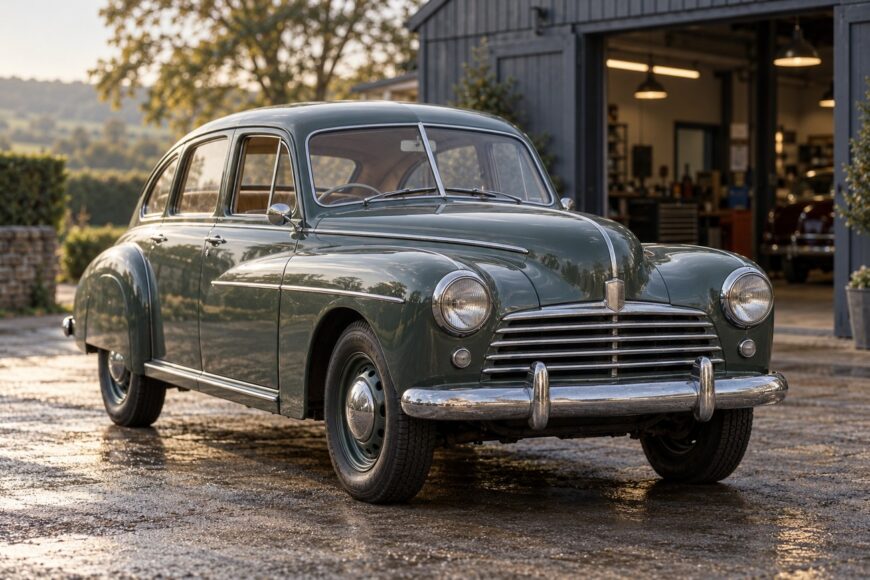
The Standard Vanguard was conceived as a postwar British family and utility car: spacious, durable in ordinary service, and capable of covering long distances on imperfect roads. Its reputation as a workhorse rests on practical engineering rather than speed. That distinction matters today, because a car designed to tolerate hard service can still be difficult to restore after decades of corrosion, storage, improvised repairs, and missing parts.
Production ran from 1947 to 1963, across Series I–IV, Sportsman, Vignale, and Vanguard Six forms. Those names describe meaningful mechanical and structural changes, rather than a single specification carried through the entire period. A Vanguard with a separate frame, a later unitary-body car, and a Vanguard Six may share a family resemblance while demanding different inspection methods and parts research.
The buyer’s central task is therefore identification. Exterior appearance, a claimed top speed, or the presence of an overdrive lever tells you little about the condition of the structure and running gear. Vanguards are not interchangeable machines or performance cars; the value of an individual car depends on its exact series, body construction, market, and mechanical condition.
- What the Standard Vanguard Was Built to Do
- Series I to Vanguard Six: How the Model Changed
- Engine, Gearbox, and Period Road Performance
- Frame, Unitary Body, and the Real Meaning of “Workhorse”
- The Ownership Problems Hidden Behind the Reputation
- How to Inspect and Buy the Right Vanguard
- Frequently asked questions
- Who made Standard Vanguard cars?
- Why did Toyota discontinue the Vanguard?
- How can I identify the correct parts catalog for a Standard Vanguard?
What the Standard Vanguard Was Built to Do
Standard Motor Company introduced the Vanguard in 1947 as a substantial postwar car for family transport, business use, and export markets. Its proportions and equipment reflected a period when one vehicle often had to serve as a daily car, a long-distance tourer, and a practical load carrier. The design favored conventional serviceability: a longitudinal engine, rear-wheel drive, a separate rear axle, and suspension intended to cope with ordinary road conditions.
Calling it a workhorse describes its role more accurately than its performance. The Vanguard provided useful space and acceptable cruising ability for its era, yet its early four-cylinder engine produced about 68 bhp. Steering, braking, gearing, and tire technology also belong to the period. A healthy example can feel composed and purposeful on a secondary road, while modern traffic exposes its modest acceleration and the effort required to operate an old manual gearbox.
The model name covers several distinct phases. Series I and II used a separate frame, while Series III adopted a unitary, load-bearing body. Later developments included Series IV, the Sportsman, the Vignale, and the Vanguard Six. These changes affect body panels, mounting points, engines, trim, electrical equipment, and the way corrosion should be judged.
Production totals require similar caution. Some sources cite 174,799 Series I cars, while some summaries cite about 550,000 cars overall. Those figures vary according to the phases, derivative versions, and assembly sites counted. A sales description that presents one total as an uncontested number may be combining categories that are difficult to compare.
Series I to Vanguard Six: How the Model Changed
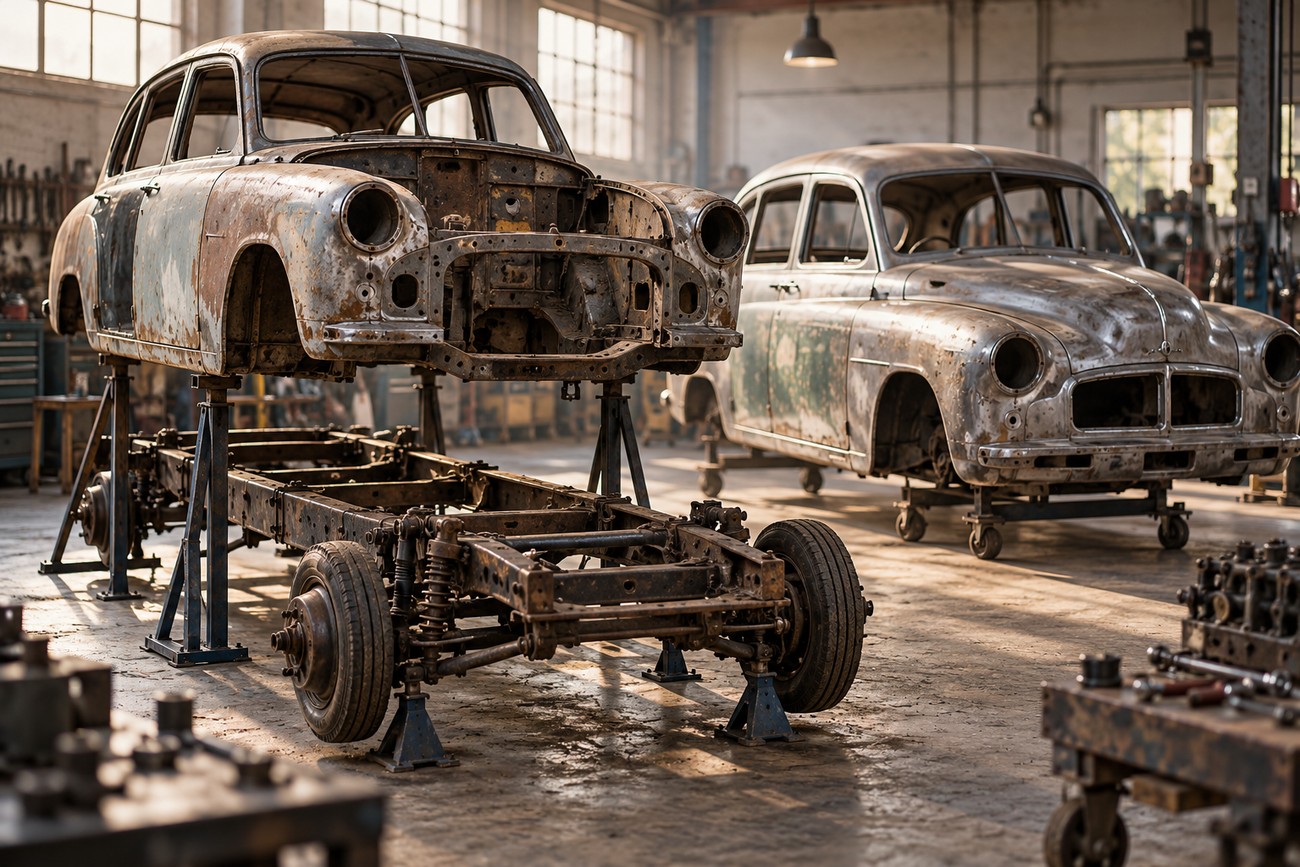
The earliest Vanguard established the basic identity: a large British sedan with a four-cylinder overhead-valve engine and a practical rear-drive chassis. Series I and Series II retained a separate frame, an arrangement familiar to manufacturers building robust cars for varied road and export conditions. For a restorer, that frame changes the inspection priority: corrosion around the chassis, body mounts, suspension attachments, and crossmembers can matter more than a presentable outer shell.
Series III represented a major engineering step rather than a routine facelift. It adopted a unitary, load-bearing body, reducing mass and improving economy. That construction also changed the repair problem. A separate frame can sometimes confine structural damage to a repairable or replaceable chassis component; a unitary body carries loads through its panels, seams, pillars, floors, and mounting zones. Corrosion in those areas may be harder to repair correctly even when the car looks lighter and more modern.
Series IV continued the model’s development, while the Sportsman and Vignale names identify further versions with their own equipment, styling, or mechanical details. The practical consequence is simple: a parts listing that says “Vanguard” has not yet identified the part. Exact series, model year, body type, engine, and local or export assembly can affect dimensions, fittings, trim, and electrical arrangements.
The Vanguard Six arrived in 1960 with a 2.0-liter six-cylinder engine. It should be assessed as a distinct mechanical package rather than an identical Vanguard with two extra cylinders. Engine installation, cooling requirements, transmission details, service parts, and driving characteristics all deserve separate confirmation. Production ended in 1963 as the model line transitioned to the Triumph 2000, marking the end of the Vanguard family rather than the start of another Vanguard series.
One easily missed detail is the difference between a model’s visual continuity and its engineering continuity. A later car can resemble an earlier one closely enough to encourage assumptions about suspension parts or interior fittings. Factory manuals, parts books, and surviving component markings are safer guides than photographs or a seller’s description.
Engine, Gearbox, and Period Road Performance
Early cars used a 2088 cm³ inline four-cylinder OHV engine with wet liners. Its 92 mm stroke, approximately 6.7:1 compression ratio, and output of about 68 bhp describe a low-stressed period engine rather than a high-output design. Wet liners are fitted sleeves that form the cylinder working surfaces inside the block; their sealing and seating are central to a correct rebuild.
The early transmission was a three-speed manual. Overdrive became available from 1950, although it was not standard on every car. When working correctly, overdrive can reduce engine speed during faster running and make the Vanguard more relaxed on a long trip. It also adds a separate electrical and mechanical system: the switch, relay, wiring, solenoid, oil supply, and internal components all need to work together.
A 1949 road test recorded 78.7 mph, 0–60 mph in 21.5 seconds, and 22.9 imperial mpg for the specific test car. These figures are useful period evidence, especially when setting expectations about the car’s intended capability. They are not universal specifications for every Vanguard, and the fuel-economy figure should not be treated as a modern consumption promise.
Condition can change real-world results substantially. Carburetor adjustment, ignition timing, compression, brake drag, tire condition, final-drive gearing, and vehicle aerodynamics all influence acceleration and economy. A car that struggles to reach its expected speed may have a tuning or mechanical problem; it may also be carrying years of wear that period road-test figures cannot reveal.
The same caution applies to engine capacity. A 2088 cm³ designation does not guarantee identical output or interchangeable components across every phase. Compression, carburetor specification, engine details, and market equipment can differ. Confirm the engine number, casting details, and relevant manual before ordering a gasket set or assuming that a familiar adjustment applies.
Frame, Unitary Body, and the Real Meaning of “Workhorse”
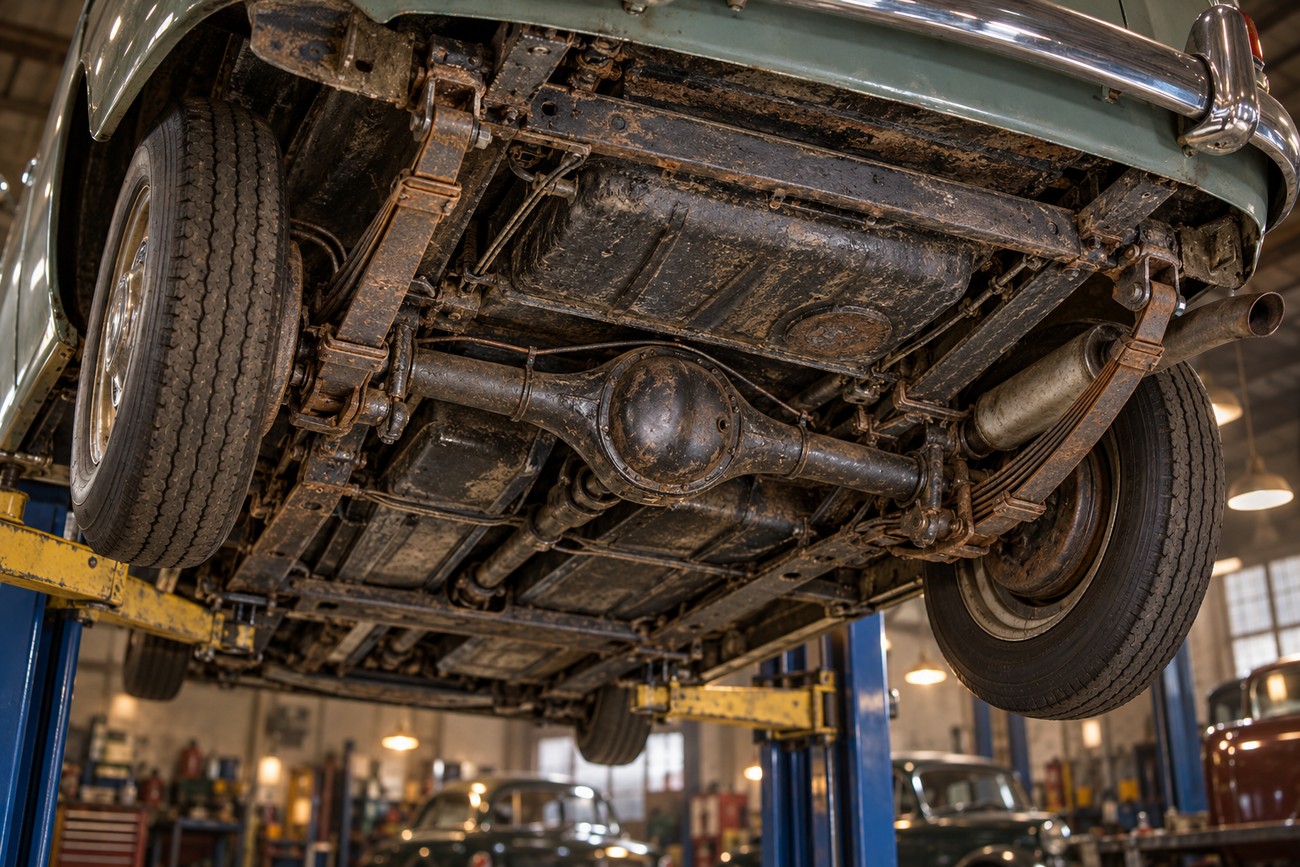
The Vanguard used a front-engine, rear-wheel-drive layout. Its front suspension was independent and spring-based, while the rear axle was located by leaf springs. Hydraulic brakes provided the stopping system. This arrangement was conventional for the period and explains much of the car’s practical character: predictable rear-drive behavior, a durable rear axle, and a suspension that could tolerate a useful load.
On Series I–II cars, the separate frame is a primary structural reference. Inspect the frame rails, crossmembers, body mounts, suspension attachments, and areas where dirt and moisture remain trapped. A sound-looking body can conceal serious chassis corrosion, while a poor outer panel may be less important than a weakened mounting point. Straightness also matters, since previous repairs or overloading can affect alignment.
Series III and later cars require a different inspection approach because the unitary body carries the loads. Floors, sills, inner wings, pillars, suspension mounting zones, and other structural panels work as part of the body shell. The lighter construction helped economy, yet corrosion in a load-bearing panel can have consequences beyond appearance and may require more complicated fabrication.
The workhorse reputation can mislead buyers into expecting simple repairs. Original engineering may be durable, but age now dominates the ownership equation. A car that spent years in damp storage, received poorly fitted patches, or used unsuitable fasteners can need extensive work even if its engine still starts and its body retains an appealing period shape.
The Ownership Problems Hidden Behind the Reputation
Parts supply is a practical concern rather than a minor inconvenience. Owners report shortages of original components and may need to locate used assemblies, adapt suitable substitutes, or fabricate small fasteners and brackets. The difficulty is greatest when a buyer has identified the car only by the Vanguard name. Exact series, year, body style, engine, and assembly market matter more than the badge when searching for compatible parts.
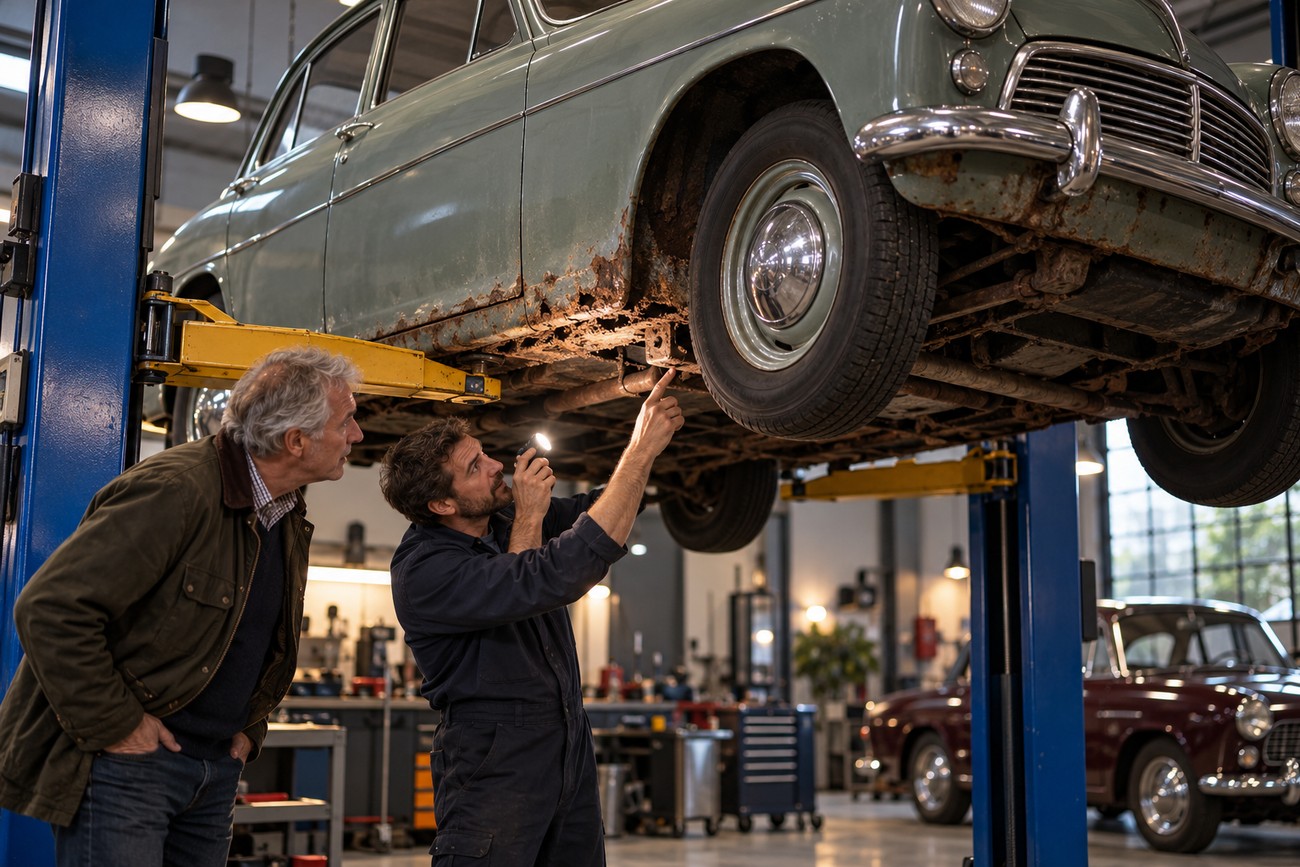
Corrosion remains the largest financial variable. On Series I–II cars, inspect sills, floors, frame areas, chassis attachments, and body-to-frame mounting points. On later unitary-body cars, examine structural body zones and the geometry around suspension and load-bearing panels. Fresh paint can hide old repairs, so a lift, strong light, a probe used carefully, and measurements between sound reference points are more informative than a bright exterior.
The wet-liner engine has a specific rebuild risk. Careless disassembly, incorrect liner seating, or incorrect liner protrusion can lead to coolant leaks and head-gasket problems. A rebuild therefore requires checking liner height and seating against the engine’s specifications, together with appropriate seals and gaskets. Treating the block like an ordinary solid-bore engine can create a defect that remains hidden until the cooling system is pressurized.
Fuel and ignition systems also need regular attention after long storage. Carburetors may have worn shafts, blocked passages, or incorrect settings; ignition components can suffer from aged insulation, inaccurate timing, or poor contacts; and the mechanical fuel pump may have a weakened diaphragm or damaged valves. Unstable starting does not automatically mean the engine needs a full rebuild, but it does justify systematic checks rather than random part replacement.
Gearbox and overdrive repairs can become expensive when wear reaches the synchronizes, gears, bushings, solenoid, or wiring. The presence of an overdrive control proves only that the car was equipped for the system. A failed switch, relay, electrical connection, solenoid, poor oil condition, or internal fault can leave the feature unusable. Available independent evidence is insufficient to rank these concerns by exact frequency, so they should be treated as recurring inspection points rather than a statistically proven fault hierarchy.
How to Inspect and Buy the Right Vanguard
Begin with identity, before judging paint or interior trim. Record the exact series, model year, body style, engine number, gearbox, overdrive equipment, and assembly market where known. Compare those details with the parts book and workshop information for that phase. A 2088 cm³ engine designation alone does not establish identical components, output, or service procedures.
Inspect the underside before spending time on cosmetic originality. Check the sills, floors, frame areas on Series I–II cars, structural body zones on Series III and later cars, suspension mounts, body mounts, and signs of chassis or shell distortion. Look for repairs that change the geometry: uneven gaps, doors that require lifting to close, suspension components sitting at different angles, and patches that cover rather than restore a load path.
Ask to see the car start from cold. Observe cranking speed, oil pressure behavior where an indication is available, exhaust smoke, idle stability, cooling-system response, and signs of coolant loss. A warm engine can conceal a difficult cold start, while a short demonstration may end before a weak fuel pump or overheating problem appears. The cooling system deserves particular attention on a wet-liner engine because coolant-related defects can become expensive quickly.
- Confirm that the clutch engages progressively and that the gearbox selects each ratio without excessive noise or resistance.
- Test the brakes for straight stopping, consistent pedal feel, and signs of drag after driving.
- Check the rear axle, suspension, and steering for clunks, looseness, or unusual vibration.
- If fitted, operate overdrive under load and verify the switch, relay, solenoid, wiring, oil condition, and mechanical engagement.
A lever or dashboard switch is not proof that overdrive works. The system should engage and disengage predictably during a road test, without slipping, persistent noise, or electrical hesitation. A seller who demonstrates only that the indicator moves has demonstrated the control, not the transmission function.
Finally, compare the car’s behavior with its claimed performance without treating period figures as a pass-or-fail test. Fuel economy and acceleration depend on carburetor setup, ignition, brakes, tires, gearing, engine condition, and aerodynamics. A slow car may need tuning; a car that pulls to one side, overheats, or loses coolant needs a more fundamental assessment. The age of the vehicle matters more now than its original reputation for durability.
Frequently asked questions
The Vanguard name can cause confusion, and the British model itself changed substantially during production. The answers below distinguish it from an unrelated vehicle and explain how to identify the right parts information. For a specific car, its series and mechanical details matter more than the name alone.
Who made Standard Vanguard cars?
Standard Vanguard cars were made by the Standard Motor Company, the British manufacturer responsible for the model from 1947 to 1963. The Vanguard name covered several phases and derivatives, so manufacturer identification alone does not identify a particular specification.
For historical research or parts ordering, pair the manufacturer with the exact series, year, body type, engine, and assembly market. That combination is more useful than treating “Standard Vanguard” as a single unchanging model.
Why did Toyota discontinue the Vanguard?
Toyota Vanguard was a separate vehicle name and was unrelated to the British Standard Vanguard. It was not a later version of the Standard car, and the British Vanguard did not become a Toyota model.
The British Standard Vanguard ended production in 1963 as its model line transitioned to the Triumph 2000. Search results that connect the two Vanguard names are therefore combining separate vehicles with no direct model succession.
How can I identify the correct parts catalog for a Standard Vanguard?
Start with the exact Vanguard phase, year, body style, engine, gearbox, and assembly market. Use the identification plate, engine and chassis markings, period workshop manuals, and parts books specific to that phase. Then compare dimensions, fastener details, electrical arrangements, and mounting points before ordering.
Generic listings can be useful leads, yet “fits Standard Vanguard” is too broad a description for many components. Confirm whether the part belongs to Series I–II, Series III, a later phase, Sportsman, Vignale, or Vanguard Six, and check whether the listing concerns an original, a known substitute, or a fabricated reproduction.







