
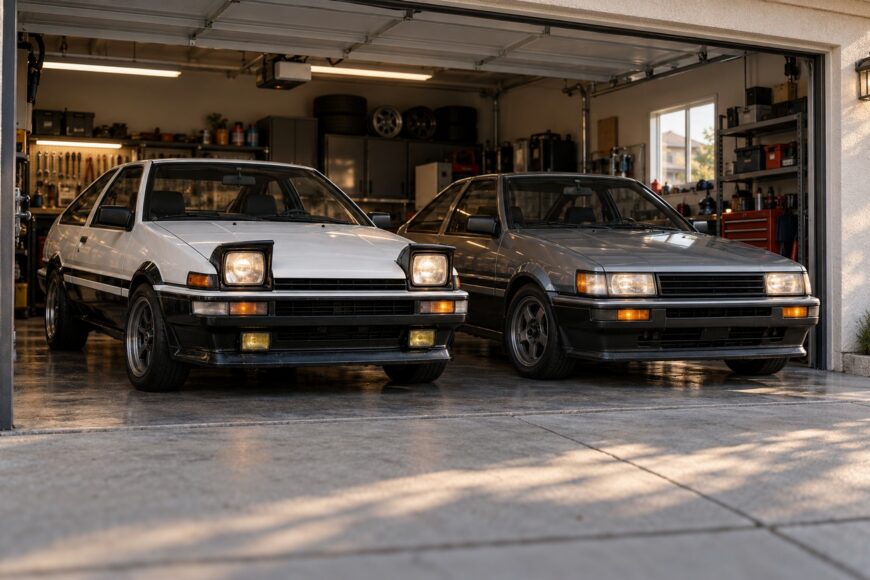
The familiar choice appears simple: a Sprinter Trueno has pop-up headlights, while a Corolla Levin has fixed lamps. That description fits the best-known AE86 versions and explains much of their visual appeal. It does not establish the identity, specification, or value of an individual car.
The more consequential problem is hidden behind the headlights. A front end may have been changed after an accident, during a drift build, or as part of a restoration. Rust in the arches, sills, suspension towers, and floor can consume a budget faster than the purchase price, while missing original lamps, panels, and trim can make a seemingly straightforward repair difficult.
Trueno and Levin are closely related Toyota variants, so the badge alone says little about performance. The right purchase depends on the actual chassis, market specification, structural condition, completeness, and the cost of returning the car to the configuration you want.
- The short answer: sister cars, not separate performance tiers
- AE86 Trueno vs. Levin: the differences at a glance
- Why the headlight rule works for AE86—and fails elsewhere
- Powertrains, chassis, and trims: what the badge cannot tell you
- Restoring the front end: the cost hiding behind the styling
- Spotting a converted car before you buy
- Which should you choose? Prioritize the shell, then the look
- Frequently asked questions
- What does Levin mean in AE86?
- What is the difference between Levin and Trueno?
- Sprinter Trueno vs. Levin: what’s the difference? Reddit discussion
The short answer: sister cars, not separate performance tiers
Sprinter Trueno and Corolla Levin were closely related Toyota versions sold under different names and styling packages. Their relationship is easiest to understand through the AE86, where the two cars generally used the same basic platform and mechanical layout. The most visible distinction was the treatment of the front end, along with related exterior details and market-specific equipment.
That makes the names poor substitutes for a specification sheet. A Trueno badge does not automatically identify a stronger engine, a superior suspension package, or a higher performance tier. A Levin badge does not automatically indicate an ordinary or less capable car. Engine, transmission, axle, trim, and equipment depend on the year, market, and version.
Toyota’s historical branding and sales channels also varied by period and market. Enthusiasts often associate the two names with different Toyota dealer networks, yet a specific dealer-chain assignment needs verification for the particular year and market. That history helps explain why both names existed; it does not provide a reliable shortcut when inspecting a used car today.
For buyers, the practical distinction is therefore visual and restorative before it is dynamic. The front panels, grille, hood, bumpers, lamps, and wiring may differ substantially, while much of the running gear can remain closely related. A well-preserved Levin can be a better car than a badly repaired Trueno, regardless of which name attracts more attention.
AE86 Trueno vs. Levin: the differences at a glance
The table describes typical AE86 configurations from 1983–1987. It is a useful starting point, rather than an identification certificate for every generation, market, or modified car.
| Area | AE86 Sprinter Trueno | AE86 Corolla Levin | What it means for a buyer |
|---|---|---|---|
| Headlights | Familiar version uses pop-up headlights. | Familiar version uses fixed headlights. | Headlights identify the common styling convention, not necessarily factory identity. |
| Front-end parts | Pop-up housings, motors, linkages, relays, wiring, and matching panels. | Fixed-lamp assemblies, grille, hood, bumper, mounts, and related wiring. | Collision repairs and conversions require more than changing a badge or lamp. |
| Mechanical basis | Generally shares the AE86 mechanical foundation with the Levin. | Generally shares the AE86 mechanical foundation with the Trueno. | Engine and equipment must be checked by market, year, and trim. |
| Specification | Trim and engine combinations vary. | Trim and engine combinations vary. | Do not assign a universal power figure or equipment list by name alone. |
| Ownership | More front-end components can require diagnosis and correct parts. | Fixed lighting is simpler to service in principle. | Rust, originality, and completeness still matter more than the lamp type. |
Why the headlight rule works for AE86—and fails elsewhere
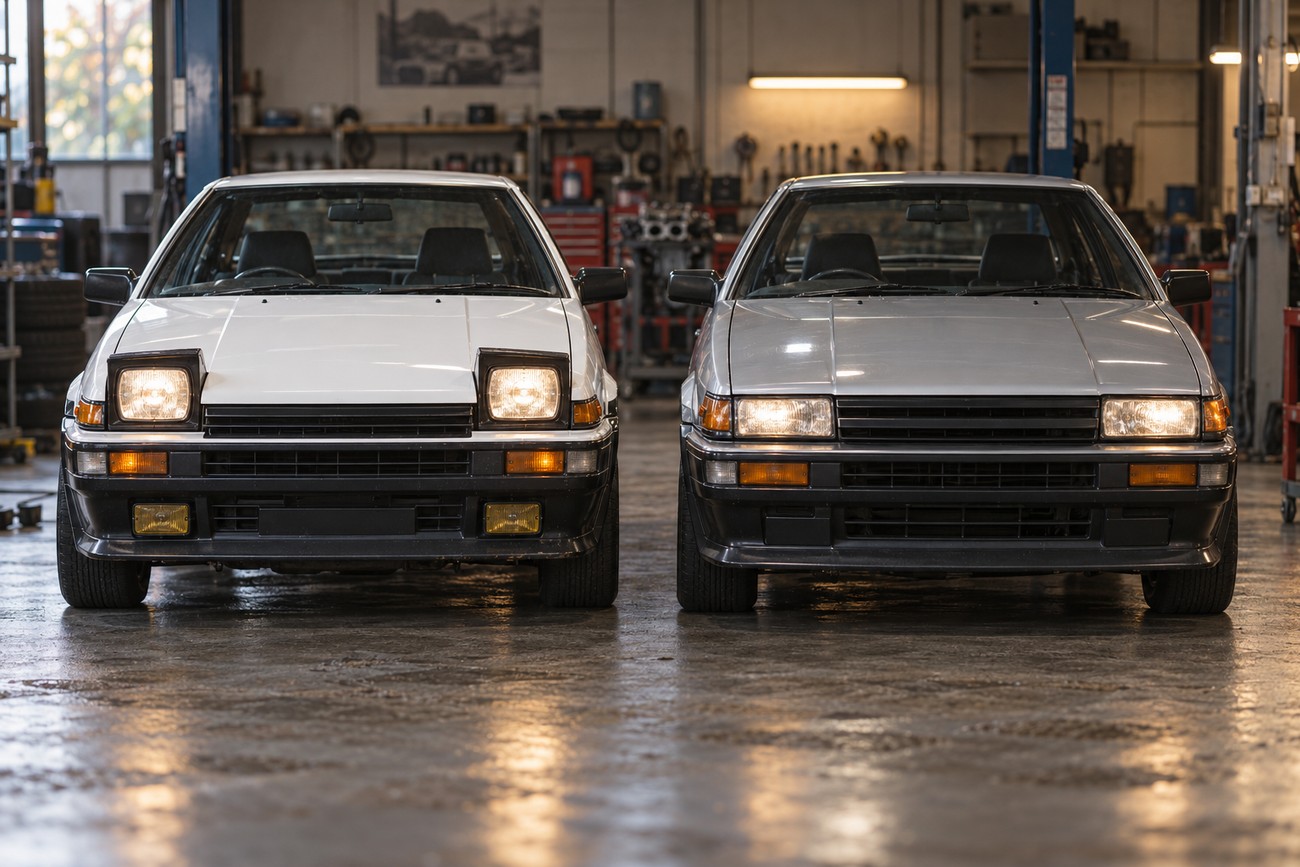
The familiar comparison comes from the AE86 generation produced from 1983 to 1987. In that form, the Trueno is recognized for pop-up headlights and the Levin for fixed headlights. The difference gives each car its distinctive face, especially when viewed alongside the grille, hood line, bumper, and front lamp arrangement.
That visual rule became so widely repeated that it is often treated as a definition of the names. It is more accurate to call it an AE86 styling convention. Other generations and markets used different combinations of body design and lighting, so the pop-up-versus-fixed description cannot be applied as an infallible rule to every Trueno or Levin ever made.
The front-end distinction extends beyond the lamps themselves. Mounting panels, the grille, hood, bumpers, indicators, brackets, and sections of the wiring may all be specific to the chosen design. Two cars can share a chassis family and much of their mechanical architecture while presenting a substantially different restoration problem at the nose.
Used examples complicate the picture further. Front-end swaps are common in drift cars, project cars, and restorations, and a damaged car may have been rebuilt from another donor. A photograph can show what the car looks like now; it cannot prove how it left the factory. That is why the chassis number, identification plates, documents, build information, and repair evidence carry more weight than the headlights alone.
Powertrains, chassis, and trims: what the badge cannot tell you
AE86 Trueno and Levin variants generally share an underlying mechanical basis. This is the reason the two names are often discussed as styling alternatives rather than wholly separate models. Suspension layout, drivetrain architecture, and many service areas can be closely related, although the exact equipment still depends on the specification.
Period 1.6-litre engines included the 4A-GEU and, in lower-spec applications depending on market and version, the 4A-C or 4A-U. Those references describe possible factory configurations rather than a universal AE86 engine. An advertisement that attaches one engine or one output figure to every Trueno and Levin should be treated cautiously.
Market differences can affect the engine code, emissions equipment, intake and exhaust hardware, transmission, interior, and final drive. Even cars that appear identical in photographs may have different factory specifications. Verify the engine number, identification information, gearbox, and equipment on the actual vehicle before comparing prices or planning upgrades.
The same caution applies to trim names. A GT-APEX, GT-V, or another period designation can tell you about the claimed package, yet it cannot replace a check of the chassis and factory records. Modifications, replacement engines, and mixed donor parts are common enough that the car in front of you deserves a specification audit of its own.
Restoring the front end: the cost hiding behind the styling
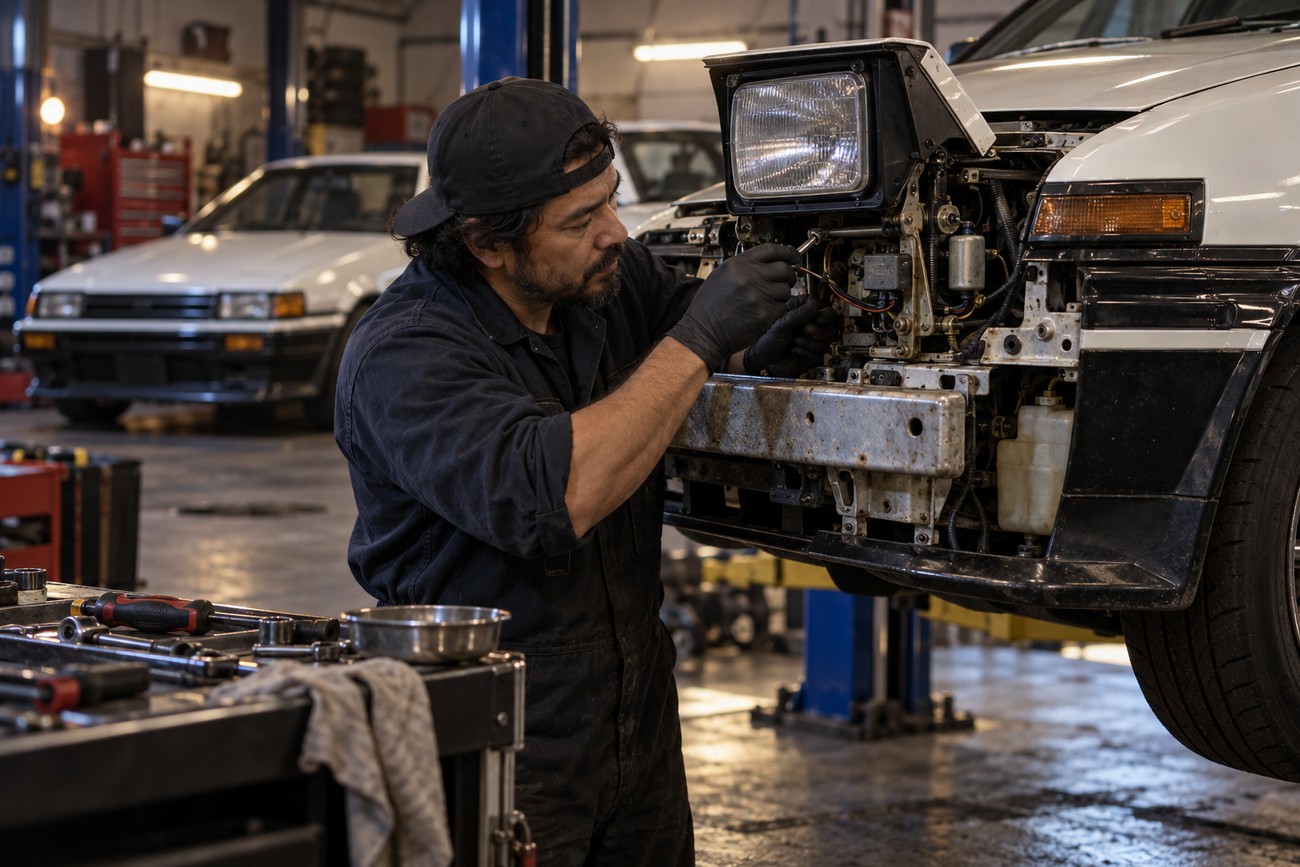
A Trueno’s pop-up lighting adds more service points than a fixed-lamp Levin arrangement. Motors, linkages, relays, switches, wiring, and adjustment hardware can each contribute to a fault. Symptoms may include a lamp that stops short, rises unevenly, moves slowly, or fails intermittently. Diagnosis requires separating an electrical problem from a mechanical bind or a damaged mounting area.
The Levin’s fixed headlights make the front end simpler in that specific respect. A fixed lamp still depends on sound housings, brackets, wiring, and correct adjustment, and a Levin can carry just as much structural damage or corrosion as a Trueno. The simpler lighting arrangement reduces one category of upkeep; it does not turn a poor shell into a sensible project.
Before pricing a front-end swap or collision repair, match the headlight assemblies, mounting points, front panels, and wiring to the car’s year and specification. A visually similar replacement may not be a bolt-on fit.
Correct original Trueno panels and lighting components can be scarce and expensive, particularly when a restoration requires the complete pop-up system rather than a cosmetic substitute. A conversion also involves the supporting front panels, brackets, hood, bumper, grille, wiring, and alignment of adjoining bodywork. Ordering a single part by badge is a reliable way to discover that the rest of the assembly belongs to another configuration.
Rust deserves equal attention. Check the wheel arches, sills, suspension towers, floor, seams, and areas hidden by underseal or fresh paint. Previous welding and repainting may look tidy from a distance while concealing distorted metal or corrosion that has returned around old repairs. A structurally sound, complete Levin may cost less to put right than an attractive Trueno missing its original front end.
Spotting a converted car before you buy
Begin with identity rather than appearance. Compare the chassis number and identification plates with the paperwork, import documents, build information, and any available repair history. Japanese-market cars should not automatically be expected to have a conventional 17-character VIN; a chassis number and identification plate may be the relevant factory references.
Next, inspect the front panel as a group. Look for uneven gaps, inconsistent paint, weld marks, drilled or unused mounting holes, different fasteners, and panel joins that do not match the rest of the shell. Fresh paint around the nose, overspray on wiring or seals, and a mixture of fasteners can indicate a repair or conversion, although each clue needs to be considered alongside the car’s history.
Trace the wiring instead of accepting a working lamp as proof of originality. A Trueno conversion may use altered connectors, extended wires, additional relays, or improvised grounds. A fixed-light car with pop-up equipment can look convincing until the headlight doors, motors, and surrounding panels are tested together. Operate the complete lighting system repeatedly and listen for binding, uneven movement, or delayed response.
Finally, compare the visible specification with the documents and the rest of the car. Check the rear badges, interior trim, engine, gearbox, dashboard details, and signs of donor parts, while remembering that these can also have been changed. The purpose is not to reject every modified car; it is to price the modification accurately and avoid paying for a factory identity that the evidence does not support.
Which should you choose? Prioritize the shell, then the look
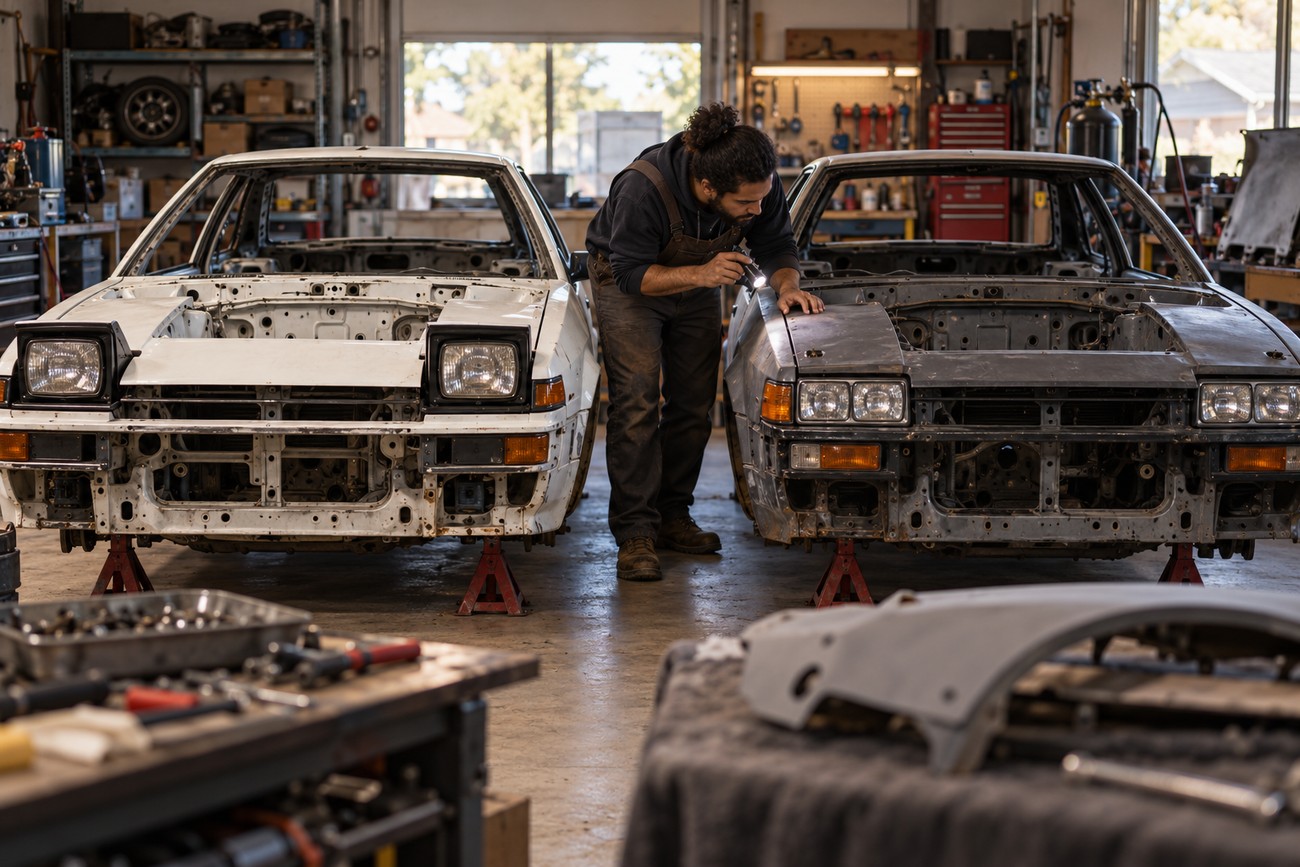
Choose a Trueno when the pop-up-headlight appearance is central to the project and you are prepared to maintain or restore its additional front-end hardware. The best candidate will have a documented identity, a complete nose, sound mounting points, and a body that does not require major structural work. Missing original lighting parts can erase the apparent value of a cheap purchase.
A Levin suits a buyer who prefers the fixed-light design and a simpler front-end service routine. That can make repairs more straightforward when the correct panels and lamp assemblies are already present. It remains essential to inspect the shell, because a fixed-light Levin with serious corrosion is a larger financial risk than a complete Trueno with a sound body.
For a driving project, choose by condition and parts availability rather than by the supposed performance ranking of the names. Confirm the engine, transmission, trim, axle, and suspension equipment, then assess whether the car is complete enough for the intended use. A modified car can be a sensible choice when its changes are documented, safe, and reflected in the price.
The usable decision rule is simple: buy the strongest shell with the clearest identity and the most complete correct parts. Treat the Trueno-versus-Levin choice as a decision about styling, front-end upkeep, and restoration preference. Corrosion, originality, specification, and repair budget determine the result far more reliably than the badge on the trunk.
Frequently asked questions
The questions below address the names, the familiar AE86 styling distinction, and the risks of modified cars. They also reinforce why condition and documentation matter more than the badge alone.
What does Levin mean in AE86?
Levin is an English word associated with lightning or a lightning flash. Trueno is Spanish for thunder, so the two names carry related storm imagery rather than describing separate mechanical categories.
Those meanings are part of Toyota’s naming and branding, not technical definitions. They do not establish which car has the stronger engine, which trim is more valuable, or whether a particular body is factory-original.
What is the difference between Levin and Trueno?
In the familiar AE86 comparison, the Trueno uses pop-up headlights and the Levin uses fixed headlights, with associated differences in the grille, hood, bumpers, panels, and wiring. They generally share the same underlying mechanical basis, while engines and equipment vary by market and trim.
The distinction becomes less certain on a modified or restored car. A front-end swap can make a Levin look like a Trueno, or the reverse, so identification plates, chassis information, documents, and repair evidence are needed to establish the original specification.
Sprinter Trueno vs. Levin: what’s the difference? Reddit discussion
Discussion threads often reduce the comparison to “pop-ups versus fixed lights,” which is a useful description of the familiar AE86 versions. It is incomplete as buying advice because the two names do not, by themselves, define separate performance tiers or guarantee a particular engine.
The practical consensus worth keeping is to inspect the shell first. A rust-free, complete, correctly identified car is usually a stronger purchase than a more fashionable badge with a swapped front end, missing lamps, or extensive hidden repairs.







