
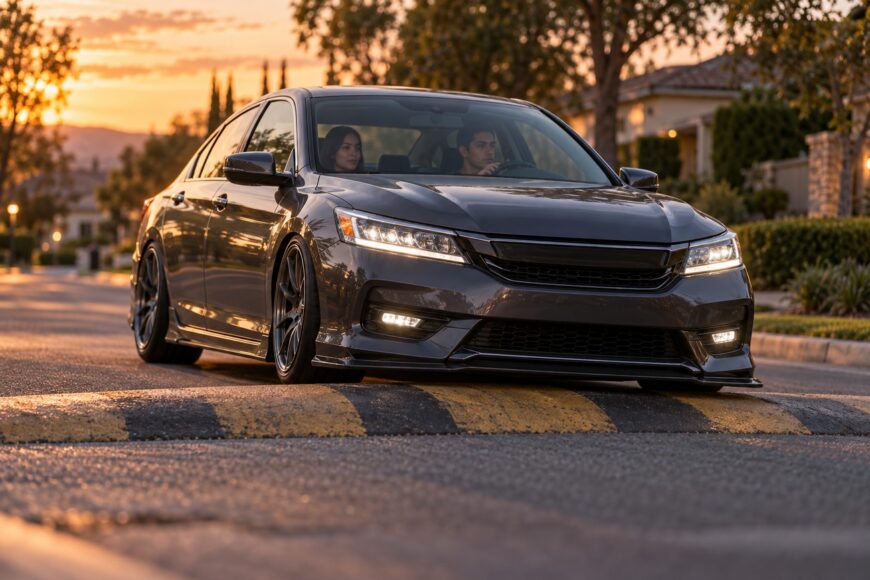
An Accord can look perfectly usable on paper and still scrape its front lip, oil pan, or exhaust on an ordinary speed bump. Lowering reduces the margin between the lowest component and the road, while the car’s long body can make a crest or driveway transition harder than its static ride height suggests.
The conflict is straightforward: a lower stance may suit the owner’s priorities, but daily roads still demand suspension travel, clearance, and usable approach angles. A clearance figure alone cannot predict whether your Accord will pass cleanly. Tire choice, loading, bump geometry, suspension condition, and the exact location of the lowest point all matter.
That is why two Accords with similar catalog specifications can behave differently on the same road. One may clear a familiar bump unloaded and scrape with passengers and luggage; another may already show damage from poor spring, damper, or wheel-and-tire choices. Driving technique reduces risk, but it cannot compensate for geometry the car simply does not have.
- Why a Lowered Accord Can Scrape Despite Its Listed Clearance
- What Usually Hits First on a Lowered Honda Accord
- The Safest Way to Cross a Speed Bump in a Lowered Accord
- The Daily-Driving Cost of Lowering an Accord
- Common Mistakes and Myths About Lowered Accords and Speed Bumps
- Speed Bumps, Road Rules, and the Wrong Idea of an Obstacle
- Stock vs. Lowered Honda Accord: Speed-Bump Trade-Offs
- Is Lowering an Accord Worth the Compromise?
- Frequently asked questions
- Which Honda Accord should I stay away from if my roads have many speed bumps?
- What should I inspect before buying a lowered Honda Accord?
- How do lowered cars deal with speed bumps?
- What are the downsides of installing speed bumps?
Why a Lowered Accord Can Scrape Despite Its Listed Clearance
Honda Accord clearance figures vary by generation, market, version, tires, load, and measurement method. Catalog and reference values commonly fall in an approximately 130–170 mm range across different Accords, so one published number should be treated as a reference rather than a guaranteed operating height.
Accord IX references include approximately 4890 × 1850 × 1465 mm, while other references list a 1435 mm height and 146 mm of clearance. That difference demonstrates how specifications can vary between versions, markets, and measurement methods. The number may also describe static clearance under conditions that do not match the car on the road.
Accord XI references list approximately 4971 mm in length, 1862 mm in width, and 1450 mm in height. A long body and wheelbase improve stability and cabin space, yet they can reduce the available approach and departure angles. The front or rear overhang may meet a ramp, or the middle of the car may contact a crest, even when the measured clearance looks adequate.
Tires alter the practical result as well. A different overall diameter, lower sidewall, or reduced pressure can change the car’s height and compliance. Passengers, luggage, and a full fuel load further reduce the remaining margin, while worn or poorly matched suspension components can allow more compression than the owner expects.
What Usually Hits First on a Lowered Honda Accord
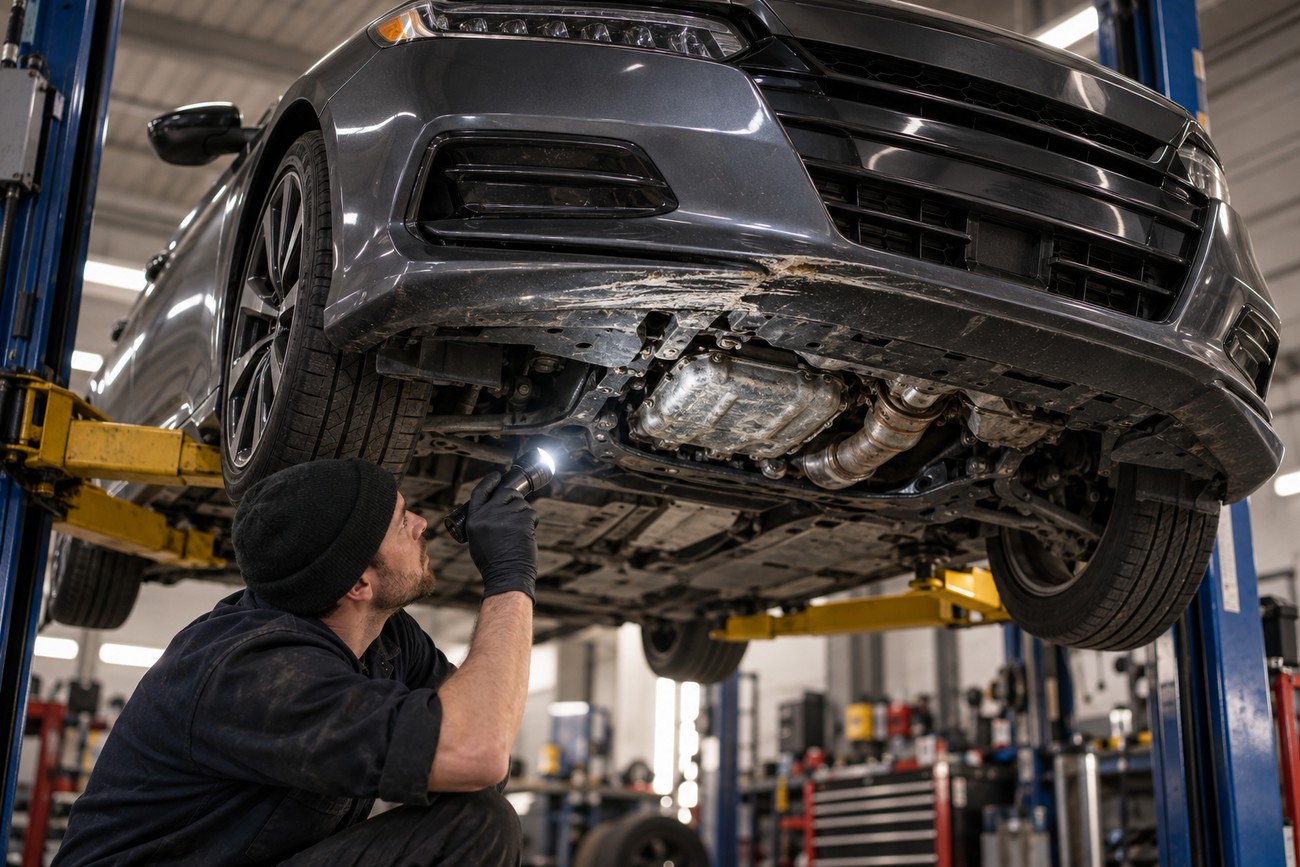
The first contact point is often the front bumper lip because it sits ahead of the front wheels and meets a rising surface before the tire can climb it. A lip may flex during a light touch, but repeated contact can leave scrape marks, loosen fasteners, or create cracks that are easy to miss from above.
The oil pan is a more serious inspection point. A bump can compress the suspension and bring the pan closer to the road, especially if the car has limited travel or the lowest section sits near the center of the vehicle. The exhaust and its brackets can also touch, dent, or move after repeated impacts.
Suspension components may contact the road directly, or they may receive loads transmitted through a hard compression event. Lowering reduces available suspension travel, so the bump has less room to be absorbed before the chassis or an attached component becomes the stop.
Minor scrapes do not always produce an immediate breakdown. A shallow exhaust dent, loosened shield, bent bracket, or developing suspension noise may appear later as a rattle or change in ride quality. Repeated light contacts can accelerate wear even when every individual event seems harmless.
The Safest Way to Cross a Speed Bump in a Lowered Accord
Reduce speed substantially before the bump, while the car is still on level ground. Keep steering, throttle, and braking inputs smooth as the front wheels climb and the chassis passes over the crest. Harsh braking during the crest can increase pitch and suspension compression at the point where clearance is already limited.
Approach straight when that keeps the lowest components clear and lets all four wheels climb in a controlled way. A carefully chosen angle can help when the bump is narrow, uneven, or shaped so that a direct line creates avoidable contact. The correct line depends on the bump shape, the Accord’s ride height, and the location of its lowest point.
The lowest component should determine the line before the wheels reach the bump. A diagonal pass should be avoided when it twists the body or shifts the crest toward the oil pan or exhaust.
A one-wheel approach is therefore not universally safer. It can reduce the effective rise at one corner in some situations, but it can also twist the body, unload a tire, or move a vulnerable component into the bump. Never use an angle simply because another lowered car appears to do so successfully.
Very low speed reduces suspension compression and impact risk, but it cannot prevent contact when the available geometry is insufficient. If the lip or underbody still touches at walking pace, the practical solution is a different line, a different route, or a change to the vehicle setup.
The Daily-Driving Cost of Lowering an Accord
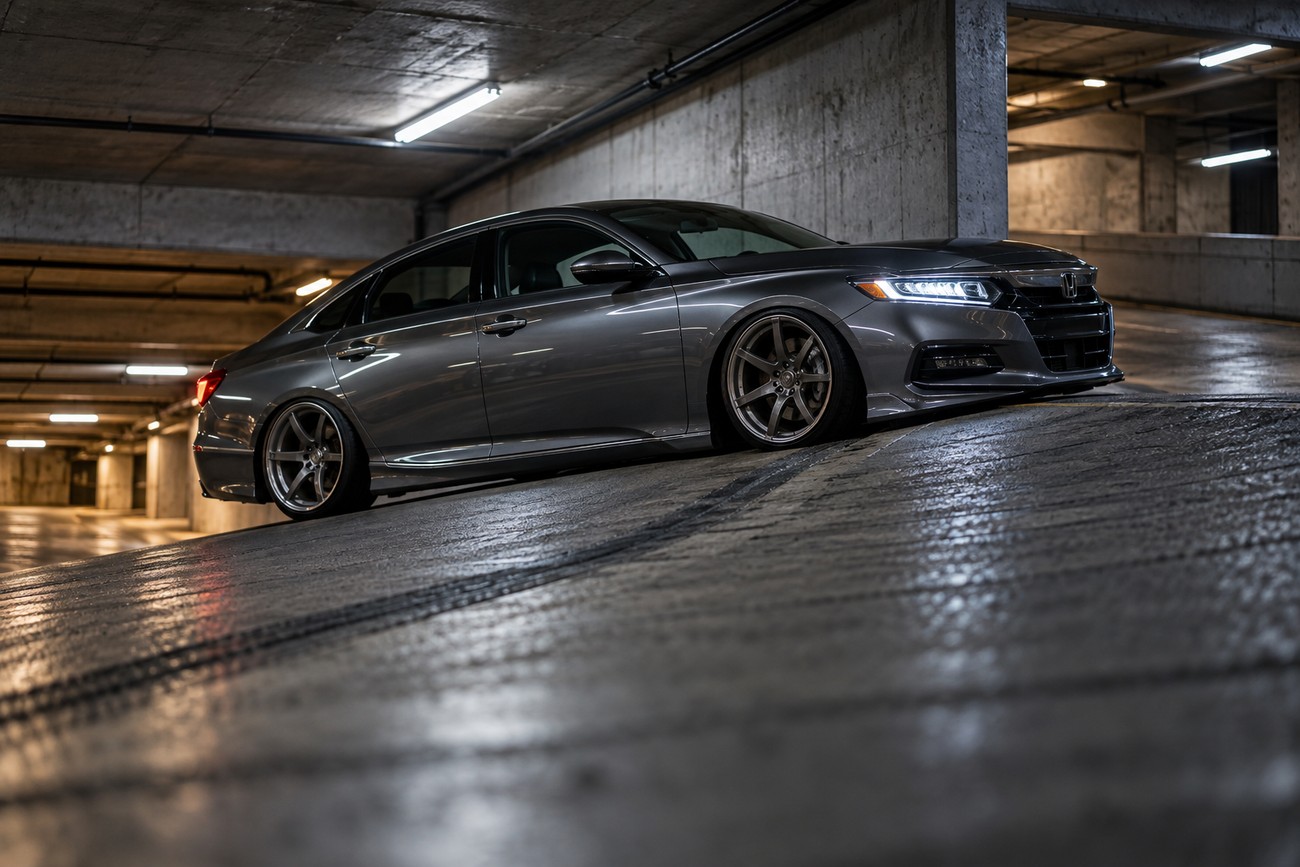
Speed bumps are only one part of the problem. Parking entrances, driveway transitions, underground garages, curb approaches, and uneven residential roads often combine a steep angle with a short crest. These surfaces can demand more from approach and departure angles than a standard, rounded bump.
A car may clear one familiar bump and scrape at the same location when approached from the opposite direction. The entry angle changes which overhang reaches the transition first, and a diagonal approach can alter the body position across the ramp. This is why route familiarity does not eliminate the need for judgment.
Passengers and luggage reduce available clearance and can change how the suspension responds. A full fuel load also reduces the remaining margin. An Accord that passes comfortably with one occupant may compress enough under load to contact the lip, exhaust, or suspension components.
Lowering can therefore reduce everyday usability in residential areas and parking facilities even while the car remains mechanically drivable. The cost is measured in slower routes, more careful parking choices, and a greater chance that a routine trip will produce a scrape or rattle.
Common Mistakes and Myths About Lowered Accords and Speed Bumps
Aggressive lowering without route planning is the first avoidable mistake. The Accord badge does not determine passability; actual clearance, suspension travel, tire size, bump geometry, load, and the driving line do. A setup that works on smooth roads may be impractical around older neighborhoods, steep garages, or poorly shaped traffic-calming devices.
Carrying speed into a bump increases suspension compression and the chance of underside impact. Braking late can make the front end dive just before the crest, leaving the front lip or oil pan with less room. Reducing speed early gives the suspension more control, although it cannot make impossible geometry passable.
Another common assumption is that any diagonal line is safer. An unsuitable angle can increase body twist or place the bump closer to the exhaust, oil pan, or a suspension component. A straight path may be better for one bump, while a carefully selected angle may help on another.
Loading is easy to ignore because the car’s appearance does not change dramatically. Yet passengers, luggage, and fuel reduce the clearance margin. Catalog clearance is also no guarantee of real-world passability, and slow driving cannot eliminate contact if the lowest point cannot clear the bump.
Speed Bumps, Road Rules, and the Wrong Idea of an Obstacle

Traffic-law terminology should be separated from driving technique. Under Russian traffic rules, an obstacle is a stopped vehicle caused by a malfunction, or a foreign object or road defect that obstructs movement in the lane. A speed bump is not automatically the legally defined obstacle described in those rules.
That distinction matters because the rule concerning an obstacle should not be treated as permission for an arbitrary maneuver around every raised or uneven section of road. Drivers still need to follow lane markings, signs, right-of-way rules, and the requirements of the road’s actual layout.
Russian traffic rules prohibit unauthorized installation of road signs, traffic lights, and other traffic-control devices, as well as leaving objects that obstruct traffic. Whether a particular speed bump or sign was installed lawfully is a jurisdiction-specific question that may require local authorities or legal sources.
These points should not be presented as universal advice for every country. The practical technique remains broadly applicable, but the legal status of a speed bump, road marking, or obstruction depends on the jurisdiction where the road is located.
Stock vs. Lowered Honda Accord: Speed-Bump Trade-Offs
A stock-height Accord generally retains more clearance and suspension-travel margin than the same car after lowering. Neither configuration can be judged from one catalog number, because tires, load, bump shape, and the lowest component still determine the result.
| Factor | Stock-height Accord | Lowered Accord |
|---|---|---|
| Clearance margin | Generally greater, with more tolerance for ordinary road variations | Reduced, with greater sensitivity to the actual lowest point |
| Suspension travel | Usually more available before hard compression | Reduced, increasing the chance of transmitted impact loads |
| Speed-bump technique | Slow, smooth passage is still advisable | Substantial early speed reduction and careful line selection are more important |
| Loading sensitivity | Passengers and luggage reduce margin, but more reserve usually remains | Passengers, luggage, and fuel can turn a marginal passage into contact |
| Parking-ramp usability | Generally more forgiving at transitions and driveway entries | More dependent on approach and departure angles |
| Likely contact points | Front lip, oil pan, exhaust, or suspension components on severe transitions | Front lip, oil pan, exhaust, and suspension components with greater frequency |
Is Lowering an Accord Worth the Compromise?
The decision is a balance between visual stance and clearance, suspension travel, comfort, and route flexibility. A modest setup that preserves usable travel may remain practical for daily roads. An aggressive setup can demand route planning, cautious parking, and acceptance that some ramps or bumps are effectively off-limits.
The real lowest point matters more than a general statement that the car is lowered. Inspect where the front lip, oil pan, exhaust, and suspension components sit relative to the road, then consider how those points move under compression and loading.
Recurring scrape marks are useful evidence. They show that the current route, load, or driving method has already exceeded the car’s available margin. New noises, dents, loose exhaust parts, or visible damage should be treated as reasons to inspect the car before continuing to accept the contact.
Marketing claims that a lowered Accord will clear bumps without difficulty often ignore bump dimensions, steep transitions, passenger load, and regional road conditions. Judge the setup by the roads you actually use and by its behavior with the people and luggage you normally carry.
Frequently asked questions
Choosing or living with a lowered Accord requires more than comparing a single clearance figure. The answers below focus on inspection, vehicle condition, and practical suitability.
Which Honda Accord should I stay away from if my roads have many speed bumps?
Avoid an individual Accord with an unknown ride height, poor-quality suspension setup, damaged underside, or recurring scrape evidence rather than rejecting a particular generation without inspection. A stock-looking car may still have unsuitable springs, worn dampers, incorrect tire sizing, or a bent exhaust component.
Check whether the car clears your regular routes with typical passengers and luggage. If the front lip, oil pan, exhaust, or suspension components already show repeated contact, the vehicle is a poor fit unless the cause can be identified and corrected.
What should I inspect before buying a lowered Honda Accord?
Start underneath the car with the lower front lip, oil pan, exhaust, and visible suspension components. Look for scrape marks, dents, cracked plastic, displaced shields, bent brackets, leaks, and fresh repairs. Examine whether the exhaust hangs unusually low or whether any component appears close to the road.
During a careful test drive, listen for unexplained rattles and compare the car’s behavior over a familiar bump, driveway transition, and parking entrance. Test it with the expected load if possible. The inspection should establish the actual lowest point and whether the suspension still has usable travel, rather than relying on the seller’s stated ride height.
How do lowered cars deal with speed bumps?
They deal with them by reducing speed early, keeping the controls smooth, and selecting a line that suits the bump and the vehicle’s lowest component. Some cars can use a carefully chosen diagonal approach, while others should cross straight to avoid body twist or moving the crest toward the oil pan or exhaust.
Inspect the road surface and the car’s behavior rather than assuming a technique will work everywhere. Speed reduction lowers risk, but it cannot overcome insufficient clearance or suspension travel.
What are the downsides of installing speed bumps?
Speed bumps can slow traffic, but they also create clearance and comfort problems for vehicles with limited suspension travel. Poorly shaped or steep transitions can increase scraping, transmitted impact loads, and difficulty for cars entering driveways, parking facilities, or residential roads.
Their effect depends on design, placement, visibility, and local rules. Under Russian traffic rules, unauthorized installation of traffic-control devices or leaving objects that obstruct traffic is prohibited, but the legal assessment is jurisdiction-specific. A driver should not assume that every speed bump is an obstacle in the legal sense or use that assumption to justify arbitrary maneuvers.







