
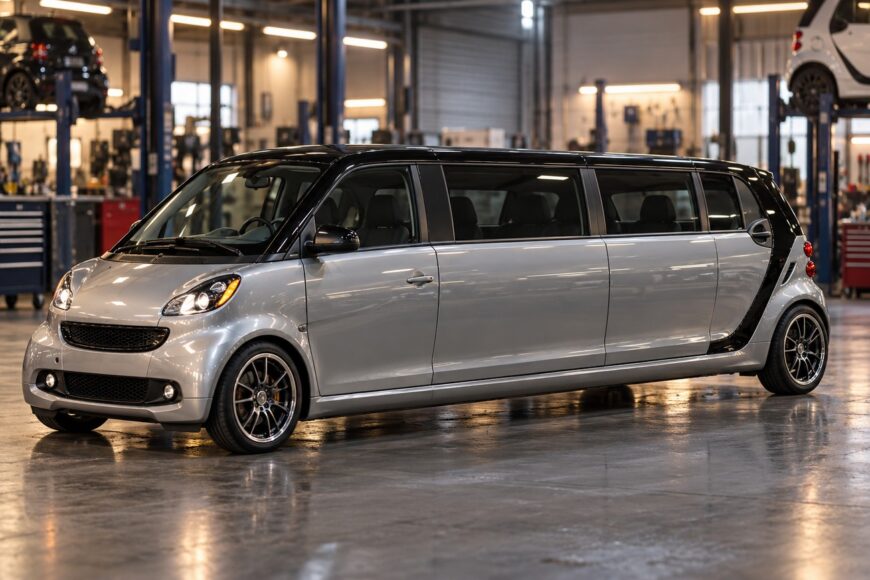
A Smart Fortwo stretch limo is a visual contradiction: a two-seat microcar with a limousine’s long profile. The extra cabin may be the attraction, but the interesting engineering question is how much length a builder can add while keeping the result usable. A photograph can show that a Fortwo has been stretched; it cannot establish its overall length or prove that the vehicle works as a road-going limousine.
There is no verified measurement here for a completed conversion, much less a supported maximum length. The sensible starting point is the donor car. A standard third-generation Fortwo measures 2,695 mm long, and its unusually short wheelbase helps explain both the appeal of the project and the difficulty of making it work.
- Is there a verified length for a Smart Fortwo stretch limo?
- The starting point: Fortwo dimensions before the stretch
- How long could one actually get?
- Why stretching a Fortwo is more than adding seats
- The tiny-car advantages a stretch might lose
- What would make a stretch-limo length claim credible?
- Frequently asked questions
- How much would a Smart Fortwo stretch conversion cost?
- How fast can a standard Smart Fortwo go?
- How much do those tiny smart cars cost?
- How fast can tiny smart cars go?
- How many miles will a Smart Fortwo last?
Is there a verified length for a Smart Fortwo stretch limo?
No single length applies to a Smart Fortwo stretch limo. Each conversion can use a different donor, inserted section, and body design. The supplied specifications describe standard cars; they do not measure a particular finished limousine or establish a longest-ever example.
For a Fortwo III, the stock overall length is 2,695 mm. The earlier Fortwo II is listed at 2,499 mm. Mixing those figures can make a claimed stretch seem longer or shorter than it is, even before anyone measures the modified vehicle.
A photograph or advertisement may document the existence of a build, but perspective, camera angle, and styling make it a poor ruler. A credible length claim needs an end-to-end measurement of the completed car, with the donor generation identified. Until then, any precise figure for that car would be a guess.
The starting point: Fortwo dimensions before the stretch
The standard Fortwo III is 2,695 mm long, 1,663 mm wide, and 1,555 mm high, with a 1,873 mm wheelbase. It has two seats. Those numbers describe the production vehicle before any extra cabin or passenger accommodation is added.
The generation matters. A Fortwo II length of 2,499 mm belongs to the earlier car, so it cannot serve as the starting length for a Fortwo III conversion. Identifying the donor also helps avoid treating a modified car’s seating arrangement as a factory specification.
The stated turning radius for the standard Fortwo III is 3.475 m. That figure helps explain the stock car’s agility in tight streets, but it says nothing precise about how a stretched example would turn. Once the wheelbase and steering geometry of a particular build are known, its maneuverability must be assessed on its own terms.
How long could one actually get?
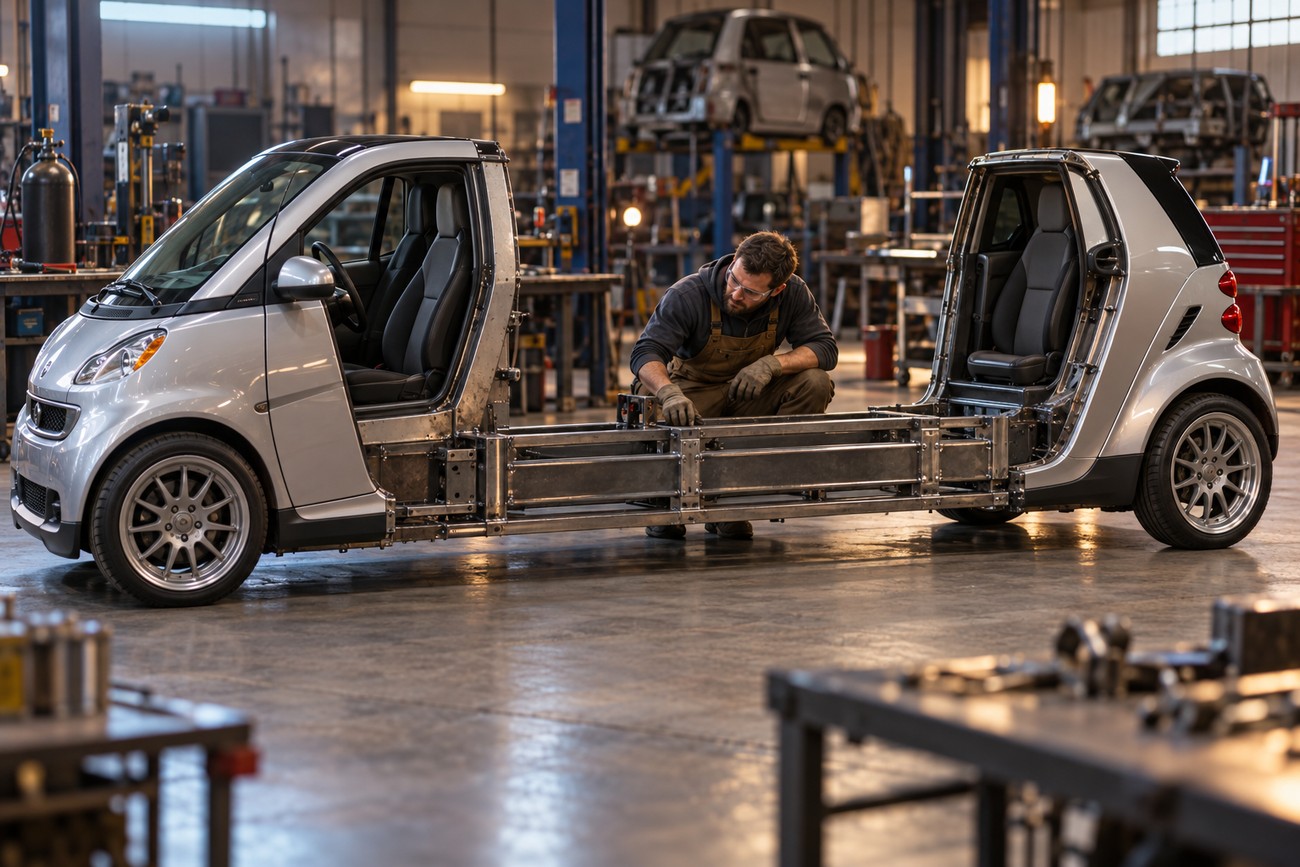
The physical idea is straightforward: add a section between parts of the original car and create a longer cabin. That can make a striking display piece. A functional road-going limousine has a harder assignment: it must carry its intended occupants while steering, stopping, and remaining structurally sound.
The Fortwo III starts with a 1,873 mm wheelbase and two seats. Extending that wheelbase changes the loads carried by the body and axles, as well as the space available for passengers. The useful length of an inserted section therefore depends on what the finished vehicle is designed to carry, rather than on a fixed multiple of the stock car’s length.
Added cabin structure, seats, and occupants bring weight that the suspension and brakes must be able to handle. Axle loads matter as much as total mass: a build could look balanced from the side while placing too much demand on one end. Engineering those systems may constrain the design before its visual proportions do.
So the conditional answer is that a Fortwo can be made longer than stock, but the supplied facts establish neither a verified conversion length nor an engineering maximum. A display car and a road-going passenger vehicle may reach different answers because they have different jobs. Without specifications and testing for an actual build, a record-setting number would be decoration rather than evidence.
Why stretching a Fortwo is more than adding seats
The Fortwo III has a rear-engine, rear-wheel-drive layout. A longer cabin has to be planned around that packaging, including the position of the drivetrain and the loads it places on the rear of the car. Simply finding room for additional seats does not show that the chassis can support their occupants.
A body extension also needs a continuous load path through the altered structure. The connections between original and new sections must carry forces from driving and braking, while the passenger compartment needs appropriate protection. These are design questions for a proposed conversion, not evidence that an unidentified finished car has failed them.
Intended passenger load should be settled before the length of an inserted section. It guides where the added structure must carry weight and how much load the running gear will face.
Weight distribution can change as passengers move through a longer cabin or occupy different seats. Suspension, tires, and brakes then need reassessment for the finished vehicle rather than reliance on the donor’s two-seat specification. Usable seating also requires safe access and restraints suited to the final layout.
The tiny donor does not make these tasks automatically easier. Its short original wheelbase leaves little room to assume that stock proportions, structure, or running gear will behave the same way after a major extension. The smaller the starting car looks, the more tempting it is to mistake available cabin length for a completed engineering solution.
The tiny-car advantages a stretch might lose
At 2,695 mm long, with a 1,873 mm wheelbase, the standard Fortwo III fits situations where a longer car can be awkward. Its stated 3.475 m turning radius is another part of that city-car appeal. A stretch creates a longer wheelbase, so neither the stock length nor the stock turning figure describes the finished vehicle.
Parking and tight turns may become less forgiving even if the conversion retains the familiar narrow-looking front end. The rear of a longer body has more distance to follow through a turn, and the driver has more vehicle to place in a space. A project built for spectacle may accept those trade-offs; a vehicle intended for regular passenger trips must live with them.
Extra cabin space does not guarantee a comfortable limousine. Seat placement, entry and exit, ride behavior, and the vehicle’s ability to carry passengers all matter. The standard car’s two seats are a useful baseline, but the seating capacity of a conversion can only be established from the finished design.
What would make a stretch-limo length claim credible?
Start by identifying the donor generation. The standard Fortwo II is 2,499 mm long, while the Fortwo III is 2,695 mm long. A claim that omits the generation leaves readers unable to judge how much vehicle was actually added.
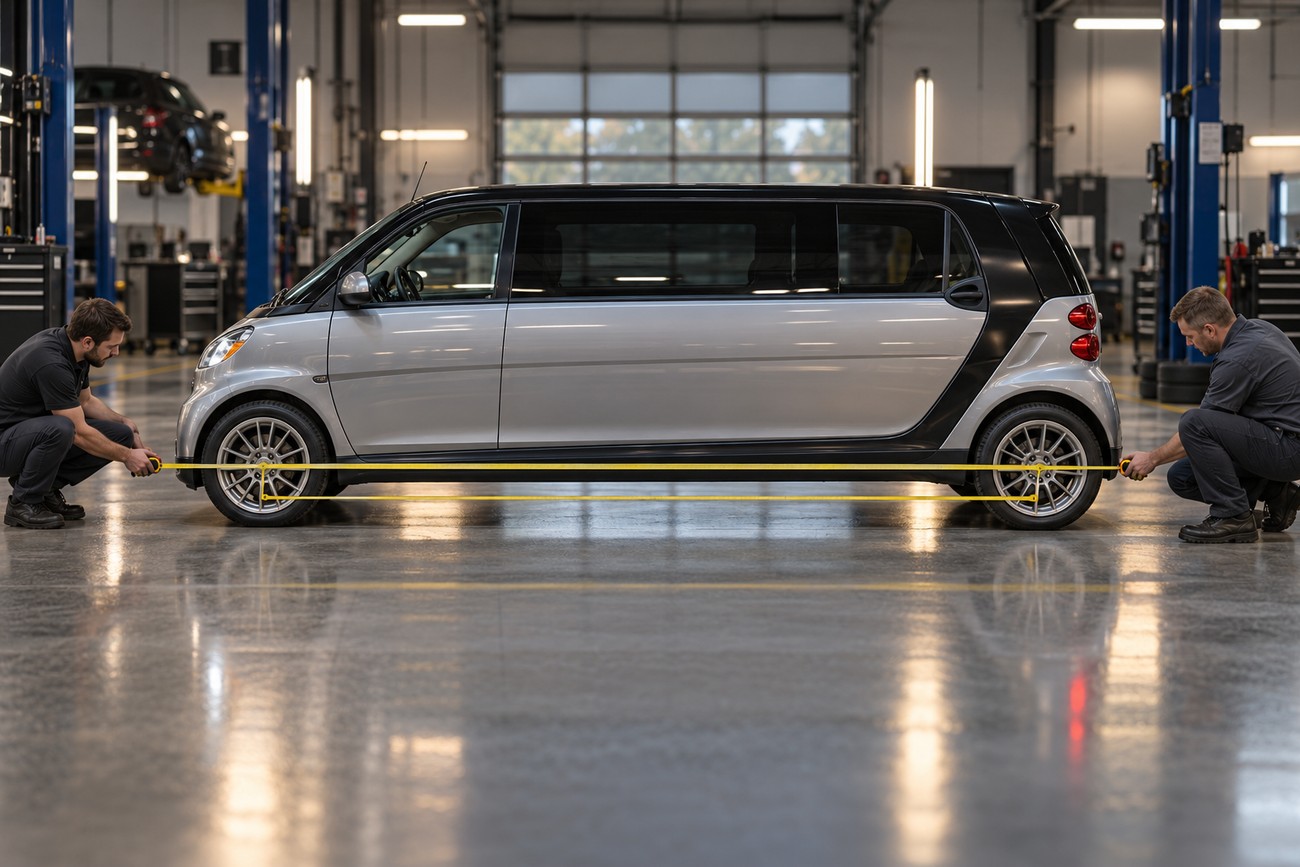
Next, look for the completed car’s measured overall length and wheelbase, labeled separately. Overall length runs from end to end; wheelbase is the distance between the axles. Reporting only the length of an inserted panel establishes neither figure for the finished car.
Dimensions are only part of a functional limousine claim. Evidence of structural work, the finished seating layout, appropriate testing, and roadworthiness in the place where the car will be used would make it more meaningful. A photograph can confirm an unusual silhouette, but it cannot substitute for measurements or show that an approval in one jurisdiction applies elsewhere.
Frequently asked questions
Stock-car figures offer useful reference points, but a custom limousine needs its own measurements and assessment. The answers below keep those two kinds of information separate.
How much would a Smart Fortwo stretch conversion cost?
No supported conversion price is available from the supplied facts. A meaningful quote would need to account for the donor car, structural fabrication, interior and seating work, testing, and any approval required where the vehicle will be used. A price for bodywork alone would leave important parts of a road-going project unaccounted for.
How fast can a standard Smart Fortwo go?
Reported top speeds for different Fortwo III variants include 145 km/h, 155 km/h, and 165 km/h. The applicable figure depends on the specific standard-car version. None of those speeds is a verified top speed for a heavier stretch conversion.
How much do those tiny smart cars cost?
There is no single supported price for a Smart Fortwo in the supplied facts. Purchase cost varies with market, generation, version, age, and condition. For a used car, the asking price is only one part of the decision; its service and repair needs deserve inspection before purchase.
How fast can tiny smart cars go?
“Tiny smart cars” covers different Fortwo generations and versions, so size alone does not determine a top speed. For the Fortwo III, reported variant-dependent figures are 145 km/h, 155 km/h, and 165 km/h. Check the specification of the particular car rather than applying one figure to every Fortwo.
How many miles will a Smart Fortwo last?
There is no verified mileage limit for a Smart Fortwo in the supplied facts. Longevity depends on the individual vehicle’s maintenance, use, and condition. For an older example, service records and an inspection of the drivetrain, suspension, and other wear items are more useful than a promised lifespan.







