
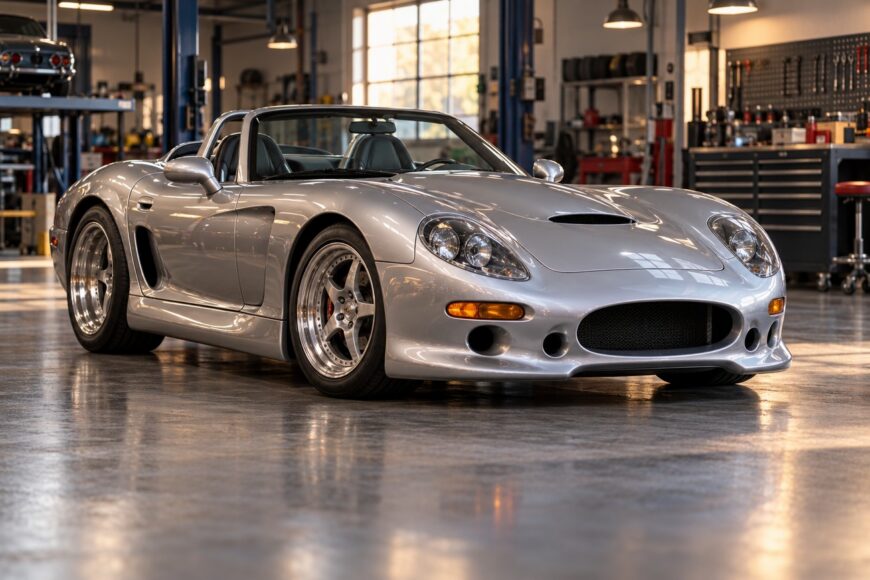
Carroll Shelby’s only ground-up car was technically ambitious, yet it became a rare, difficult-to-support niche project rather than another mass-market Shelby success. The Series 1 was a clean-sheet two-seat roadster produced by Shelby American Inc., with an unusual GM powertrain and a bespoke chassis instead of the familiar Ford-based formula.
That distinction matters when assessing one today. The standard car used a naturally aspirated Oldsmobile Aurora V8, while the approximately 450-hp figure belongs to the supercharged S/C version. Production is also disputed: specialist sources commonly cite 249 official factory cars, while some encyclopedic listings give 500.
The Series 1 is therefore best understood through its specification and paperwork, not its badge alone. Published figures for power, torque, weight, and performance vary, and ownership can be more demanding than the car’s relatively simple appearance suggests.
- Why the Shelby Series 1 Was Different
- Series 1 Specifications: Base Car Versus S/C
- The Aurora V8, ZF Transaxle, and Unusual Layout
- Why the Numbers and Production Count Do Not Line Up
- The Ownership Reality: Rare Parts, Expensive Repairs, and Documentation
- Common Myths About the Shelby Series 1
- Frequently asked questions
- How rare is a Shelby Series 1?
- What is the rarest Shelby model ever built?
- What was Carroll Shelby’s best car?
Why the Shelby Series 1 Was Different
Carroll Shelby positioned the Series 1 as his only ground-up car. That description separates it from the Cobra, Shelby Mustangs, and other projects built by modifying an existing Ford platform or production model. The Series 1 was conceived as an independent sports car with its own chassis, body, suspension layout, and packaging.
Shelby American Inc. produced the car as a two-seat roadster. Its low, wide body and front-mounted, rear-wheel-drive format gave it the visual language of a traditional American performance car, but the engineering brief was more ambitious than a routine conversion. The project aimed to combine low mass, a sophisticated drivetrain, and supercar-level acceleration in a limited-production package.
The engine also breaks the usual Shelby association. Rather than a Ford small-block, the Series 1 used a 4.0-liter DOHC Oldsmobile Aurora L47 V8. That choice reflected the project’s independent identity and helped create a car with a different mechanical character from the V8-powered Ford Shelbys that shaped the brand’s public image.
Low volume was part of the car’s identity, but it also became a commercial weakness. A rare chassis, specialized components, and inconsistent published records make the Series 1 more difficult to compare, service, and value than a more common sports car with similar performance.
Series 1 Specifications: Base Car Versus S/C
The figures below separate the naturally aspirated base car from the supercharged Series 1 S/C. They are approximate published values, and S/C performance should never be treated as standard Series 1 specification.
| Specification | Series 1 base car | Series 1 S/C |
|---|---|---|
| Engine | 4.0-liter DOHC Oldsmobile Aurora L47 V8, naturally aspirated | 4.0-liter DOHC Oldsmobile Aurora L47 V8 with supercharging |
| Power | Approximately 320–324 hp | Approximately 450 hp |
| Torque | Approximately 393–407 N·m | Published figures vary by source and specification |
| Transmission and drive | Six-speed manual ZF transaxle, rear-wheel drive | Six-speed manual ZF transaxle, rear-wheel drive |
| Acceleration | Approximately 4.4 seconds from 0–60 mph | Approximately 3.5–3.7 seconds to 100 km/h |
| Top speed | Approximately 274 km/h | Approximately 306 km/h |
The Aurora V8, ZF Transaxle, and Unusual Layout
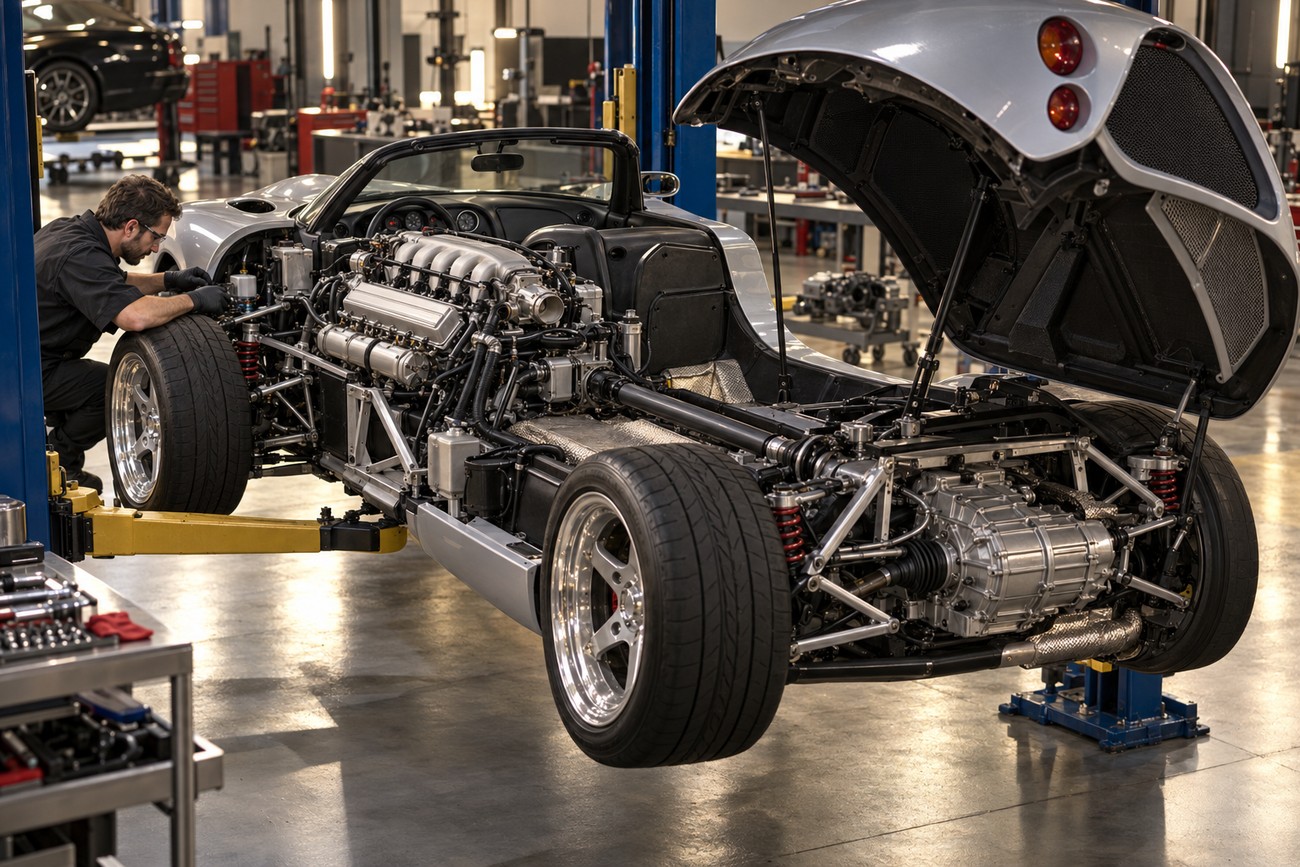
The 4.0-liter DOHC Oldsmobile Aurora L47 V8 began life as a much less powerful engine than the Series 1 figures suggest. One cited test describes the stock Aurora unit as producing 250 hp and 260 lb-ft before Shelby development. In production Series 1 form, the naturally aspirated engine is commonly listed at approximately 320–324 hp.
Shelby’s work therefore involved more than installing a catalog engine. The Aurora’s compact aluminum V8, double-overhead-cam design, and high-revving character suited the roadster’s engineering goals, while the final output placed the base car in serious performance territory. The supercharged S/C version changed the mechanical and dynamic equation again, with approximately 450 hp commonly attributed to it.
Power reached the rear wheels through a six-speed manual ZF transaxle. Locating the transaxle at the rear helped the overall packaging and weight distribution, but it also introduced a specialized component that can complicate repair and parts sourcing today.
Descriptions of the layout place the engine longitudinally at the front but positioned within the wheelbase. That unusual arrangement explains why some summaries use mid-engine-like language; it does not establish the Series 1 as formally mid-engine. The safer description is a front-mounted engine located unusually far back within the wheelbase.
Why the Numbers and Production Count Do Not Line Up
Specialist buyer’s guides and profile sources often cite 249 official factory cars. Some encyclopedic listings instead state that 500 cars were built. Those figures should be treated as a documented disagreement rather than combined into a single precise production total.
The same caution applies to performance data. Base power is commonly listed between 320 and 324 hp, while torque figures are often given at approximately 393–407 N·m. Differences may reflect varying source standards, test methods, vehicle specifications, or confusion between the base car and S/C versions.
Weight and acceleration figures also vary. The base car is often quoted at approximately 1,202 kg, with approximately 4.4 seconds from 0–60 mph, a quarter-mile time of approximately 12.8 seconds, and a top speed near 274 km/h. These numbers describe a useful performance reference, not a guarantee for every surviving car.
For a buyer, the disagreement changes the research method. A listing that claims a production number, power figure, or S/C identity should be checked against the car’s VIN, build documentation, engine, transaxle, and modification history. A polished auction description is weaker evidence than a consistent documentary trail.
The Ownership Reality: Rare Parts, Expensive Repairs, and Documentation
The Series 1 can be expensive to maintain because its chassis and packaging are rare. Owners and observers commonly report difficult service work, while the ZF transaxle and specific GM-derived components may require specialist knowledge or careful parts sourcing. A mechanically straightforward-looking repair can therefore take longer and cost more than an equivalent job on a common sports car.
Parts availability depends on identifying exactly what is fitted to the car. The Aurora engine is GM-derived, but that does not mean every component is interchangeable with an ordinary Oldsmobile application. The same principle applies to the ZF transaxle and the bespoke chassis hardware.
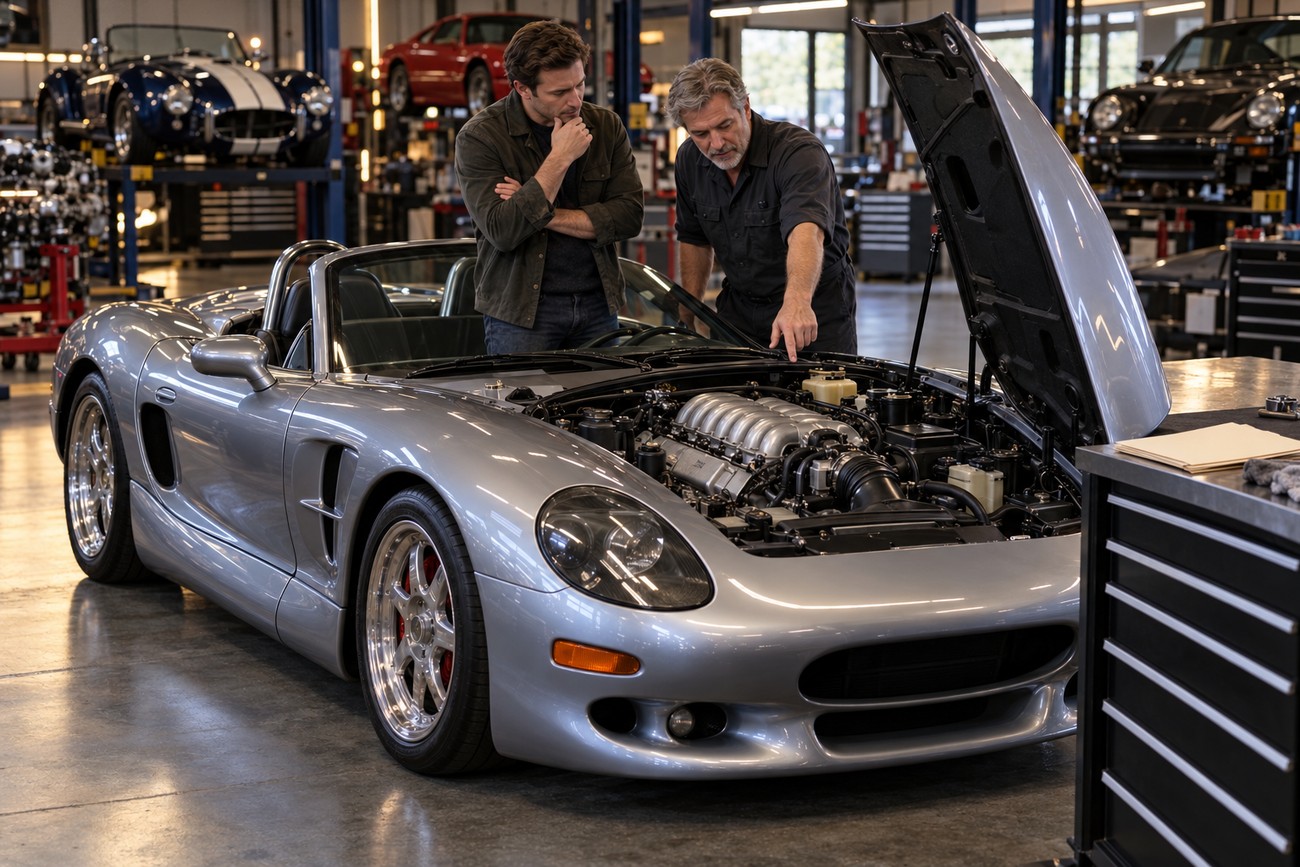
Match the VIN and build documentation to the engine, transaxle, and claimed S/C specification before purchase. Badges, bodywork, and a single auction listing cannot establish whether a car is a factory or otherwise documented supercharged example.
Documentation can influence value as much as cosmetic condition. A buyer should seek evidence of the original build, engine specification, drivetrain identity, service history, and any supercharger installation. Official S/C cars and later conversions should be distinguished clearly because the mechanical work and the historical status are separate issues.
A careful inspection should also account for the car’s intended use and support network. A Series 1 may deliver exceptional performance for its era, yet ownership is less forgiving if the buyer expects ordinary dealer support or readily available aftermarket replacements.
Common Myths About the Shelby Series 1
Myth: every Series 1 has 450 hp. Reality: the base naturally aspirated car is commonly listed at approximately 320–324 hp. Approximately 450 hp refers to the supercharged S/C version, and a claimed S/C specification requires documentation rather than visual inspection alone.
Myth: the Series 1 is a Ford-based Shelby. Reality: its engine is the GM Oldsmobile Aurora L47 V8, and the car used an independent chassis and drivetrain package. Its Shelby identity comes from Carroll Shelby’s project and Shelby American Inc.’s production, not from a Ford small-block foundation.
Myth: all reliable sources agree that 500 cars were built. Reality: specialist sources often cite 249 official factory cars, while some encyclopedic listings cite 500. The production count remains disputed, so rarity claims should identify which definition and source they use.
Myth: the unusual engine position automatically makes the car mid-engine. Reality: the engine is described as longitudinally front-mounted but positioned within the wheelbase. That is an unusual front-engine layout, and the supplied evidence does not firmly support calling the Series 1 formally mid-engine.
Frequently asked questions
The questions below address the Series 1’s rarity, historical position, and ownership significance. Its disputed production count makes documentation especially important. Its engineering specification also sets it apart from more familiar Ford-based Shelby models.
How rare is a Shelby Series 1?
The Series 1 is rare, but its exact production total is disputed. Specialist sources commonly cite 249 official factory cars, while some encyclopedic listings cite 500, so a buyer should avoid treating either number as universally settled.
For collectors, provenance is more useful than a headline count. A documented factory car with a traceable specification can be more significant than an example whose advertised rarity depends on an uncertain database entry. Market comparisons should also separate base cars, documented S/C examples, and later conversions.
What is the rarest Shelby model ever built?
There is no objective single answer without defining what counts as a model. A ranking may include factory production cars, prototypes, racing cars, limited derivatives, or one-off engineering exercises, and those categories produce different results.
The Series 1 is clearly among the rare and unusual Shelby-branded road cars, but its importance does not depend on winning a rarity contest. Its stronger historical claim is that it represents Carroll Shelby’s only ground-up car as he positioned it, rather than another modification of an existing Ford.
What was Carroll Shelby’s best car?
The answer depends on the criterion. Racing success favors one set of Shelby projects, historical influence favors another, and collectability may favor a different car again. Engineering independence gives the Series 1 a distinctive claim because it was developed as an original roadster rather than as a familiar Ford conversion.
The Series 1 is therefore best judged on its own terms. It combines a 4.0-liter Aurora V8, a six-speed ZF transaxle, low-volume construction, and unusual packaging, but its specialized support requirements make it a demanding ownership proposition. “Best” is subjective; documented specification and condition are practical facts.







