
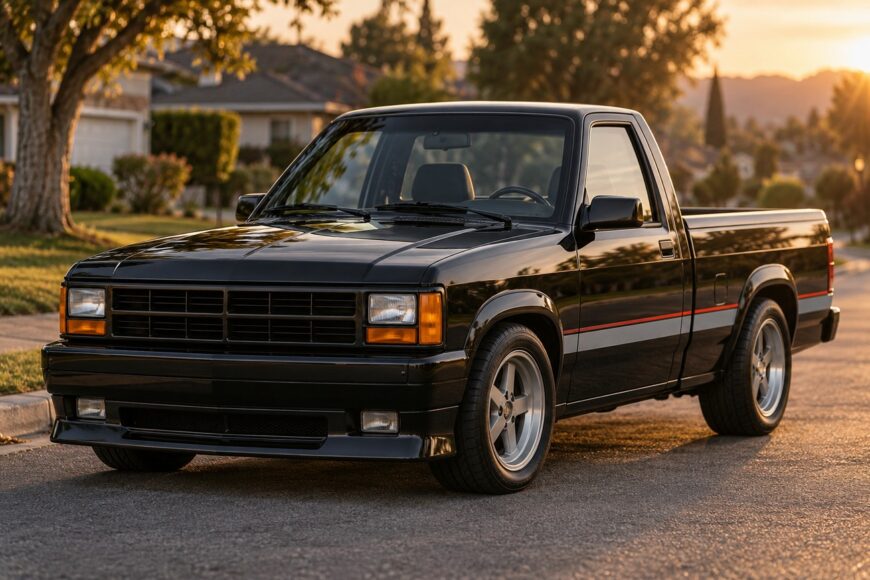
The Shelby name suggests a thunderous V8, yet the 1989 Shelby Dakota made 175 hp. Its appeal was never simply a horsepower figure. This limited version of Dodge’s pickup paired a 5.2-liter V8 with Shelby-specific equipment at a time when a factory-backed performance truck was still unusual.
For a buyer now, the central question is whether the truck’s history, original package, and scarcity matter more than outright speed. A sound, documented example offers a distinctive piece of late-1980s automotive history. A modified or incomplete one can be much harder to assess and repair than its familiar Dodge engine suggests.
- Why the Shelby Dakota Mattered in 1989
- Shelby Dakota at a Glance: Factory and Test Specifications
- What Shelby Changed Beyond the 318 V8
- How It Drives—and Where the Legend Overreaches
- Ownership Reality: Parts, Wiring, and Compatibility
- Buying a Shelby Dakota Without Buying a Headache
- Frequently asked questions
- What is the average price of a Dodge Dakota Shelby?
- How much horsepower does a Dakota 4.7 V8 Magnum have?
- How much horsepower did a 1989 Dodge Shelby Dakota pickup have?
- How much horsepower does the Dodge Dakota 4.7 V8 Magnum engine have?
Why the Shelby Dakota Mattered in 1989
The Shelby Dakota was a limited version of the 1989 Dodge Dakota. It was described as Shelby’s first V8 pickup and its first production rear-wheel-drive vehicle since the 1960s. Those milestones explain its place in Shelby history more clearly than a comparison with modern performance trucks.
The project also gave a compact pickup a different character. Its longitudinal Chrysler V8 delivered useful torque at low engine speeds, while the Shelby package included changes to the suspension, brakes, wheels, and tires. Treating the truck as an ordinary Dakota with an engine swap overlooks equipment that matters to both its identity and its value.
Scarcity is part of the appeal, but it needs careful handling. A Shelby badge cannot establish that all the original hardware is still present, and a rare model can still have serious mechanical or cosmetic needs. Buyers should judge a particular truck by its documentation and completeness rather than assume that rarity alone makes it desirable.
In its period, the Dakota was a street-oriented performance pickup with an unusual combination of name, layout, and factory-backed specification. By modern performance standards, its power is modest. Both views can be true without diminishing the truck’s historical significance.
Shelby Dakota at a Glance: Factory and Test Specifications
The figures below separate the truck’s stated specifications from period road-test results and original prices. Test numbers describe a tested vehicle, while the prices are historical figures rather than a guide to current market value.
| Item | Specification or period result |
|---|---|
| Engine and output | 5.2-liter Chrysler small-block V8 (318 cid); 175 hp at 4,000 rpm and 270 lb-ft at 2,000 rpm |
| Layout and chassis | Longitudinal V8, rear-wheel drive, ladder frame; 112-inch wheelbase |
| Transmission and axle | Four-speed automatic with lock-up torque converter; rear limited-slip differential |
| Brakes | Front discs and rear drums with ABS |
| Road-test weight | Approximately 3,625–3,626 lb |
| Car and Driver test results | 0–60 mph in 8.7 seconds; quarter mile in 16.5 seconds; 113 mph top speed |
| Period pricing reported by Hot Rod | $15,813 base price; $16,498 as tested |
What Shelby Changed Beyond the 318 V8
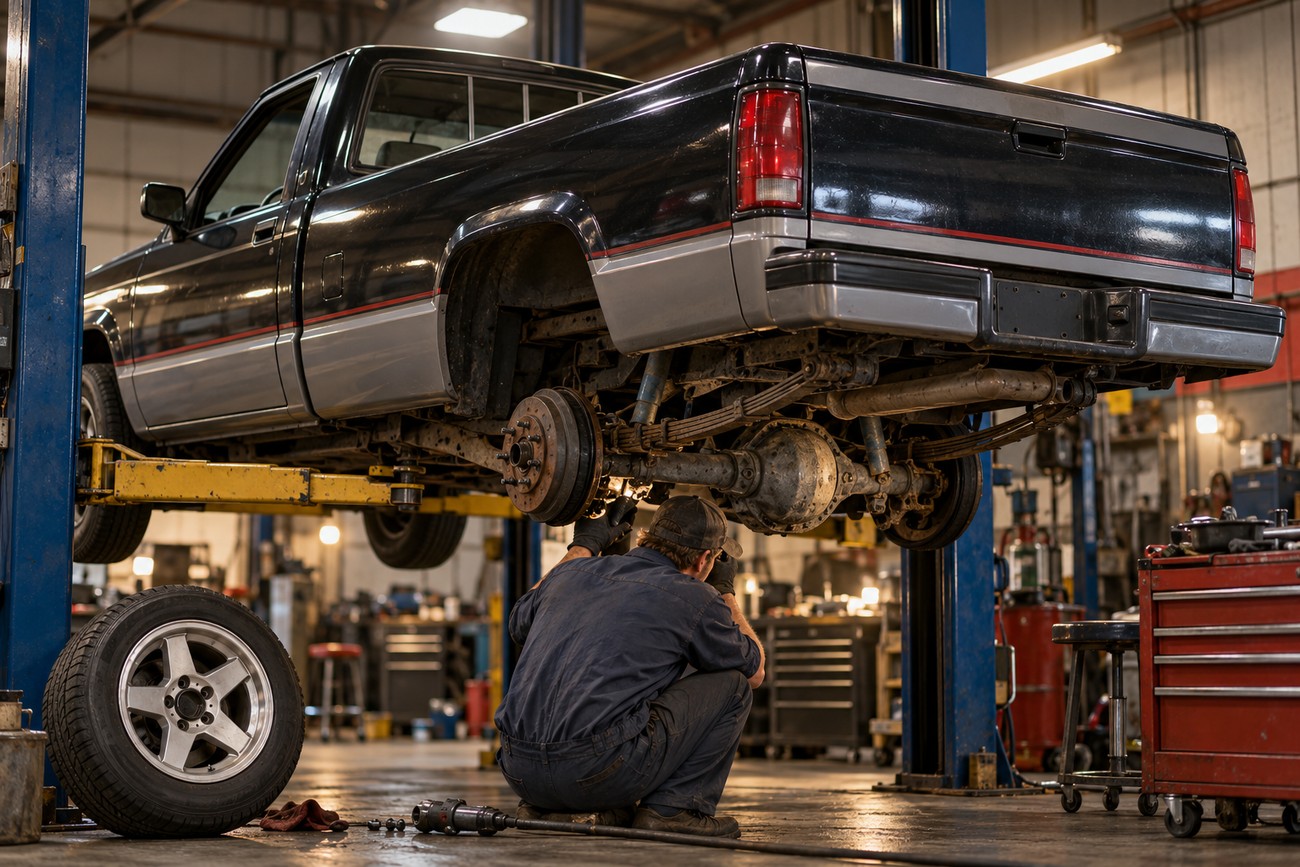
The engine was a 5.2-liter (318 cid) Chrysler small-block V8, rather than a unique Shelby-designed V8. The wider package distinguished this Dakota: period descriptions identify changes to the suspension, brakes, wheels, and tires. That combination deserves attention during an inspection, because a surviving V8 alone does not prove that the rest of the Shelby specification survives.
A rear limited-slip differential helped the rear-drive truck put its low-speed torque to use. Front disc brakes and rear drum brakes with ABS formed part of its braking specification. These features are relevant to how the truck drives, but their presence should be checked on an individual example instead of inferred from exterior graphics.
Underneath, it remained a ladder-frame pickup with a longitudinal engine and a 112-inch wheelbase. Shelby’s changes did not turn that architecture into a sports-car chassis. Period commentary noted the lack of a high-g cornering focus and sports-car-style seats, useful context for anyone expecting the badge to promise track-oriented handling.
Engine-control descriptions require similar restraint. Period accounts identify electronic control but use differing TBI and port-fuel-injection terminology. Those descriptions should prompt inspection of the actual vehicle and its components, rather than an assumption that every truck—or every replacement part—has the same setup.
How It Drives—and Where the Legend Overreaches
The strongest case for the Shelby Dakota’s V8 is its 270 lb-ft at 2,000 rpm. Torque arriving that low in the rev range suits a street-driven pickup: the engine need not be worked hard to feel responsive in ordinary acceleration. The 175 hp rating, meanwhile, is more meaningful in its late-1980s setting than as a claim of present-day V8 performance.
Car and Driver recorded 8.7 seconds from 0–60 mph and a 16.5-second quarter mile. Those results support the description of a lively period street truck, rather than a machine that will feel exceptionally quick against modern performance pickups. The recorded 113 mph top speed adds context, though maximum speed says little about the condition or safe use of a surviving example.
Expect the chassis to communicate its pickup origins. The Shelby equipment gave it a purposeful road character, but period testers did not describe a high-g cornering specialist. Seats and general refinement likewise belong to an older utility vehicle, so a buyer seeking sports-car responses is likely to misunderstand its strengths.
Sound is part of that distinction. Road tests noted that the cooling fans were noticeably audible when running at high speed. Alongside the truck layout and period cabin, that makes the Dakota better understood as a hot street-oriented pickup than as a quiet modern daily driver.
Ownership Reality: Parts, Wiring, and Compatibility
Mechanical familiarity can make the Shelby Dakota look easier to own than it is. The 318 belongs to Chrysler’s small-block family, which may help with some routine service, but parts specific to this rare version—including body, interior, and Shelby components—can take much longer to locate. Before purchase, distinguish parts that are worn from parts that are missing altogether.
Age also complicates diagnosis. Owners of older Dakotas report wiring irritations and minor electrical faults, and an intermittent problem can consume time even when the failed component is inexpensive. Inspect the truck’s electrical functions in operation, then look for altered wiring and evidence of previous repairs rather than accepting a brief successful start-up as proof that everything works.
That distinction becomes especially important on a modified truck. Period fuel-injection descriptions vary, so the hardware fitted to the individual Dakota is stronger evidence for repair planning than a generic catalog description. Suspension, brake, wheel, and trim components need their own application checks; engine-family compatibility says nothing about them.
A V8 badge is no shortcut to a towing decision, either. This is an aging light-duty pickup, and cooling, brakes, axle, transmission condition, and any modifications all affect what a particular example can reasonably do. Establish the truck’s applicable limits and present condition before treating performance hardware as towing hardware.
Buying a Shelby Dakota Without Buying a Headache
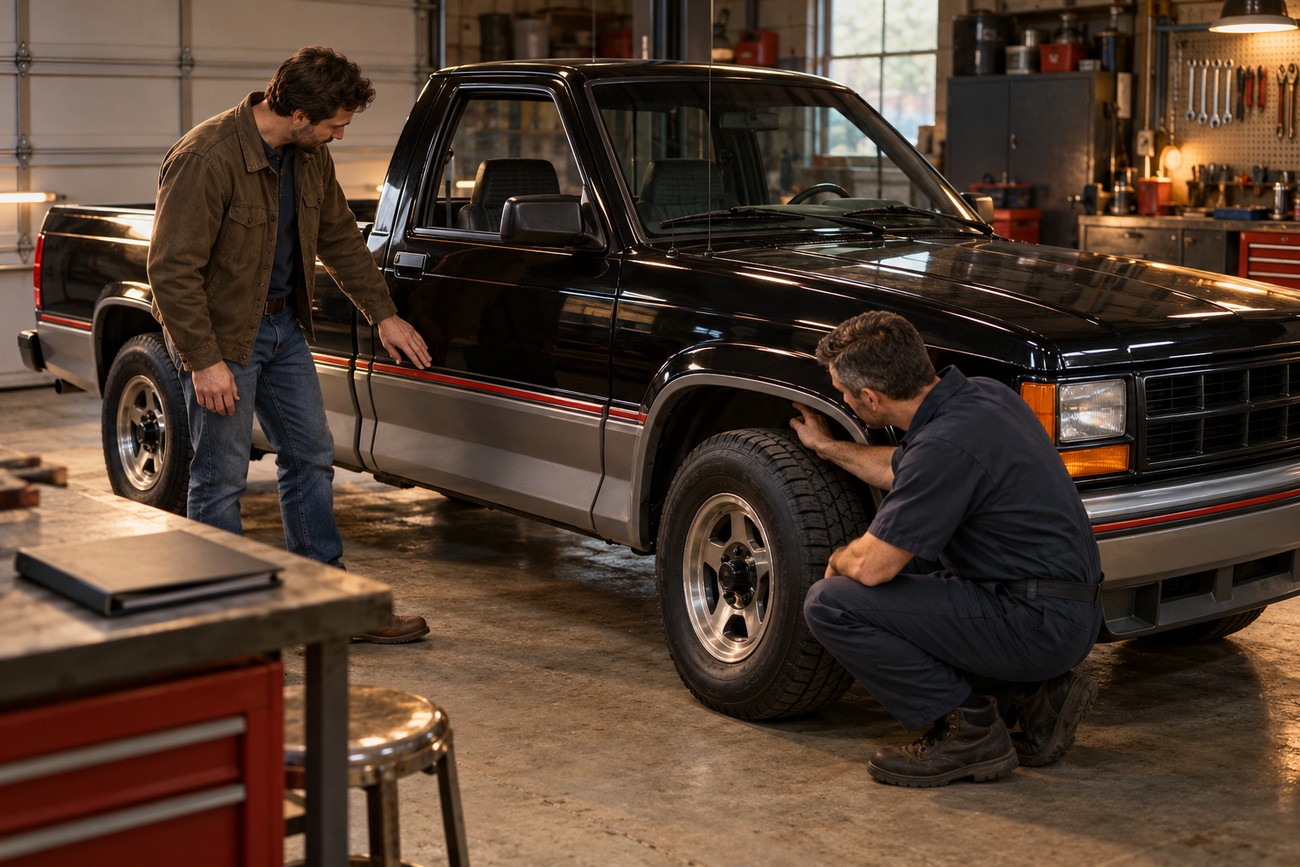
Start by verifying that the vehicle is a 1989 Shelby Dakota, not a later Dakota wearing similar cues. Check its identification and surviving paperwork against the truck in front of you, then inspect the engine, transmission, axle, brakes, suspension, wheels, and interior. Later Dakota generations and engine families are poor shortcuts for identifying an original Shelby example.
Completeness matters because some missing pieces are harder to replace than worn ones. Budget separately for scarce body parts, interior pieces, and emblems, and look closely at whether the Shelby-specific hardware remains. An otherwise tidy truck with missing original equipment may demand a longer search than a mechanically needy but complete one.
Separate documented originals from modified or swapped trucks. A replacement engine may share the 318/360 small-block architecture yet introduce questions about intake, management, accessories, wiring, and calibration. Changes to brakes, suspension, or drivetrain deserve the same scrutiny: ask what was installed, how it was fitted, and whether the work can be verified.
Finally, assess price against the actual truck rather than its badge or the cost of an ordinary Dakota. The figures above establish period base and tested prices, not a present-day average. Condition, originality, documentation, completeness, and the market in which it is offered determine whether a particular asking price is persuasive.
Frequently asked questions
These distinctions help keep later Dakota specifications and historical prices from distorting an assessment of the 1989 Shelby truck.
What is the average price of a Dodge Dakota Shelby?
No reliable current average follows from the period figures: $15,813 was the base price, and $16,498 was the tested price reported by Hot Rod. To judge a listing now, compare trucks with similar condition, originality, documentation, and completeness. Ordinary Dakota asking prices are not a direct benchmark for a limited Shelby version.
How much horsepower does a Dakota 4.7 V8 Magnum have?
There is no 4.7-liter horsepower figure in the information used here, and it would not describe a 1989 Shelby Dakota in any case. The Shelby truck used a 5.2-liter (318 cid) V8. Check the model year and exact engine application before using a later Dakota specification to identify or value a vehicle.
How much horsepower did a 1989 Dodge Shelby Dakota pickup have?
Its 5.2-liter Chrysler small-block V8 was rated at 175 hp at 4,000 rpm, with 270 lb-ft of torque at 2,000 rpm. The torque figure helps explain the truck’s street-driving character; horsepower alone does not describe the contribution of its limited-slip axle and wider Shelby package.
How much horsepower does the Dodge Dakota 4.7 V8 Magnum engine have?
An exact output cannot be established from the information here; it would require the relevant model year and engine specification. The 4.7-liter application is separate from the 1989 Shelby Dakota’s 5.2-liter (318 cid) V8, so a 4.7-liter figure should not be used as the Shelby truck’s rating.







