
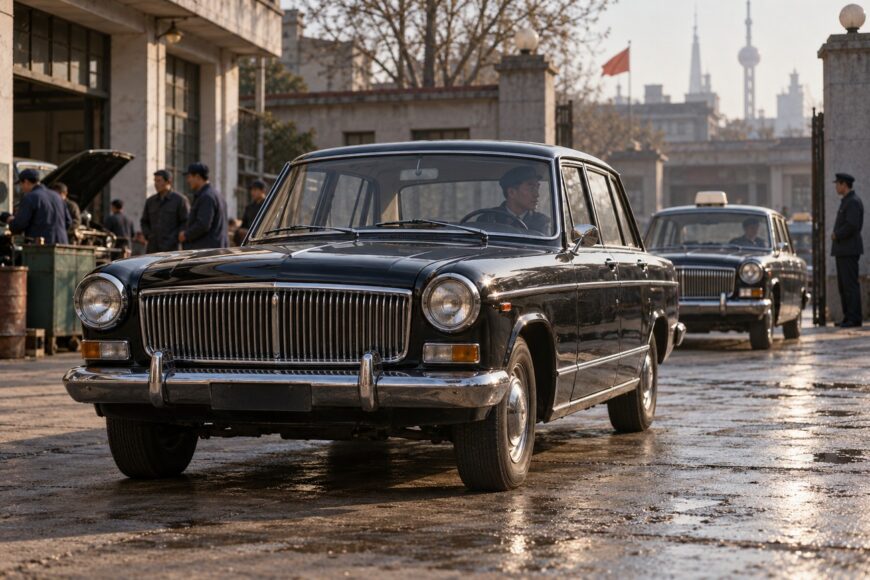
The Shanghai SH760 carries the image of an official sedan, yet its working life extended to taxis and government fleets. It was associated with mid-ranking officials, while Hongqi occupied the higher-status position. Calling every SH760 a limousine for senior leaders gives a misleading picture of where these cars served.
Its history is also easy to compress too far. Shanghai sedans remained in production for decades, but the early SH760 and later versions did not share one unchanging specification. For enthusiasts and restorers, that distinction matters as much as the car’s place in Chinese motoring history: a familiar badge cannot, by itself, date an engine, identify a brake system, or establish a surviving car’s originality.
- Who rode in the Shanghai SH760?
- From European influence to a Chinese-built sedan
- Early SH760 and later 682Q-equipped Shanghai: key differences
- Why the SH760 name does not describe one unchanging car
- What period performance means on today’s roads
- How to judge a surviving or restored SH760
- Frequently asked questions
- Where was the SH760’s gear lever?
- How should an SH760 be kept during long periods off the road?
- Why is Shanghai so different from China?
Who rode in the Shanghai SH760?
The SH760 was associated with mid-ranking officials who needed a formal, enclosed sedan for official travel. Its size and restrained appearance suited that role, and the association remains central to how the model is remembered. It does not establish that every example carried an official, or that every official rode in an SH760.
Shanghai sedans also worked as taxis and in government fleets. Those uses matter because they put the car in regular service rather than reserving it for ceremonial appearances. A surviving vehicle may therefore have accumulated a very different history from the polished official-car image suggested by its name.
Hongqi held the higher-status association in China’s official-car hierarchy. Describing the SH760 as transport exclusively for top leaders blurs that distinction and overlooks its more routine duties. The contrast helps explain the model’s historical interest: it represents a broader layer of state and urban transport.
For a prospective buyer, an “official’s car” story is useful only when records connect it to the particular vehicle. Fleet use, taxi service, later private ownership, and restoration can all leave different traces. The badge establishes the model family; it cannot supply an individual car’s biography.
From European influence to a Chinese-built sedan
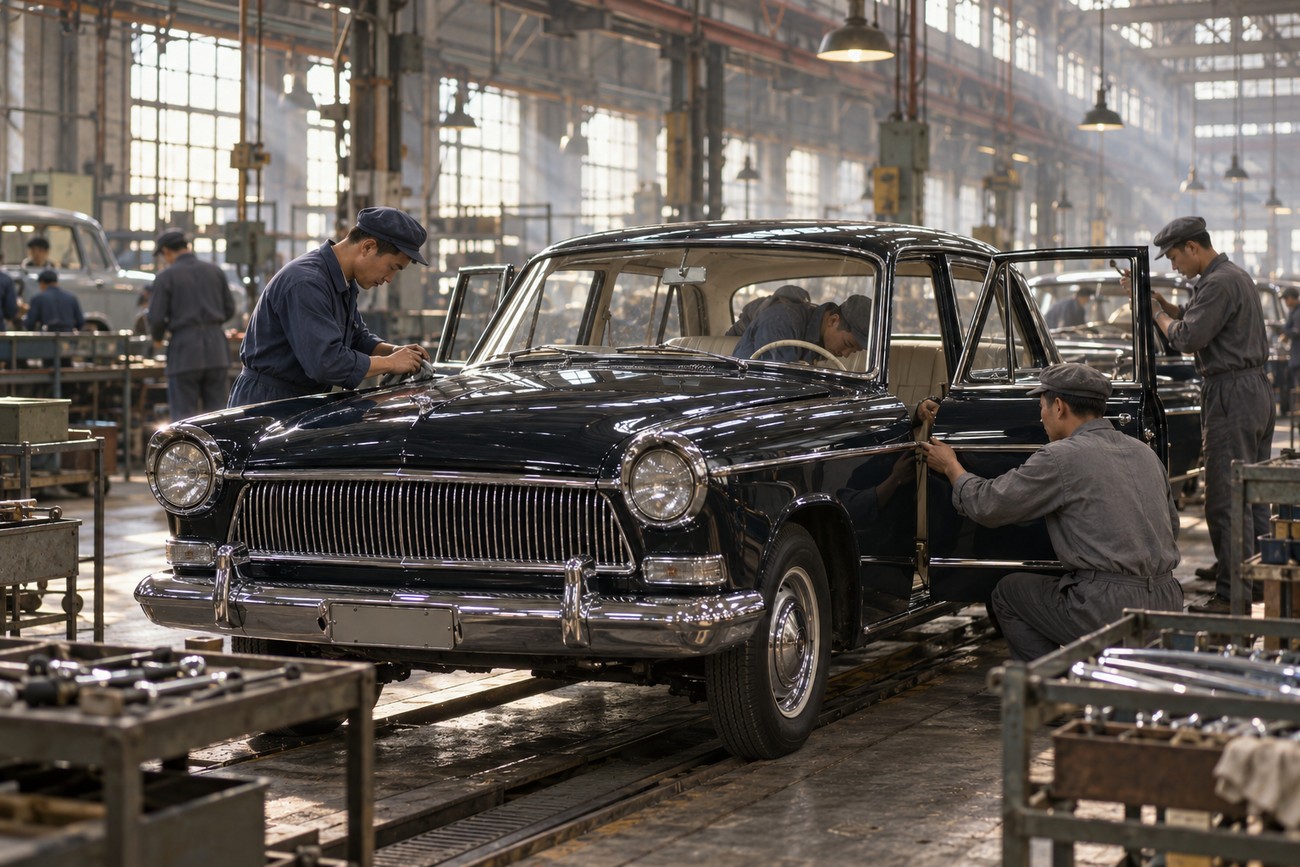
Production of the basic SH760 began in the mid-1960s and is commonly dated to 1964–1974. It emerged at a time when a domestically produced sedan could help meet official and fleet transport needs without relying solely on imported cars. Later Shanghai variants continued through 1991, so that longer span should not be assigned unchanged to the basic model.
The car’s shape shows European influence, including a resemblance to the Mercedes-Benz 220S. That resemblance is a starting point for understanding its design, not evidence that the SH760 was an exact copy. Its body and mechanical package were adapted and produced in China, where production requirements shaped the finished car.
The layout was conventional for a substantial sedan of its period: a front-mounted inline-six gasoline engine, rear-wheel drive, and a four-speed manual gearbox. These broad features describe how the car was built without settling the specification of every Shanghai variant. Individual components still need to be identified against the vehicle at hand.
Visual similarity can be especially costly during restoration. A trim piece or mechanical part that looks familiar may differ in its fittings or dimensions. Treating Mercedes-Benz 220S parts as interchangeable without checking the actual item can turn a search for originality into a chain of avoidable modifications.
Early SH760 and later 682Q-equipped Shanghai: key differences
Published figures describe different versions and should stay attached to them. The later column below uses a museum specification for a 682Q-equipped Shanghai, rather than a universal specification for every car called an SH760.
| Specification | Early SH760 | Later 682Q-equipped Shanghai |
|---|---|---|
| Engine displacement | Approximately 2.23 L | 2.345 L |
| Output | 66 kW (about 90 hp) | 74.6 kW |
| Torque | 147 Nm | 166.6 Nm |
| Stated maximum speed | Approximately 130 km/h | 132 km/h |
| Brakes | Equipment must be verified on the individual car | A later version had vacuum-assisted, dual-circuit brakes |
The figures show why an engine description taken from a later vehicle can misidentify an early one. The brake distinction has a more immediate consequence: documentation of a later upgrade does not establish that every early SH760 had it. Engine markings and the brake hardware on the car are better evidence than a family-wide specification sheet.
Why the SH760 name does not describe one unchanging car
The basic SH760 is commonly dated to 1964–1974, but the story of Shanghai sedans extends beyond it. The SH760A and later variants belong to that longer history. Similar names and familiar body shapes make it tempting to combine them, even though engines and brakes changed over time.
Later Shanghai variants continued through 1991. That date describes the endurance of the broader line; it does not mean a basic SH760 built near the start was mechanically identical to one of its successors. A listing that gives “1964–1991” as a single model specification conceals the distinctions a parts search requires.
Approximately 80,000 is an often-cited estimate for the broader Shanghai sedan family over a long period. It is not a confirmed production count for early SH760s. The distinction matters when assessing claims of rarity: a family-wide total cannot establish how many examples of a particular year or variant were built.
Start identification with the car’s claimed year and variant, then compare its body, chassis, engine, and fitted equipment with whatever records survive. That work may reveal a later assembly or an older car updated during its service life. Either can be worth preserving, provided its description reflects what is actually there.
What period performance means on today’s roads
An early SH760 measured 4,780 mm long and approximately 1,770–1,775 mm wide, with a 2,830 mm wheelbase and a mass of approximately 1,440 kg. Those dimensions give it a substantial presence on the road. They also make its response to steering, acceleration, and braking worth judging on its own terms rather than by the standards of a modern sedan.
Its stated maximum speed was approximately 130 km/h. That is a period specification, not a recommended cruising speed or proof that a surviving example can safely reach it. Tire condition, brakes, suspension, and decades of repairs matter more to a present-day road test than the last number in a catalog entry.
The carbureted engine also needs attention after storage. Old fuel, dried seals, and an out-of-tune carburetor can affect starting and idle quality, while aged hoses can compromise braking. These are sensible checks for old machinery; systematic reports from private SH760 owners are too scarce to present them as measured, model-specific failure rates.
Before using one in modern traffic, assess how consistently it starts, stops, and tracks straight at modest speeds. A later version’s vacuum-assisted, dual-circuit brakes should never be assumed present on an early car. The safest comparison is between the car’s documented equipment and its present condition, rather than between two advertised top speeds.
How to judge a surviving or restored SH760
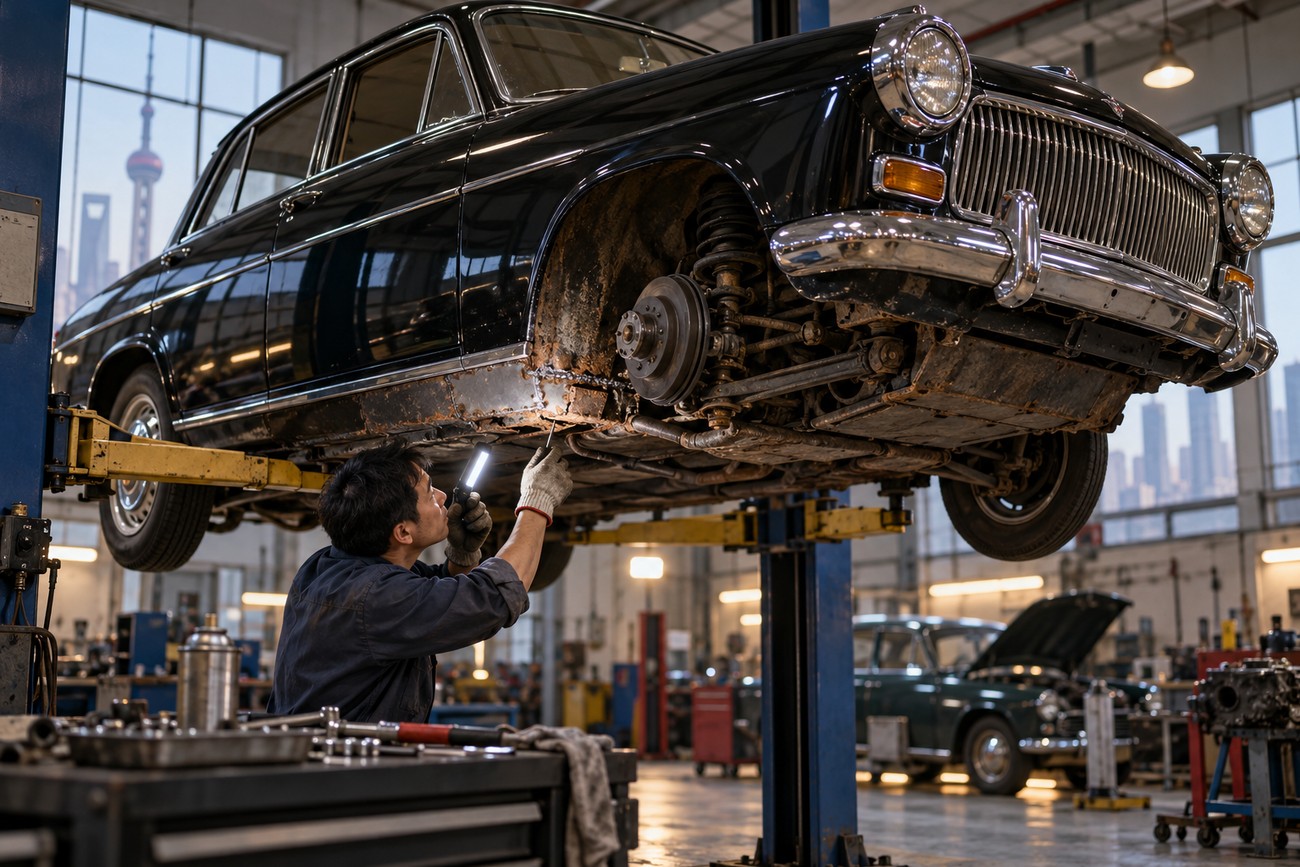
Begin with identity. Check body, chassis, and engine identifiers against the claimed year and variant, and ask for registration, service, and restoration records where available. A convincing account should explain major component changes rather than rely on the words “official car” as proof of provenance.
Next, look beneath the finish. Inspect the underside, structural members, sills, suspension mounting points, and brake lines for corrosion or concealed repairs. Fresh paint may be careful restoration work, but it cannot show what lies under a sealed floor or behind a welded panel.
Assess the braking system as fitted, including hoses and evidence of leaks; do not assume later vacuum assistance or dual-circuit plumbing is present. Trace the wiring rather than accepting a tidy-looking dashboard as proof of sound electrical work. Improvised connections and incompatible replacements can be harder to correct than visible cosmetic defects.
Finally, inventory the engine, carburetor, electrical fittings, interior trim, and seals before planning a rebuild. Original components can be difficult to source, and adapting substitutes requires checks for fit, load, and operation. A museum-quality example can show an excellent finish, but it cannot establish what a road-used survivor is likely to need.
Frequently asked questions
A few details become especially important once an SH760 moves from historical interest to hands-on use. The answers below distinguish the car’s layout from the checks needed for a particular survivor. Storage and operation should always take its actual condition into account.
Where was the SH760’s gear lever?
The SH760’s four-speed manual gearbox used a column-mounted gear lever, beside the steering wheel. Before a first drive, establish the shift pattern on that car and practice selecting gears while stationary; the lever’s position will feel unfamiliar to someone accustomed to a floor shift. Avoid forcing a stiff mechanism until its linkage has been checked.
How should an SH760 be kept during long periods off the road?
Keep it dry and ventilated, and plan for fuel deterioration, battery maintenance, and the condition of seals and brakes before the next drive. Fuel-storage practices depend on the fuel available and how long the car will stand; a specialist can advise on the fitted system. After extended storage, inspect for leaks and sticking brakes before starting or moving it.
Why is Shanghai so different from China?
In this car’s name, Shanghai identifies the city associated with its production and the sedan family, while China is the country in which it was made. They are different kinds of geographic name, not competing origins. For parts or historical research, “Shanghai” alone is still too broad: identify the year and variant of the car.







