
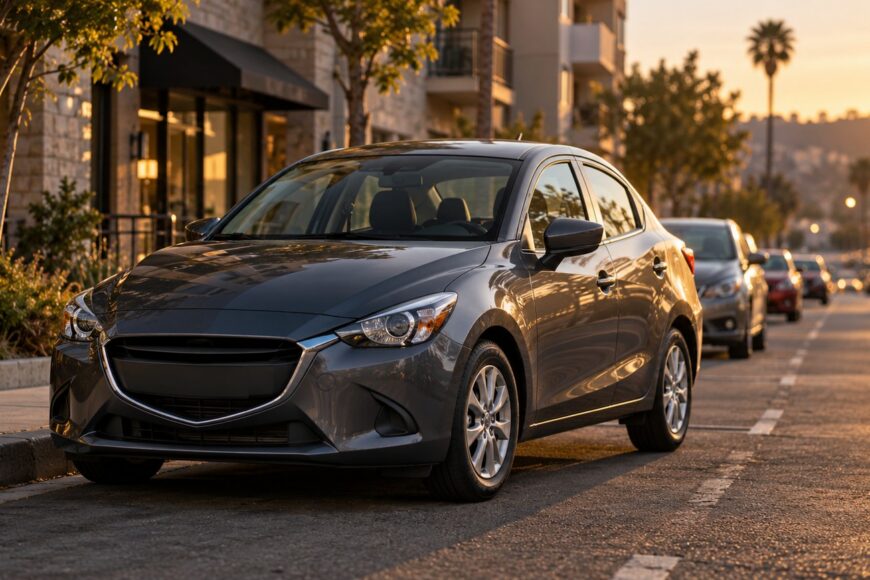
The Scion iA is easy to overlook because its badge suggests a distinct Scion product, while its engineering comes from the Mazda2/Demio. That combination gives you a small, efficient sedan with useful standard equipment and relatively simple day-to-day practicality. It also means the car’s appeal depends more on condition and familiarity with Mazda-based systems than on Scion identity.
For urban commuting, the iA makes a strong practical case. Its compromises become clearer once the road leaves town: rear-seat space is limited, the trunk is modest for family travel, the ride can feel firm, and the 106-hp engine needs patience when the car is heavily loaded. Highway noise and the discontinued Scion brand also matter more to a used-car buyer than the original marketing suggested.
- What the Scion iA Really Is
- Scion iA Specs and Standard Equipment
- How the iA Drives: Economy Before Excitement
- Cabin Space, Comfort, and Everyday Usability
- Used Scion iA Buying Guide: What to Check
- Who Should Buy the Scion iA—and Who Should Not
- Frequently asked questions
- What does the iA’s 12.0:1 compression ratio mean for an owner?
- Why do online Scion iA listings show different fuel-economy and equipment figures?
What the Scion iA Really Is
The Scion iA was a U. S.-market B-segment sedan produced for 2015–2016. It was essentially a Mazda2/Demio sedan sold under a Scion badge, with Mazda-sourced engineering, controls, and powertrain hardware. That relationship is the central fact to understand before shopping for one.
Scion positioned the iA as an accessible, youthful compact with a stronger equipment package than its size might suggest. The underlying car was more rational than expressive, however. It was designed around efficient transportation, low weight, and straightforward urban use rather than a special Scion driving character.
Buyers expecting an independent Scion model can therefore come away disappointed. The iA does not offer the distinctive mechanical identity associated with some larger Scion products, and its cabin and road manners make its Mazda2 connection apparent. That is not automatically a weakness: Mazda-based parts knowledge can be useful on the used market, provided the car is correctly identified.
Scion was later discontinued, which affects badge recognition and resale perception. The iA’s value now comes from its specification, condition, and suitability for a particular driver. A shopper who understands it as a Mazda2-based compact sedan is more likely to judge it fairly than someone searching for a rare or sporty Scion.
Scion iA Specs and Standard Equipment
The figures below use U. S.-market specifications. Online listings sometimes combine Mazda2 and Scion iA data or apply different fuel-economy conventions, so individual advertisements should be checked against the vehicle identification number and original equipment documentation.
| Item | Scion iA specification |
|---|---|
| Engine | 1.5-liter gasoline Skyactiv-G with direct injection |
| Power and torque | 106 hp and 103 lb-ft, approximately 140 N·m |
| Compression ratio | 12.0:1 |
| Transmissions | Six-speed manual or six-speed automatic |
| Curb weight | About 2,385 lb manual; 2,416 lb automatic |
| EPA fuel economy | Manual: 31/41 mpg city/highway; automatic: 33/42 mpg city/highway |
| Length | 4,361 mm |
| Width | 1,694 mm |
| Wheelbase | 2,570 mm |
| Ground clearance | About 140 mm |
| Core equipment | 16-inch wheels, rearview camera, push-button start, keyless entry, cruise control, and a 7-inch Mazda multimedia system with rotary controller |
| Notable safety equipment | Forward-collision warning was a notable feature for the segment; exact availability should be verified for the individual car |
How the iA Drives: Economy Before Excitement
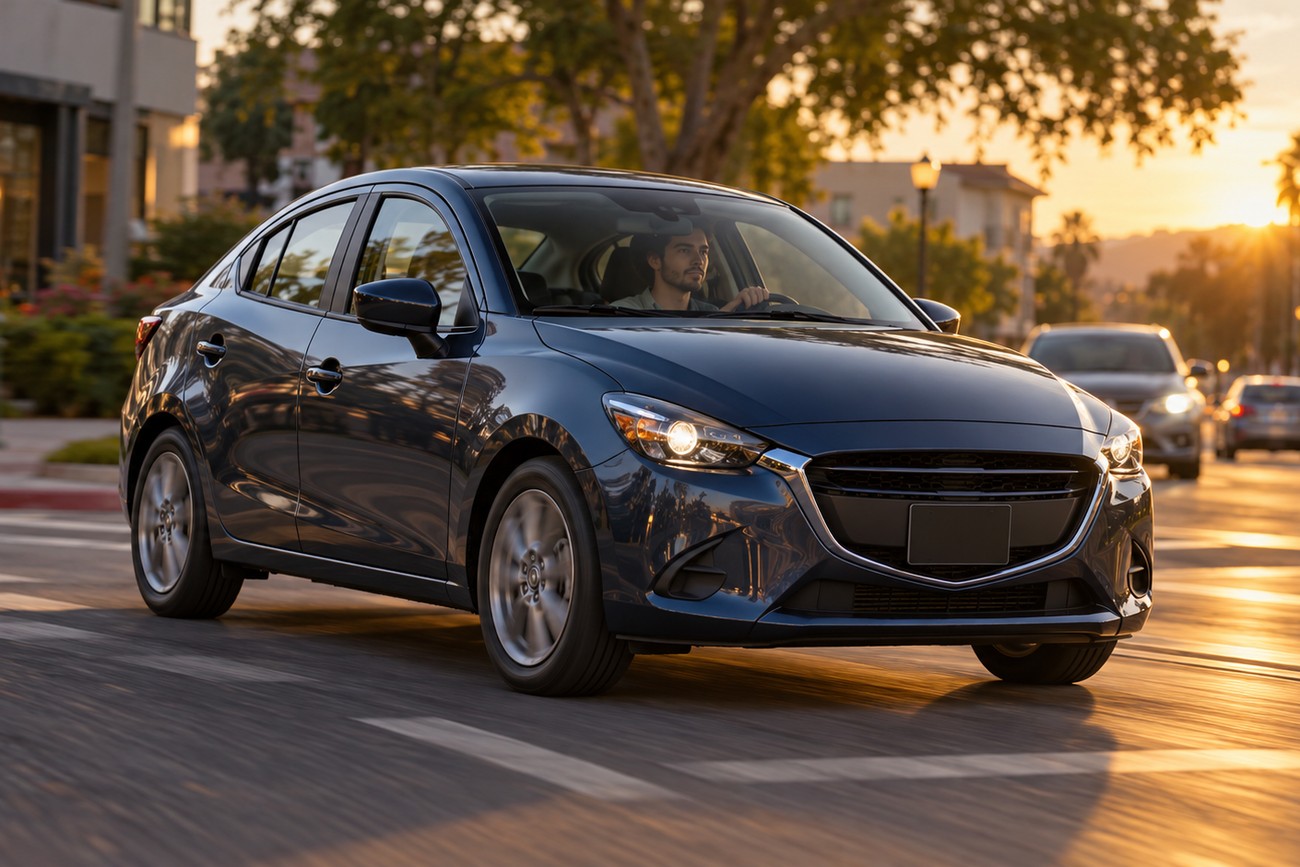
The 1.5-liter Skyactiv-G is a gasoline engine, not a diesel. Its 106 hp and 103 lb-ft are adequate for commuting, parking-lot maneuvering, and ordinary city traffic, especially in a car with a curb weight of about 2,385 to 2,416 lb. The 12.0:1 compression ratio and direct injection reflect an efficiency-focused design rather than a promise of strong acceleration.
In town, the engine’s modest output is easier to live with because speeds are lower and the car feels light. The six-speed manual gives the driver more control over momentum and makes it easier to keep the engine in its useful range. That can suit someone who values involvement and predictable response, although buyers should still check clutch condition and engagement on an older example.
The six-speed automatic is easier in traffic and delivers the better EPA figures in the supplied U. S. specifications. Its response can feel hesitant during abrupt throttle inputs, particularly when a quick merge or pass requires a downshift. A relaxed driving style suits it better than repeated demands for immediate acceleration.
Ride quality follows the same practical brief. The suspension can feel firm over potholes and road joints, while road and aerodynamic noise become noticeable at higher speeds. A short drive on smooth streets can hide both issues, so the car should be driven over imperfect pavement and at highway speed before purchase.
Cabin Space, Comfort, and Everyday Usability
The front cabin is where the iA makes the most convincing case for daily use. The 7-inch Mazda multimedia system and rotary controller are more considered than the basic price positioning might suggest, and the standard equipment includes features many small cars once treated as upgrades. Push-button start, keyless entry, cruise control, a rearview camera, and 16-inch wheels reduce the sense that this is a bare commuter appliance.
Rear-seat space is the main packaging limitation. Adults can use the back seats for shorter trips, but legroom and overall space are limited, especially when taller front occupants set their seats comfortably. Families should check the actual child-seat and passenger arrangement rather than assuming that a four-door body makes the iA a spacious small family sedan.
The trunk is useful for routine shopping and commuter luggage, yet modest for family travel. A couple or solo driver can work around that limitation with sensible packing, while regular trips involving several passengers and bulky bags will expose the car’s small-sedan compromises quickly.
The iA is best suited to urban transport with occasional longer trips. Extended highway use brings more tire, road, and wind noise into the cabin, and the firm suspension becomes more tiring on broken surfaces. It can cover distance, but its strongest ownership case remains compact dimensions and efficient commuting rather than quiet long-distance comfort.
Used Scion iA Buying Guide: What to Check
Condition matters more than the Scion emblem on an older iA. Start with the service history, then compare the vehicle identification number, equipment, and specification details with the listing. Records that show regular maintenance are more useful than claims that a Japanese small car should be trouble-free simply because of its origin.
On an automatic car, check engagement from park and reverse, low-speed shifts, and response during moderate and firm acceleration. Hesitation, harshness, delayed engagement, or inconsistent shift quality deserves further investigation. A smooth idle in a parking space does not prove that the transmission behaves correctly under load.
A short, smooth test drive can miss several of the iA’s important faults. Drive it first on rough pavement, then at highway speed, and finally test acceleration with a realistic passenger or luggage load; that sequence is more likely to reveal suspension impact damage, automatic hesitation, highway noise, and the limits of the engine.
Inspect the suspension for knocks, excessive harshness, damaged components, and evidence of hard impacts. Check the brakes for uneven wear, steering-wheel vibration, and pulsation during a controlled stop. The roughly 140 mm of ground clearance makes contact with damaged roads more consequential, so look underneath for scrapes and poorly repaired damage.
Use the highway portion of the test drive to assess wind and road noise rather than treating it as a minor detail. Noise that seems acceptable for five minutes in town may become tiring during a daily freeway commute. If possible, carry a passenger or equivalent load and observe how much planning is needed for merging and passing.
Finally, confirm that the car’s equipment is genuinely present and working. Because listings can mix Mazda2 and Scion iA information, an advertised feature or fuel-economy figure should not be accepted without checking the actual vehicle. Used-market value depends primarily on maintenance, accident history, mechanical condition, and familiarity with Mazda-based parts and service, with limited independent value coming from the discontinued Scion badge.
Who Should Buy the Scion iA—and Who Should Not

The iA suits a solo commuter, a couple, or an urban driver who wants compact dimensions, strong fuel economy, and useful standard equipment. The manual version can appeal to someone who prefers direct control, while the automatic is easier to operate in congested traffic. In either case, the car’s main benefit is efficient daily transportation with a sedan trunk.
It is a weaker choice for a household that regularly carries adults in the rear or travels with substantial luggage. Limited rear-seat space and modest trunk practicality become daily irritations when every seat is occupied. Buyers who regularly drive on rough roads should also take the firm suspension and low ground clearance seriously.
Drivers who expect strong loaded acceleration, quiet highway behavior, or a polished long-distance ride should look elsewhere. The iA is not a sporty compact sedan, even if its light weight and Mazda connection create some appeal from behind the wheel. Its character is economical and manageable, with performance that rewards realistic expectations.
The most sensible way to view the car is as Mazda architecture wearing a U. S.-market Scion badge. That makes the Mazda2 connection a practical advantage for research and parts familiarity, while the discontinued brand limits standalone identity. Verified U. S. specifications and a careful inspection should carry more weight than conflicting online descriptions.
Frequently asked questions
What does the iA’s 12.0:1 compression ratio mean for an owner?
A 12.0:1 compression ratio means the engine is designed to extract useful efficiency from each combustion cycle. Combined with direct injection and the Skyactiv-G design, it supports the iA’s low-weight, economy-focused character.
The figure does not promise strong acceleration. The engine still produces 106 hp and 103 lb-ft, so performance can feel limited during loaded highway passing. Owners should interpret the specification as an efficiency detail, not as evidence that the iA is a performance model.
Why do online Scion iA listings show different fuel-economy and equipment figures?
Listings often mix Scion iA information with Mazda2 specifications, while other sources use different testing standards or catalog conventions. Some descriptions also repeat equipment from another market or trim without verifying the individual car.
Use the U. S. EPA figures as the reference point: 31/41 mpg city/highway for the manual and 33/42 mpg for the automatic. Confirm equipment through the vehicle itself, its identification number, and original documentation rather than relying on a generic listing.







