
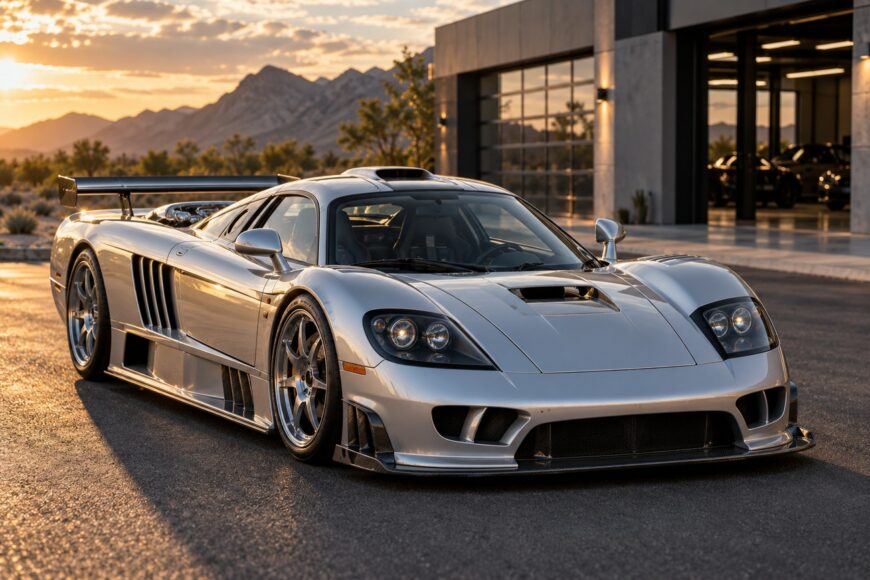
The Saleen S7 combines headline numbers with the practical risks of owning a rare, track-oriented American supercar. Its mid-engine layout, carbon-fiber bodywork, and dramatic performance figures suggest a machine built for serious speed. Its limited production, scarce parts, difficult access, and demanding heat management create a very different ownership proposition from a mass-produced American sports car.
The central decision is therefore larger than choosing between 550 hp and a twin-turbo figure. You must identify the exact version, establish its provenance, inspect the chassis and composite bodywork, and confirm that competent technical support is available. A low odometer reading or an impressive specification sheet cannot compensate for poor history, structural damage, or unavailable replacement parts.
- Why the Saleen S7 Still Matters
- The Engineering Behind the S7
- Saleen S7 vs. S7 Twin Turbo: What Actually Changes
- What the S7 Feels Like on the Road
- How to Inspect a Saleen S7 Before Buying
- Ownership Costs: Parts, Service, Storage, and Risk
- S7 Myths That Distort the Buying Decision
- Frequently asked questions
- How much is a Saleen S7 worth today?
- How many Saleen S7s exist?
- What makes an S7 more valuable than another car with the same mileage?
Why the Saleen S7 Still Matters
The Saleen S7 was a mid-engine, rear-wheel-drive supercar built in the United States from 2000 to 2009. That layout placed it in a different category from the front-engine muscle cars and conventional American sports cars that shaped the country’s performance identity. The S7 pursued the priorities of an international supercar: low mass, aerodynamic stability, high power, and a driving position suited to serious speed.
Its limited-volume, hand-built character is central to its appeal. The car was never designed for broad production or a large service network, so each surviving example carries more historical and mechanical significance than a typical performance model from the same period. It is now better understood as a collector car with racing influence than as an exotic version of a familiar American coupe.
Early Saleen and press material described the S7 as the first fully American production supercar after a long gap. That description remains definition-dependent. The answer changes according to which cars qualify as fully American, how production is defined, and whether limited-volume vehicles are included, so the phrase should be treated as historical positioning rather than an uncontested fact.
The S7 still matters because it represented an unusually ambitious American interpretation of the supercar formula. Its importance comes from the complete package: an unconventional layout, lightweight construction, race-influenced aerodynamics, and hand-built rarity. The car’s legacy rests less on one absolute speed claim than on the fact that Saleen attempted this program at all.
The Engineering Behind the S7
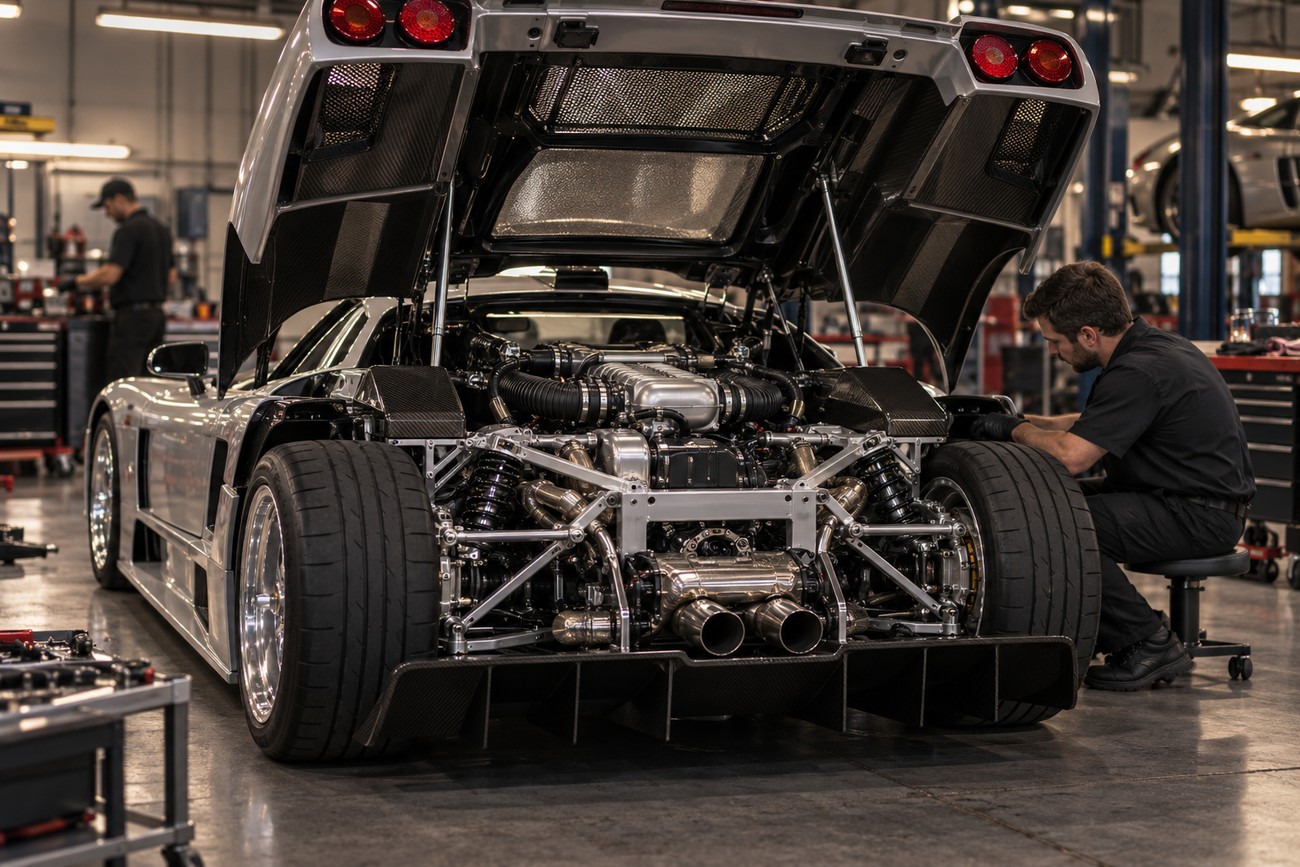
The S7 uses a mid-engine, rear-wheel-drive layout, placing the powertrain close to the center of the car and sending drive to the rear wheels. That arrangement supports a balanced handling character and gives the front axle less work to do under acceleration. It also contributes to the S7’s distinctive cabin position, visibility limitations, and packaging compromises.
Construction makes extensive use of an aluminum chassis and carbon-fiber bodywork. The combination helps keep mass under control while allowing the body to take a shape driven by airflow rather than conventional sedan-derived proportions. Reported weight figures vary by version and equipment, commonly falling around 1,250–1,360 kg.
The exterior design reflects race-influenced aerodynamic thinking. Large openings, long body sections, and prominent aerodynamic surfaces support cooling and high-speed stability, while also increasing the cost and complexity of even minor damage. These features are functional parts of the car’s identity, rather than decorative additions that can be replaced casually with generic components.
The same engineering priorities that make the S7 compelling reduce its everyday flexibility. Low mass, aerodynamic focus, and a compact supercar package take precedence over quietness, easy access, generous visibility, and relaxed ride quality. For a buyer, that means the S7 should be assessed as a road-legal performance machine with track-oriented compromises.
Saleen S7 vs. S7 Twin Turbo: What Actually Changes
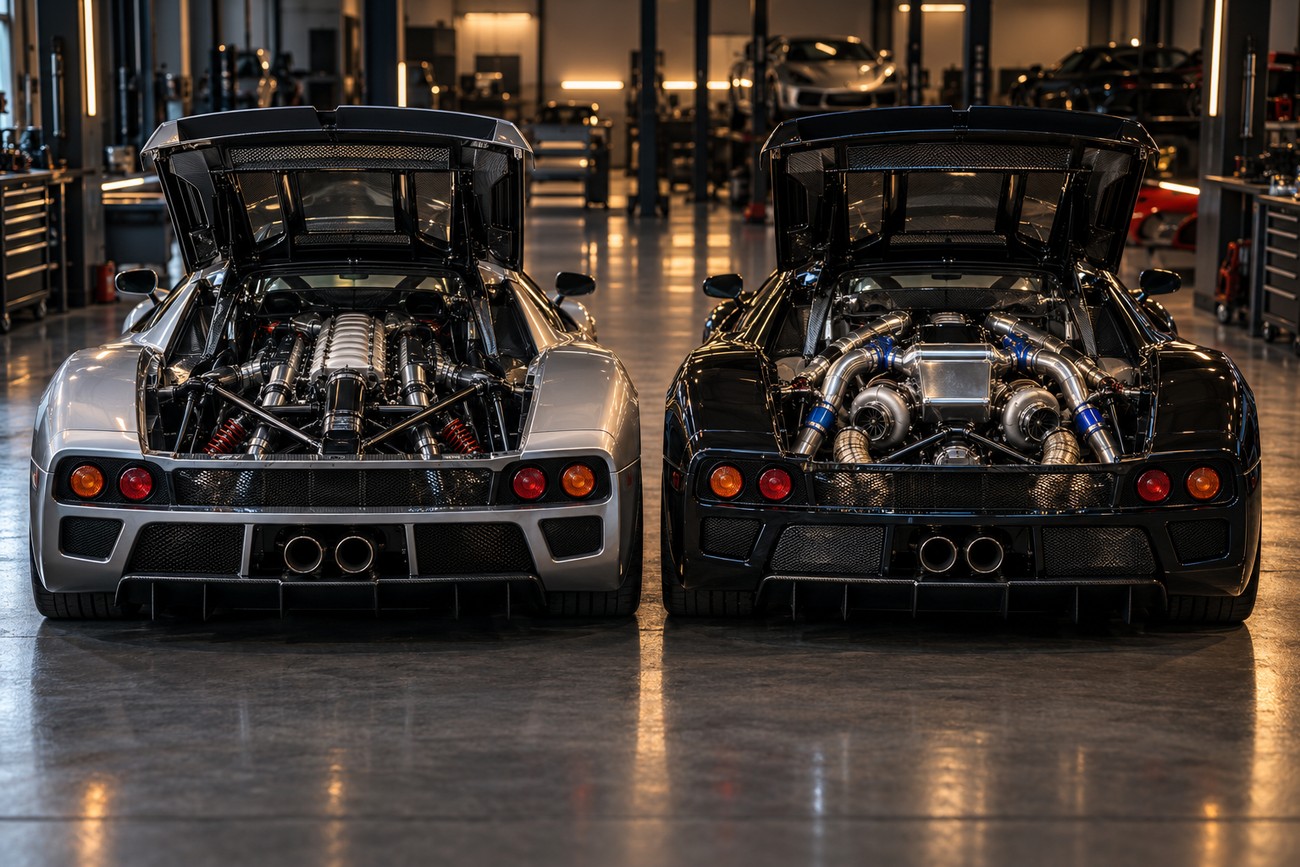
The naturally aspirated S7 and the S7 Twin Turbo share the same basic concept, yet their performance and ownership implications are materially different.
| Specification | Saleen S7 | Saleen S7 Twin Turbo | Buyer implication |
|---|---|---|---|
| Engine character | 7.0-liter Ford-based small-block V8, naturally aspirated | Turbocharged development of the S7’s high-output V8 concept | The naturally aspirated car offers more direct power delivery; the Twin Turbo introduces substantially greater thermal and drivetrain demands. |
| Stated power | About 550 hp | About 750 hp in early specifications; up to about 1,000 hp in later or competition specifications | Confirm the exact factory or competition specification rather than relying on the “Twin Turbo” name alone. |
| 0–60 mph claims | About 3.2–3.8 seconds, depending on version, tires, and test method | About 3.2–3.8 seconds in commonly cited claims, with results varying by specification, tires, and test method | Published acceleration figures are useful for context, but they do not establish the condition of a particular car. |
| Top-speed claim | About 200 mph | 220-plus mph claimed; independent confirmation varies by source | Consider these figures conditional claims shaped by gearing, tires, test conditions, and measurement standards. |
| Practical meaning | Still a lightweight, highly specialized supercar with significant road compromises | More demanding in cooling, inspection, service, and drivetrain support | Version identification is essential before estimating value, risk, or running costs. |
Specifications vary by year, tires, testing method, and whether a road or competition specification is being described. The early Twin Turbo figure is commonly given as about 750 hp, while later or competition specifications are reported at up to about 1,000 hp. That range should never be applied indiscriminately to every S7 carrying a Twin Turbo badge.
Acceleration and top-speed figures also require careful reading. Claims of about 3.2–3.8 seconds from 0–60 mph and approximately 200 mph for the naturally aspirated car provide useful period context. The Twin Turbo’s 220-plus mph claim is more conditional, and independent confirmation varies by source.
What the S7 Feels Like on the Road
The S7’s road manners reflect its engineering brief. The suspension is reported by owners to be very firm, while cabin noise can be substantial. Limited visibility, a low seating position, and a wide, unusually shaped body add effort to ordinary maneuvers, especially in traffic or confined parking areas.
Weight figures around 1,250–1,360 kg help explain the car’s responsiveness, yet low mass does not make it comfortable. The car’s balance and aerodynamic focus are most relevant when the road allows sustained speed and precise inputs. On rough urban surfaces, the same qualities can produce tiring ride motions and constant awareness of the road surface.
Low ground clearance and long body sections create an expensive exposure to ramps, broken pavement, and careless parking. A small incident can affect carbon-fiber bodywork, aerodynamic components, cooling ducts, or other parts that are difficult to source. The visual drama of the S7 therefore comes with a practical requirement for careful route selection and secure storage.
Heat management deserves attention in dense traffic. Owner reports describe situations in which heat load and cooling behavior become more concerning than expected from a road-going car, particularly when airflow is limited. These reports are practical warnings rather than proof of a universal defect, but a buyer should inspect cooling performance and thermal evidence instead of assuming that a rare car has inherently trouble-free systems.
How to Inspect a Saleen S7 Before Buying
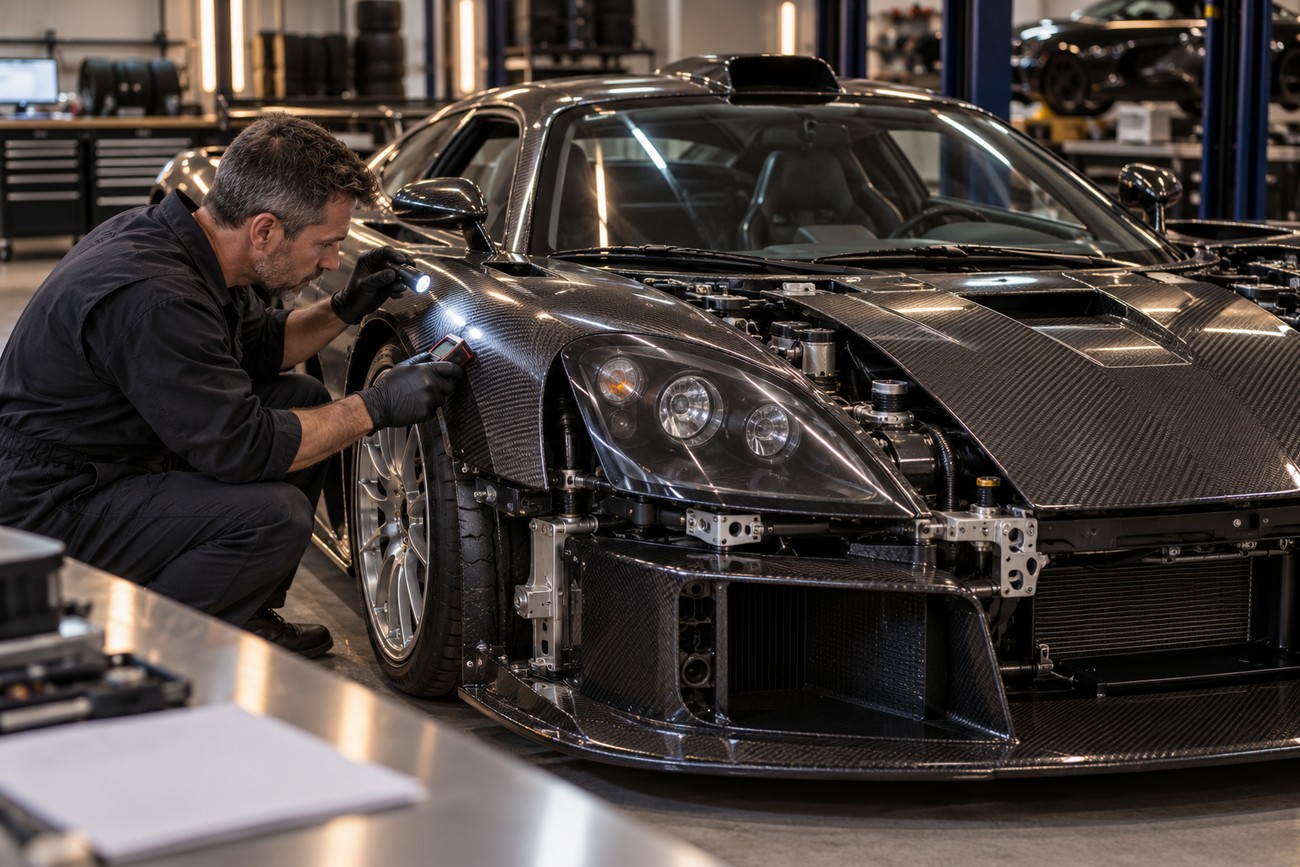
Begin with identity and provenance. Verify the VIN, identification panels, documented history, and exact specification, including whether the car is naturally aspirated, an early Twin Turbo, or associated with a later or competition configuration. The name “S7” covers meaningful differences, so photographs and seller descriptions are insufficient evidence on their own.
Examine the carbon-fiber bodywork and aerodynamic components for originality, repair marks, mismatched finishes, and non-factory mounting solutions. A replacement panel may be structurally sound yet still affect collector value if its shape, weave, fit, or specification differs from the original. Check the underside as carefully as the visible surfaces because low clearance can leave evidence of repeated contact.
Chassis geometry, heat-related evidence, and original composite panels often reveal more about an S7’s real condition than a low odometer reading. A lightly driven car with poor repairs can require more work than a higher-mileage example with documented maintenance and correct structure.
An independent inspection should include chassis geometry, suspension mounting points, steering and brake components, thermal-load areas, cooling systems, and signs of major structural repair. Track use is not automatically disqualifying, although repeated circuit operation can expose the car to stresses that ordinary road mileage does not record. Look for evidence of overheating, competition preparation, crash repair, and improvised modifications.
Electrical work deserves its own review. Non-factory wiring, control units, gauges, cooling fans, or alarm systems can complicate diagnosis and create failures that a general repair shop cannot easily resolve. The inspection should document what is original, what has been replaced, and whether each modification has proper engineering support.
Buyers often focus on power figures or rarity because those features are easy to advertise. The more useful decision comes from comparing provenance, geometry, bodywork, thermal condition, and service documentation. Authentic, minimally modified examples may be more desirable to collectors than heavily upgraded cars, even when the modified car produces more power.
Ownership Costs: Parts, Service, Storage, and Risk
Owning an S7 is not comparable to owning a Corvette or another widely supported American sports car. Rare body panels, glass, lighting components, and other specialized parts may require long waits or sourcing through specialist owner communities. A repair can therefore involve transport, research, and extended downtime before the actual labor begins.
Many general repair shops lack the experience, equipment, or documentation required for this car. Specialist labor may be available only in selected locations, which adds shipping and scheduling costs. Even routine work can become inconvenient if the vehicle has to travel a substantial distance to reach someone familiar with its chassis, electronics, cooling system, or composite construction.
Predictable running costs are only one part of the ownership calculation. The larger risks involve scarce consumables, composite panels, glass, lighting, insurance, secure storage, and damage caused by a minor road incident. A buyer should maintain a reserve for rare-event repairs and periods when the car is unavailable, without assuming that every expense can be forecast from normal service intervals.
Rarity does not make the S7 simpler or automatically more reliable to maintain. It reduces the number of interchangeable parts, experienced technicians, and documented repair solutions. A strong support network and a secure place to store the car are practical prerequisites rather than optional luxuries.
S7 Myths That Distort the Buying Decision
The label “fastest American supercar of the 2000s” is too broad to function as a settled fact. The answer depends on the comparison set, model year, version, test method, and whether road or competition specifications are included. The S7 was exceptionally fast, but one headline ranking cannot replace a precise comparison.
All S7s do not have the same power. The naturally aspirated car is generally described with a 7.0-liter Ford-based small-block V8 producing about 550 hp. Early S7 Twin Turbo specifications are commonly given at about 750 hp, while later or competition specifications are reported at up to about 1,000 hp.
Top-speed claims also require qualification. The naturally aspirated car is commonly associated with about 200 mph, while the Twin Turbo is credited with a claimed 220-plus mph. Conditions, gearing, tires, surface, and test methodology affect the result, and repeatable independent confirmation is not equally available for every published figure.
Finally, rarity should not be confused with mechanical simplicity. A limited-production car may be valuable and historically important while still having scarce parts, limited specialist support, and a narrow tolerance for neglected maintenance. The sensible purchase is the example with the clearest history and strongest technical support, rather than the one with the most dramatic advertisement.
Frequently asked questions
Values, production totals, and collector appeal all depend on the exact specification and the quality of the available documentation. The following answers focus on the factors that make one S7 meaningfully different from another.
Road cars, Twin Turbo examples, competition-related specifications, and surviving vehicles may be counted or compared differently. Buyers should therefore treat broad market claims as starting points and verify the details of each example.
How much is a Saleen S7 worth today?
There is no reliable universal price for every Saleen S7. Value depends first on whether the car is naturally aspirated or Twin Turbo, then on authenticity, documented provenance, condition, modifications, service records, and the quality of recent comparable sales.
A market comparison should separate road cars from unusual later or competition specifications and should account for originality. Recent transactions involving genuinely comparable cars are more useful than an asking price, especially when the advertised example has incomplete history or undocumented upgrades.
How many Saleen S7s exist?
Production totals should be reported cautiously because published counts may use different definitions. Road cars, Twin Turbo cars, competition-related examples, and documented surviving vehicles are not necessarily counted in the same way.
A credible count should identify its source and counting method. Without that information, a precise total can create false certainty, particularly when production records, specifications, and surviving-car registries do not align.
What makes an S7 more valuable than another car with the same mileage?
Documented provenance, original bodywork, correct factory specification, complete service records, and a credible ownership history can matter more than odometer mileage. These factors show how the car was used, maintained, repaired, and modified.
A higher-mileage S7 with sound geometry, authentic composite panels, and consistent records may be a stronger collector purchase than a low-mileage car with track damage, incomplete documentation, or extensive undocumented upgrades. Mileage is evidence, but it is not a complete condition report.







