
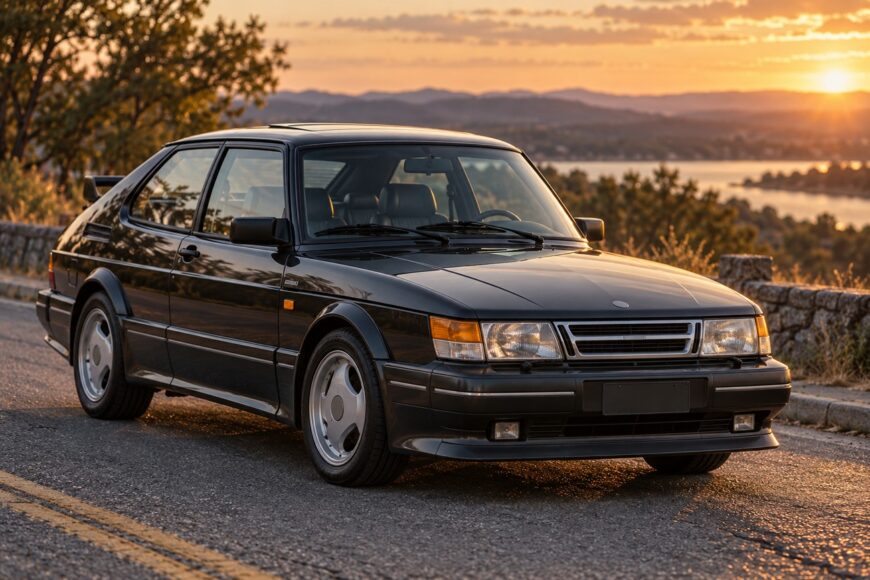
The Saab 900 SPG was a practical three-door hatchback that became one of Saab’s clearest performance statements. It carried luggage, offered unusual winter-weather confidence, and retained the brand’s eccentric engineering logic, yet its Aero bodywork and turbocharged drivetrain gave it a presence far beyond an ordinary family car. That combination helped define Saab in the 1980s.
The same qualities make an SPG a demanding classic today. A clean-looking car can conceal corrosion in the sills, shock-tower areas, or rear chassis rails, while a bright boost gauge may distract a buyer from failing APC components or a tired turbocharger. The SPG rewards careful ownership, but it punishes anyone who confuses rarity, cosmetic appeal, and mechanical health.
- What the Saab 900 SPG Actually Was
- The Aero Package: More Than a Body Kit
- Turbo Performance and the SPG Driving Experience
- Buying a Saab 900 SPG: The Body Comes First
- Ownership Reality: APC, Turbo Hardware, and Electrical Gremlins
- Why the SPG Still Defines Saab
- Frequently asked questions
- What does Saab SPG stand for?
- What is the rarest Saab model?
- What is the top speed of the Saab 900 SPG?
- How can you tell a genuine Saab 900 SPG from a replica?
What the Saab 900 SPG Actually Was
SPG stands for Special Performance Group, and the name was used primarily for the United States market. Saab sold the 900 SPG there for the 1984–1991 model years, generally as a three-door hatchback with a turbocharged 16-valve engine, distinctive Aero bodywork, and a firmer, lower chassis specification. It occupied a special place above the regular 900 Turbo because the package addressed appearance, stability, and performance together.
European buyers encountered closely related cars under different names. The 900 Turbo Aero and the 900 Turbo 16S/16-valve Turbo represented the same broad idea, although equipment, engines, wheels, emissions hardware, and naming conventions varied by market. Comparable Aero or SPG-spec sedans also existed in some markets, so a three-door body is characteristic of the model rather than an absolute definition of every related car.
An authentic SPG is therefore more than a standard 900 with an Aero kit attached. Its identity lies in the relationship between the B202 16-valve turbo engine, boost calibration, suspension, wheels, brakes, alignment, and bodywork. Market differences make a rigid checklist unreliable, but a car that has only the visible plastic parts should be treated as a possible replica until its mechanical specification and history are established.
No publicly available factory document confirms the total SPG production run. Club and registry estimates commonly place it at approximately 8,000–10,000 cars, though that figure should remain an estimate rather than an audited factory total. The uncertainty adds interest for collectors, yet it also creates room for inflated claims in advertisements, especially when a regular Turbo has acquired period-correct trim.
The Aero Package: More Than a Body Kit
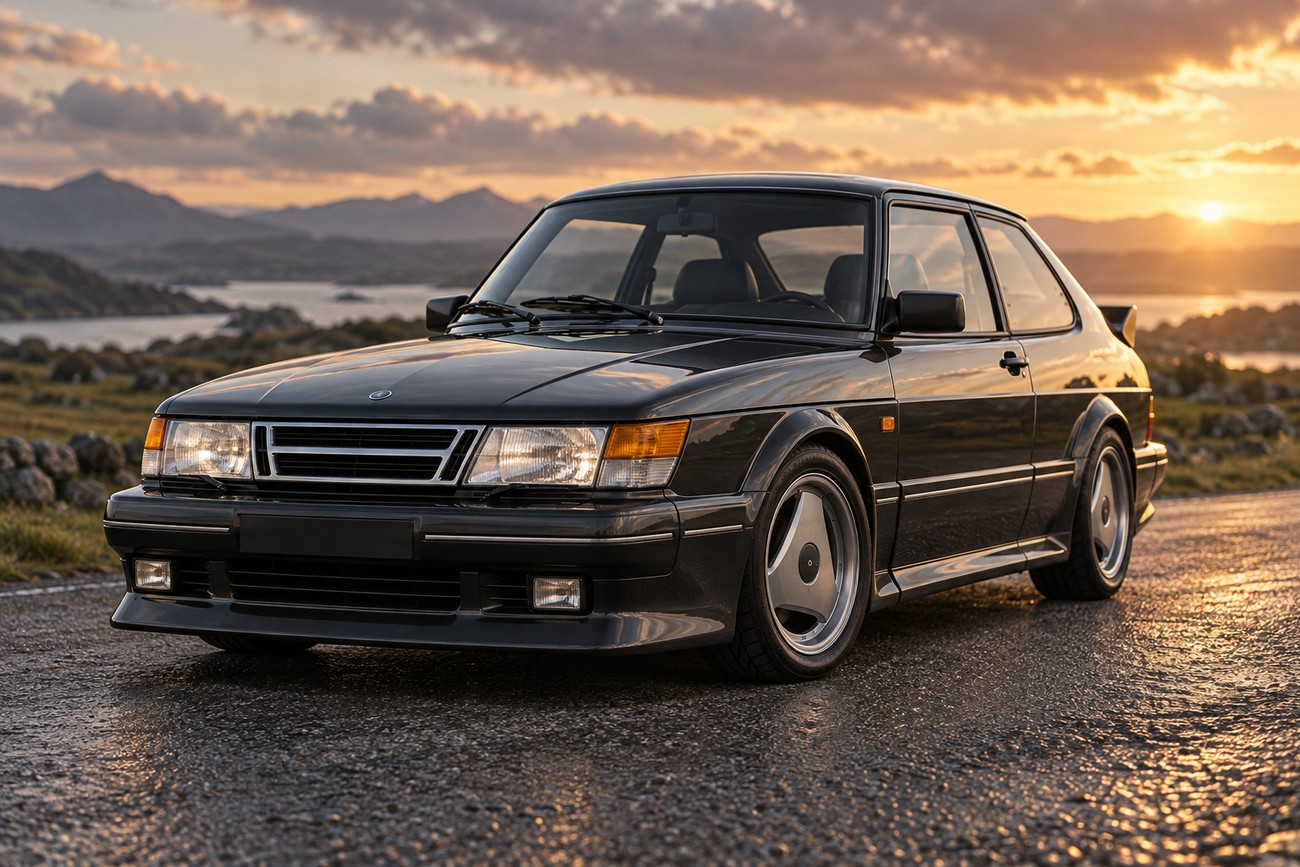
The SPG’s visual package included extended wheel arches, a front spoiler, side skirts, and a rear spoiler. These parts gave the tall 900 hatchback a lower, wider stance, but their purpose extended beyond styling. Saab designed the Aero bodywork to reduce lift and improve high-speed stability, a meaningful benefit for a car intended to cover long distances quickly on open roads.
The bodywork worked with a chassis that used lower springs, firmer dampers, revised alignment, and a different wheel and track specification. Factory wheels were 15-inch items, commonly Aero or Turbo designs, with market-specific variations. The result was a more settled car at speed, although the lower ride height also reduced clearance and made damaged or poorly repaired body panels easier to spot.
That package is why a replica can look convincing in a driveway and still drive like an ordinary 900 Turbo. A clone may have the arches, skirts, spoilers, and badges without the corresponding suspension, engine, or brake specification. Conversely, a genuine car that has been lowered further on cheap springs may have lost the balance Saab engineered into it.
Restoration should preserve the original ride height and wheel specification wherever possible. Indiscriminate lowering changes suspension travel, alignment behavior, and the way the car reacts to rough pavement. The factory Aero wheels also help establish period identity, and replacing them with oversize modern designs can make inspection more difficult while weakening the car’s original character.
Turbo Performance and the SPG Driving Experience
The SPG used Saab’s B202 16-valve turbo engine. Most non-catalyst examples produced approximately 160–175 hp and approximately 250–273 N·m of torque. Factory boost was roughly 0.75–0.9 bar, compared with about 0.6–0.7 bar for a regular 900 Turbo. Later catalyst-equipped versions could be slightly less powerful, so output should always be considered alongside market, emissions equipment, and engine condition.
Those figures give the SPG a forceful mid-range, although the sensation is more distinctive than dramatically quicker than every healthy standard Turbo. Turbo lag is noticeable, followed by a sharp transition into boost that can make the car feel urgent on a clear road and awkward in slow traffic. Throttle control matters on wet pavement, where an abrupt surge can overwhelm old tires or expose worn suspension bushings.
Saab’s period material claimed significantly improved handling, and the Aero bodywork did contribute to high-speed stability. Club experience adds an important qualification: the firm setup can allow more roll and nervousness on uneven roads than a casual glance at the lowered stance suggests. A smooth highway can make the SPG feel composed, while broken pavement may reveal tired dampers, worn bushes, or an alignment that is only approximately correct.
Power delivery also depends heavily on APC operation, ignition health, engine condition, and vehicle weight. A well-maintained standard 900 Turbo can feel close enough in ordinary use that the SPG’s value rests on the integrated package rather than a huge acceleration advantage. Fuel consumption reflects the same reality. Active, boost-heavy urban driving commonly reaches approximately 12–14 L/100 km or higher.
The best examples are quick in a usable, old-fashioned way. They build speed with a hard-edged mechanical character, communicate load through the steering, and retain the practical hatchback layout that made Saab unusual. They also transmit more noise and vibration than a regular 900 once springs, dampers, mounts, and rubber components have aged, so a long trip can become tiring in a car that feels entertaining for a short drive.
Buying a Saab 900 SPG: The Body Comes First
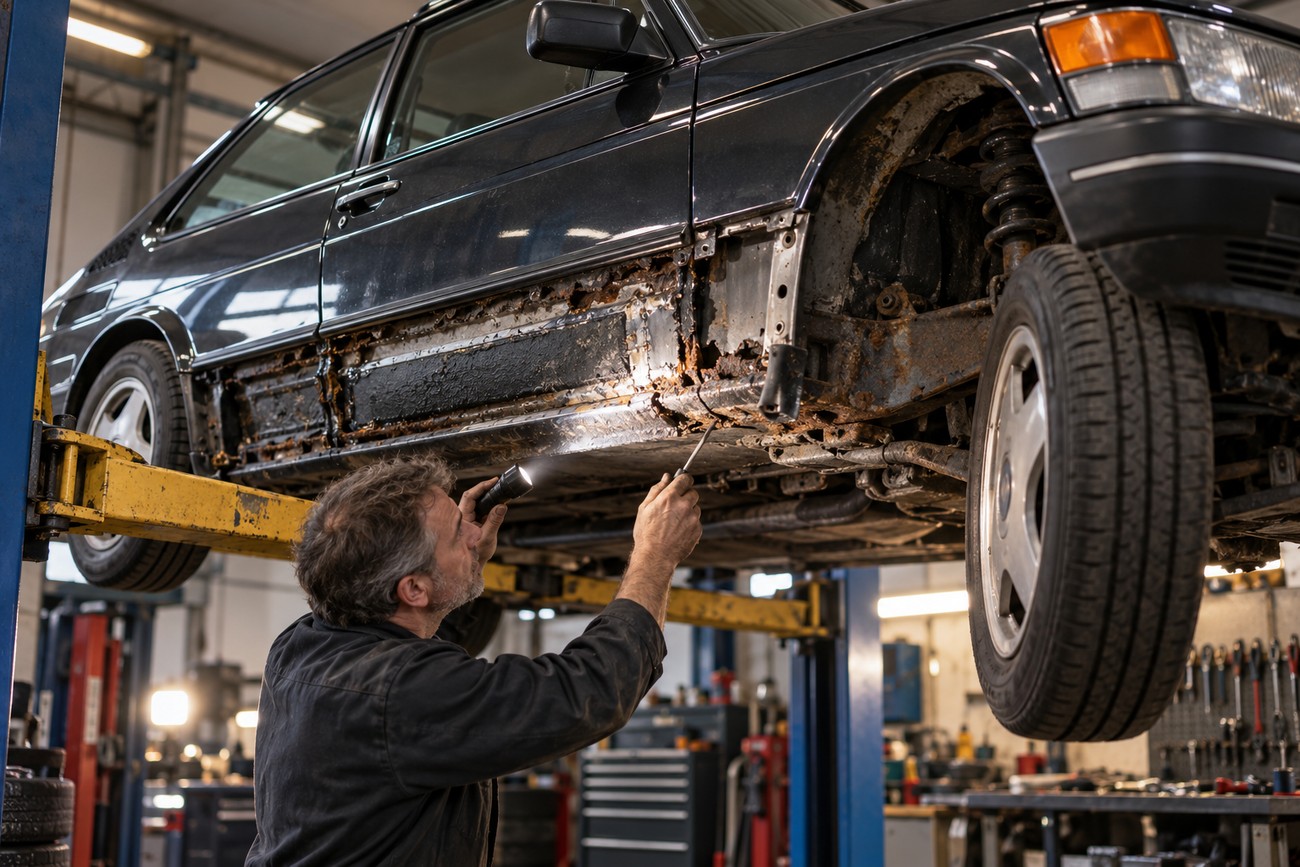
Inspect the structure before judging paint, seats, or the completeness of the Aero trim. Corrosion commonly affects the sills, shock-tower areas, and rear chassis rails, and an attractive exterior can conceal repairs that are unsuitable for continued use. A lift inspection, probing of suspect areas, and close examination of previous welding are worth more than a polished engine bay or a convincing advertisement.
The sills deserve special attention because the body kit can hide both corrosion and poor repairs. Aero components are attached around areas that may already be weakened, and their mounting points can fail when connected to rusty metal. Repair then involves welding, corrosion treatment, and hand-fitting of plastic panels, rather than a simple replacement of a clip or screw.
SPG plastic bodywork is vulnerable to minor impacts, curb strikes, and careless lifting. Cracked or missing pieces are increasingly difficult and expensive to replace, particularly when the car also needs correct brackets, end sections, or mounting hardware. A complete-looking kit may contain repairs beneath fresh paint, while an apparently incomplete car may have valuable original parts that can be restored.
Documentation and underside evidence should establish what the car was before restoration. Badges and a visual Aero kit do not prove factory SPG engine or chassis specification. Compare the identification and service history with the engine, boost-control equipment, suspension parts, wheels, and brake configuration, allowing for market-specific differences rather than rejecting a car solely because one detail differs.
Originality can be surprisingly difficult to recover. Colors, seat fabrics, emblems, steering wheels, and wheel specifications varied by market, while specific interior panels and trim are scarce. Early cars and uncommon colors such as Edwardian Grey and Talladega Red are valued by enthusiasts, but rarity should never outrank sound metal. A structurally weak car with rare upholstery remains a costly body project.
Ownership Reality: APC, Turbo Hardware, and Electrical Gremlins
The APC system is central to safe turbo operation. It uses a boost-control solenoid, a pressure sensor, and related wiring to control boost and respond to detonation. When the system behaves incorrectly, the symptom may be low or unstable boost, sudden power loss, or inconsistent performance rather than an obvious warning that identifies the failed component.
Grounds, contacts, connectors, and wiring deserve inspection before an owner replaces expensive turbo hardware or reaches for a higher-boost modification. Poor electrical connections can imitate a mechanical turbo fault and can also upset ignition and APC behavior. A car that improves after careful electrical cleaning may have avoided an unnecessary turbocharger replacement, while a car that has been tuned around a wiring fault can suffer greater damage later.
Neglected APC operation and detonation can contribute to piston damage or block cracking, especially when an owner celebrates uncontrolled boost as evidence of a healthy engine. Fuel quality and octane should be considered when checking APC and ignition operation. A questionable fuel supply, incorrect calibration, and an engine already showing poor compression form a risky combination, regardless of how strongly the car accelerates on a short test drive.
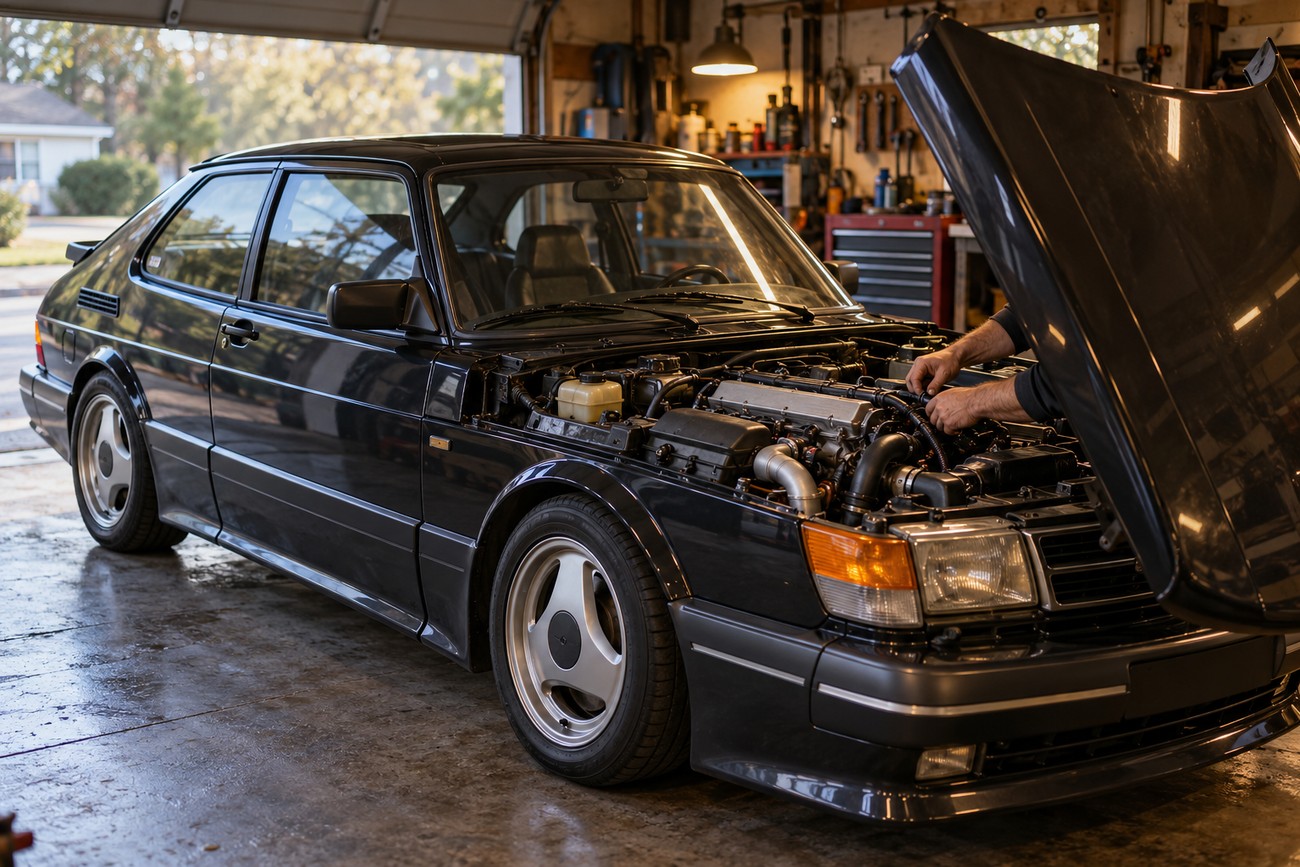
The engine bay is densely packed around the turbocharger, intake plumbing, wiring, and accessories. Routine work can take longer than its simple four-cylinder layout suggests, and access becomes more frustrating when fasteners, hoses, and connectors have survived decades of heat. Inspect turbo shaft play, oiling evidence, smoke, boost behavior, cooling performance, ignition components, and service records before treating a strong test drive as proof of health.
Age also brings the familiar Saab lottery of intermittent faults involving contacts, relays, sensors, lights, and the heater. Original interior parts, panels, seats, and specific trim are scarce and can command high prices. A specialist who understands the 900 and its APC system is valuable because generic turbo tuning can miss the way Saab’s control strategy, wiring, and chassis specification interact.
Why the SPG Still Defines Saab
The SPG remains important because it expressed Saab’s identity through engineering choices rather than a simple cosmetic performance badge. It combined a practical hatchback, a turbocharged 16-valve engine, purposeful aerodynamic work, and a chassis tuned for fast road use. European 900 Turbo Aero and 900 Turbo 16S versions also show that the concept was not exclusively American; the name and exact specification changed with the market.
Its performance reputation needs similar precision. The difference from a healthy standard 900 Turbo is moderate and depends heavily on APC setup, engine condition, gearing, and vehicle weight. The Aero kit had a functional effect on lift and stability, even though its absolute benefit on a race circuit would be limited. Its greatest value appears during high-speed road driving, where stability, confidence, and the unusual shape matter together.
Calling the SPG virtually indestructible is poor buying advice. Rust, neglected boost control, detonation, tired suspension, and electrical faults can demand major investment, while a damaged body kit can turn a small accident into a restoration problem. The car is durable when maintained with the correct knowledge, fuel, and parts; it does not forgive years of deferred work simply because the engine still makes boost.
Preservation starts with sound structure, correct systems, and an honest specification. Original wheels and factory ride height generally serve the SPG’s intended handling better than indiscriminate lowering, and a carefully sorted APC system matters more than an aggressive chip. For a buyer, the right car is the one with healthy metal and coherent engineering, even if its paint is less spectacular than that of a polished clone.
Frequently asked questions
The SPG name is familiar, yet several details remain blurred by market differences, modified cars, and enthusiastic advertising. These answers separate documented terminology from estimates and claims that depend on a particular vehicle.
What does Saab SPG stand for?
SPG stands for Special Performance Group. It describes Saab’s performance-oriented group designation for a particular 900 package rather than a separate engine family.
The package combined the B202 16-valve turbo engine with Aero bodywork, specific suspension and wheel equipment, and market-dependent details. A car carrying SPG badges therefore still requires mechanical and structural verification; the acronym alone does not establish authenticity.
What is the rarest Saab model?
There is no universally correct answer because rarity can mean original factory production, surviving cars, a particular market specification, or an unusual body and color combination. Some limited-production Saab derivatives may have had fewer examples built, while other models are rarer today because poor survival rates removed them from circulation.
The SPG should not automatically be marketed as Saab’s rarest model. Club and registry estimates place total SPG production at approximately 8,000–10,000 cars, but no confirmed publicly available factory total establishes that figure. Early cars and uncommon colors can be especially desirable without making every example the rarest Saab.
What is the top speed of the Saab 900 SPG?
There is no single definitive top-speed figure that applies to every Saab 900 SPG. Published claims vary with market, catalyst specification, gearing, tire and wheel configuration, vehicle condition, and the source’s testing method.
Top speed is therefore a poor authenticity test. A car with correct boost control, sound compression, healthy cooling, proper alignment, and an undamaged drivetrain is more significant than an advertised number. Modified or poorly maintained cars can produce misleading results in either direction.
How can you tell a genuine Saab 900 SPG from a replica?
Start with documentation and identification, then compare the engine and APC specification with the suspension, wheels, brakes, body details, and underside. Look for coherent evidence rather than one decisive badge: the car should make sense as a complete market-specific package.
Inspect the sills, shock-tower areas, rear chassis rails, and body-kit mounting points before valuing rare trim. A genuine car can have replacement parts or non-original repairs, while a replica can use convincing original Aero panels. The combination of records, mechanical specification, factory-style chassis details, and sound structure provides the strongest answer.







