
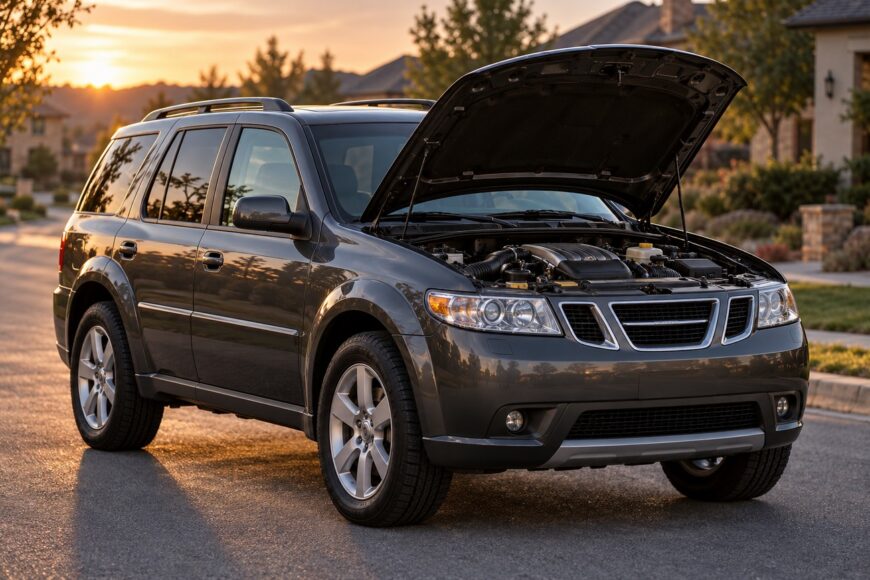
The Saab 9-7X Aero is an unusual collision of ideas. Its 6.0-liter V8 belongs to the GM LS2 family associated with the Corvette, yet the engine sits in a heavy, aging Saab SUV with permanent all-wheel drive, a four-speed automatic, and a long list of expensive components outside the engine bay. The result has genuine appeal, but the badge can make buyers overlook the vehicle surrounding the V8.
The important question today is whether the complete 9-7X Aero is worth owning, rather than whether its LS2 sounds exciting. A healthy example can deliver rare character, strong road performance, useful cargo space, and confident traction. A neglected one can turn its engine availability into a distraction from worn hubs, stressed driveline parts, electronic faults, and difficult-to-source Saab-specific trim.
- Why the Saab 9-7X Aero Is More Than a Badge Swap
- The LS2 Is Corvette-Related, Not a Literal Corvette Installation
- AWD, Fuel Economy, and the Limits of the Aero Formula
- The Ownership Reality: What Usually Costs Money
- What to Inspect Before Buying a Saab 9-7X Aero
- The Biggest Myths—and Who Should Buy One Today
- Frequently asked questions
- How many Saab 9-7X Aeros were made?
- What should I do if my 9-7X Aero has mismatched tire wear?
- Which Saab engine is considered the best?
Why the Saab 9-7X Aero Is More Than a Badge Swap
The Aero was the performance version of Saab’s 9-7X range for 2008, and its headline feature was a naturally aspirated 6.0-liter GM LS2 V8. Saab styling gave the SUV a distinctive grille, lighting treatment, interior design, and road presence. Underneath, however, the vehicle remained a GMT360-based SUV, sharing its basic engineering context with other GM sport-utility models of the period.
That platform matters more than the Saab emblem suggests. The 9-7X carries the mass, suspension loads, packaging compromises, and driveline demands of a large body-on-frame GM SUV architecture. The Aero therefore feels forceful rather than delicate: the V8 supplies strong acceleration, while the chassis and four-speed transmission define how that power reaches the road.
Its Corvette connection is technically meaningful, since the LS2 family is closely associated with Chevrolet’s sports car. It can also mislead. The engine was adapted for the GMT360 platform, and the surrounding cooling, exhaust, accessories, calibration, transmission, and all-wheel-drive hardware belong to the SUV application.
Rarity adds interest, yet it does not establish collector value or make the vehicle easy to sell. A rare SUV with incomplete records can be harder to repair and less liquid than a more common performance vehicle. Condition, service history, and access to replacement parts should determine the purchase decision.
The LS2 Is Corvette-Related, Not a Literal Corvette Installation
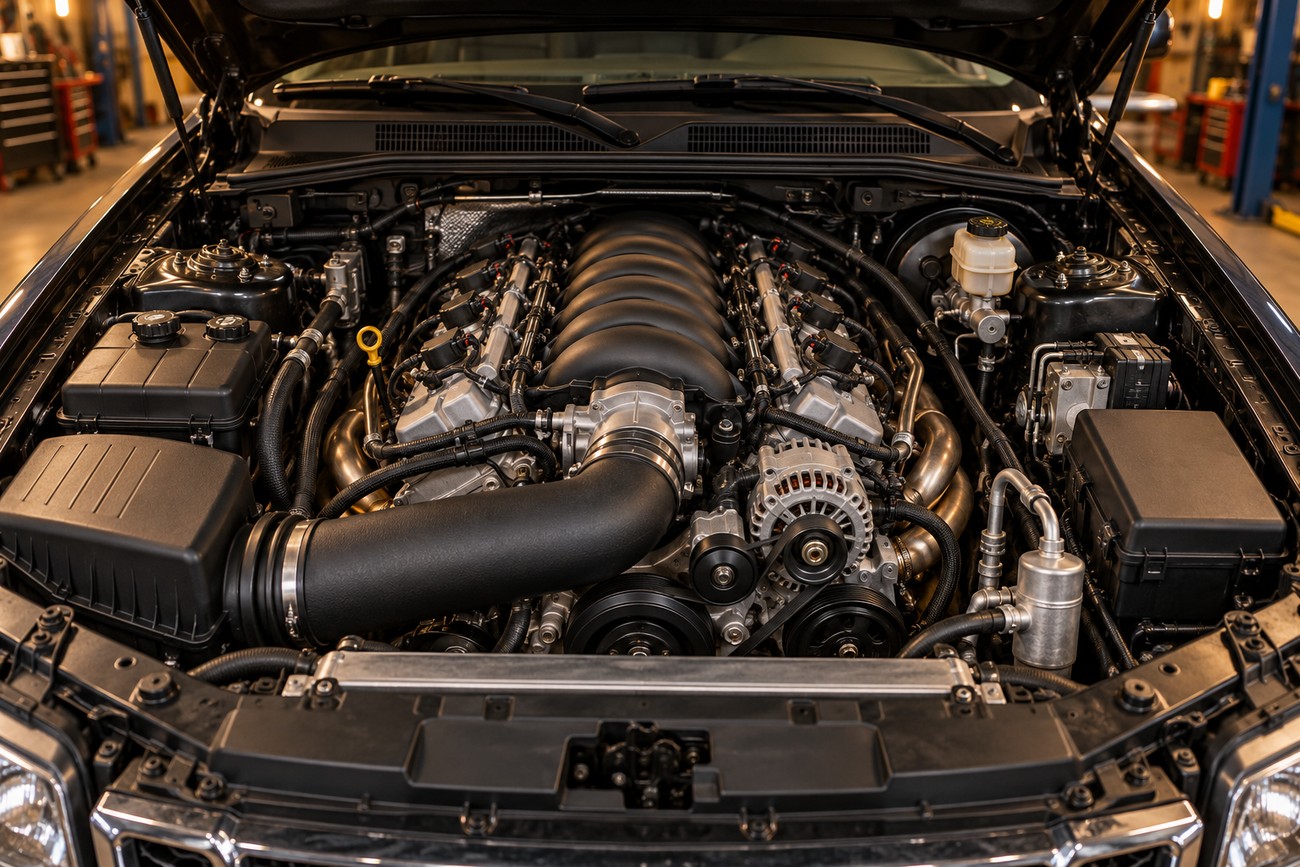
The Aero’s naturally aspirated 6.0-liter GM LS2 V8 is rated at 390 hp at 6,000 rpm. Published torque figures vary between 395 and 400 lb-ft at 4,000 rpm, and both figures appear in reference sources. That discrepancy is worth reporting accurately; it does not change the engine’s basic character or the buying advice.
The installation is closer in concept to the LS2-powered Chevrolet Trailblazer SS than to an unchanged Corvette engine. In the Saab, the V8 was adapted for the GMT360 platform and paired with a 4L60E four-speed automatic. The calibration, accessory arrangement, exhaust system, cooling package, and mounting details can therefore differ from parts-catalog assumptions based on a Corvette.
On the road, the Aero’s performance comes from torque and displacement rather than a modern transmission strategy. The V8 gives the SUV convincing throttle response and a strong midrange, but the 4L60E has only four forward gears. Gearing, vehicle weight, and all-wheel-drive drag make the car feel more like a powerful grand-touring SUV than a sports car with extra ride height.
That distinction should guide maintenance. GM-related LS2 service parts are generally easier to source, while the complete installation still requires application-specific research. Ordering components by engine family alone can produce the wrong accessory, sensor, exhaust, or cooling part. A useful search strategy includes Saab 9-7X Aero, Trailblazer SS, and GMT360 references together.
AWD, Fuel Economy, and the Limits of the Aero Formula
The Aero uses permanent all-wheel drive with a Torsen automatic center differential. When the rear wheels lose traction, the center differential can transfer torque toward the front axle. Torsen does not mean a fixed 50:50 split in every condition; torque distribution changes within the mechanical limits of the system.
The published fuel-economy reference is 12 mpg city and 16 mpg highway, approximately 19.6 and 14.7 L/100 km. Those figures are consistent with the vehicle’s mass, permanent AWD, and four-speed automatic. A driver expecting around 20 mpg in mixed use is likely to find the ownership budget unpleasant, especially with short trips, winter fuel, or frequent acceleration.
Curb weight is approximately 4,720–4,781 lb, with about 1,230 lb of payload. The weight helps the SUV feel planted and gives it a substantial towing platform, but it also increases demands on tires, brakes, wheel hubs, suspension components, and driveline parts. The payload figure also includes people and cargo, so a full passenger load reduces the practical amount available for luggage or tongue weight.
Cargo capacity is 39.8 cu. ft. behind the second row and up to 80.1 cu. ft. with the rear seats folded. That makes the Aero useful for ordinary hauling, while its approximately 7.7 inches of ground clearance limits serious off-road work. AWD helps on wet roads, snow, and loose surfaces; it does not eliminate the consequences of a long wheelbase, low clearance, heavy body, and road-oriented tires.
The Ownership Reality: What Usually Costs Money

Fuel is the most predictable expense. The 12–16 mpg range is a realistic operating expectation rather than an exceptional worst case, and the 22-gallon tank does not turn the SUV into an economical commuter. The LS2 itself can be relatively straightforward to support through GM parts channels, yet fuel consumption remains tied to the entire vehicle’s weight and drivetrain.
The 20-inch wheels fitted to the Aero can reduce ride comfort and raise tire costs. Low-profile tires also have less protection against potholes, so wheel damage and sidewall failures deserve attention during inspection. A vehicle wearing inexpensive tires with uneven tread may cost less at purchase and create more risk for the AWD system afterward.
Age and load combine in the suspension and braking systems. Owners commonly face expensive work involving suspension components, wheel hubs, brakes, driveshafts, differentials, transfer-case areas, and other AWD-related hardware. A smooth-running engine does not tell you whether a bearing is noisy, a joint is worn, or a driveline mount is deteriorating.
Electrical faults can be just as frustrating. Sensors, power windows, climate-control functions, and warning messages may fail as the vehicle ages. Saab-specific body panels, interior pieces, and electronic modules can be substantially harder to locate than LS2 service parts. This is why a complete, documented example deserves a premium over a cosmetically attractive project with an appealing engine sound.
What to Inspect Before Buying a Saab 9-7X Aero
Begin with a cold inspection and a vehicle-history check. The engine should start cleanly from cold, settle into a stable idle, and show no unexplained warning lights. Review the VIN, recall history, oil-service records, transmission work, and evidence of previous AWD repairs before spending time on cosmetic details.
A compression test can provide useful information, but it is only one part of the assessment. Check the 4L60E for delayed engagement, slipping, harsh shifts, and inconsistent downshifts. Inspect the transfer-case and differential areas for leaks, examine the driveshaft for play or vibration, and evaluate wheel hubs, brakes, and suspension on a lift where possible.
Driveline vibration under load deserves more attention than a quiet idle. Combined with uneven tire circumference, it can point toward AWD stress or a more expensive driveline fault even when the LS2 runs smoothly.
Test the vehicle under load rather than limiting the drive to a straight, smooth road. Listen for vibration during acceleration and deceleration, check steering response over uneven pavement, and confirm that the AWD system behaves without binding or unusual noise. Inspect all four tires carefully: identical sidewall size does not guarantee identical effective rolling radius when tread wear differs.
Operate every electrical function, including windows, locks, seat controls, gauges, warning indicators, audio equipment, and climate controls. Run the air conditioner through its settings and perform a diagnostic scan for stored and pending codes. Towing-capacity references vary between 5,500 and 6,600 lb, so verify the VIN-specific rating, hitch, and actual equipment before using the SUV for a trailer.
The Biggest Myths—and Who Should Buy One Today
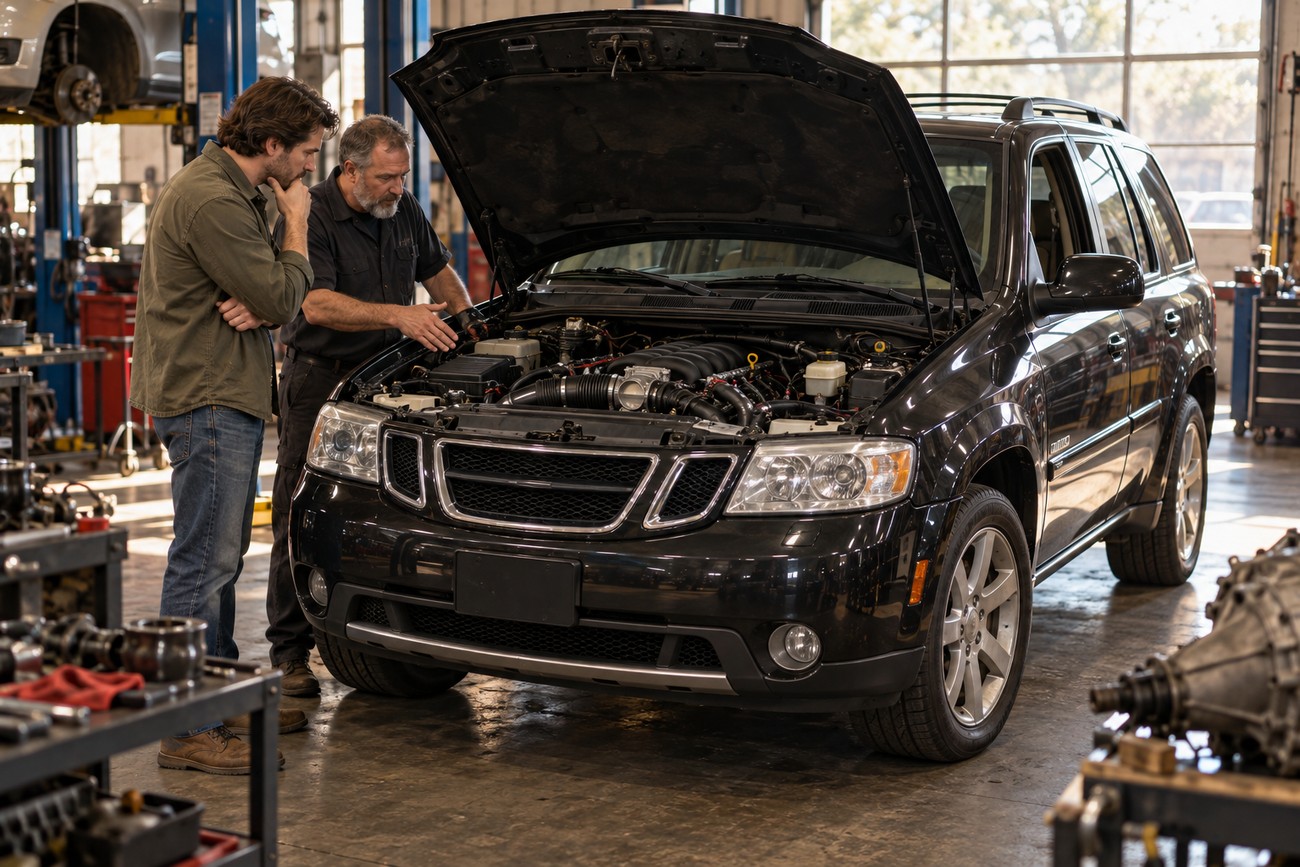
The first myth is that the Aero contains the same Corvette LS2 without meaningful changes. It has an LS2-family engine rated at 390 hp, yet the installation was adapted for GMT360 hardware and the 4L60E automatic. Corvette parts may share a family connection without being interchangeable with every engine, calibration, accessory, or drivetrain component in the Saab.
The second myth is that the SUV should return approximately 20 mpg in normal mixed driving. The published reference is 12 mpg city and 16 mpg highway, or approximately 19.6 and 14.7 L/100 km. A buyer who accepts those figures before purchase will make a more realistic budget than someone treating the Aero like a lighter performance car.
Towing claims also need restraint. Some references list 5,500 lb, while others reach 6,600 lb. The correct limit depends on the specific vehicle’s documentation, hitch, and equipment, so every Aero should be checked individually rather than assigned the higher figure by default.
The right buyer understands that the appeal lies in the combination of unusual styling, LS2 power, useful cargo space, and permanent AWD. That buyer also has access to a capable repair shop, accepts high fuel use, and will inspect the complete driveline. The wrong buyer wants a cheap Corvette-powered SUV, has no budget for age-related repairs, or assumes rarity guarantees appreciation.
Frequently asked questions
How many Saab 9-7X Aeros were made?
No dependable production total is established by the supplied evidence, so an unverified number should not be treated as fact. Online listings show cars currently advertised or previously recorded, not every vehicle produced, and duplicate listings or inactive advertisements can distort those counts.
For a buyer, the exact total matters less than the individual car’s condition. Documented maintenance, a sound AWD system, complete interior and body trim, and realistic parts support provide more useful evidence of value than an internet rarity claim.
What should I do if my 9-7X Aero has mismatched tire wear?
Measure the actual circumference of all four tires and address the mismatch before extended AWD use. Identical size markings on the sidewalls do not prove that the tires have the same effective rolling radius, particularly when tread depths differ substantially.
Have the tires, alignment, and AWD-related components inspected together. Replacing only one tire may leave the rolling-radius problem in place, while continuing to drive without checking can add stress to the center differential and other driveline parts.
Which Saab engine is considered the best?
There is no universal answer because “best” depends on the buyer’s priority. The LS2 is the standout for power in the 9-7X Aero, while service simplicity, fuel economy, parts availability, and long-term operating cost may favor a different Saab engine or a different model entirely.
For this SUV, the engine choice should be judged together with the transmission, AWD system, cooling, electronics, and parts supply. The LS2 family connection gives the Aero strong mechanical appeal, yet it does not make every surrounding component as easy to source as a Corvette part.







