

In remote Nevada, a low-fuel warning can become a roadside exposure and traffic-safety problem long before you reach a station. High-speed traffic, heat, weak cellular coverage, and long distances between fuel stops leave little margin once the engine stops.
The Raptor’s “miles to empty” display can help with planning, but it is not a guaranteed operating reserve. Plan around a reliably operating fuel station and the conditions ahead. Exact tank capacity and fuel requirements vary by model year and version, so the specific owner’s manual remains the authority.
- What “0 Miles to Empty” Really Means in a Ford Raptor
- Why a Raptor Can Act Like It Is Running Out of Fuel
- What to Do If Your Ford Raptor Runs Dry in Nevada
- Nevada Roadside Help: What NDOT Can and Cannot Do
- How to Prevent a Fuel Emergency on a Nevada Drive
- Frequently asked questions
- How much does it cost to fill a Ford Raptor’s tank?
- How can I tell whether a Raptor problem is low fuel or a mechanical fault?
- Why is my truck acting like it’s running out of gas?
- How many miles can a Ford Raptor go on a full tank?
- How much is a full tank on a Raptor?
What “0 Miles to Empty” Really Means in a Ford Raptor
“Miles to empty” is an estimate based partly on recent fuel consumption, not a direct measurement of usable fuel. The calculation can change as driving conditions change, so the displayed figure should be treated as guidance rather than a promise that the vehicle can travel that distance.
Speed, recent consumption, aggressive acceleration, tires, payload, drive mode, slopes, and off-road terrain can materially change the estimate. A Raptor driven quickly into a strong headwind or across rough ground may consume fuel at a different rate from the one used to calculate the earlier range. A sudden drop in the display can therefore reflect changing consumption as well as the fuel level.
Slopes and uneven terrain create another source of uncertainty. Fuel can move within the tank while the truck climbs, descends, leans, or makes abrupt maneuvers, making the level and range readings less reliable for a period of time. A reading that looks comfortable on level pavement may offer less practical confidence after extended off-road travel.
Ford directs owners to the specific owner’s manual for the vehicle’s fuel-tank capacity and fuel requirement. The exact fuel capacity and recommended octane depend on the Raptor’s model year and version. Using a universal capacity or assuming that every Raptor has the same reserve can lead to a poor decision before an isolated Nevada stretch.
Why a Raptor Can Act Like It Is Running Out of Fuel
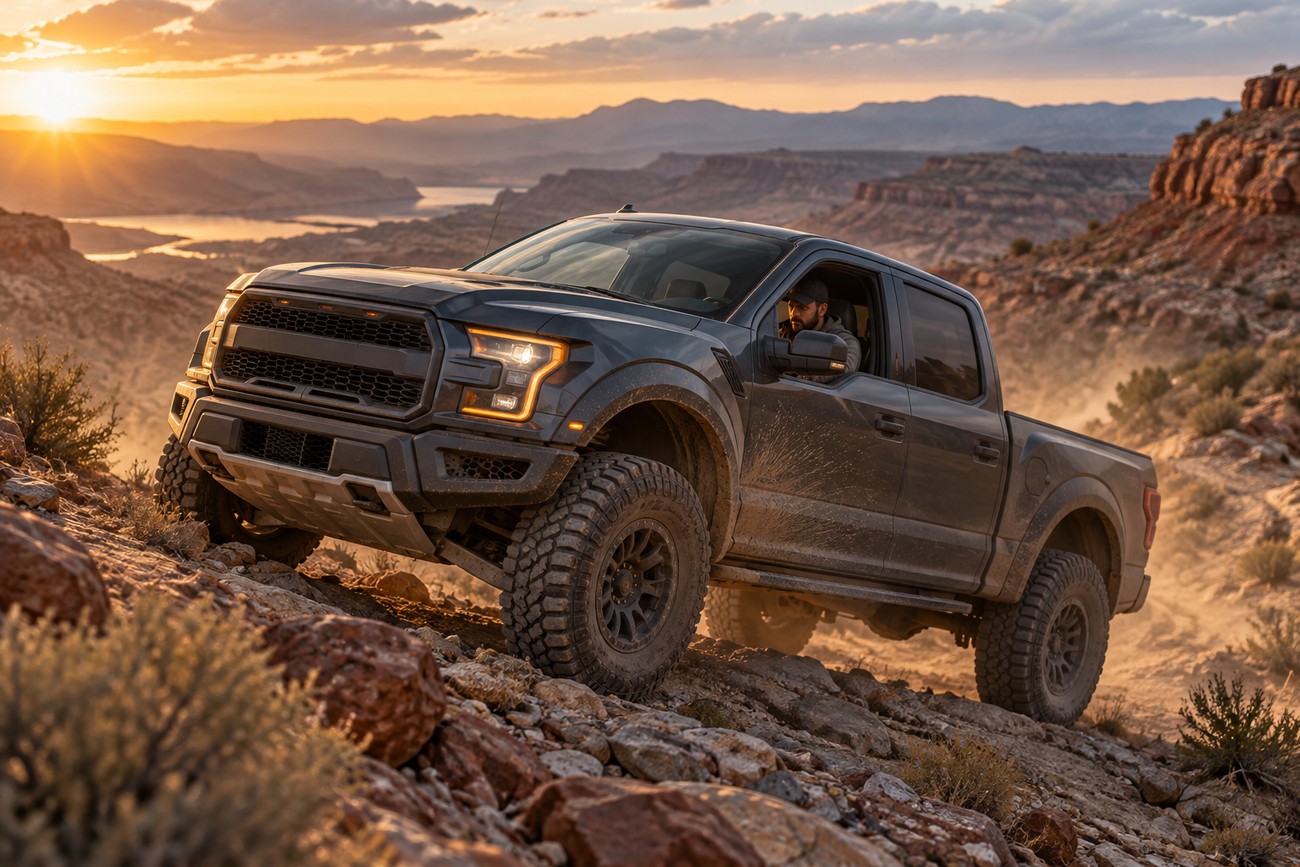
A changing range estimate, fuel movement in the tank, and genuine fuel starvation can feel similar from the driver’s seat. Recent fuel use may make the display fall quickly, while steep grades or off-road angles can temporarily affect how fuel reaches the pickup system. Symptoms can therefore appear before the tank is completely empty.
Some owners report fuel remaining after a zero or near-zero range display, but this is not a dependable or universal reserve. The range algorithm can be wrong after steep grades, off-road travel, or abrupt maneuvers, and the amount remaining can vary between vehicles and conditions. Treating another driver’s reported post-zero distance as a safe allowance is a serious mistake.
When fuel supply becomes intermittent, the engine may hesitate, lose power, or stop. Continuing to drive aggressively can turn a marginal fuel situation into complete fuel exhaustion, especially where the next station is far away. Moving safely toward the shoulder is more important than trying to extract a few additional miles from the estimate.
After complete fuel exhaustion, repeated starting attempts or fuel-system priming may be needed. Prolonged cranking can strain the battery and starter, leaving you with a second problem after the fuel arrives. Once the truck is safely supplied, follow the vehicle’s starting guidance and avoid repeatedly holding the starter for long periods.
What to Do If Your Ford Raptor Runs Dry in Nevada
The first priority is reducing exposure to moving traffic. If the truck still rolls, move it as far from active traffic lanes as safely possible, avoid stopping in a travel lane or along a narrow shoulder, and activate the hazard lights.
Do not walk along a high-speed freeway to find fuel. Remain belted inside the vehicle when traffic conditions make standing outside dangerous, particularly around heavy trucks, poor visibility, or a narrow shoulder. Call 911 for an immediate danger or crash risk, or use *647 for urgent roadside assistance where that service is available.
Direction of travel and the exact exit or cross street usually locate a disabled vehicle faster than the name of the nearest town. On a long desert freeway, the same town may be many miles from the actual stop.
- Tell the dispatcher the freeway and direction of travel.
- Give the nearest exit, cross street, mile reference, or visible landmark.
- Provide the Raptor’s color, body style, license information if requested, and the vehicle’s condition.
- Give a callback number and exact coordinates from the vehicle’s navigation system or phone when available.
- Keep the seat belt fastened and follow dispatcher or roadside-worker instructions while waiting.
If leaving the vehicle becomes necessary, do so only when the traffic situation permits and follow official instructions. Keep the hazards operating when the electrical system allows, and make the truck visible without placing yourself in the path of traffic. Keep the location details available if the call drops or another service must be contacted.
Nevada Roadside Help: What NDOT Can and Cannot Do
NDOT Freeway Service Patrol is intended to address hazards on designated Nevada freeway service calls. The patrol may provide a small amount of fuel, helping a vehicle reach a safer condition or continue to an appropriate location under the circumstances.
That service is not a guaranteed free fill-up, free towing arrangement, or promise to transport the Raptor to the station the driver prefers. Private fuel delivery, towing, and longer-distance transport may involve separate providers and charges. Confirm the service and its cost before authorizing private recovery.
Other drivers approaching the scene have responsibilities as well. Nevada’s Move Over Law requires drivers to move over when possible or slow down near stopped emergency and service vehicles. This is why standing beside the truck on a fast freeway can expose you to danger even when the Raptor is fully off the lane.
An abandoned or obstructing vehicle may be removed, with the resulting costs charged to the owner. Respond promptly to instructions from law enforcement, NDOT, or a contracted service provider, and do not assume that leaving the truck unattended will avoid towing or storage expenses.
How to Prevent a Fuel Emergency on a Nevada Drive
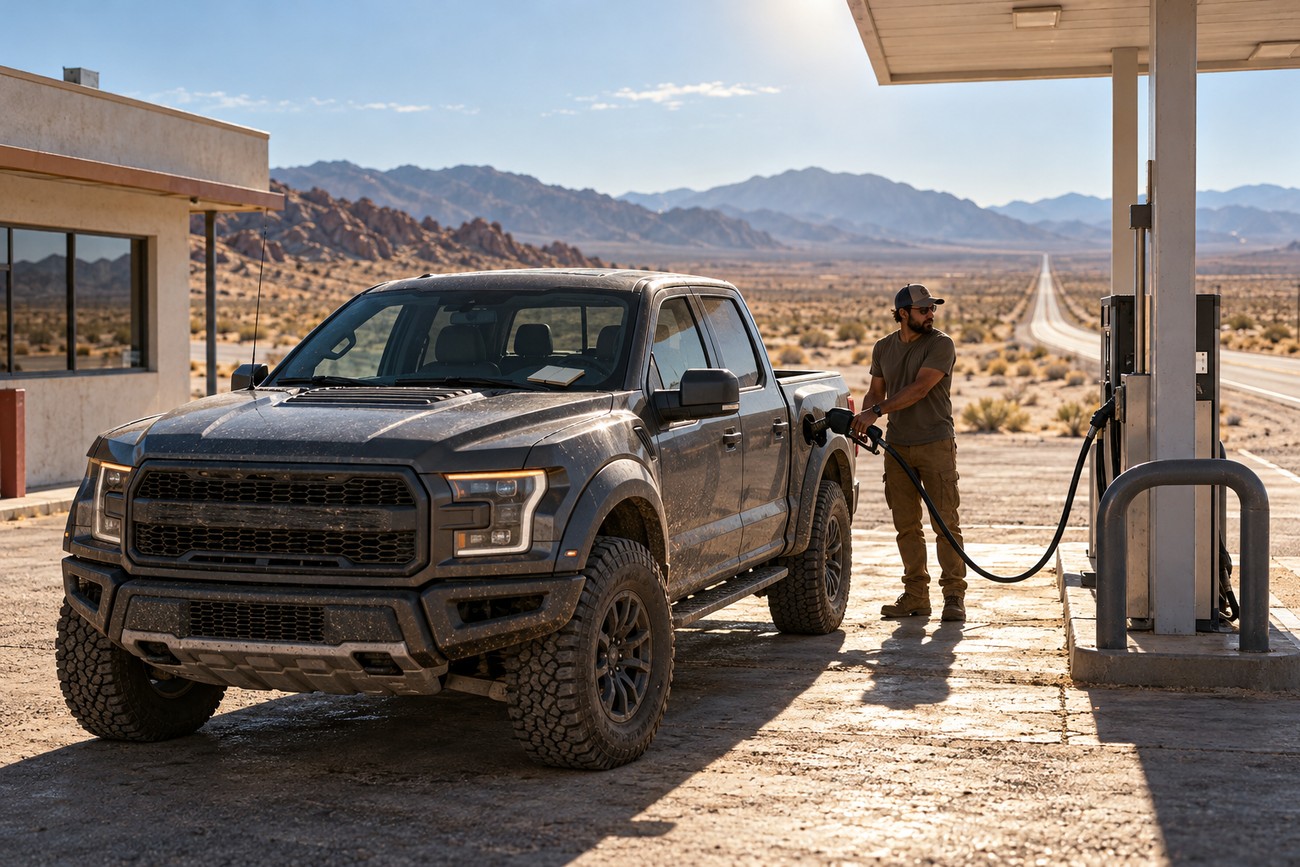
Plan the trip around the nearest reliably operating fuel station, not the most optimistic “miles to empty” figure or a map pin that may be closed, inaccessible, or farther away than it appears. Include detours, traffic, poor cellular coverage, heat, and the long gaps between stations in the decision to continue.
Before departure, check the owner’s manual for the Raptor’s exact fuel capacity and required or recommended octane. The manual also provides the vehicle-specific information needed to avoid applying assumptions from another model year or version. Refuel before a long isolated stretch rather than waiting for the display to approach zero.
Save the vehicle’s coordinates or a clear location reference before entering a remote area. If a stop becomes necessary, the freeway, direction of travel, exit, and exact coordinates are more useful to a dispatcher than a general destination or nearby town. Weak coverage can make it harder to reconstruct that information later.
If you carry spare fuel, use an appropriate certified fuel container and secure it according to the container and vehicle instructions. An improvised container is a poor choice, particularly in high heat. A small, planned margin is safer than depending on a zero reading or attempting to walk beside an isolated highway.
Frequently asked questions
A Raptor’s fuel planning depends on the specific vehicle, its recent use, and the route ahead. These answers separate vehicle-specific facts from assumptions that can create problems on Nevada roads.
How much does it cost to fill a Ford Raptor’s tank?
Estimate the cost by multiplying the fuel volume needed by the current pump price. Use the tank capacity listed in the specific owner’s manual, then allow for the fact that a normal refill may require less than the full published capacity because some fuel remains in the tank.
There is no reliable universal fill cost for every Raptor. Model year, version, local pump prices, and the amount already in the tank all affect the final total.
How can I tell whether a Raptor problem is low fuel or a mechanical fault?
Range fluctuations after a change in speed, terrain, slope, or driving style point toward the estimate changing, while hesitation or loss of power near an empty reading can indicate fuel starvation. Warning lights, unusual noises, fluid leaks, persistent rough running, or a no-start condition after fuel is added raise the possibility of a mechanical or electrical fault.
These signs cannot safely confirm the cause at the roadside. Move away from traffic, call for assistance, and avoid repeated long cranking. A qualified technician can diagnose the vehicle after it is in a safe location.
Why is my truck acting like it’s running out of gas?
The truck may be responding to low fuel, fuel movement during steep or uneven travel, or a range calculation based on recent consumption that no longer matches current conditions. Aggressive acceleration, high speed, heavy payload, tires, drive mode, and off-road angles can all change how the vehicle behaves and how quickly the estimate falls.
If the behavior continues after adding the correct fuel, treat it as a possible mechanical fault rather than assuming the display is still adjusting. Avoid relying on a post-zero reading to continue driving.
How many miles can a Ford Raptor go on a full tank?
There is no single dependable distance for every Raptor. The result depends on the model year and version, tank capacity, speed, recent consumption, tires, payload, drive mode, slopes, and terrain.
Use the vehicle’s manual and actual trip consumption for planning, while reserving enough fuel for detours, traffic, and the next reliably operating station. The dashboard estimate remains a changing calculation rather than a guaranteed distance.
How much is a full tank on a Raptor?
“Full tank” can mean either the tank’s published capacity or the amount needed at the pump from the current fuel level. Check the specific owner’s manual for capacity, then multiply the amount purchased by the current price per unit of fuel.
Because Raptor capacity varies by model year and version, a universal gallon figure or universal price would be misleading. The pump total also changes with local fuel prices and how much fuel remains before refueling.







