
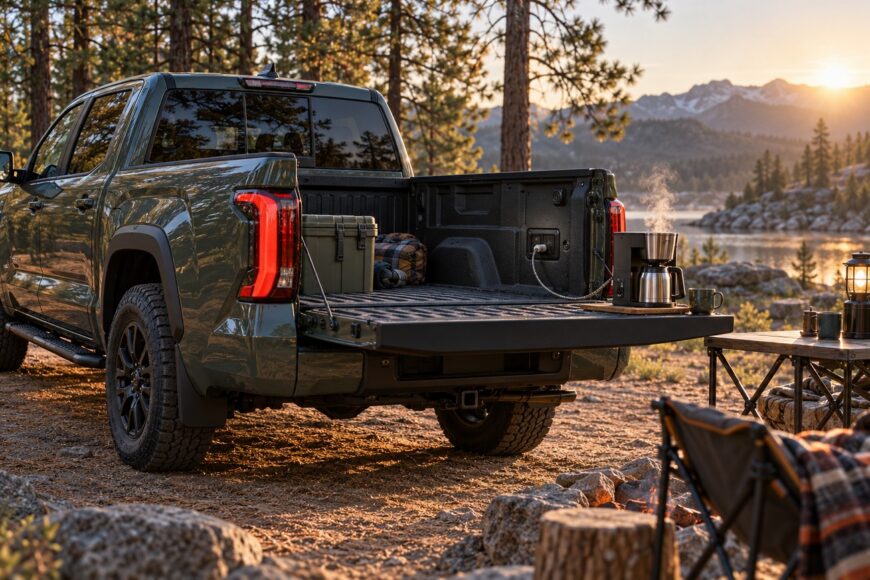
A Toyota Tundra i-FORCE MAX may have a hybrid traction battery, yet its factory AC outlet remains limited to 120 V and 400 W. That rating is the practical boundary for running appliances from the truck, regardless of how much power the hybrid system can produce elsewhere.
Most heated single-cup and automatic drip coffee makers draw about 700–1500 W. A plug may fit the outlet physically while the appliance remains electrically unsuitable. The safe approach is to read the coffee maker’s rating label first, compare its continuous demand with 400 W, and choose a lower-power method rather than forcing an overload.
- Can a Toyota Tundra Hybrid Run a Coffee Maker?
- Check the Coffee Maker’s Real Power Demand
- Why the Tundra Outlet May Shut Off
- Power Options That Actually Fit the Use Case
- The 12V Inverter Trap
- A Safe Coffee-Making Setup: Checklist and Mistakes to Avoid
- Frequently asked questions
- What should I do if the Tundra’s AC outlet shuts off while brewing?
- What are the common problems with the Toyota Tundra Hybrid?
- What does the coffee cup symbol mean on a Toyota Tundra?
- What is the gas mileage of a 2026 Toyota Tundra hybrid?
- What are the rumors about the 2027 Toyota Tundra?
Can a Toyota Tundra Hybrid Run a Coffee Maker?
Sometimes, but most standard heated coffee makers exceed the Toyota Tundra Hybrid’s factory outlet rating. Toyota specifies the outlet at 120 V and 400 W and recommends checking the owner’s manual for the specific vehicle. A coffee maker rated below that limit may be usable, provided the outlet is activated correctly and no other loads push the system beyond its rating.
The hybrid traction battery does not turn the truck’s AC outlet into an unrestricted household inverter. The battery, power electronics, wiring, inverter, and outlet each have their own limits. The 400 W figure applies to the specific factory AC output, not to the total capability of the hybrid system.
Most conventional coffee makers use a heating element that demands about 700–1500 W. That includes many products marketed as compact, mini, or travel models. The word “travel” describes the product’s size or intended use; it does not guarantee that its electrical demand is suitable for a 400 W vehicle outlet.
A coffee maker that starts briefly and then loses power is not demonstrating compatibility. It may simply be exceeding the outlet’s operating limit. Physical plug compatibility only confirms that the connector fits; electrical compatibility depends on voltage, continuous wattage, wiring, protection, and the appliance’s actual operating behavior.
Check the Coffee Maker’s Real Power Demand
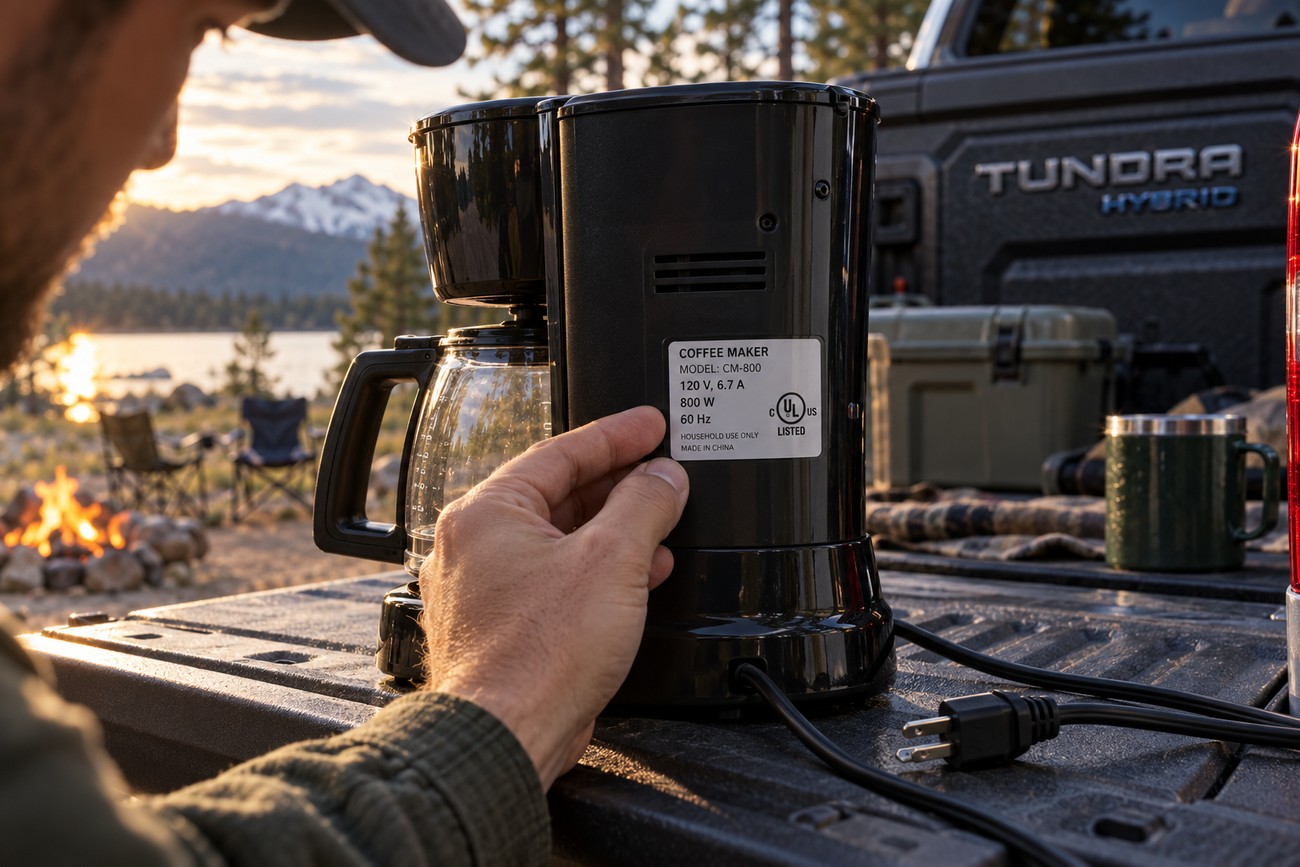
Start with the rating label on the coffee maker, its power cord, or the manufacturer’s electrical specification. Look for watts, shown as W, rather than relying on a product title or a small footprint. If the label lists volts and amps instead, power can be estimated with P = V × I.
At the Tundra outlet’s limit, P = V × I gives 120 V × 3.3 A, or about 400 W. In other words, the factory outlet can supply about 3.3 A at 120 V under its stated rating. A coffee maker marked 800 W would require roughly twice that power before accounting for any additional losses or operating conditions.
Heating appliances create a sustained load. The heating element continues drawing power while water reaches brewing temperature, so this is not merely a short startup event. A specification that looks close to 400 W leaves little margin for inverter losses, temperature-related derating, or other equipment connected to the same supply.
For an appliance used through a separate inverter or portable power station, check continuous output rather than peak output. A station may advertise a high short-term surge rating while being unable to sustain the coffee maker’s heating cycle. The relevant comparison is the station’s continuous AC rating against the coffee maker’s stated demand.
Why the Tundra Outlet May Shut Off
The common failure pattern is simple: the coffee maker begins heating, the outlet disconnects, and brewing stops. A load above 400 W is outside Toyota’s stated operating limit for the factory AC outlet. Depending on model year and equipment, the system may shut down, activate protection, or operate outside the specified range.
Toyota does not promise normal operation for a heating appliance above 400 W. Exact overload behavior, thermal thresholds, and reset behavior can vary by year and trim, so a general fault code or universal reset procedure should not be assumed. The owner’s manual for the specific Tundra is the controlling reference.
The outlet also requires the correct operating state. Toyota’s stated activation conditions are ACCESSORY or IGNITION ON, with the AC 120V master button pressed. If the button is not enabled, the outlet may appear dead even when the vehicle is otherwise powered.
Repeatedly resetting an outlet that trips does not make an oversize coffee maker safe. Each attempt can recreate the same overload or heat condition, while the reason for the shutdown remains unresolved. Disconnect the appliance, verify its rating, and treat the protection response as a warning rather than a challenge to overcome.
Power Options That Actually Fit the Use Case
The most practical choice depends on whether you need brewed coffee, hot water, or a full-size appliance. Compare the appliance’s continuous demand with the available source before connecting anything.
| Option | What it can realistically do | Main limitation |
|---|---|---|
| Factory 120 V outlet | Can support a suitable load up to the stated 400 W limit, subject to the owner’s manual and operating conditions. | Most heated coffee makers drawing about 700–1500 W exceed the rating. |
| Low-power travel coffee maker | May work if its rating is within the outlet’s continuous capability and the total connected load remains within the limit. | The label must be checked; “travel” or “mini” does not establish compatibility. |
| Preheated water, thermos, or mug | Provides hot water or coffee without running a heating element from the truck. | Water must be heated in advance or by a separate suitable source. |
| Separate portable power station | Can run a conventional coffee maker if its continuous AC output exceeds the appliance load and its battery has sufficient energy. | Peak output alone is insufficient, and the station is a separate power source rather than an extension of the Tundra outlet. |
A low-power travel brewer can be a reasonable match, but only after its rating is confirmed. Leave headroom rather than selecting a device that sits exactly at the outlet’s maximum. Coffee brewing is a sustained heating task, so a marginal setup is more likely to expose thermal or protection limits.
Preheated water is often the simplest camping solution. A thermos or insulated mug avoids inverter sizing, cable heating, battery depletion, and outlet shutdown altogether. It also lets you make coffee while the vehicle is parked and the electrical system is switched off.
A portable power station should be rated for the coffee maker’s continuous wattage, with enough stored energy for the entire brew cycle and any other planned loads. Do not combine the Tundra’s AC and 12V outputs to bypass their individual limits. Separate outputs remain separate circuits with separate ratings.
The 12V Inverter Trap
A cheap inverter plugged into a 12V 10A socket is not a practical way to run a normal heated coffee maker. The basic input ceiling is 12 V × 10 A, or approximately 120 W before inverter losses. After conversion to AC, the usable output is lower still.
An inverter marked “2000 W” describes what the inverter may be capable of under suitable input conditions. It does not make a vehicle socket, fuse, or wiring deliver 2000 W. Drawing that level of power through a 12V accessory outlet can overload the circuit, blow its fuse, overheat wiring, or cause a voltage drop before the appliance can operate properly.
Installers size the entire 12V path—socket, fuse, cable, inverter, battery, and battery protection—rather than trusting the wattage printed on the inverter case.
A separate battery-powered inverter system is a different installation. It requires appropriately sized cables, a fuse located near the battery, secure connections, and protection against deep discharge. The battery must also be capable of supplying the required current for the complete heating period, not merely for a brief test.
Do not plug an inverter into the Tundra’s factory AC outlet to “increase” available power. That configuration does not bypass the 400 W limit and can create an unsafe connection between power-conversion devices. If a full-size coffee maker is essential, use a properly rated independent power station or a correctly designed separate battery and inverter system.
A Safe Coffee-Making Setup: Checklist and Mistakes to Avoid
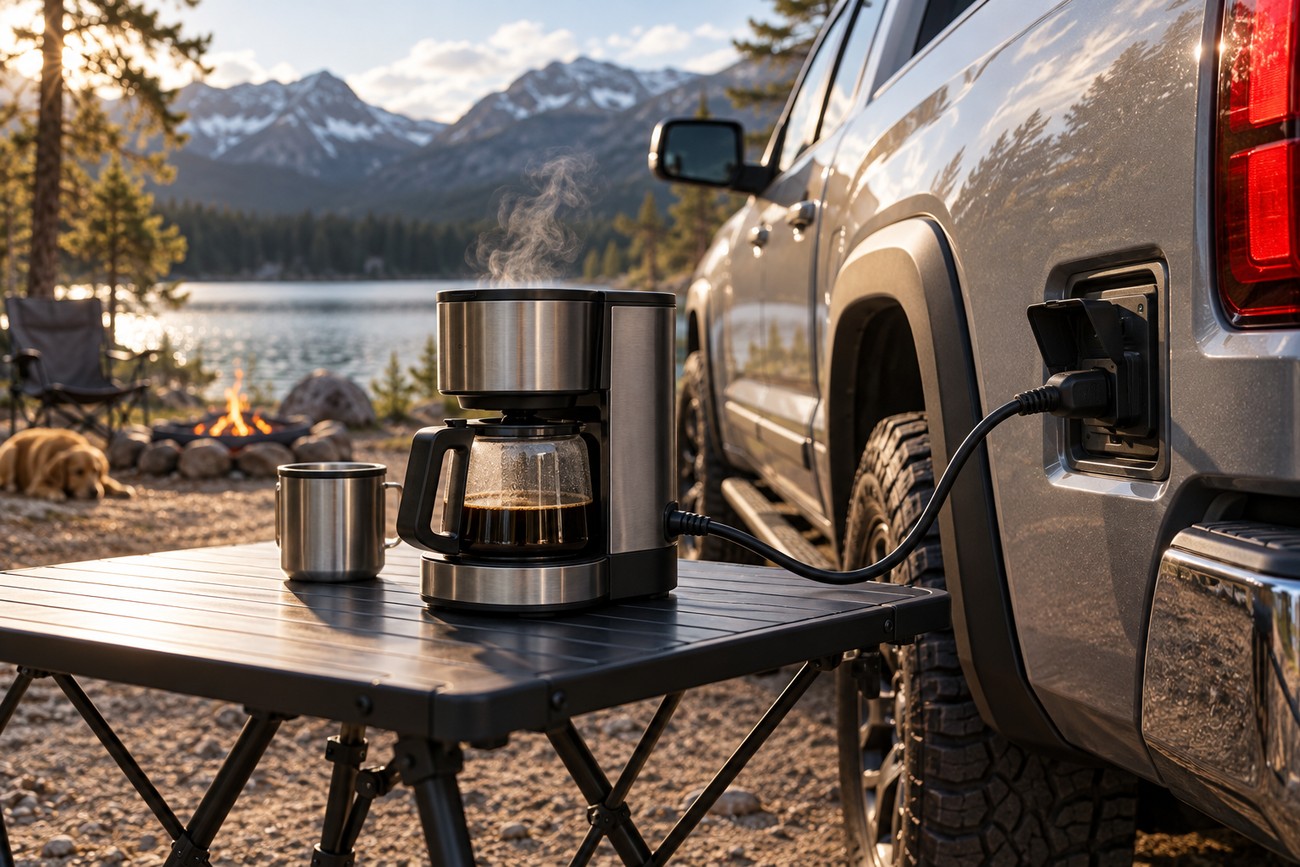
Begin with the coffee maker’s rating label. If the continuous demand is above 400 W, do not use the factory AC outlet for that appliance. If it is within the limit, remove unnecessary connected loads and confirm that the vehicle’s manual permits the intended use.
- Check the coffee maker’s voltage and wattage on its label.
- Compare continuous wattage with the factory 400 W limit.
- Use ACCESSORY or IGNITION ON as specified, and press the AC 120V master button.
- Keep other AC and 12V loads disconnected while brewing.
- Use a short, adequately rated cord if one is necessary; avoid long or thin extension cords.
- Stop immediately if the outlet trips, the plug becomes hot, or the appliance behaves erratically.
Long or thin extension cords can increase voltage drop and heating. They also add another failure point between the outlet and a sustained heating load. The safest arrangement is generally a correctly rated appliance placed close to the outlet, with no improvised adapters or damaged cords.
Extended ACCESSORY operation may drain the 12V battery, and the owner’s manual for the specific vehicle governs how the system should be used. READY mode may allow the vehicle to manage its electrical systems differently, but it does not guarantee silent operation or zero fuel consumption. The engine may start, and the truck remains an operating vehicle rather than a silent campsite power source.
Never treat a tripped outlet as evidence that the coffee maker is almost suitable. Stop, unplug the load, and investigate the rating and connected devices before trying again. If the appliance exceeds 400 W, switch to preheated water, a lower-power brewer, or an independent power source designed for the load.
Frequently asked questions
What should I do if the Tundra’s AC outlet shuts off while brewing?
Stop the coffee maker, unplug it, and remove any other devices connected to the same supply. Check the coffee maker’s rating label, then compare its continuous wattage with the factory outlet’s 400 W limit. Do not repeatedly reset the outlet while the same appliance remains connected.
If the appliance is within the rating, confirm that the AC 120V master button is pressed and review the vehicle manual for the relevant year and trim. If the outlet still shuts off with a suitable load, stop using it and seek qualified service rather than bypassing the protection.
What are the common problems with the Toyota Tundra Hybrid?
For this camping use case, the most common mistakes are electrical assumptions rather than a single universal hybrid fault. Owners may confuse the hybrid battery’s overall capability with the 400 W limit of the factory AC outlet, leave the truck in ACCESSORY for too long, or use an undersized 12V inverter for a heating appliance.
Actual vehicle concerns vary by model year, trim, maintenance history, and operating conditions. A warning light, repeated outlet shutdown with an appropriate load, or a weak 12V system should be diagnosed from the vehicle’s manual and service information instead of being attributed automatically to the hybrid battery.
What does the coffee cup symbol mean on a Toyota Tundra?
A coffee cup or cup-shaped dashboard symbol generally relates to a driver-attention or rest reminder, rather than the power available at the AC outlet. It is not an indication that the truck can run a coffee maker, and it does not change the outlet’s electrical rating.
Symbol meanings can vary by equipment and market. Check the instrument-panel section of the owner’s manual for the exact Tundra, especially if the symbol appears with a message, chime, or driver-assistance warning.
What is the gas mileage of a 2026 Toyota Tundra hybrid?
There is no single mileage figure that applies to every 2026 Tundra Hybrid. Fuel economy depends on cab and drivetrain configuration, tires, payload, weather, driving speed, and whether the vehicle is towing.
Use the official rating for the exact configuration rather than a general hybrid estimate. For trip planning, the vehicle’s onboard fuel-economy display can also differ from certified testing, particularly during camping trips with idling, heavy loads, or accessory use.
What are the rumors about the 2027 Toyota Tundra?
Rumors about a future Tundra may concern styling, powertrain updates, technology, or equipment, but unconfirmed reports should not be used to plan an electrical setup. Unless Toyota publishes a specification for a particular trim, assume that a future vehicle’s outlet rating and operating procedure still need to be verified independently.
For a purchase or camping decision, check official specifications, the window sticker, and the owner’s manual for the exact model. A larger hybrid battery or new marketing description would not, by itself, prove that a factory AC outlet can exceed its stated rating.







