
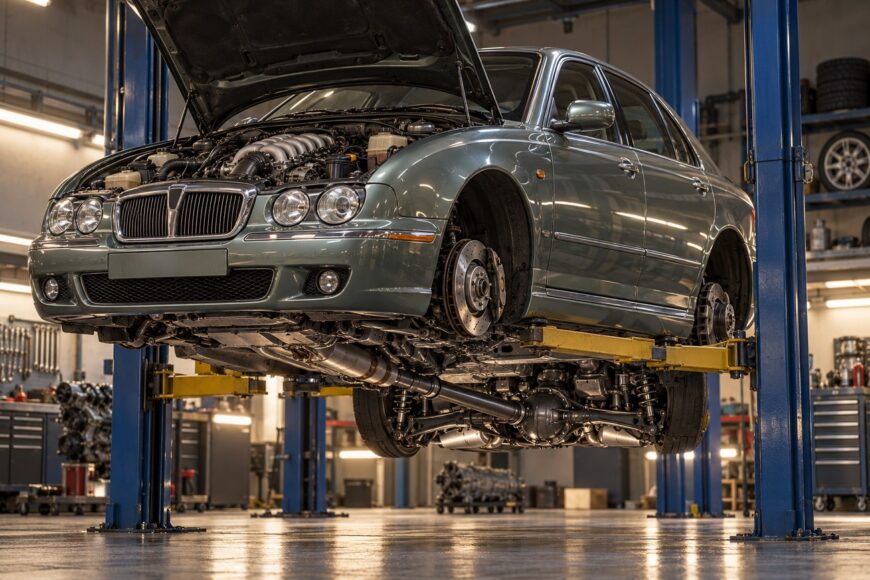
The familiar Rover 75 became something quite different when engineers fitted a longitudinally mounted 4.6-litre V8 at the front and drove the rear wheels. The result was a factory-built, rear-wheel-drive saloon that looks close enough to an ordinary Rover 75 to fool a casual buyer.
Its appeal is also its complication. The 260 hp and 410 Nm promise effortless speed, yet the car was tuned for comfort, while fuel consumption, rare drivetrain parts, and inconsistent published performance figures make ownership less straightforward than the badge suggests.
The Rover 75 V8 is best understood as an understated fast grand tourer with niche collector potential, rather than an obvious sports sedan.
- The Rover 75 V8 Was More Than an Engine Swap
- Performance Figures Are Less Certain Than the Badge Suggests
- Rover 75 V8, Standard 75, and MG ZT 260: What Changes
- Ownership: Fuel, Weight, and Rare-Part Exposure
- How to Verify a Genuine Factory Rover 75 V8
- The Hidden Trade-Off: Grand Tourer, Not V8 Sports Saloon
- Frequently asked questions
- How many Rover 75s are left on the road?
- How much does a Rover 75 V8 cost today?
- What are common Rover 75 problems?
- How much does a Rover 75 cost?
The Rover 75 V8 Was More Than an Engine Swap
The standard Rover 75 uses front-wheel drive, with its engine and transmission arranged around that layout. The V8 version changed the architecture substantially: its 4.6-litre Ford/Mustang-family V8 is mounted longitudinally at the front, and power is sent to the rear wheels. That required a different transmission arrangement and supporting hardware.
This distinction matters because the Rover 75 V8 cannot be assessed as an ordinary 75 with a larger engine. The rear-drive system changes the car’s balance, servicing requirements, and the parts that need to be identified during a purchase inspection. Its appearance does little to advertise those differences.
Externally, the V8 can remain remarkably discreet. A seller can present a normal 75 with badges, exhaust changes, or other cosmetic details that suggest a more powerful model. Without checking the drivetrain and the vehicle’s provenance, visual confidence is misplaced.
The understated body is part of the appeal, especially for buyers who prefer a fast car without an aggressive image. It also creates the central buying risk: an apparently convincing Rover 75 V8 may be a conversion, a modified standard car, or a model confused with the related MG ZT 260.
Performance Figures Are Less Certain Than the Badge Suggests
The V8 is generally specified with 260 hp and 410 Nm from its 4.6-litre Ford/Mustang-family engine. Those figures give the car strong low-speed authority and relaxed motorway performance. They do not, by themselves, establish how sharply the car responds in corners or how closely a particular example matches a catalog claim.
Published 0–100 km/h figures disagree. Sources cite under 7 seconds, 7.2 seconds, and 6.2 seconds, while reported top speeds range from 240 to 250 km/h, including figures around 243–245 km/h. The variation may reflect different testing methods, markets, specifications, or repeated secondary reporting, so one number should not be treated as definitive without a clear test source.
The driving character explains some of the gap between expectations and experience. The Rover 75 V8 was tuned as a comfortable fast cruiser, with a softer emphasis than the more aggressively framed MG ZT 260. It can gather speed with little effort, but its responses are not necessarily those of a sharply focused sports saloon.
That makes the car more satisfying on a long, quick drive than on a demanding back road for buyers who value composure and refinement. Anyone shopping by acceleration figures alone may find the experience less urgent than expected, especially if they have used the MG ZT 260 as their reference point.
Rover 75 V8, Standard 75, and MG ZT 260: What Changes
The three cars are related, but they should not be treated as interchangeable. The table separates the confirmed layout and character differences from transmission claims that vary between catalogs and related applications.
| Model | Drivetrain | Engine placement | Transmission references | Chassis character | Identification risk |
|---|---|---|---|---|---|
| Standard Rover 75 | Front-wheel drive | Different from the V8’s longitudinal arrangement | Depends on the specific standard model and market | Conventional Rover 75 character | Can be dressed up to resemble a V8 |
| Rover 75 V8 | Rear-wheel drive | Longitudinally mounted 4.6-litre V8 at the front | Five-speed automatic listed in some catalogs | Fast, smooth, and comfort-oriented | Often confused with conversions or the MG ZT 260 |
| MG ZT 260 | Rear-wheel-drive related application | Related V8 architecture | Manual references are associated with this related model and must not be transferred automatically | More aggressively presented and set up | Closely related, but not the same car as the Rover 75 V8 |
The standard 75 is the easiest source of confusion because the body shape can conceal the mechanical difference. A genuine Rover 75 V8 should have rear-wheel-drive hardware and the front-mounted, longitudinal V8 arrangement. Badges and exhaust sound are supporting clues at most.
The MG ZT 260 adds another layer of uncertainty. It shares family links and the V8 theme, but its presentation and setup differ. Manual-transmission references commonly associated with the MG ZT 260 should not be used as proof that every Rover 75 V8 had a manual gearbox; some catalogs list the Rover as a five-speed automatic.
For buyers, the practical lesson is simple: identify the exact model before pricing, insuring, or ordering parts. Treating a standard 75, a Rover 75 V8, and an MG ZT 260 as one vehicle can lead to incorrect assumptions about handling, transmission parts, and originality.
Ownership: Fuel, Weight, and Rare-Part Exposure
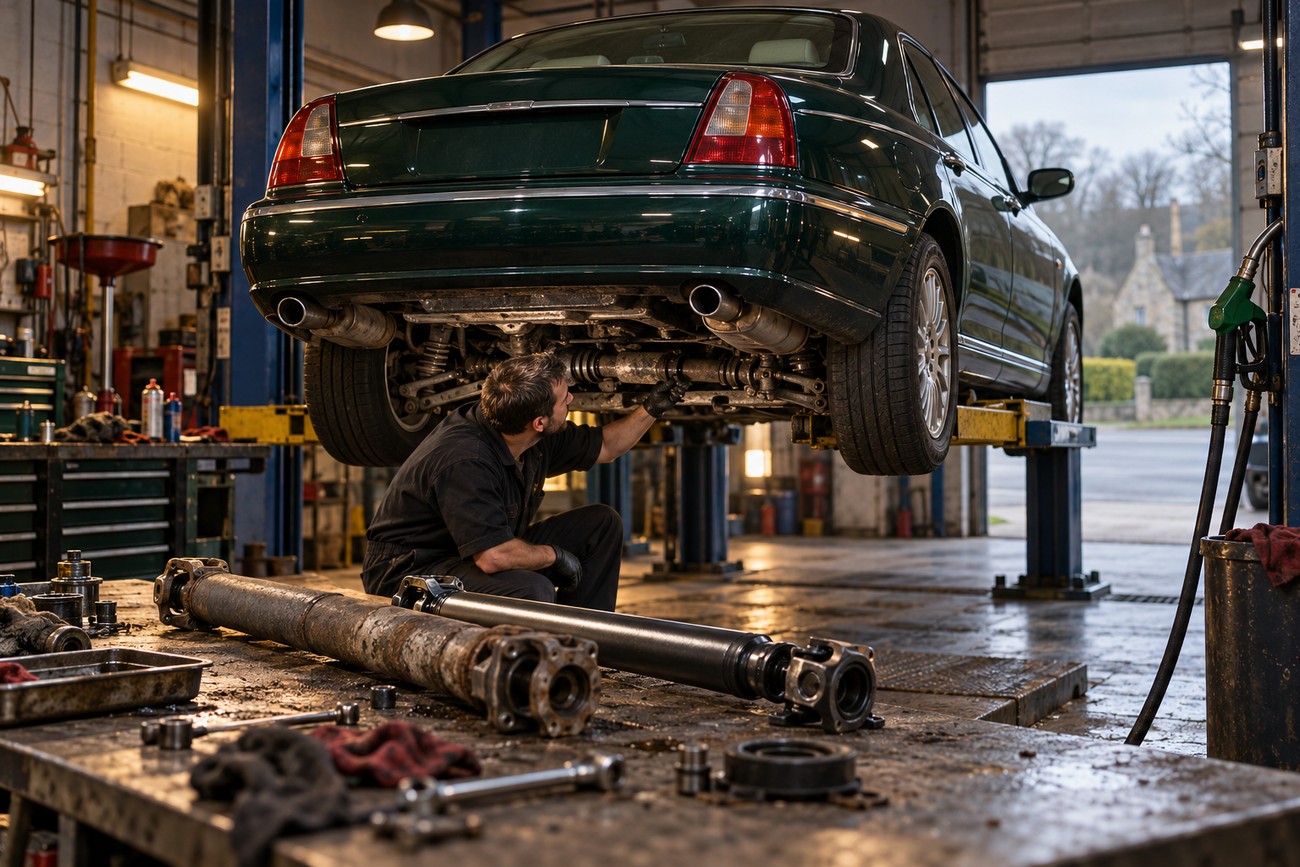
Fuel use is a permanent part of the V8 proposition. Reported figures are about 18.3 l/100 km in the city and 13.4 l/100 km combined. Real consumption depends on traffic, driving style, vehicle condition, and measurement method, but these catalog figures already show why the car can be expensive to use as a routine commuter.
The issue is broader than fuel. The V8 version is less mechanically unified with ordinary Rover 75 models than its body suggests, so a familiar-looking component is not automatically the correct component. Rare-specific parts, suitable donors, and specialist knowledge may take more time to locate, particularly when a repair involves the engine, transmission, or rear-drive system.
Weight and torque also make condition more important. Cooling performance, transmission behavior, and suspension condition deserve close inspection because the V8 places substantial demands on those systems. This does not establish a fixed list of failures for every car, but it does make neglect harder to forgive.
Parts availability should be checked before the purchase, not after the first major repair. A car can be mechanically sound and still become inconvenient if its rare-specific hardware has no obvious replacement route.
Rarity alone does not prove that every example is costly to maintain. A well-documented, properly maintained car may be a better financial proposition than a cheaper-looking example with uncertain history. The margin for careless buying is simply narrower because the normal Rover 75 parts network cannot be assumed to cover the entire V8 installation.
How to Verify a Genuine Factory Rover 75 V8
Begin with provenance. The reported production period is 2004–2005, and one source mentions around 1,000 cars in 2004, but that figure should be treated as a reported reference rather than an independently confirmed worldwide total. Ask for production documentation, registration history, service records, and any factory or specialist records that connect the car to its original specification.
Next, inspect the mechanical architecture. The engine should be a 4.6-litre Ford/Mustang-family V8 mounted longitudinally at the front, with rear-wheel-drive hardware beneath the car. The transmission must also be identified correctly; a five-speed automatic is listed for the Rover 75 V8 in some catalogs, while manual references relate to the MG ZT 260 or related applications.
Rear-drive hardware and documented provenance carry more weight than badges, trim, or engine sound. A convincing conversion can imitate the visible details, while the underside reveals whether the car has the architecture the seller claims.
Visual inspection still has value, but only as a screening step. Look for evidence that the body, engine bay, transmission tunnel, exhaust system, rear axle, and suspension arrangement belong together. A loud exhaust or V8 badge cannot prove factory origin, and a clean-looking engine bay cannot establish the car’s original identity.
Separate three possibilities in your notes: a factory-built Rover 75 V8, a standard Rover 75 converted to V8 power, and a standard car styled to resemble one. The second may be an interesting engineering project, but it should be valued and inspected as a conversion. The third has no mechanical basis for V8 pricing.
Before committing money, have the identity and drivetrain checked by someone familiar with this specific family of cars. The cost of that inspection is small compared with buying a rare-looking car whose documentation, layout, and parts situation do not match the description.
The Hidden Trade-Off: Grand Tourer, Not V8 Sports Saloon
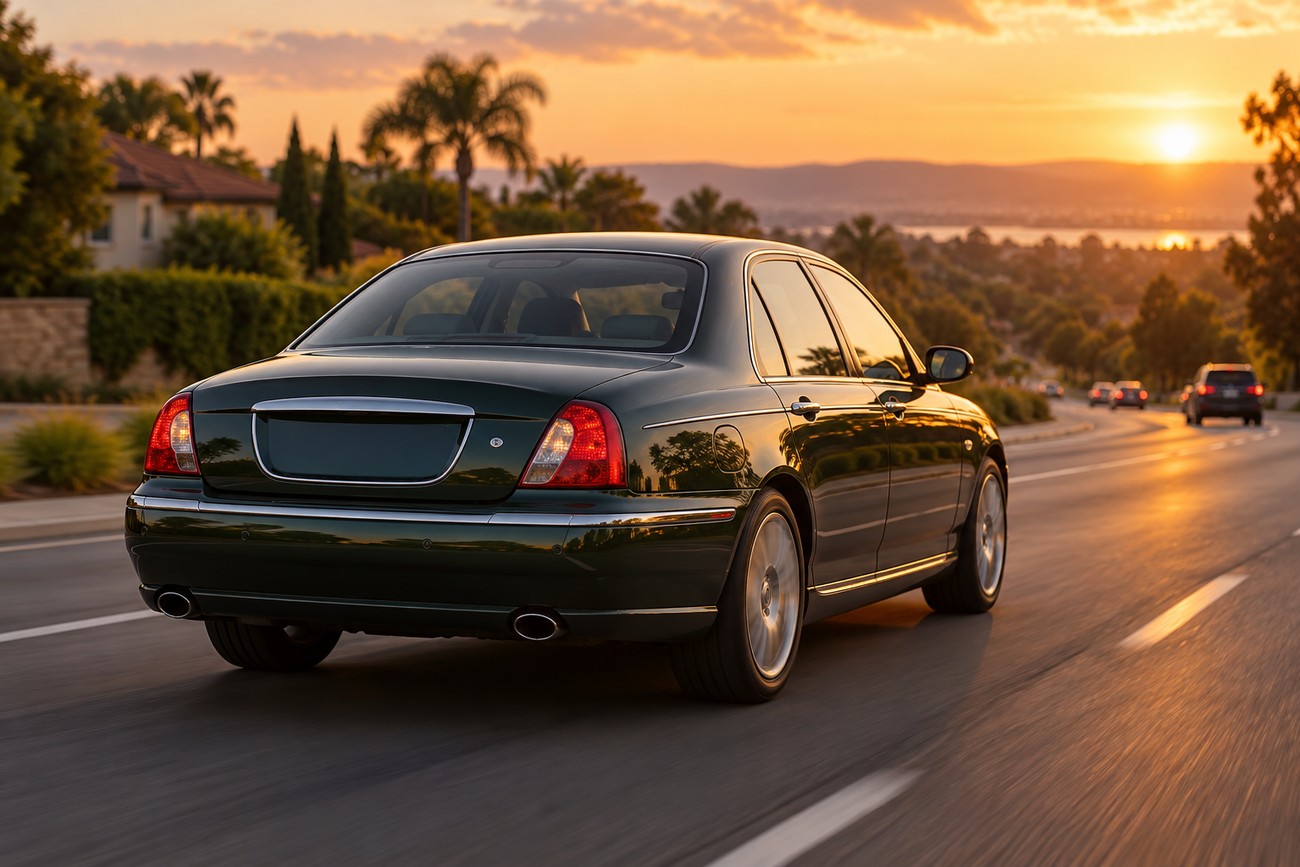
Rear-wheel drive and a V8 soundtrack naturally create sporting expectations. The Rover 75 V8 does not necessarily meet them in the way a track-focused or sharply tuned sedan would. Its softer chassis setup favors calm progress, long-distance comfort, and effortless overtaking.
That character is a strength for the right buyer. Someone seeking an unusual, discreet saloon with relaxed speed may value the combination of rarity, refinement, and understated styling. Someone expecting MG ZT 260 urgency may instead notice the softer responses and feel that the car leaves some performance potential unused.
Real-world ownership puts the trade-off into sharper focus. Fuel consumption, rare-part access, transmission condition, and the quality of the cooling and suspension systems matter more than a disputed acceleration figure when choosing between two used examples.
The Rover 75 V8 earns its niche appeal through its unusual architecture and limited production, rather than through outright sporting aggression. It is a collector-minded grand tourer for buyers prepared to verify originality and maintain a car whose most important differences are hidden underneath.
Frequently asked questions
The Rover 75 V8 is difficult to research because surviving cars are mixed with standard 75s, MG ZT 260s, and conversions. Registration data may also cover different body styles and markets without identifying the V8 accurately. Treat broad claims about numbers and values cautiously, and prioritize documentation and mechanical inspection over a listing title.
How many Rover 75s are left on the road?
There is no single authoritative worldwide count in the available evidence. National registration systems, export records, inactive vehicles, and cars stored off the road can all produce different totals.
Ordinary Rover 75s should also be separated from the much rarer Rover 75 V8. Club registers and market listings may help establish whether a car is known to enthusiasts, but they should not be treated as a complete global census.
How much does a Rover 75 V8 cost today?
Its value depends chiefly on verified factory provenance, mechanical condition, documentation, and exposure to rare-specific maintenance costs. There is no reliable universal price in the supplied evidence that would apply across markets.
A documented factory car with sound cooling, transmission, suspension, and rear-drive hardware should be assessed differently from an undocumented conversion. A low asking price may reflect missing history or future parts risk rather than a bargain.
What are common Rover 75 problems?
For the V8, the main ownership concerns are fuel consumption, the availability of rare-specific parts, and the condition of the cooling system, transmission, and suspension. These areas deserve close inspection because the V8’s mass and torque make neglect more consequential.
Standard Rover 75 references should be applied carefully. The V8 has a different drivetrain architecture, so a problem or repair solution associated with a front-wheel-drive 75 may not describe the V8 accurately.
How much does a Rover 75 cost?
The answer varies widely by model, condition, market, and documentation. A standard Rover 75 and a genuine Rover 75 V8 should not be priced as the same vehicle, and a modified car should be judged separately from a factory example.
For any version, inspect the specific car rather than relying on model reputation. For the V8, confirm the drivetrain and factory provenance before treating rarity as a reason for a higher value.







