
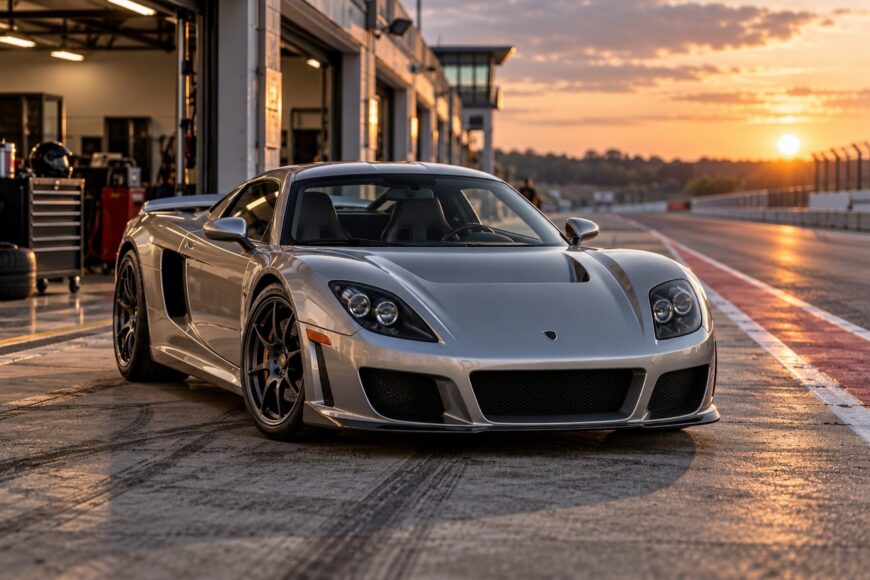
The Rossion Q1 is a lightweight, two-seat, mid-engined, rear-wheel-drive coupe built for drivers who value lap-time pace over easy road manners. Its mechanical recipe is compelling: a twin-turbo V6, manual transmission, limited-slip differential, low mass, and no electronic stability-control system to dilute the driver’s role.
Its identity needs careful framing. The Q1 is an American-assembled evolution of the Noble M400, with a redesigned body, revised cabin, and chassis-related changes rather than a clean-sheet American supercar. Performance figures also vary by version and source: early tests cited 450 hp, while later specifications commonly list 508 hp and 521 lb-ft. Weight and acceleration figures are similarly inconsistent, so the car deserves more scrutiny than a single headline number.
That combination creates the central choice. The Q1 can deliver exceptional track pace and direct mechanical feedback, but difficult launches, limited comfort, no stability control, and a specialist parts ecosystem make ownership demanding. It is best understood as a road-legal track car with improved accommodation, rather than a conventional grand tourer.
- What the Rossion Q1 Really Is
- Engine, Gearbox, and the Numbers That Need Context
- Performance Figures: Claimed Versus Tested
- Why the Q1 Works on a Track—and Bites Back
- Road Use, Comfort, and the Ownership Compromise
- Buying a Rossion Q1: Costs, Options, and Specialist Risks
- Frequently Asked Questions
- How much is a Rossion Q1?
- How many Rossion Q1 cars were made?
- What should be checked before buying a used Rossion Q1?
What the Rossion Q1 Really Is
Rossion Automotive positioned the Q1 as a more polished interpretation of the Noble M400 formula. The layout remained familiar: two seats, a mid-mounted engine, rear-wheel drive, and a compact performance-focused structure. The new body gave the car a distinct visual identity, while changes to the cabin and chassis aimed to make the package more complete.
That origin matters because the Q1 is often described too loosely as an entirely original American supercar. Its architecture is British-derived, even though the car received American assembly and presentation. The distinction is useful for buyers: Noble lineage explains the Q1’s compact proportions and track bias, while Rossion’s changes explain why its equipment and driving character cannot be assumed to match an M400 exactly.
The cabin was more civilized than the Noble’s. Leather and Alcantara trim, power windows, power mirrors, and additional engine-monitoring gauges were available, giving the driver more information and a better-finished environment. Those additions improve the experience between corners, but they do not transform the Q1 into a quiet or spacious road car.
In the performance-car market, the Q1 sits closer to an exclusive club-level machine than to a mass-produced supercar. Its appeal comes from low weight, a manual gearbox, and a direct connection between driver and chassis. Its drawbacks follow from the same brief: limited production, little standardization between cars, and a cabin designed around function rather than universal usability.
Engine, Gearbox, and the Numbers That Need Context
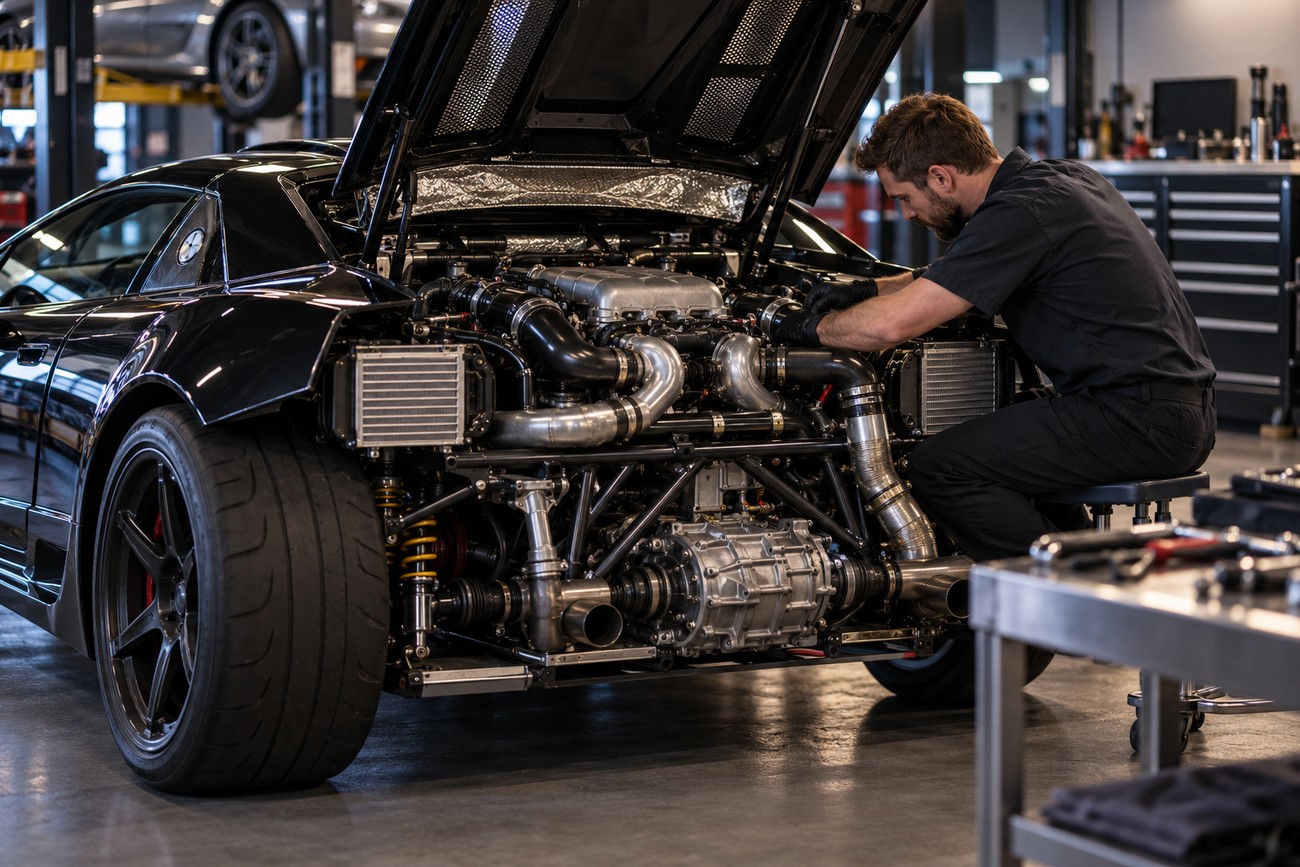
The main power unit is a 3.0-liter twin-turbo Ford Duratec V6. It drives through a six-speed Getrag manual gearbox and a Quaife differential, a combination that gives the Q1 a distinctly mechanical character. There is no automatic transmission option to soften the delivery or make traffic easier, so clutch control and throttle discipline remain part of the car’s operating demands.
Power figures should be tied to the specific car. Car and Driver tested an early configuration rated at 450 hp, while later commonly cited specifications list 508 hp and 521 lb-ft. Treating those figures as one universal output creates a false impression of consistency and can lead a buyer to judge a particular car against equipment it never had.
Car and Driver recorded 0–60 mph in 3.4 seconds, 0–120 mph in 10.0 seconds, and the quarter mile in 11.6 seconds. Those results provide a useful independent reference because they describe a complete car under test conditions, rather than an isolated factory claim. Other media commonly quote 3.1–3.3 seconds to 100 km/h, but those figures should be read as version- or source-dependent rather than guaranteed results.
The engine’s torque also explains why the Q1 can be rewarding and awkward in equal measure. A powerful rear-drive car with a manual gearbox needs a suitable surface, warm tires, and a measured throttle hand to launch cleanly. On a cold or dirty road, the theoretical advantage of low mass does not automatically become forward motion.
Performance Figures: Claimed Versus Tested
The figures below separate factory claims, commonly repeated specifications, and independent test results. Differences in weight, output, test method, and vehicle configuration are more informative than a single “official” number.
| Measure | Reported figure | Source or context |
|---|---|---|
| Engine output | 450 hp | Early Car and Driver test configuration |
| Engine output | 508 hp and 521 lb-ft | Later commonly cited specification |
| Reported curb weight | Approximately 1,043 kg / 2,299 lb | Some specifications |
| Reported curb weight | Approximately 2,600 lb | Car and Driver road test; version or measurement differences may apply |
| 0–60 mph | 3.4 seconds | Car and Driver independent test |
| 0–100 km/h | 3.1–3.3 seconds | Commonly quoted media range |
| 0–120 mph | 10.0 seconds | Car and Driver independent test |
| Quarter mile | 11.6 seconds | Car and Driver independent test |
| Top speed | 185 mph, approximately 298 km/h | Rossion factory claim |
| Top speed | 302.4 km/h | Some media reports |
| Skidpad grip | 1.09 g | Car and Driver independent test |
The table shows why advertised acceleration and top speed should be treated as reference points, not purchase guarantees. A car with different tires, alignment, fuel load, options, or power calibration may produce a different result. The 1.09 g skidpan figure is especially relevant because it demonstrates that the Q1’s ability is not limited to straight-line acceleration.
Why the Q1 Works on a Track—and Bites Back
Low mass is the Q1’s most important dynamic asset. It reduces the work required from the brakes and tires, helps the car change direction, and makes mechanical grip easier to exploit. Rear-wheel drive and the Quaife differential add another layer of involvement, allowing a skilled driver to shape the car with throttle position rather than relying on electronic intervention.
Car and Driver measured 1.09 g on the skidpad, a strong indication of the Q1’s lateral capability. Rossion also claimed that forged 18-inch wheels reduced unstrung mass by approximately 28 lb. Less unstrung mass can help the suspension control wheel movement over a circuit, although the benefit depends on the complete wheel-and-tire package and the condition of the dampers.
Tire temperature, pressure, and suspension alignment need to be checked before judging the Q1’s traction or steering. A cold-road launch can make the car appear unruly, while a properly prepared track setup may reveal a much more coherent balance.
Launch traction is a recurring weakness. Cold pavement, old tires, poor surfaces, and abrupt throttle application can produce wheelspin that overwhelms the impressive published acceleration figures. The same car may feel difficult at a winter road junction and highly effective after its tires and alignment are prepared for a circuit.
Steering feedback can also be deceptive at low speed. Reports of looseness or play around town contrast with a more settled feel at higher speed, which makes a careful inspection essential rather than allowing a seller to dismiss every vague sensation as “race-car character.” With no stability-control system, a sudden throttle lift or excessive boost application near the limit has fewer electronic safety nets.
The Q1 therefore rewards procedure. Tire choice, road temperature, surface quality, driver input, and suspension setup all influence its behavior. A buyer who wants the car to provide easy, repeatable performance in every condition is likely to find its mechanical purity demanding; a driver prepared to manage those variables may consider that the point.
Road Use, Comfort, and the Ownership Compromise
The Q1 is a difficult daily driver because its basic priorities remain track-oriented. Low ground clearance makes ramps, steep driveways, and damaged pavement a concern, while stiff suspension transmits road imperfections into the cabin. Noise and limited storage further reduce its usefulness for long-distance travel or routine commuting.
The cabin is better equipped and more comfortable than the Noble M400’s, but “better” does not mean conventional. Visibility, access, ride quality, and noise insulation remain secondary to the driver’s connection with the car. Leather, Alcantara, power equipment, and extra gauges add usability without changing the underlying architecture.
The absence of stability control matters on public roads as much as on a circuit. Rain, cold tires, painted surfaces, and unexpected corrections can expose the limits of a rear-drive car with substantial turbocharged torque. The Q1 demands more attention than a modern sports car that quietly corrects an imperfect input.
It makes sense as a weekend performance car that can reach a track under its own power. It makes less sense as a single vehicle expected to handle traffic, poor weather, luggage, and relaxed highway miles. Buyers who make that distinction before purchase are less likely to mistake the car’s limitations for faults discovered too late.
Buying a Rossion Q1: Costs, Options, and Specialist Risks
The original budget could change substantially with air conditioning, paint, interior trim, navigation, and other options. Two cars that appear similar in photographs may therefore differ in equipment, specification, and intended use. Present asking prices also need to be separated from original list pricing, especially when documentation and condition are uneven.
Low-volume production creates a smaller service and parts ecosystem than mass-produced sports cars. The British-derived architecture and American assembly do not make parts sourcing straightforward; some components may require specialist knowledge or careful provenance checks. Assuming that every Noble M400 part transfers directly is an expensive shortcut.
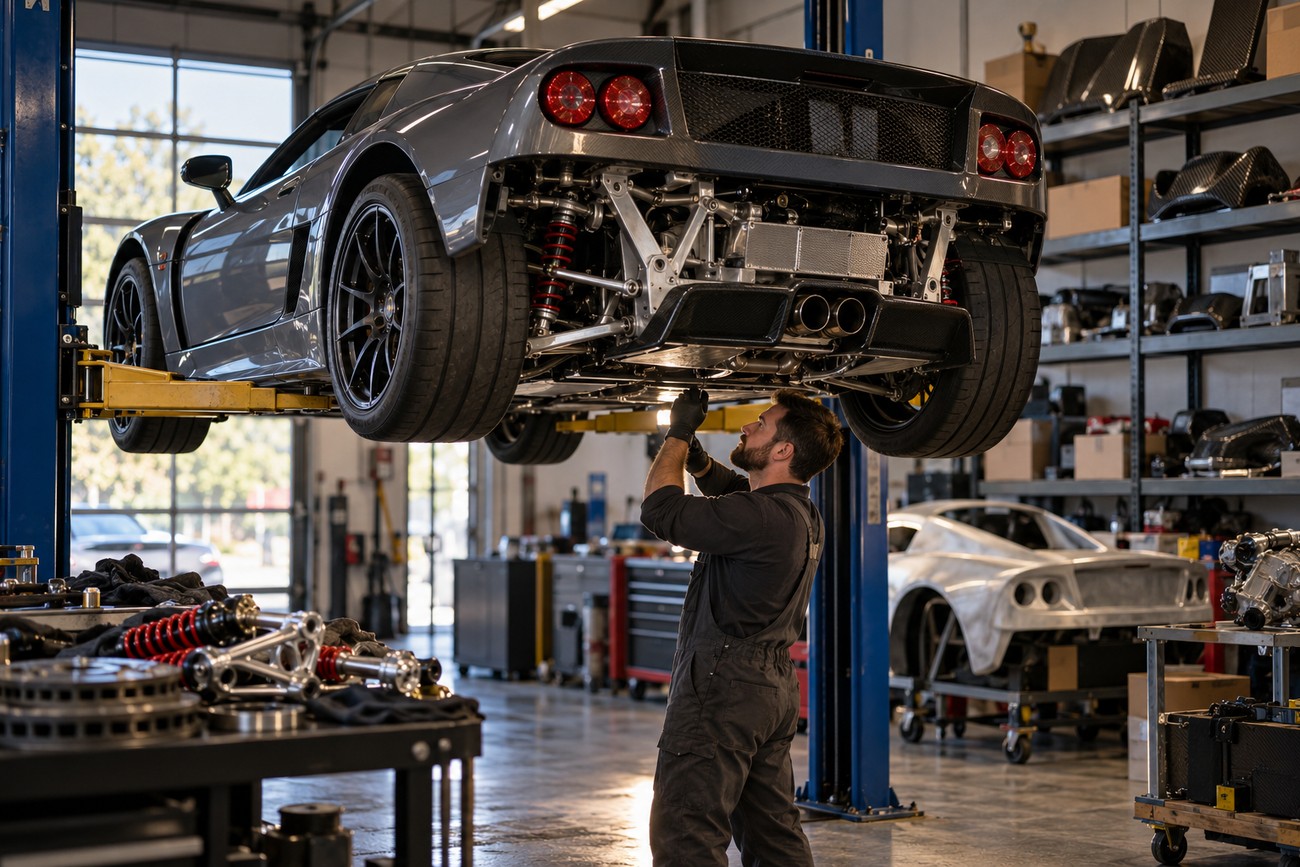
An inspection should begin with the fundamentals rather than cosmetic presentation. Check steering play, tire condition and age, suspension wear, underbody contact damage, cooling performance, and signs of abnormal heat. A cold start can reveal battery, idle, and fluid issues, while a controlled drive should confirm boost delivery without unexplained hesitation or thermal instability.
Build documentation deserves equal attention. Verify the VIN, equipment list, engine specification, wheel package, gearbox details, and any modifications against the car being sold. A Q1 with an attractive paint finish but uncertain maintenance history may be a weaker purchase than a less polished example with clear records and traceable parts.
- Confirm whether the car matches the early 450-hp configuration or a later commonly cited 508-hp specification.
- Inspect tires, alignment, steering components, and suspension before evaluating handling.
- Check cooling and thermal behavior during both cold-start and road testing.
- Document the source and fitment of replacement parts, especially specialist components.
- Compare original equipment and options rather than relying on a generic Q1 description.
Frequently Asked Questions
The Rossion Q1 is rare enough that ordinary used-car assumptions are unreliable. Price, production history, and specification need to be established from the individual vehicle’s documents.
How much is a Rossion Q1?
There is no reliable single price for every Rossion Q1. Original pricing depended on options such as air conditioning, paint, trim, navigation, and other equipment, while current asking prices depend on rarity, condition, maintenance records, documentation, and specification.
Compare listings by checking the actual build sheet, mileage, tire and suspension condition, modifications, and parts history. A low asking price may reflect missing records or deferred specialist work, while a higher figure is only meaningful if the car’s equipment and provenance support it.
How many Rossion Q1 cars were made?
A definitive production total should be verified rather than repeated from an unsourced estimate. Low-volume marques often have incomplete public records, and advertised totals may combine different periods or related models.
For a specific car, request factory or registry confirmation where available, then cross-check the VIN, build documentation, and ownership history. Seller paperwork that identifies the car’s specification is more useful than a broad production number that cannot be traced.
What should be checked before buying a used Rossion Q1?
Start with a cold start, then inspect boost behavior, cooling, steering play, tire age, and underbody damage. Follow that with a lift inspection of suspension components, fluid leaks, brakes, driveline parts, and evidence of track impacts. Tire condition and alignment deserve priority because they strongly affect the Q1’s traction and steering behavior.
Finally, verify option fitment, engine and gearbox specification, modifications, and parts provenance against the VIN and available build documents. A specialist inspection is worthwhile because the car’s low-volume construction makes familiar-looking components harder to identify and source than those on a mainstream performance car.







