
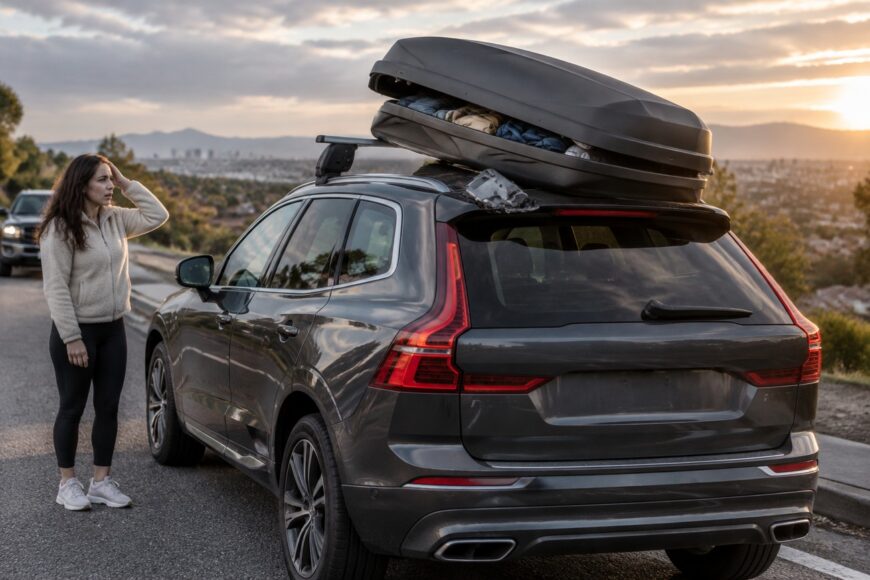
A roof cargo box that comes off a Volvo XC60 can become a projectile. Volvo warns that hard braking or a collision may detach a roof box, while skis or other cargo may also escape and strike another vehicle. The result can include serious road danger, damage to the XC60, and loss of control.
A box may be correctly rated and still be unsafe if the XC60 has the wrong rail interface, loose clamps, excessive total load, or poor positioning. The failure chain often begins with a small amount of movement, then develops through braking, crosswinds, aerodynamic lift, or a bump. The key is to diagnose the attachment system rather than judge security by the closed lid alone.
- What It Means When a Roof Box Flies Off an XC60
- XC60 Roof Types and the Correct Mounting Approach
- How to Install and Secure the Crossbars and Box
- Roof Load, Box Capacity, Speed, and Aerodynamic Forces
- Warning Signs, Common Mistakes, and What to Check Before Driving
- Myths and Hidden Consequences After a Detachment
- Frequently asked questions
- What should I do if the roof box starts moving while I am driving?
- How can I identify integrated rails on a Volvo XC60 before buying crossbars?
- What is the most common problem with the Volvo XC60?
- What is the maximum weight a Volvo XC60 roof can hold?
- How do you fix a roof box to a car?
What It Means When a Roof Box Flies Off an XC60
A locked roof-box lid does not prove that the box is attached securely to the vehicle. The lock primarily secures the lid. Mechanical clamps or mounting feet connect the box to the crossbars, and the crossbars transfer the load to the XC60’s roof interface.
A box can first move forward under hard braking, contact the tailgate, or deform its mounting fittings before it detaches completely. That movement may be caused by incompatible hardware, loose fasteners, incorrect bar placement, excessive load, or a combination of these factors. A fitting that feels acceptable by hand can still be poorly retained when exposed to repeated shocks and aerodynamic forces.
Speed and weather can amplify a marginal installation. Crosswinds create side loads, while airflow around the box can produce lift and sudden changes in force. A bump or emergency maneuver may then turn a small amount of looseness into a rapid shift.
Volvo’s warning about a detached box becoming a projectile should be treated as a practical safety limit, not as a remote theoretical possibility. If the box has moved, stop safely and inspect the entire attachment system before driving farther.
XC60 Roof Types and the Correct Mounting Approach
The correct crossbar system depends on the actual XC60 roof configuration. Physical fit alone is insufficient, especially where integrated rails are concerned.
| Roof configuration | What you see | Suitable crossbar interface | Main compatibility risk |
|---|---|---|---|
| Fixed mounting points | Specified attachment points, often beneath removable covers or access panels | Vehicle-specific feet that locate in the designated points | Using the wrong positions or failing to seat the feet fully |
| Bare roof | No rails and no visible crossbar mounting rail | Feet designed for the XC60 roof and its approved contact areas | Incorrect door-frame contact, pressure points, or unsupported placement |
| Raised rails | Rails with a visible usable gap beneath them | Clamps designed to pass around or grip raised rails | Assuming this hardware also suits flush integrated rails |
| Integrated flush rails | Rails sit close to the roof without a usable gap | Matching profile-and-slot feet or clamps made for integrated rails | Using raised-rail clamps that cannot engage the required profile securely |
Integrated rails require hardware that engages a dedicated profile and slot rather than simply wrapping underneath the rail. A universal product advertised for raised rails may appear tight during installation yet have inadequate retention during braking or a crosswind.
Check the exact roof configuration, model year, and vehicle-specific manual before buying crossbars. The same XC60 name can cover different roof arrangements, and the manual controls both compatible attachment points and the applicable load limit.
How to Install and Secure the Crossbars and Box
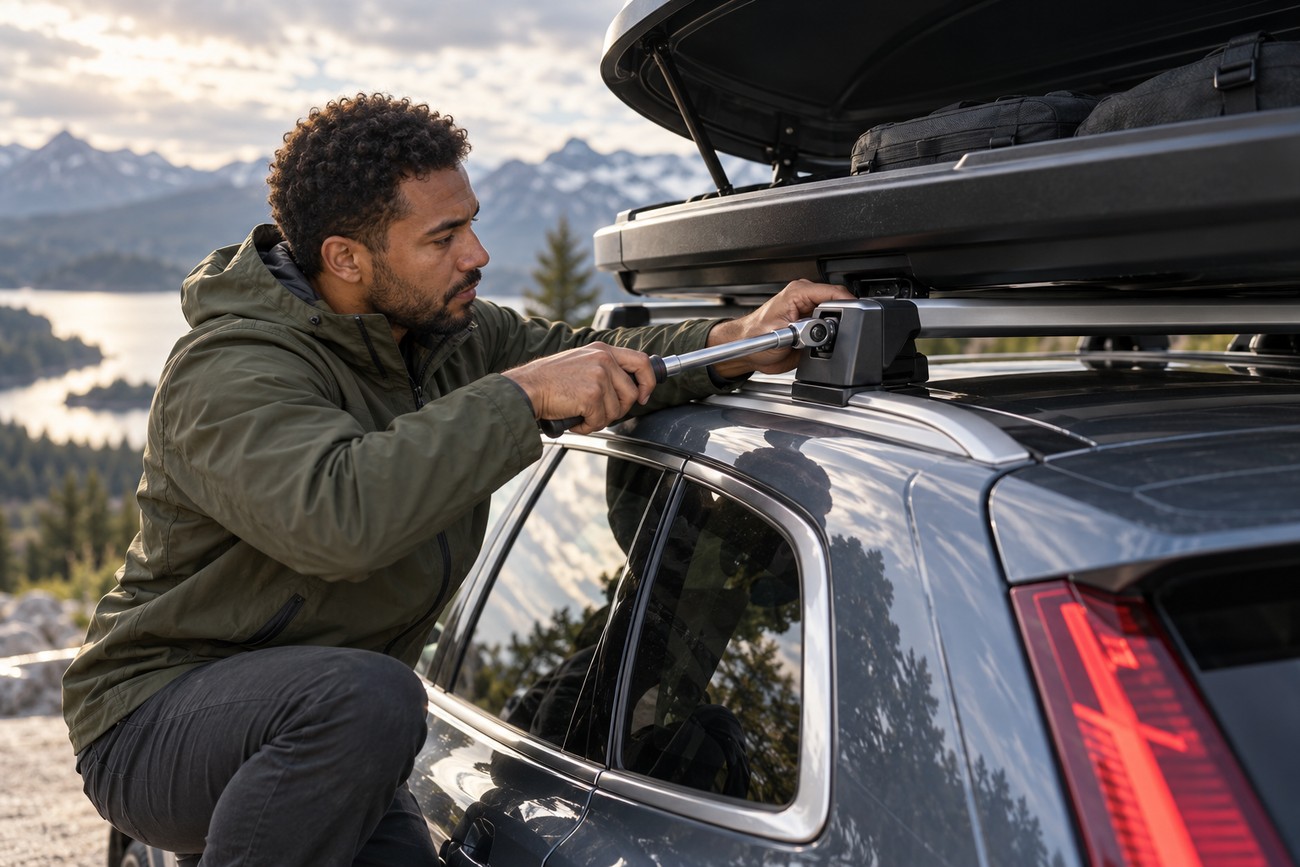
Begin with the mounting points and bar positions specified for the exact XC60 configuration. Do not estimate the positions from another vehicle or place the bars where the box happens to sit conveniently. Incorrect positioning can concentrate loads, reduce stability, and interfere with the tailgate.
Seat every foot or clamp fully against its intended interface before tightening. On integrated rails, confirm that the profile-and-slot connection is properly engaged; on fixed points or a bare roof, confirm that the feet are located in the specified areas. After tightening, try to move each crossbar laterally by hand. Any sliding, rocking, or uneven contact requires correction before the box is installed.
Use the manufacturer’s specified tightening method, and use a torque wrench when the instructions provide a torque value. Do not invent a torque setting or rely on “tight enough” by feel: under-tightening leaves movement, while over-tightening can damage threads, feet, or the rail interface.
Attach the box using its supplied mechanical clamps or mounting feet, then check that each attachment point is engaged and that the box cannot shift along the bars. Position it so the XC60 tailgate opens without touching the shell. After installation, perform controlled braking at approximately 20–30 km/h in a safe location, then inspect the bars, clamps, box, and tailgate clearance for movement.
Roof Load, Box Capacity, Speed, and Aerodynamic Forces
For many modern crossovers, including the XC60, the roof-load figure is commonly around 75–100 kg, including crossbars and the roof box. This is a general range, not a universal XC60 specification. The applicable vehicle manual controls the exact limit for the vehicle’s configuration.
Calculate the total roof load as box weight plus crossbar weight plus cargo weight. The box’s own payload rating does not replace the vehicle roof limit. If the vehicle limit is lower, it controls, even when the box could physically carry more.
The Volvo Travel Active 500 has a 500 L volume, weighs approximately 23.5 kg, and has a 75 kg internal payload rating, subject to the vehicle roof-load limit. Its published recommended maximum speed is 130 km/h. These figures must be read alongside the XC60 manual and the installation instructions.
Dynamic roof loading changes the situation while driving. Bumps, hard braking, crosswinds, sudden maneuvers, and aerodynamic lift can amplify forces beyond the box’s static weight. A 130 km/h recommendation is not a guarantee that this speed is appropriate with a questionable mount, overload, strong crosswind, or poor road conditions.
Noise and vibration commonly reported above 90 km/h should be treated as warning symptoms, not as a normal safe-speed threshold. Misalignment or a box positioned too far rearward can increase airflow disturbance, but reducing noise does not correct a loose or incompatible attachment.
Warning Signs, Common Mistakes, and What to Check Before Driving
Before departure, check that both crossbars are fixed, the feet are seated, and the clamps or bolts have not moved. Inspect the box shell, mounting points, locks, and the area around the XC60 roof. The box should remain aligned with the vehicle and should not shift when pushed firmly by hand.
New vibration, increased noise above 90 km/h, lateral bar movement, or a box that has shifted forward requires an immediate stop and inspection. Forward movement can allow the box to contact the tailgate or deform its mounting hardware. Damaged clamps, cracked plastic, bent fittings, or elongated mounting holes are reasons to stop using the system until the damaged parts are replaced or properly assessed.
Recurring mistakes include using raised-rail hardware on integrated rails, selecting incorrect mounting points, exceeding the total roof limit, and tightening fasteners without following the instructions. A box that was installed once should still be checked before every trip and again during stops, particularly after rain, washing, freezing conditions, or significant temperature changes.
Do not continue if any fitting, clamp, rail interface, crossbar, or box shell has moved or is damaged. Unexplained movement is a mechanical fault, not a noise issue to monitor later. Remove the load if necessary and correct the installation before returning to the road.
Myths and Hidden Consequences After a Detachment
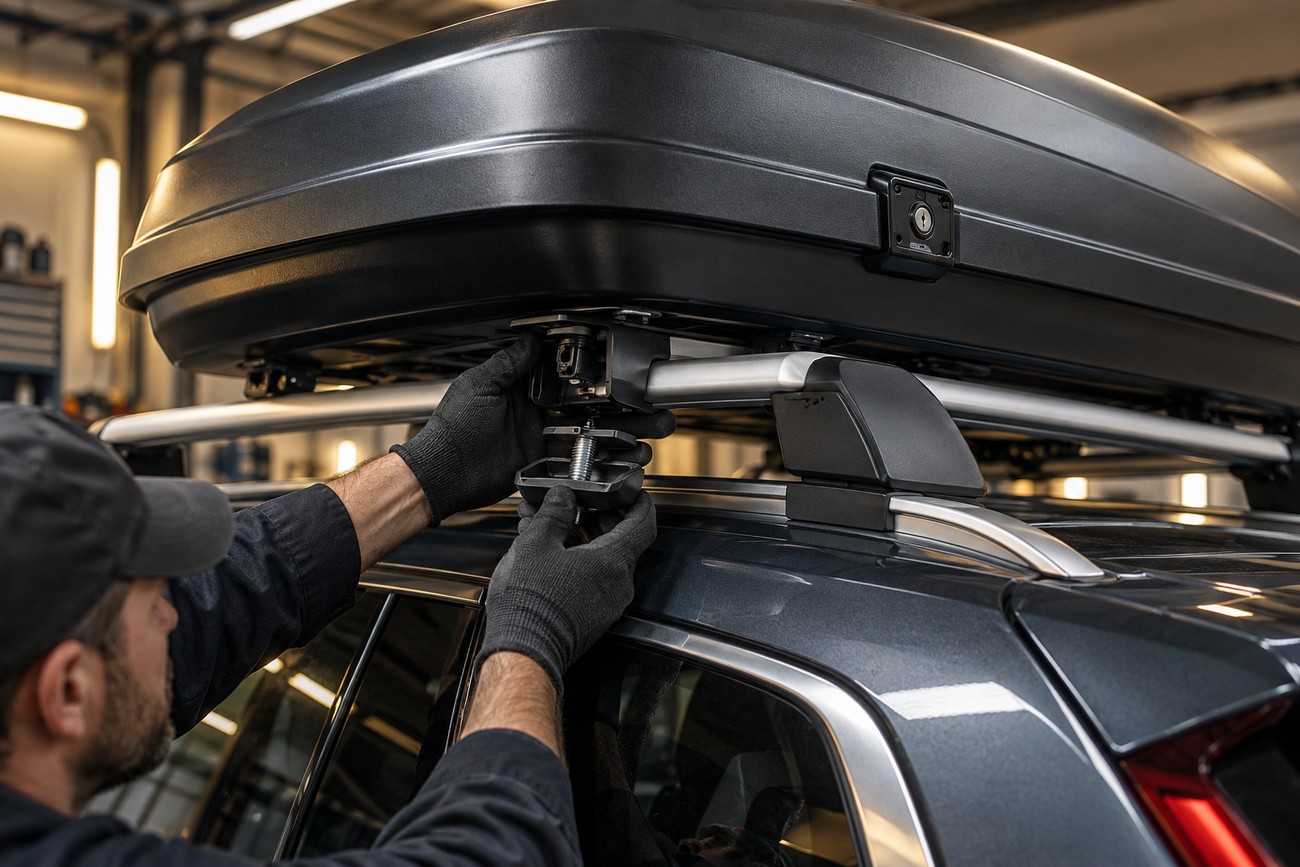
A locked lid does not mean the box is securely attached. The lid lock mainly prevents the lid from opening; the clamps or mounting feet carry the structural load between the box and crossbars. A box can therefore be locked and still detach if its attachment hardware is wrong or loose.
A universal system is not automatically safe because it physically fits. Integrated flush rails have no usable gap beneath them and require matching profile-and-slot hardware. A clamp intended to wrap around raised rails may look secure while failing to provide adequate retention on an XC60 with integrated rails.
The box payload rating also does not control everything. The vehicle roof limit includes the box and crossbars and may be lower than the box’s rated payload. Overloading can increase dynamic forces, damage the roof or fittings, and contribute to detachment during braking or a sudden maneuver.
After a detachment, inspect the roof, rails, crossbars, clamps, box shell, and tailgate for damage before reuse. If installation or loading breached the vehicle or accessory instructions, warranty questions may arise depending on the evidence and applicable terms. An insurer may also examine whether incorrect installation or overloading contributed to the loss, but the outcome depends on the policy and local rules.
Frequently asked questions
What should I do if the roof box starts moving while I am driving?
Reduce speed smoothly, avoid a sudden steering reaction, and stop in a safe location as soon as practical. Do not continue simply because the lid remains closed.
Once stopped, inspect the box, clamps, crossbars, rail interfaces, and roof for movement or damage. If any part has shifted, bent, cracked, or lost tension, secure the load only if it can be done safely; otherwise, arrange recovery rather than driving on.
How can I identify integrated rails on a Volvo XC60 before buying crossbars?
Integrated rails sit close to the roof and do not have the usable gap visible beneath raised rails. If a clamp is designed to pass underneath a rail, it is intended for raised rails and is not automatically suitable for integrated rails.
Confirm the configuration against the XC60 manual and the crossbar manufacturer’s vehicle-specific fit information before purchase. Product descriptions should identify the correct rail family and attachment method.
What is the most common problem with the Volvo XC60?
There is no single universal roof-box failure for every XC60. A recurring problem is a mismatch between the vehicle’s rail type and the crossbar hardware, often combined with loose or incorrectly positioned clamps.
Check compatibility first, then inspect seating, tightening, lateral movement, and tailgate clearance. These checks address the attachment system rather than assuming that the box itself is defective.
What is the maximum weight a Volvo XC60 roof can hold?
The exact maximum depends on the XC60’s model year and roof configuration, so the applicable vehicle manual controls. A commonly reported range for modern crossovers is approximately 75–100 kg, including crossbars and the roof box.
Subtract the weight of the crossbars and box from the vehicle limit to determine the remaining cargo allowance. The lower limit applies if the box’s payload rating and the vehicle’s roof rating differ.
How do you fix a roof box to a car?
Fit compatible crossbars to the vehicle’s specified mounting points or rail interface, seat and tighten the feet according to the instructions, then attach the box with its mechanical clamps or mounting feet. Check that the bars cannot slide laterally, the box cannot move along them, and the tailgate opens without contact.
After loading, keep within the vehicle roof limit, secure the cargo inside the box, and perform a controlled brake test at approximately 20–30 km/h in a safe location. Reinspect the complete system before normal-speed driving.







