
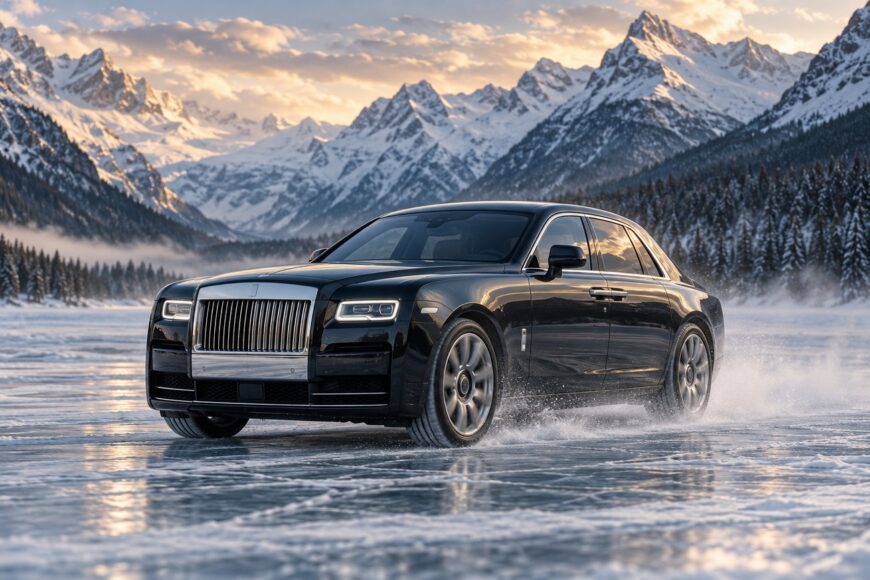
A 571-hp Rolls-Royce Ghost approaching an icy Lake Louise course presents a contradiction. Its V12 can gather speed with little apparent effort, yet its mass, tires, and braking grip matter far more than its badge or acceleration figure once the surface turns slippery. The question is whether its calm road manners survive when traction becomes scarce.
The answer depends on how it is driven. A Ghost can glide through measured inputs and generous margins, then slide when a driver asks its tires to accelerate, turn, or stop beyond their grip. Lake Louise is a setting for that test of winter physics, not a reason to expect rally-car behavior from a large luxury sedan.
- The Ghost’s baseline: luxury mass, not race-car logic
- Why Lake Louise ice changes the equation
- Glide or slide: how the Ghost’s chassis feels at the limit
- AWD is not a braking system
- The expensive mistakes hidden behind the luxury badge
- A sensible ice-driving verdict: glide, if the driver respects the physics
- Frequently asked questions
- Why do different sources list 563, 571, or 612 hp for the Rolls-Royce Ghost?
- What should a Ghost driver do if the car begins to understeer on ice?
The Ghost’s baseline: luxury mass, not race-car logic
The Ghost is an executive sedan designed around quiet travel and composed responses. The Ghost Series II provides a useful reference point: its 6.75-liter twin-turbocharged V12 produces 571 hp and 850 Nm, delivered through an 8-speed automatic transmission. Series II is generally listed with all-wheel drive, although specifications should be checked for the particular car.
That output sounds formidable, and the cited 0–100 km/h time of 4.8 seconds confirms that the car can accelerate hard. It says little about the effort needed to change direction or stop on ice. Test specifications put curb weight at approximately 2,490–2,530 kg, so each steering or braking request must manage substantial momentum.
The standard Series II measures 5,546 mm long, 2,148 mm wide, and 1,571 mm high. Those dimensions leave less room to correct a misplaced line than a smaller car would have, particularly where the usable driving area narrows. The driver needs to plan where the whole body will go, rather than aiming only the front wheels.
Ghost listings also span different generations, markets, and variants. Some identify rear-wheel drive, while published power figures vary. For an ice drive, confirming the actual drivetrain and tires is more useful than assuming every car bearing the Ghost name has the same hardware or limits.
Why Lake Louise ice changes the equation
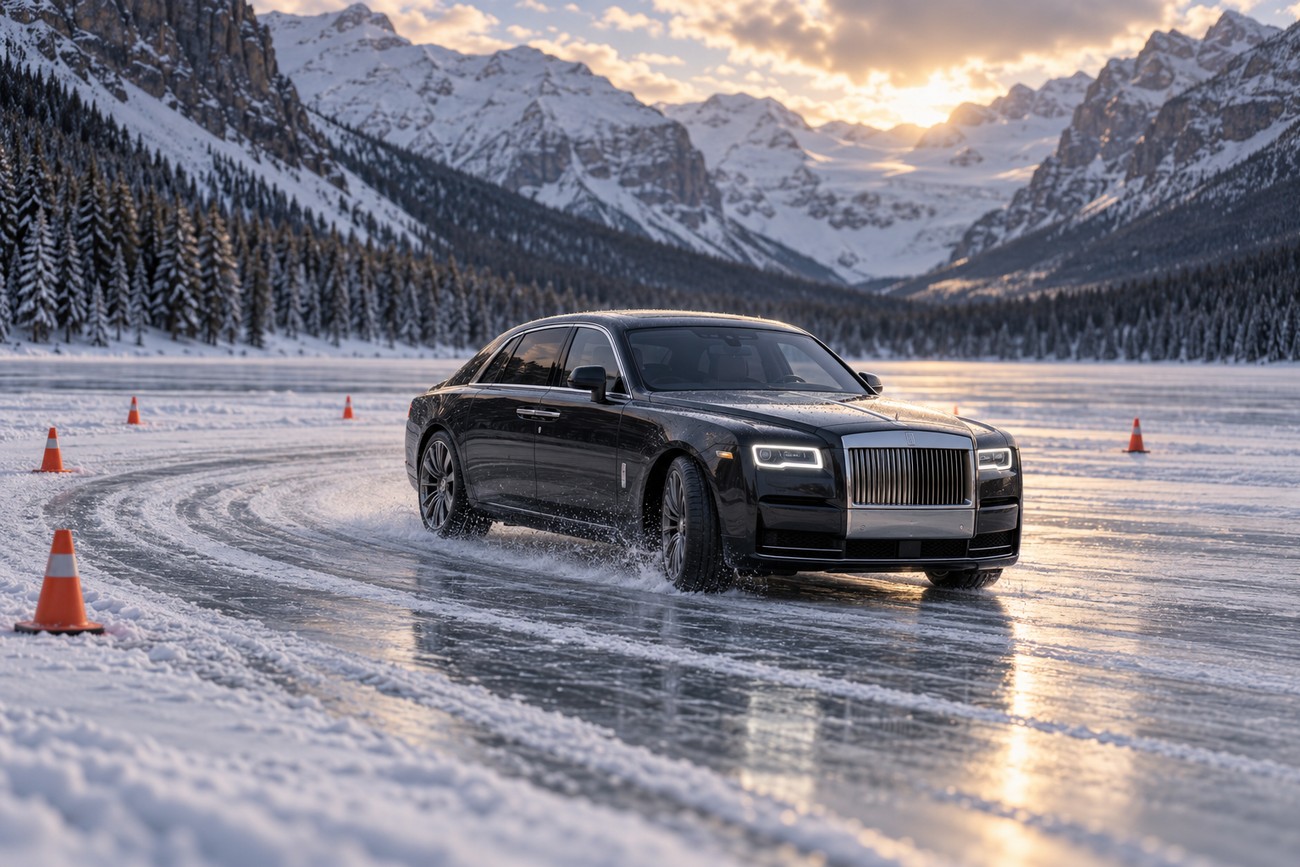
Ice separates the ability to pull away from the ability to turn or stop. All-wheel drive can distribute engine torque among the wheels and help a Ghost move off cleanly. Once the car reaches a corner or braking point, its tires still have to generate force against a low-friction surface; additional driven wheels cannot create extra grip there.
The Ghost’s approximately 2,490–2,530 kg curb weight makes early decisions important. Mass alone does not determine grip, but a heavy car carries substantial momentum into a mistake, and the driver has limited friction with which to correct it. Braking before a turn leaves more of that limited grip available for steering.
Body size shapes the line as well. At 5,546 mm long and 2,148 mm wide in Series II form, the standard Ghost calls for deliberate placement and room to unwind the steering. Its edges can approach a course boundary while the driver still feels comfortably centered in the cabin. That matters on any winter route where the safe line is constrained or uneven.
The Extended Wheelbase model, or EWB, stretches to 5,716 mm. Its added length and longer wheelbase make a quick change of direction less natural. Neither version needs a particular description of Lake Louise’s weather or course layout to reach the same conclusion: on ice, speed must be chosen before the car arrives at the turn.
Glide or slide: how the Ghost’s chassis feels at the limit
The Ghost’s suspension and cabin refinement are assets when the driver makes measured requests. They help the car feel settled over imperfect surfaces and keep its responses progressive. They do not deliver the immediate, detailed feedback expected from a dedicated sports or ice-racing car, so the driver should leave space for each input to take effect.
Quietness can also complicate judgment. With road noise subdued, a small change in tire grip may be less obvious than it would be in a lighter, more exposed car. The driver has to watch the car’s path and note changes in steering response, rather than waiting for a dramatic sound or movement to announce a slide.
Turn in too sharply or carry too much speed, and the front tires may run out of lateral grip, sending the car wider than intended. Abrupt throttle or steering corrections can then demand more grip from tires already at their limit. Smooth steering, progressive throttle, and time for the body to settle give the chassis a better chance to respond predictably.
The EWB’s 5,716 mm length and longer wheelbase increase its reluctance to change direction quickly. That suits relaxed travel but is less helpful in a tight sequence of turns. In either body style, a clean glide is an exercise in restraint; a slide begins when the requested change in speed or direction exceeds what the surface will support.
AWD is not a braking system
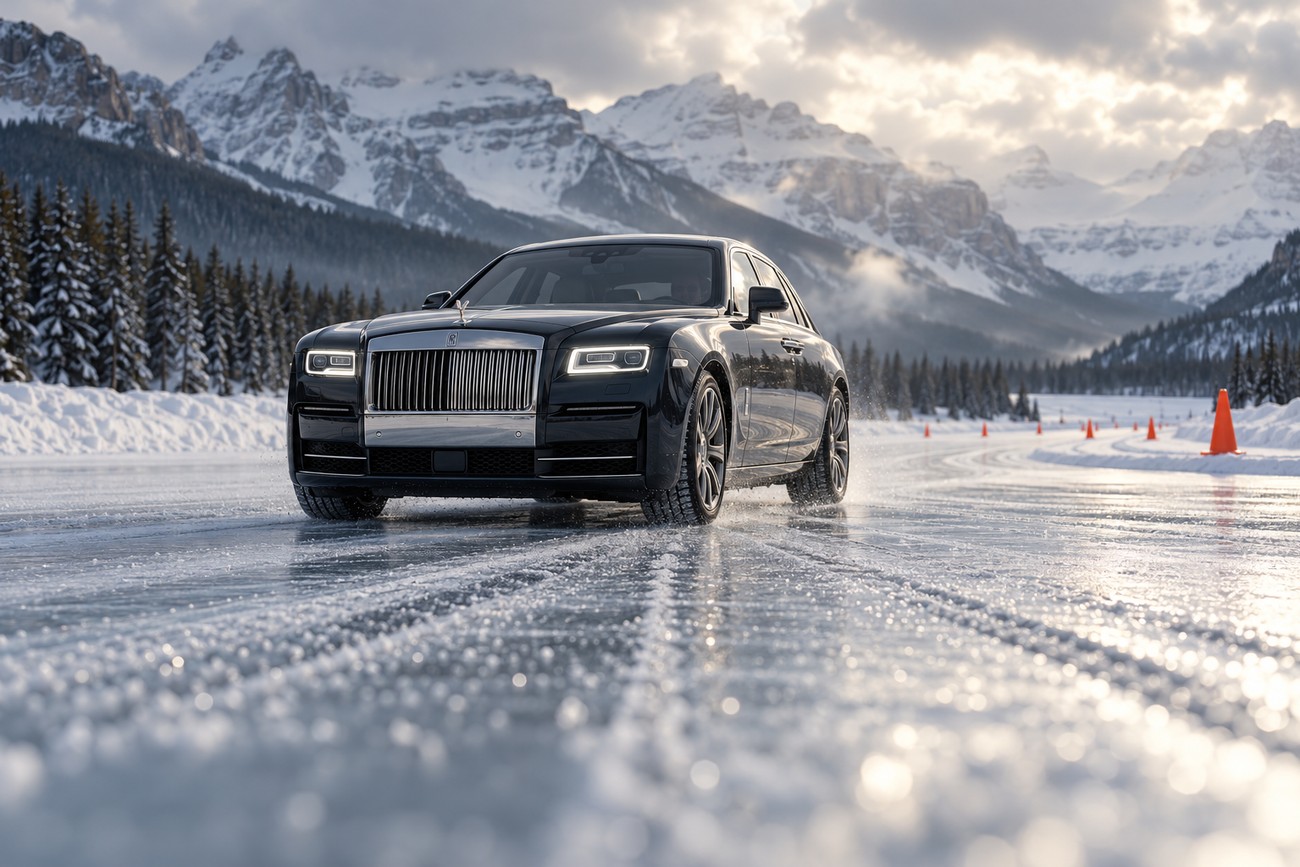
Series II is generally specified with all-wheel drive, though some listings for other markets, generations, or models differ. With suitable tires, driven wheels can help it accelerate on a slippery surface. Under braking, however, each tire must find friction against the ice. The drivetrain cannot solve the stopping problem created by low grip.
Cornering and braking draw on the same limited tire-road contact. Ask for heavy braking while turning, and the tires may have too little grip left to hold the intended line. The safer sequence is to shed speed early, ease off the brake as steering demand grows, and apply throttle progressively once the car is pointed where it needs to go.
First controlled laps are best treated as a calibration phase: keep inputs mild while the tires begin to warm and the driver learns how readily the car turns and stops. A quick launch is a poor measure of the grip available at the next corner.
Tire choice remains decisive. Winter tires suited to the conditions give the electronics a better foundation than unsuitable rubber; incorrect pressure can undermine that advantage. Cold tires can offer substantially less initial grip than tires brought toward working temperature, so an early run deserves particular caution. Pressure decisions should follow the vehicle and tire manufacturers’ guidance, rather than an improvised ice-driving setting.
Stability and traction systems can reduce wheelspin or intervene when the car deviates from its intended path, but they work through the same finite tire grip. Smooth throttle modulation helps them manage torque without repeated, abrupt interventions. The V12’s output is useful only to the extent that the tires can put it onto the surface.
The expensive mistakes hidden behind the luxury badge
The easiest mistake is to confuse a tidy all-wheel-drive launch with proof that the Ghost can brake as it does on dry pavement. Speed then builds quietly, and the driver reaches the next turn too late to lose it comfortably. In a car weighing approximately 2,490–2,530 kg, that misjudgment can take more room to resolve than expected.
Unsuitable tires or neglected pressure make the problem worse before the first corner. A powerful drivetrain may conceal poor tire performance while accelerating, yet braking and steering expose it. A cautious driver checks tire suitability and pressure before driving, then uses the initial runs to establish how the car actually responds.
Attacking a corner creates a second trap. The Ghost’s width and length make a narrow winter line harder to follow, while a sudden steering correction asks its tires to recover grip at the least favorable moment. A slower entry and one smooth arc leave more room to adjust than a late brake application followed by a sharp turn.
The financial margin matters too. Even a minor encounter with a hard edge, packed snow, or an obstacle can damage expensive wheels, bodywork, or suspension. Keeping distance from boundaries and resisting a rushed correction reduces the chance that a small driving error becomes a costly repair or recovery.
A sensible ice-driving verdict: glide, if the driver respects the physics
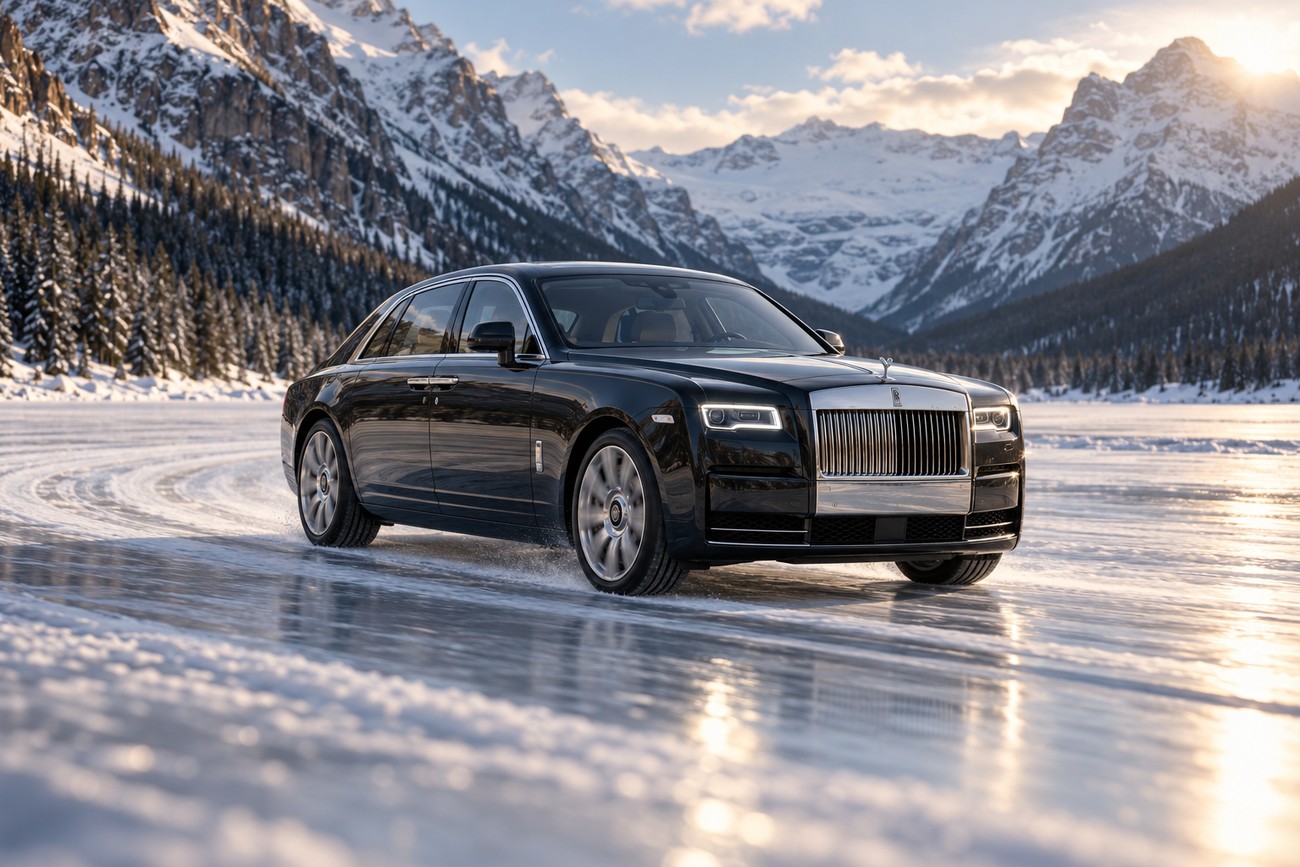
The Ghost can feel stable and composed on ice when its driver makes smooth, early decisions. Its measured responses suit progressive steering and throttle, with braking completed well before the tightest part of a turn. That is a credible winter strength for a luxury sedan, even though it offers little reason to treat the car as an ice-racing machine.
The cited 0–100 km/h time is 4.8 seconds for both the Ghost Series II and the EWB. On ice, that figure describes potential acceleration under specified conditions, not a safe corner-entry speed or a short stopping distance. Tires, available friction, and the behavior of the electronic systems matter more once the driver needs to change course.
There is also a useful distinction between the two bodies. The standard Ghost’s 5,546 mm length still calls for ample room and patient inputs. The 5,716 mm EWB adds length and wheelbase, making rapid direction changes less natural without offering a cited acceleration advantage. For tight ice-course work, the standard body is the more sensible choice.
So the answer is glide, provided the driver accepts a deliberately modest pace and gives the car room to respond. Push beyond the tires’ grip, and either Ghost will slide. The most convincing run is controlled and repeatable, with enough margin left to stop.
Frequently asked questions
Two practical points help when comparing Ghost specifications and responding to a loss of grip. Identify the exact car before relying on a published output figure, and treat an emerging slide as a reason to reduce demands on the tires.
Why do different sources list 563, 571, or 612 hp for the Rolls-Royce Ghost?
Those figures can describe different generations, markets, refreshes, or Black Badge variants rather than conflicting specifications for one identical car. The Series II reference used here is 571 hp and 850 Nm from a 6.75-liter twin-turbocharged V12. If you are checking a particular vehicle, match its model year and variant before comparing its output or drivetrain with another listing.
What should a Ghost driver do if the car begins to understeer on ice?
Reduce the throttle smoothly and avoid adding more steering lock. Give the front tires time to recover grip, then make a gentle steering adjustment as the car begins to follow the intended path again. An abrupt lift, extra power, or a sharp correction can unsettle a heavy car further; on a controlled course, leave room for recovery and follow the instructor’s directions.







